Showing posts with label Star Wars. Show all posts

Saturday, October 13, 2012

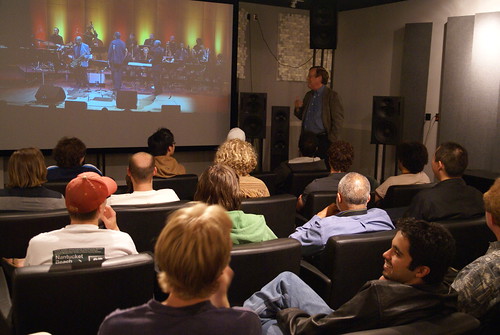
Randy Thom @ VIEW Conference 2011


On Friday, Oct. 28, 2011 VIEW Conference hosted a Master Class with Randy Thom, Director of Sound Design at Skywalker Sound. He is a firm believer that the sooner the sound designer is involved in the pre-production, the better the story can be told. Randy illustrated how sound can shape a film, talking about how doors can be opened to sound. He also shared clips from movies where this kind of early collaboration has happened. Here's an excerpt of his talk during the workshop.

Sound as a full collaborator to make better films 

Alan Splet, Walter Murch and Ben Burtt where the three people who lived within about 20 miles each other near San Francisco who really brought a new revolution into American film sound during 70s. I was lucky enough to work with all three of them and “steal” some of their best ideas. One of the first things that you learn as a sound designer is not think to literally about sound, so one aspect of training your ear is to interpret sound in emotional terms. Subjectivity in filmmaking is a playground for sound: when the audience understand that they don’t figure out consciously, but what they seeing and hearing is being filtered through a character’s or filmmaker’s point of view in a subjective way. Very often working on a sequence for a film what you want to do is think of how you want the sound to make people feel and you analyze what it is about that sound makes you feel certain way and you go looking for sounds or raw material that have those qualities. 


Apocalypse Now

If there was ever a film where sound and image were treated more or less equally and allow to affect each other certainly is Apocalypse now. The first sound that you hear in the film - before any music or any dialogue - is a very odd, electronically synthesized helicopter sound - the Ghost Helicopter. Captain Willard is hearing the memory of the helicopter that he has. What you’re listening to is this guy’s brain. He’s remembering things, he’s hallucinating, he’s dreaming, he’s drunk and under the influence of drugs, he’s listening to his brain operate. The opening sequence is the launching point for all story, immediately the audience is put in a frame of mind that anything can happen, this is going to be a very strange ride. As he stands at the window looking outside he might heard a little fly buzzing: it took me a week to record that fly (laugh). At first he hears - and we hear - the sound of Saigon outside (car horns, Vespas, police whistles). Those sounds morph into the sound of the jungle: each one of those individual city sounds turns into specific jungle sound. Physically for the all sequence he’s still in his hotel room, but in his mind he moves back into the jungle.


Once upon a time in the West 

Sergio Leone decided early on that they will record all the music for this movie before they started shooting the film and they used the music during the shooting to help the actors and essentially to inform how the film is going to be shot. They were struggling how to make music and sound working together before shooting the sequence. Ennio Morricone, the composer, happened to go to a musique concrete concert - a genre involved using real world sounds, rather than traditional musical instruments - by a guy who played a latter, banging and scraping on it. Then he called Leone and said: “There’s should be no conventional music at all in the beginning of the film: instead you perhaps should shoot around the sound effects.” Leone went shooting the sequence thinking about how the sound of this little train station were going to work in the storytelling.

I think that’s a tragedy that very few studios these days will have the guts to allow a filmmaker to do a sequence like that. They say: “People are going to be bored, we have to fill up with uptempo music through the all thing”. Some budget filmmaking these days is “fear based”, it’s not an attempt to do something new, interesting and unusual, to open people imagination. It’s an attempt to avoid boring people, which is never a good motivation in art.

One of the things that these two scenes have in common is a very strong sense of point of view. Camera angle are very important to sound, believe it or not. The kind of shot, where an actor looking at nothing in particular, is another open door for creative, subjective sound, because the audience knows intuitively that they’re going inside the character’s head. It’s an open door for sound designers to put almost any kind of sound that we want. Having some ambiguity or mystery about the visual image makes it easier for me to do something useful with the sound. Extreme close-ups get across the idea of subjectivity. Long duration shot opens the door for sound, too. The character’s closing eyes is also an opportunity for sound to do something interesting (imaging, remembering...). The most difficult kind of shot is a brightly-lit medium shot, because you’re not focusing on anything in particular and there’s no mystery there, there’s nothing that invites the ear to help figure out what’s going on.

Another element they’ve in common is sparse dialogue. I’m certainly not against dialogue in film - dialogue will always has a role. Dialogue and sound design generally don’t go well together, because there’s something about the human voice that the human ear want to attempt to.
If someone is talking - no matter how hard a director ask me to try to push sound effects during that sequence - it will distract you from the dialogue, which the audience is trying to hear. The way to solve that problem is to design the sequence in a way that there are moments for the dialogue and moments for sound effects. A compromised has to be made, you can’t as a filmmaker try to fire all your bullets at the same time, it’s not going to work. One category of sound tends to dominate at a time - it’s dialogue, it’s music or it’s sound effects. Another bad tendency in contemporary filmmaking is to try to set it up so that all three dominates simultaneously, it will never works. Lazy filmmakers will just call the composer: “make some very strange music telling the audience that this is a very strange place”. As a sound designer you try to do things and variations in the same way a music composer, to use sound in pure musical way: tempo, harmony and rhythm to evoke emotion. Think about what elements in a set could generate the sound useful for the storytelling: this will be more powerful at the end, it’s not a decoration, that’s a very organic way of telling the audience “this is a very strange place”.


Sound-friendly scripts

Most writers are obsessed with words, and they tend to think words should dominate every sequence, with wall-to-wall dialogue.
Filmmakers simply don’t think about how to use sound in that way before start shooting the sequence. Think about what the characters hear. Think about how the things they hear affects them and how character changes over time. I often found people who come from visual/light background - which David Lynch did - have very interesting sound ideas. He demands you to be creative all the time.

Another thing I told to directors is: during rehearsal in a live action scene, play with your actors in terms to find things in the space that can make sound that will be useful to the story.
As a sound designer, try to imagine ways that sound could playing in an interesting but organic, truthful way to help the storytelling in the sequence. Try to think to other powerful sounds that the audience doesn’t expect. Part of your job as a sound person - I think - is to help the director make the best film possible. If you have interesting ideas - and you should have them - about the way of film shooting that allow you to do something you couldn’t do otherwise, of course you should talk about it.


Sound for Animation 

Thanks to big aesthetic jumps in animation, more contemporary animation directors want movies should sound like a live-action movie. For “How to Train Your Dragon” I come up very early on with some speculative vocalizations for the dragons that will help the animators to animate to those elements. I tried to use real-world animal sounds - tiger growls, elephant, whales, goats, camel, dogs - to cover a wide range of emotions, allowing sound to influence the animation. The challenge is how to make the transition from one to another, which needs a lot of work and experimentation with pitch-changing techniques.


Sound Mixing 

Mix is about to choose right or most powerful sound in any given moment. In a moment when you need to hear the dialogue you try to artfully lower or eliminate sets of other sounds that are competing with the dialogue at that moment. Space can make sounds useful to the story: there are a lot of others tricks like moving the sound effects and the music into the side loudspeakers and have the voices mostly come out from the center speaker, which make a little bit easier to understand the lines of dialogue. Sound is more powerful if comes from a place we doesn't expect. You need to think of sound in terms of spectrum and frequencies and tailor those for a given moment.


Related Post:

Wednesday, January 04, 2012

Ben Burtt about the genesis of the TIE fighter sounds

[an excerpt from The Sounds of Star Wars - © Chronicle Books]

The genesis of the TIE fighter sounds is another story, one that began with Ben Burtt's search for the laser gun effect.


Originally, George Lucas had seen a British documentary on PBS about the Battle of Stalingrad in World War II and had noted that the firing sound of some strange Nazi rockets was quite weird and interesting. Lucas mentioned that it might make a great sound for the laser gun and Burtt managed to find a copy of the documentary. He then set about finding sources that could emulate that sound. Luckily, at Twentieth Century Fox Studios, Don Hall let Burtt go through the Fox sound library, where he found recordings of some elephants that had been done for an Errol Flynn movie The Roots of Heaven [1958]. In that film, elephants stampeded and bellowed. with an almost shrieking sound (the same sounds were used for the dinosaurs in Journey to the Center of the Earth).
After making a copy of that recording, Burtt realized that when he slowed it down and stretched it out, he ended up with a sound similar to the rocket one in the PBS documentary.


[The Lost World - 1960]

But it wasn't quite right, so Burtt took the sound of the elephant and mixed it with pass-bys he'd recorded of cars during a rainstorm as they sped through puddles in front of a motel where he was staying (a pass-by is when a vehicle comes toward the viewer, passes by, and then speeds away).
"Swoosh, the car would come by, and you heard this car plowing through the water," he says. "I took that sound still thinking that I was making a laser of some kind." The key "a-ha" moment occurred during temp track auditions, as shots started coming in from ILM of the gunport sequence.
"When we did temp mixes and played it back for the crew at Park Way, I would take advantage of the fresh audience, because the editors hadn't heard anything with sound," Burtt explains.
"The gunport sequence came along with the first trial shots of actual TIEs in motion. There was pressure to just get some temporary sound in for a screening, so I grabbed a random set of sounds I liked and cut in a different one each time a TIE fighter zoomed by," continues Burtt. "One sound was the elephant shriek, the next one was a slowed-down World War II warbird, the next a processed jet or rocket."
After the screening was over, the only talk in the room was about that elephant swoosh sound. "That was the greatest sound for those ships you could have possibly picked!" Of course, I was saying, "Oh yeah, of course". I’d really put it in because I had no other altemative, but it got great reviews, so naturally it became the sound ofthe TIE fighters."
"ln World War II, the super dive bombers had an artificially created siren wail created by air ducts," explains Joe Johnston, visual effects art director. "They didn't serve any purpose except to create this noise, which would terrify people. It was intended that the TIE should achieve the same effect."

Friday, June 24, 2011

An interview with Gary Rydstrom

This interview is now part of DROIDS, a free book: unidentifiedsoundobject.com/droids

by Matteo Milani and Federico Placidi - U.S.O. Project, 2011 


Gary Rydstrom was born in 1959 in Chicago, IL. He graduated from the University of Southern California - School of Cinematic Arts in 1981. He began his career at Sprocket Systems, formerly Skywalker Sound, in 1983. Offered the job by a college professor, Gary received the opportunity to work with his mentor, Star Wars sound designer Ben Burtt. He created sound for numerous successful films including Backdraft, Terminator 2: Judgment Day, Jurassic Park, Titanic, Saving Private Ryan, Minority Report and Finding Nemo. Through this work he has won 7 Academy Awards.
Rydstrom did his first work for Pixar on the short film Luxo Jr.. John Lasseter has said it was Rydstrom's work on Luxo Jr., such as creating the lamp's voice from the squeak of a lightbulb being screwed in, that taught him how sound can be a partner in the storytelling of a film. In 2006 he has made his directorial debut with the Pixar animated short Lifted. He recently jumped again into the director's chair to create his second animated short Hawaiian Vacation, set to play in front of Cars 2. 


[Rydstrom talks about the first of Pixar's new brand of Toy Story shorts @ AWN] 

For every director and for all of us the goal is at any one moment in a movie to have the audience on the edge of their feet and can't wait to see what happens next. You are moved by these characters, you believe in these characters. All the meticulous and hard work should be completely invisible. We wanted to be involved in the scene and we don’t you to think that Nemo is a bunch of computer layout. We do not want you to think the many hours that took to create that scene. You are just carried away by the scene and every focus in every step of the production that we do at Pixar is about the story. It is about entertaining the audience. - John Lasseter, 66th Venice Film Festival 


USO: Gary, you’re the third person – of our personal “respect-list” – who came from a sound career and crossed over to a director’s chair: Walter Murch did it first, Ben Burtt came after him. They still design their own sound for their works, just as you did for your first short movie Lifted (with a tribute like the Wilhelm Scream at the very end). How did you manage the transition from sound designer/re-recording mixer to director? How about your feelings?

Gary Rydstrom: Working in film sound is a great way to immerse yourself in the rhythms of a movie. Having done sound for so many movies, and so many different kinds of movies, I’m hoping I’ve developed some mysterious “film instinct.” I think the best directors – and best sound designers – work more from their gut than their brain. In other words, to make movies, your gut has to be bigger than your brain… or maybe I should rephrase that?


GR: "It was a little scary but I always wanted to make films and wanted to have opportunities to write and tell stories. So Pixar being old friends, they gave me this opportunity to come over there and do that. So it was a little scary because there were a lot of things I had to learn. But doing sound for so many years, what I found was that the big similarity is that sound is all about rhythm. It’s about using sound, rhythm helps delineate sound effects, sound tracks, and telling a story with these kind of rhythms is really key. Animation is really about rhythms and timing so I think working in sound gave me a great sense of timing. In fact, on Lifted I used, before animation had been started, used a temp soundtrack to express the timing that I wanted to the animators so they had some reference of what I was after. It was a way for me to even communicate to the animators." - CanMag


[Lifted producer Katherine Sarafian and director Gary Rydstrom © AWN Inc]


USO: Did you develop and learn your new craft in sound room working movie by movie?


GR: Central to sound design is finding what feels right for a movie, what matches its look and heart. So every movie I worked on taught me different lessons. I kept thinking I was close to end of my lessons, but they never ended. Turns out that’s what makes working in film fun. It’s never the same twice. 


USO: Being close to first-class directors during all your sound career has thought you well?

GR: I felt like a spy, watching a lot of directors. I’ve been very lucky to have worked with many of the best – Spielberg, Cameron, Lasseter, Redford – and you probably don’t need me to tell you (their movies do) how different in approach they were. One thing the best have in common: they inspire their crews.


GR: "... I've had this long, great relationship with John Lasseter and Pixar. I've felt involved throughout the whole filmmaking process on their films. They offered me an opportunity to develop and direct films, maybe because I bring an outsider's perspective while still being a Pixar guy through and through.
My friends there know that I've had a long-standing love of comedy. When I first told Steven Spielberg and George Lucas that I was doing this, they were touchingly supportive and generous with advice. I'm grateful for my sound career. It gave me the equivalent of 50-yard-line seats, second row, during a fascinating era in film history." - Mix Magazine


USO: Can you describe what you were feeling when you left the Technical Building (where you spent almost 20 years), and all your friends at Lucas Skywalker Sound, to your new life/experience in Emeryville?

GR: Luckily I get back to Skywalker Sound quite often, otherwise I’d REALLY miss my old friends and career. Pixar’s no slouch, but there isn’t a more beautiful place to work than Skywalker Ranch. 


I've known Gary for over 20 years and he's really been a mentor and a role model for me, as to how to do this work. His standard for quality, inventiveness and humor is really always in the back of my mind when I work. No one is a quicker study when you break down a scene or a film in terms of what, soundwise, is the best direction to go to serve the story. - Tom Myers, Skywalker Sound 


USO: What does it mean for you to associate a particular sound to a visual event (identifying it in a vast catalogue as big as the sound library of SkySound)? What are the mental or purely instinctive paths competing in making the choice?

GR: Something magical happens when a sound effect is added to picture – and it’s not predictable. After all my years of doing it, I still depend on experimenting, putting sounds against image and seeing what happens. First time I did this, as a film student, it amazed me how sound could “open up” a movie, how the combination of sound and visual could create something greater than the sum parts. Having a great sound library is essential, but the real secret is how one uses it. 


GR: "I wanted to give the lamps in Luxo Jr. character through sound. I told John (Lasseter) that I'd come up with these voices. He'd never imagined they'd have voices and was wary of the idea. But I experimented with taking real sounds — a lot of it as simple as unscrewing a light bulb or scraping metal. Every once in a while, a sound would be produced that would remind you of sadness or glee. I always think of sound design being like prospecting for gold. Start by, say, goofing around, making lots of sounds, then find the one percent that has something interesting about it. Put this against the film, and there's a magical moment when the sound, if it's right, merges into the image, brings it to life. They were not cartoon-y. They were fun, reality-based sounds. It felt like the birth of something new, even then." - Mix Magazine


USO: Many sound artists working in other domains like electroacoustic music, musique concrete, environmental sounds has been strongly influenced by the contemporary cinema, and by its ability to create stories with the help of sound effects, soundscapes and even to define the personality of some "objects" with unmistakable sounds. How it is possible to interrelate these multiplicity of experience? 

GR: What all sound artists share is a desire to convey emotions, so I certainly was inspired by non-movie sound work. Sound is emotion. Not just music, but all sound. Humans (who can hear) seem to take sound in general for granted, which is frustrating, but liberating. How manipulative can we be when no one’s paying attention! 


USO: While Europe was experiencing electronics and sound design like natural language consequence of the avant-garde of 50's, in the U.S. this journey took place independently in the field of the film industry with other purposes and objectives. You were aware of what was happening in the old continent and its experiments?

GR: I’m certainly aware of the European traditional of producing “soundscapes” (for lack of a better word) for radio. In some ways, I was jealous of sound work that didn’t depend on the visual – how free it seemed! Best I could do was build an “off-screen” world in film. But I always had a movie to be influenced by – how scary to have sound work stand on its own. 


USO: You've been one of the most assiduous "regulars" of the Synclavier, an instrument widely used in various musical fields. Can you describe the creative approach with this tool? What were your procedures? What made it such as a instrument so unique? To create the sound of the engines of the Titanic you and Chris Boyes worked long on the Synclavier to reproduce the effect in question. Do you remember how you did it?

GR: I fell in love with the Synclavier early in my career because it was such a powerful instrument for shaping natural sounds. I never used the FM synthesis – even making electronic sound effects I would try to use natural sounds, just because I find real sounds are more interesting. Sampling sounds and putting them on a keyboard allowed me to quickly experiment with pitch and layering, which are my primary tools for bending real sounds to my will. The Titanic engine sounds took advantage of how the Synclavier could speed up and slow down a sound pattern. For me, nothing beats using a “musical” instrument for creating sound effects.


GR: "The idea of using a sampler for sound effects work had astonishing potential. With sampled sounds in RAM, you can instantly pitch-bend it and layer it and play it and shape it, without using any processing time. You can layer on the same key and very finely manipulate the pitch and delay and merge them together in ways that were harder to do in the tape-to-tape days. It allowed me to create the dinosaurs in Jurassic Park, in which I took several layers and blended different animal sounds into what sounds like one animal.
With the Synclavier, I have a library of sound “parts,” little snippets that are like phonemes in language. Interesting bits of sound that can be rearranged in multitudes of ways. It's a library of raw material, and it's valuable still." - Mix Magazine


USO: How about your relationship with Ben Burtt along your sound career and especially now in Pixar? I mean crosstalk and dialogue, to share ideas. Could you describe him as a mentor, a friend, a colleague, a druid?


GR: All of my approaches and philosophies about sound come from Ben Burtt. At the time he was revolutionizing sound design, I was lucky enough to get a job at Sprocket Systems and see how he did it, how much he knew about film sound history, and most importantly how much he cared about using sound to tell a story. When I started working on Jurassic Park, I remember Ben was away on vacation. I stumbled along until he came back – for all sorts of reasons, psychological and practical, I couldn’t get started until he was in the building.


[Gary Rydstrom Talks About Cinema Sound - via DolbyInsider]


USO: Nowadays many sound designers are working in nonlinear environments like Pro Tools, Nuendo with tons of plug-ins to make everything. One thing we always admired in your work is the exquisite and unfailing "organic" sound and his innate musicality. It seems that sounds "exist" in nature and are not a product of a skilled craftsman. Would you like to talk about that?

GR: There’s a danger in processing sound too much. I believe the best sound effects come from the best raw recordings, and are tweaked as little as possible. The world is so full of amazing sounds – sounds no synthesizer can match – so why not find them and use them?


GR: [...] I remember a scene in the first Mission Impossible in which Tom Cruise breaks into a computer room at the CIA, for which we’d added all these sound details for equipment he was using to lower himself in. Yet the idea was that if he made any sound over a certain level, he would trip the alarm. Brian De Palma ultimately said, “No, take it all out.” And for the most part, that scene plays with nothing on the track. I went to see it with an audience and it had the desired effect: It made everyone lean in, pay closer attention, get nervous. Tension comes from the silence of that scene.
[...] Silence can be thought of as a type of sound. It’s like when somebody years ago figured out that zero was a number. And silence is just as valid as an amazing sound. Every sound editor can’t help but think of how to fill up a track; it’s what we’re paid for. - excerpts from “From here on in, absolute silence.” [via Benjamin Wright]


Thanks Gary... keep up the good work! M&F

Thursday, January 06, 2011

Sunday, December 12, 2010

Interview: Ben Burtt and J.W. Rinzler - 'The Sounds of Star Wars'

Ben Burtt and J. W. Rinzler discussed The Sounds of Star Wars book on NPR's Weekend Edition Sunday with Liane Hansen.


Though The Sounds of Star Wars is a gold mine for Star Wars buffs, it's designed to appeal to more casual audiences as well.
"This book is meant to appeal to anybody who's interested in cinema or sound," Rinzler says.
The idea came from an outfit, Becker and Mayer, that had just published a birdsong book.
"They came to us at LucasFilm and said, 'You know, we think the technology is good enough so we could do a Sounds of Star Wars book,'" Rinzler says. "I contacted Ben, who was, I think, justifiably skeptical."
Burtt was afraid the explosions wouldn't sound right, but he came around eventually. When they decided to go ahead and do it, he suggested the book include an earphone jack.
"So kids can take the book to bed and get under the covers with their headphones and their parents won't know," he says, laughing.

[read more: The Sounds Of Star Wars, 'Now At Fans' Fingertips - via NPR]

Friday, July 30, 2010

Ben Burtt to present "Emma's Time Machine: Adventures in Time and Space"

While reading this article by Paul Liberatore (via Marin History Museum), we discovered that our hero Ben Burtt just finished editing "Red Tails", the upcoming movie about the Tuskegee Airmen - the African-American pilots who fought in World War II (produced by Lucasfilm). And he's about to start sound work on the first live-action film by Andrew Stanton, "John Carter of Mars".

Ben will join his daughter Emma Burtt for the premiere of Adventures in Time and Space, the latest chapter of Emma's Time Machine, a 90-minute documentary on the history of Marin County. Narrated by Emma, the film also takes a look back at the early days of Lucasfilm in San Anselmo and includes clips of the Marin County locations used for motion pictures, from the days of silent movies until Indiana Jones.

"This film is really the result of a lot of little stories," Ben Burtt said. "I decided that we'd try to connect them all together in a kind of walking tour idea that juxtaposes the past and the present. It's nostalgia. I've always had a great interest in finding some way to connect with the past."

[Dad-daughter film team makes time to go back in time]
[Emma's Time Machine: Adventures in Time and Space - via California Film Institute]

Friday, June 11, 2010

Ben Burtt receives Silver Award from the Town of San Anselmo

[Photo Credit: berndt2]

Ben Burtt, who helped preserve San Anselmo history in films, has been named a Silver Award winner. Burtt documented the local floods of 1982 and 2005 in “The Great Flood of 1982” and “12/31.” He says, he “collected footage from 15 or 16 different people and added that to my own. The film shows people being rescued, basements being flooded and so on.” 
Burtt, who says he’s always had “a big interest in history,” first became interested in San Anselmo’s while working on the first “Star Wars” film with George Lucas. He became fascinated with pictures he found in the local library that showed some of the changes the town had gone through.
Burtt also made a lengthy audio recording of the town’s historical walking tour, complete with sounds of old San Anselmo. That recording, a celebration of the town’s 2007 centennial, is available for download from the museum’s website.

[via marinscope.com]
[see footage online of Burtt’s film @ filmnight.org]

Before Skywalker Sound there was Lucasfilm's Sprocket Systems, which opened in 1979 at 321 San Anselmo Avenue in San Anselmo. Film editors worked upstairs on "Raiders of the Lost Ark" and "The Empire Strikes Back" while sound editors downstairs worked on "Alien" and "E.T." Kentfield resident Pat Walsh, discovered while shopping at Seawood Photo, provided the voice for the loveable alien, with the help of actress Debra Winger. Sprocket's parking lot was also notable: It's where Harrison Ford practiced snapping a bullwhip for his role in "Raiders." Sprocket's work on "The Return of the Jedi" came to a halt when the Flood of 1982 ruined equipment. The division moved to Lucafilm's Kerner complex in March of that year.

[sananselmohistory.org]

'The Prisoner of Zenda'
- Playing at the Rafael Film Center on June 13th, 2010 -
Craig Barron, Oscar®-winning visual effects supervisor and Academy governor, and Ben Burtt, Oscar-winning sound designer, will introduce a rare screening of the 1937 adventure-romance 'The Prisoner of Zenda'. Burtt will demonstrate how the sound effects from the film's famous swordfights were achieved.

[via California Film Institute]

Saturday, December 12, 2009

The tale of Lucasfilm & Skywalker Ranch (by Philip Bloom)


Skywalker Ranch from Philip Bloom on Vimeo.

Filmed at Skywalker Ranch on the Canon 5DmkII conformed to 24p and the Canon 7D shooting native 24p.

Timelapse done using stills.

Music is Venus by Gustav Holst.


Read more about this excellent, stunning work via philipbloom.co.uk. Pure magic!

Monday, May 04, 2009

More Sound Trekking

Ben Burtt’s Further Explorations of Audio Frontiers

[photo by Gregory Schwartz]

In the MAY-JUN 09 Editors Guild Magazine’s cover story, "Sound Trek: The Audio Explorations of Ben Burtt," the four-time Oscar-winning filmmaker goes deep into the evolution of a personal 35-year journey that has seen a revolution in the organic art of sound effects creation and editing.
In this interview by Michael Kunkes, Burtt amplifies his print comments about his work on J.J. Abrams' feature Star Trek, revealing how he seamlessly re-created and updated some of the best-loved signature sounds from the original TV series. He also discusses his feelings about picture editing, music and his own still-evolving creative aspirations.

[read the full interview- via Editors Guild Magazine]

Wednesday, April 22, 2009

An interview with Tomlinson Holman, pt. 3

This interview is now part of DROIDS, a free book: unidentifiedsoundobject.com/droids

by Matteo Milani, U.S.O. Project, April 2009
(Continued from Page 2)


MM: Where did come the idea to write your book Sound for Film and Television? When you started teaching at school?

TH: Yes. It really was taken from the first seven years of teaching and followed the outline of my course. I am currently at work on the 3rd ed. [now out]. Having now fully made the digital transition there is much new information but I'm hoping this is the magnum opus and I won't have to revisit it again for a very long time.

THX continued to grow inside Lucasfilm. A division with excellent revenues and low overhead, the THX Sound System became the 'de facto' standard of superior theatrical presentation, and it had a profound impact on the theater industry. [...] THX remained part of Lucasfilm until 2002, when it was spun off as an independent company, owned partly by LFL, with other corporate and private investors. [...] Tom Holman began working with Audyssey Labs in 2002, a start-up company whose first product was a device that could tune professional and home theater sound.
[excerpt from Droidmaker]


MM: Ten years of '5.1 Surround Sound - Up and Running'. Where are we today?

TH: Well that book is in its 2nd ed. now called only Surround Sound -- Up and Running. We dropped the 5.1 because when it first came out the idea was new to music people, and now the idea is well understood. 5.1 remains the principal film-making format, with up-mixing in home receivers to 7.1 routinely, and newly introduced 9.1 and 11.1 channel systems.


MM: Your thoughts about Cinema Digital distribution. Toward linear PCM (no bit-rate coders) sound on a server with picture?

TH: Yes, they are 24-bit, 48 kHz, multichannel systems, so are transparent in a theatrical environment. Even those who argue for wider bandwidths have to be content with 48k sampling in large spaces because air absorption over 10m and more just does in very hf frequencies.

About Absorption
Sound may be absorbed by its interaction with boundaries of spaces, by absorptive devices such as curtains, or even by propagation through air. Absorption is caused by sound interacting with materials through which it passes in such a way that the sound energy is turned into heat.

[excerpt from Sound for Film and Television]


MM: Meaning and your progress of 10.2 channel sound at 'TMH Corporation'.

TH: I've been working on 10.2 for many years now, a system with a full path (not an upmix) from input to output because among the three competitors for bit rate, sample rate, bit depth or word length, and spatial capability it is the spatial one that is the most interesting since everyone we've exposed to the system can hear the differences across 1 to 2 to 5.1 to 10.2. There's simply no debate except "well how practical is it?" Well how "practical" is 192 kHz sampling? Who can get to 24 bits of precision, one part in about 17,000,000 in just over 5 microseconds? Nobody, that's who. Those extra bits are "marketing bits" if the truth were to be told.


MM: Marketing bits. As you wrote, is sampling at 60 kHz still enough?

TH: Yes I covered this extensively in Surround Professional magazine, taking on every single theory that has been proposed that I could find, and 60 kHz is adequate for all. 48 is pushing things a little bit. You know the 20 kHz limit of hearing is a "soft" limit, an average of thousands. As a young person I could hear an undistorted sine wave out to about 24 kHz, and we've had students who could do this in our lab confirm it in the last few years. But above about 24k there's just no response. So that leaves little wiggle room for 48k sampling, but probably enough for almost all practical purposes, certainly for cinema due to its air propagation effects.


MM: Beyond 5.1 - Height sensation, missing from all stereo and multichannel system. Is it for you unnecessary nowadays to implement in the movie industry?

TH: IMAX has had its Center Top channel for many years. I made that stereo since a width and height sensation is required I believe. In fact, Fantasound in some of its eight renditions in 1939 had some overhead channels, so it's not new, just "new" in the marketplace.

[Prev | 1 | 2 | 3 ]

Related Posts:

Bibliography

Books
Holman, T. (2007) Surround Sound: Up and Running, Focal Press
Rubin, M. (2006) Droidmaker: George Lucas and the Digital Revolution, Triad Publishing Company
Blesser B. | Salter L.(2006) Spaces Speak, are You Listening?: Experiencing Aural Architecture, MIT Press
Holman, T. (2001) Sound for Film and Television, Focal Press

Websites
tmhlabs.com
wikipedia.org
cinema.usc.edu
imdb.com
digitalcontentproducer.com
focalpress.com
britannica.com

An interview with Tomlinson Holman, pt. 2

This interview is now part of DROIDS, a free book: unidentifiedsoundobject.com/droids

by Matteo Milani, U.S.O. Project, April 2009

(Continued from Page 1)

MM: You've invented a system that is a signal processing chain of different products, blending knowledge, math, material, and so forth. How did you manage this huge work of taking care of each small step during its development?

TH: With a lot of help, which I credited in the THX Manual. The ideas did come from many sources, some dating to the 1930's whereas some were brand new in 1980. It was my skill to: go to the MIT library and read the whole field within a week of getting the job (I was in Boston at my company 'Apt Corporation' at the time), selecting from amongst those developments the ones that made sense; working with John Eargle at JBL to find real products that would meet the standard sought; to assemble and figure out how to measure them; to exchange measurements with, and have experiments conducted, at Waterloo University (Stan Lipshitz, now retired, and John Vanderkooy); to select the LR4 crossover and get help in implementing it; to figure out how to make delay lines and fit poles and zeros with which I had help from Gordon Jacobs; then to build the crossover networks, find a manufacturer, etc. So there was lots of help but I performed an integration and leadership function.

The invention came about after it was nearly finished. Standing one day at the base of a wall that contained the system, with my head stuck between the wall and screen, I heard lots and lots of high-frequency energy, and figured out that this was from multiple bounces between the wall and screen. The wall was needed to support low frequencies but was a problem at high frequencies, so covering the wall in high-frequency absorbing material made it disappear acoustically at high frequencies. That's the patent: more a "discovery" than an "invention" that I set out to do.

[Holman Talking About 10.2 Possibilities - via sklathill]


MM: How was the relationship with Dolby Laboratories? What's the output of your collaboration at that time?

TH: Dolby set the stage by improving film sound to the point where THX was worth doing. While they concentrated on the pipeline to get program material from studio to cinema and home, I concentrated on what happened to it once it was delivered. So they were compatible completely, although some ignorant parts of the marketplace thought one was supplanting the other and vice versa. Never was true.

By the mid-'80s, Lucasfilm and Dolby labs were ping-pongin developments - "technological leapfrog" Tom Holman called it. Dolby was pushing improvements for recording sound on film and playing it back with expanded frequency and dynamic ranges; Lucasfilm focused on the auditorium.
In 1987, a committee of audio engineers debated the number of channels for digital sound on film. It was lively debate about a range between two and eight channels; Holman proposed 5.1 - five main channels and a dedicated sub-woofer channel. (Technically speaking, the sub-woofer represented 0.005 of a channel in bandwidth. "I call that marketing rounding!" said Holman.) 5.1 Surround Sound became the industry standard.
[excerpt from Droidmaker]


MM: What was exactly the Lucasfilm's Theater Alignment Program? It was an early version of THX?

TH: No, it was a companion program to see that all theaters were tuned up to the best of their ability and consisted of lab viewing of 70 mm prints, installation tune-up by certified technicians, and viewing by trained people separate from the technicians with feedback to Lucasfilm, and end-to-end quality control for films in theaters. It ran a number of years on a lot of films but didn't make any money.


MM: Few words on the development of Home THX.

TH: I went to CES (Consumer Electronics Show) in the mid-80's and found misrepresentations of the work of Ben Burtt and others, some of it deliberate, and some of it from a lack of knowledge. So I set our to better represent movies over home systems, and Home THX with its patented technology is the result. It also had a "better housekeeping seal of approval" component, especially in areas where people routinely stretched the truth, such as power amplifier output capacity. We used loudspeakers to test, not resistors, and some high-end products simply failed to pass the standard based on real program material into real loads.


MM: When (and why) did you move away from Lucasfilm?

TH: I started teaching at USC in 1987 and working at Lucasfilm mainly in THX by that point from 1987 to 1994, but it was a hard road to hoe to have two jobs, one in northern and one in southern California, so the dye was cast with the completion of the Technical Building in 1987, the design and building of which occupied three years of 60 hour plus weeks for me.

Tom Holman had succeeded beyond everyone's expectations in his execution of C Building; he produced some of the most remarkable filmmaking workspaces ever, and, in the process, launched the TAP/THX projects. After testing out numerous ideas on Kerner, Holman transitioned into working full time on the engineering specifications for the 750,000 square foot Technical Building.
[excerpt from Droidmaker]

In the 'Stag Theater' at Skywalker Ranch it's twenty-two speakers all-around which are positioned for uniformity of coverage. The multiple arrival times screw up your ability to localize any one sound. A lot of things in the Tech Building are all hidden from view on purpose, because if you don't see one, you don't locate one.
[excerpt from Sound-On-Film]

[Prev | 1 | 2 | 3 | Next]

An interview with Tomlinson Holman, pt. 1

This interview is now part of DROIDS, a free book: unidentifiedsoundobject.com/droids

by Matteo Milani, U.S.O. Project, April 2009

This is the last chapter dedicated to the new era of film sound, started in the early 80's, thanks to George Lucas and his talented crew. His efforts to develop new technologies had taken the cinema experience radically into the future. We take for granted technologies like THX, now been absorbed in the popular culture. I had the pleasure of interviewing Tomlinson Holman, the developer of the THX Sound System and its companions Theater Alignment Program, Home THX, and the THX Digital Mastering program. He was at Lucasfilm for 15 years, winding up as the company's Corporate Technical Director.

Mr. Holman is Professor of Film Sound at the University of Southern California School of Cinema-Television and a Principal Investigator in the Integrated Media Systems Center at the university. IMSC is the Engineering Research Center for multi-media of the National Science Foundation. He is founding editor of Surround Professional magazine, and author of the books Sound for Film and Television and Surround Sound Up and Running, both published by Focal Press. He is an honorary member of the Cinema Audio Society and the Motion Picture Sound Editors. He is a fellow of the Audio Engineering Society, the British Kinematograph Sound and Television Society, and the Society of Motion Picture and Television Engineers. He is a member of the Acoustical Society of America and the IEEE. He has lifetime or career achievement awards from the CAS and the Custom Electronics Design and Installation Association. Tom holds 7 U.S. and corresponding foreign patents totalling 23, and they have been licensed to over 45 companies.


MM: Could you describe the movie sound at the beginning of the 80's, a period of study and development about a new way of experience movies that eventually became THX. But what was there before it (untrained professionals, unprepared audience)?

TH: Just after WWII cinema sound systems had gotten standardized. Drawing on the developments of the '30's, but adding to them the outgrowth of technology developed for the war, the 'Altec Voice of the Theater' became "standard," with 80%+ market share in theaters, and thus in dubbing stages. This chicken-and-egg served decently for decades, but even its own inventor tried to improve upon it, but couldn't crack the chicken begets egg paradigm. An example of the WWII technology employed is the permanent magnets used in the loudspeakers. They were originally developed for bombadier crew earphones! The loudspeakers of the 1930's needed dc current to form their magnetic fields. So the 'Voice of the Theater' was a great step forward, but also froze technology at the 1947 level until 1980.

What I did was to consolidate many of the developments made between 1947 and 1980, add a few of my own (which got patented), and make one comprehensive system out of it, and then install it only in rooms that met required acoustical standards. It was the first time ever that anyone tried to standardize on room acoustics from place to place, eventually around the world, within certain parameters--the very opposite of, say, concert hall design, but in many ways far simpler.

[..] With the introduction of surround sound, audio mixing engineers were forced to adapt the old rules and paradigms to that had been used for mixing a stereo production. Answers were needed for new questions. Tomlinson Holman, the father of THX cinema surround, pointed out that the most important decision in creating surround sound was the choice between two primary listener perspectives: the 'in-audience perspective', where the listener sits in the best seat in the house, sonic activity is located at the front, and surround creates reverberant ambience; and the 'onstage perspective', where the listener sits in the midst of the musicians, encircled by active sound sources.
[excerpt from Spaces Speak, are You Listening?: Experiencing Aural Architecture]


MM: You're in the film history, as you invented the "de-facto" standard of theater industry. How could you describe your early days at "Lucasfilm"?

TH: Heady. We were on a mission to improve the whole experience of going to the movies. THX was only one of the resulting developments, but it had the most public face eventually.

People have been asking the question for years: what does THX stand for? And this is was exactly Jim Kessler's marketing intent: keep 'em asking question after question, and they're taking about you!" [...] "It's gotta sound cool, high-tech, and I wanted a way to credit Tom Holman, the inventor," said Kessler. Doodling around, "I just wrote the initials for Tom Holman Crossover on my desk one day." "Crossover" was a reference to the way the speakers divide the treble and bass for ideal acoustics. Traditionally, the crossover is done passively, in a loudspeaker. Holman had designed an electronic crossover. Kessler wrote "crossover" with an X, as in "X-over." He smiled as he recognized the letters THX from George's film THX 1138. "George always seemed to like them, and had used them as a private joke on a license plate on Harrison Ford's roadster in American Graffiti." Kessler liked that the name was both very "Lucas" and still not immediately identifiable as Lucas. "THX, that's perfect!" So Kessler rushed down the stairs and into the cool dark mixing theater beneath him, where Lucas was sleeping on the couch during another marathon Jedi mixing session. Lucas woke up and watched in silence as Kessler waved the paper around and ranted about how perfect the name would be. "Great" was all he said, and that was the end of it.
[excerpt from Droidmaker]


MM: Could you technically describe the C building in San Rafael, the site of the original THX speaker installation?

TH: Within the first weeks of joining Lucasfilm I had a conversation on the phone lasting past midnight with the architect/acoustician of the C building dub stage. He wanted a text book approach as he was an MIT grad and trained members of the team headed by Leo Beranek, who had written the great classic book 'Acoustics'. Beranek's "recommendation" for cinemas was an average of cinemas he found pre-1952, and in the stereo era, I thought the reverberation time should be shorter than what were in fact old vaudeville theaters revamped for cinema. He wanted 1.2 s RT60 and I wanted something like 0.6 s. We compromised on 0.9 s but he forgot some absorption so it came in at 0.8 s. When we finished and listened to movies in the room, I was convinced of the utility of lower RT than the average 1930's theaters for improvement in speech intelligibility and localization.

The first phase of Holman's work would be the new sound mixing environment for the dubbing stage. "Bring a new level of quality to film post-production," said George Lucas to Tom. C Building was his canvas. [...] The Sprockets theater was a marvel. Visitors to C Building from Hollywood and from theater exhibitor companies were stunned by the audio. "They wanted that sound in their new facilities," said Tom Holman, "because it was clearly better."
[excerpt from Droidmaker]

The reverberant process smears together the syllables of speech and the sound effects so that a loud sound will cover up a soft one that comes after it. [...] If you want reverberation, you record it on the sound track and if you don't want it, you turn it off. That's really a rather different way of doing things. That makes it pretty independent of the number of people in the auditorium. [...] There's a fundamental difference between a concert hall, which is a space for production, where the orchestra plays and interacts with the hall, and a movie theater, which is a space for reproduction.
[excerpt from Sound-On-Film]


MM: How Ben Burtt helped you to develop the system at Lucasfilm? Did you shaped with him the sound post-production workflow and method in an innovative way?

TH: I was hired as a back up in case the computer division didn't get it all done digitally within three years. It didn't, but their work eventually became Pixar and some went to Avid, etc. So the work flow was pretty much standard, but highly cleaned up: three generations of magnetic heads made the response flatter and flatter, 3000 man-hours of modifications to a music industry console for features and sound improvements beat film consoles, and many more. Ben was vital in being the main customer, and at recognizing the value and quality of what was being done. He also taught me a great deal about workflow, history of Hollywood sound, etc. I remember one time we were in the first small room before the C building in a store front. We were working on Raiders. He told me that the sound source for opening the lid of the ark in the last reel was within 20'. I couldn't figure it out. It turned out to be lifting the back off the toilet above the water chamber, and slowing it down. I was astonished at his methods and remain in awe of them as heard recently in Wall-E. I liked later to define the difference in roles as "I make it sound good; he makes it sound interesting."

Film sound consoles weren't very good because they were custom built to the needs of film sound in small quantity without much competition. We bought a music industry console built in much higher volumes and with a lot of more competition and changed its functions to make it into a film sound console.
[excerpt from Sound-On-Film]

[ 1 | 2 | 3| Next ]

Wednesday, April 08, 2009

The Sound Behind the Image: Ben Burtt and the Art of Sound Design

Though many consider motion pictures to be primarily a visual medium, it would be impossible to create the full magic of cinema without sound.
The Sound Behind the Image - hosted by Academy Award-winning sound designer Ben Burtt, and presented in partnership with the Academy of Motion Picture Arts and Sciences - will explore the extraordinary impact of sound in feature films.

The event will also take a fresh look at the revolutionary sound design of the 1977 Oscar-winning classic, Star Wars. A combination of film clips and live demos will examine the role that sound played in shaping the movie.

Friday 10th April 2009, British Film Institute, London

[read more - via bfi.org.uk]

Tuesday, February 17, 2009

An interview with James A. Moorer, pt.3

This interview is now part of DROIDS, a free book: unidentifiedsoundobject.com/droids

by Matteo Milani, February 2009

(Continued from Page 2)

MM: Can you talk about the synthesized arrows in Indiana Jones and the Temple of the Doom?

JM: This was done by linear prediction. Ben had recorded the sounds of arrows going by, but they were too fast. I took 100 ms from the middle of one of those sounds and created a filter of order 150 from it. When driven by white noise, it made the same noise as the arrow, but continuing forever. He then put that sound in the doppler program to produce the sounds of the arrows flying by.

In addition to being a numbers prodigy, ASP is quite garrulous. It can synthesize speech, the sounds of musical instruments, and even special effects by the same mathematical techniques. In Indiana Jones, for example, there is a hang-onto-your-seat scene in which Jones and his pals, while dangling precariously from a rope bridge slung across a deep chasm, come under attack by a band of archers. Lucasfilm technicians had recorded the sound of a flying arrow in a studio, but they discovered that the whistling noise did not last long enough to match the flight of the arrow on the film.
ASP came to the rescue. Moorer copied 25 milliseconds from the middle of the one-and-a-half-second recording and spliced the duplicate sounds to both ends, all electronically. Then he manipulated the arrow's noise so that it faded as the missile moved from left to right across the screen. To ensure total accuracy, Moorer even used ASP to include a Doppler shift - the change in pitch from high to low heard when an object sweeps rapidly past. Thus, as the arrow flies by actor Harrison Ford's head the audience hears a subtle change of frequency in its noise. In this way the sound track dramatically increases the audience's sense of the hero's peril.
[excerpt from Discover Magazine, August 1984
]


MM: How did Ben Burtt use the machine at its fullest on his projects?

JM: There were a number of sounds in "Temple of Doom" that were done using the ASP. The main ones were the arrow sounds and the sound of the airplane crashing near the beginning of the movie, although there were many, many other sounds throughout the film that were processed on the ASP.


MM: Do you recall the 'SoundDroid Spotter' genesis? Could you describe the early “spotting” system for searching sound effects libraries inside SoundDroid?

JM: People said they wanted a less expensive system. I designed and built a 1-board processor with a TI DSP chip on it for doing sound effects spotting. TI (Texas Instruments) made a DSP (digital signal processor) chip called the 320. It was a bit like the Motorola 56000 that we used later at Sonic Solutions, except that it could only use 16-bit samples.


MM: The first digital devices have landed in recording studios as outboard gear. Does it make sense nowadays to have custom DSP to spread calculation outside the computer?

JM: No. It didn't then, and it doesn't now. First digital devices were outboard devices. This never made any sense. For instance, they could not be automated. You can have this nice, big mixing desk with all this fancy automation, but none of your outboard equipment could be turned on or off using the mixer automation. Similarly, the tape recorder and the mixing desk and the outboard equipment were all separate things. There is no way to make sure that your automation program for the mixing desk is the correct one for the audio tape you put on the tape recorder. If you have to pick up a project a year later, it is impossible to get all the same settings, since you never remember what outboard equipment was used or what special patching might have been present between the tape recorder and the mixing desk. If you want to make the "disco mix" a year later, there is no way to do it. It is like starting all over. It creates more problems than it solves. Now, you do everything through one program, and all the effects are perfectly automated, and all the automation is combined with the editing into one integrated project. The mixing desk with external tape recorded and "uncontrolled" outboard devices never made any sense to me.


MM: You're the real composer of the original THX logo. Michael Rubin wrote in his book "Droidmaker" that it was the startup sound of ASP first, correct? Who came up with this idea like the Apple Mac's startup sound? Did you name it Deep Note (or The Chord)?

JM: It was not the startup sound of the ASP. It was a program that you would load into the ASP which, when started, synthesized the sound in real time. I had named it Deep Note. I have no idea who came up with the Apple Mac's startup sound. The THX logo was started because the THX sound system was to come out in time for the release of "Return of the Jedi". They were doing a 35-second animation that would go before feature was presented in the theater. The director of that animation came to me and said that he wanted a sound that "comes out of nowhere and gets really, really big". I told him that I knew how to do that, and 2 weeks later, we had the THX logo theme.

Jim Kessler found Andy Moorer in the second floor kitchen when he pitched him on his vision for a THX logo. He [...] wondered if the ASP could generate a cool sound. "It's gotta swirl around and it should be like this really big one dynamic thing," Kessler explained, "and make sure we all get the stereo high range and low range." Being a musician and composer himself, Moorer was excited to have a musical project. [...] Moorer retreated to the prototype ASP he had built. It was the only device of its kind in the world. [...] He envisioned a power chord that would emerge from a cluster of sounds. He built a single note from thirty-two voices of synthesized sounds. Moorer called the sound "Deep Note" (possibly one of the most recognizable sound logos ever, and certainly the most recognizable piece of completely digitally synthesized music. It plays more than 4,000 times every day).

Thirty-two simultaneous voices of sound from a synthesizer in real time would be a computational challenge, even by modern standards. Moorer programmed the computer to generate a cluster of sounds between 200 and 400 Hertz that sort of "wandered up and down," but soon resolved into a big carefully planned chord based on a note of 150 Hertz, a little below D. The exact trajectories of the "wandering" sounds were created randomly by the ASP, so every time Moorer ran the program, the score was slightly different.
[excerpt from Droidmaker]


MM: The task of re-creating the THX sound is a standard homework assignment at Stanford's CCRMA (Center for Computer Research in Music and Acoustics) in an introductory course entitled "Fundamentals of Computer-Generated Sound." Every year, twenty or so students attempt to re-create the sound using LISP and Common Lisp Music. How much influence has your musical preparation had in the "composition" of "The Deep Note"?

JM: I knew exactly what it was going to sound like before I made a sound.

The THX logo theme consists of 30 voices over seven measures, starting in a narrow range, 200 to 400 Hz, and slowly diverting to preselected itches encompassing three octaves. The 30 voices begin at pitches between 200 Hz and 400 Hz and arrive at pre-selected pitches spanning three octaves by the fourth measure. The highest pitch is slightly detuned while there are double the number of voices of the lowest two pitches.
[via tarr.uspto.gov]


I set up some synthesis programs for the ASP that made it behave like a huge digital music synthesizer. I used the waveform from a digitized cello tone as the basis waveform for the oscillators. I recall that it had 12 harmonics. I could get about 30 oscillators running in real-time on the device. Then I wrote the "score" for the piece.

The score consists of a C program of about 20,000 lines of code. The output of this program is not the sound itself, but is the sequence of parameters that drives the oscillators on the ASP. That 20,000 lines of code produce about 250,000 lines of statements of the form "set frequency of oscillator X to Y Hertz". [...] It took about 4 days to program and debug the thing. The sound was produced entirely in real-time on the ASP. [...] There are many, many random numbers involved in the score for the piece. Every time I ran the C-program, it produced a new "performance" of the piece. The one we chose had that conspicuous descending tone that everybody liked. It just happened to end up real loud in that version.
[via musicthing.blogspot.com
]


MM: Would you like to make some comments about the evolution of the digital audio industry, and some of the expectations for the future of this technology?

JM: It was very difficult to convince people that we could perform all the operations on audio using the computer. Nowadays, nobody could imagine doing audio in any other way. The big challenge for the future is the amount of audio we will have. By 2040, we will all carry devices the size of an iPod Nano that will hold ALL THE AUDIO THAT HAS EVER BEEN RECORDED IN THE WORLD! You will not download audio any more - it will ALL be on your player all the time. The problem will be in indexing that material so you can find it. You will not press buttons - you will talk to your devices to tell them what to do. You will be able to get your email by asking your telephone to read you your new messages without ever touching it. You will start to forget that they are machines. You will give them names, like we do our pets.

"Sometime in the near future, the technology will make it possible to store all of the information in the world in a cube that's 12 inches square....but the index to access that knowledge would take up an space 1/2 the size of the planet." - James A. Moorer
[via blogs.adobe.com]


[Prev | 1 | 2 | 3 ]


Related Posts:

References

Signal Processing Aspects of Computer Music - A Survey. Invited Paper, Proceedings of the IEEE, Volume 65, Number 8, August 1977, pp. 1108-1137

The Audio Signal Processor: The Next Step in Digital Audio. in "Digital Audio", Collected Papers from the AES Premiere Conference, Rye, New York 1982, June 3-6, pp. 205-214

"Digital Audio Processing Station: A New Concept In Audio Post-Production" by James A. Moorer, et al., Journal of The Audio Engineering Society, 34:6, June 1986, pp. 454-463


Bibliography
Books
Rubin, M. (2006) Droidmaker: George Lucas and the Digital Revolution- Triad Publishing Company

Websites
jamminpower.com
mixonline.com
en.wikipedia.org
cnmat.berkeley.edu

An interview with James A. Moorer, pt.2

This interview is now part of DROIDS, a free book: unidentifiedsoundobject.com/droids

by Matteo Milani, February 2009

(Continued from Page 1)

MM: Did Lucas himself choose the name SoundDroid?

JM: No. It came from the name of the group, which was "The Droid Works". Peter Langston came up with the name "Droid Works".


MM: Is it true that SoundDroid was the second generation digital audio workstation after the ASP? Or the ASP was called later SoundDroid?

JM: The ASP was later renamed SoundDroid. We were working on a second generation when the work was stopped.

The Droid Works closed before the production-ready version of the device was completed, before any products were delivered. Still, the audio research that went into it lived on. In the last months of 1986, Lucasfilm tried to find an industry leader to purchase the technologies had been created there, with no success.
[excerpt from Droidmaker
]


MM: What kind of sound processing did you implement? Filtering, eq, dynamics?

JM: All the kinds that were known at that time - filtering, dynamics, spatialization, reverberation, pitch shifting, denoising, and many more.


MM: Did your pioneering work on the Phase Vocoder lead to NoNoise for removing hiss, noise, clicks and pops from recordings?

JM: The Phase Vocoder work did lead directly to the algorithms for removing clicks and pops. The broadband noise reduction came out of some work I did with John Strawn on the "Karen Silkwood Tapes" back at Stanford. These were the techniques used for the Amadeus restoration projects.

Milos Forman was [...] mixing “Amadeus” at Fantasy Films (Saul Zaentz). [...] There was a scene in the movie (the asylum scene) where the performances of Salieri and Mozart were excellent but the audio recording was not. Forman's sound engineers, Mark Berger and Tom Scott, knew that Lucas's teams were pioneering new technology for exactly this kind of problem. They brought the tapes over to Andy Moorer and asked if his ASP could help.[...] Andy immediately digitized the tapes into the ASP. Then he excised small samples of pure noise and had the computer analyze them - getting, in essence, a fingerprint of the background noise. Then the pure noise was subtracted from the dialog tracks, leaving the human voices intact.
"About half of the tapes they brought me we were able to clean up," said Moorer. Amadeus was the first feature film to utilize their new noise reduction technology.
[excerpt from
Droidmaker]


MM: The visual waveform had been demonstrated originally in your program called "S" (for Sound) at Stanford in 1970. How was your contribution to the user interface design? Where did you find your inspiration of waveforms, from optical recordings?

JM: ALL modern digital audio workstations use the SAME waveform display that I created in the program "S". All modern digital audio workstations are descended directly from "S". I have no idea where the idea for the display on "S" came from. It just seemed good at the time.


MM: What was the audio recording format for the SoundDroid?

JM: We used 16 or 24-bit samples at 48 kHz.


MM: How big was the storage of the SoundDroid?

JM: We used 300 MByte "Storage Module Drives" on the original ASP. One drive would hold about 50 minutes of monaural sound at 48K and 16-bit samples. You could attach up to 4 drives to one ASP. With SoundDroid, we got some newer drives that could hold 850 MBytes, or about 2 hours of mono. Four of those drives adds up to about 1 hour of eight-track audio.


MM: How was your connection with Tomlinson Holman? Did you collaborate at that time?

JM: I enjoyed working with Tom Holman, although we had different responsibilities. He was all analog and didn't really work much with digital audio.


MM: How was your relationship with Ben Burtt? Was he the only figure who helped you sweetening the software?

JM: Ben helped me understand what sound designers did and how they do it.

"Ben Burtt said the biggest bottleneck was the spatializing of sounds; it was his biggest time sink," recalled Andy [Moorer]. Ben needed fine control over the room size around a sound, a magic knob that would adjust the spatial environment so he could immediately hear how a sound could be varied.
His traditional method was slow and tedious, with tape decks and amplifiers. And creating flybys! All those objects - space ships, motorcycles, airplanes - that had to be made to sound like they were moving fast by an imaginary microphone. He needed a Doppler shift that could be added to a sound.
Andy provided a solution. "We put a box in his little mixing room in the basement of C building, connected through the wall to the sound pit, where the ASP resided." He wrote Ben a basic set of programs that would allow the box to input a sound, fly it around at a desired speed, and output it.
[excerpt from
Droidmaker]

MM: The Doppler machine you invented for Ben was stand-alone or was it a remote controller doing a specific task?

JM: It was a remote terminal on the ASP. We would load a specific program into the machine for him to use.


[Prev | 1 | 2 | 3 | Next]