Showing posts with label Granular Synthesis. Show all posts

Friday, November 06, 2015

GRM pt.3: What made Syter original

(Continued from pt.2)

an excerpt from the booklet about the Syter system at INA - GRM | Archives GRM (CD 4) - by Daniel Teruggi

Looking back on it now, it is not easy to describe just how original the tool was for the time. It was at this time that the first "black boxes" were beginning to appear in the shops, at very high prices, enabling users to do a limited amount of processing to sounds. It was impossible to programme these devices. They had a certain number of parameters which were determined in advance and could be controlled using buttons and potentiometers to simulate analogue devices. At the same time, the first samplers were appearing, enabling users to record a sound just a few seconds long into memory and then to replay it, by transposing it and modifying certain parameters.
Syter was all of that and much more besides: processing and synthesis tools, rapid memories, the possibility of reading and recording sounds in real time on a hard disk (500 Mb, which was considered to be absolutely fabulous at the time) and above all, the possibility of reprogramming the processing tools and building new ones to your heart's desire, using a modular programming approach. Syter was the potential book of magic on the basis of which all the existing processing and synthesis methods could be rethought and new processes imagined and designed. All of this had a cost, and the price of the system was such that only one institution was able to buy it (although it was only about 10 times the cost of a synthesiser or a digital processing box at the time), and it required maintenance engineers to keep it running.
The originality came from the fact that processing methods that had come from studio work, and which had been used from the outset for GRM concrete music, were made readily available, without the need to learn programming languages or to have an assistant constantly on hand. In other words, the real originality was to be found in the algorithms and the interfaces.
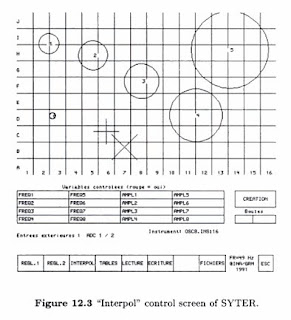
Concrete music and the use of electroacoustic studios had stabilised and modelled a certain number of sound-related operations on the basis of perception-based concepts. For example, an extremely powerful analogue studio process, "micro-editing", involved cutting minute fragments of sound from magnetic tape (using scissors!), which were then stuck end to end to create a new continuity. This principle was very successfully applied by the deferred time software and by Syter, making it possible to reorganise the material into new coherent sequences. This became known as "brewing". But brewing is not the end of the story, because the difficulty lies in controlling the way the brew comes together. Graphical interfaces, which these days are at the very heart of all computer technology, but which at the time were practically unheard of, were used to visualise the sound and the control parameters, and there was even an interpolation screen for exploring the intermediary terrain between two processing states.
Syter was a hit with musicians, both for studio work and instrumental work. In the studio, it could be easily built into the existing environment and breathed new life into the palette of processing possibilities. The system was essentially used for the processing of sound, meaning that the composer would record sounds and then modify them using the processing tools that were already built in, or by creating his own tools. In so doing, he would be faithful to the GRM tradition of processed sound, even though many hybrid processing techniques (between recorded sounds and synthesised sounds) provided entirely new kinds of sound. This material would then become (whether or not mixed with other sounds from other sources) the basis on which the composer would build his work.
Furthermore, at the time there was a unique relationship between composers and technical designers, who thanks to the modular programming techniques and their user-friendliness, could quickly build the tools necessary for creative work. A number of models that were later to become GRM Tools were a result ot this experimental relationship (in particular Doppler and Pitch Accum]. Once they had been built up, these algorithms were simple to implement, and integrated the whole palette of processing tools available in the system (around 40 different algorithms were designed and 15O variants of these basic algorithms).

An approach founded in pedagogy

The philosophy of the GRM has always been that the creator should work independently on his own process of composition, without the assistance of anybody else. Most composers had the training necessary to handle the techniques, to understand and work the analogue studio, and only in very rare cases were they assisted by the technician-musician. There was such a great interest in the deterred time software or the Syter system, and it was aimed at musicians of such varied backgrounds, that a training programme had to be set up in order to help them come to grips with the different systems. Man of these composers who came from an electroacoustic background, and many others were not familiar with studio techniques but who wished to become acquainted with them and develop projects bringing together instrumental and electroacoustic techniques. There were many other professionals from other fields: artists, radio and sound technicians, teachers or musicologists.
Week-long courses with small groups of trainees began to be organised 2 or 3 times a year, involving generally 6 to 8 participants (a total of 20 courses between 1985 and 1993]. During these courses, the system was explained and the participants had the chance to experiment and play with sounds. The objectives of these courses were manifold: the first was to provide composers with the training necessary for them to be autonomous in their work and to enable them to develop a project.
Another objective was to test the system with users. Because it was such an innovative system, using original approaches with regard to algorithms and interfaces, it had to demonstrate that it was up to the task and that the composers could use it easily and efficiently. Around 120 people followed these courses, and 80 works were composed, sometimes several of which were written by the same composer.

From pedagogy to production and concert presentation

Many of the composers were attracted by the possibilities offered in terms of the real time processing of acoustic sounds, and embarked on projects that brought together live instrumentalists, real time processing and recorded sounds. Others used the system in the studio, for acousmatic works, either to complement other existing studio technologies and tools, or sometimes as the sole production tool.
I was personally involved in this pedagogical and production aspect of the Syter system for some ten years. When it was first presented in-house in 1984, everybody underlined the technical prowess it had been to develop a system of that kind, but there was little enthusiasm on the part of the GRM composers, in light of the small number of existing algorithms and the fact that there were no instructions for use. I was fascinated by this approach and I proposed to Jean-François Allouis that I would help him in his project, in particular by explaining to composers how the system worked and by writing up a manual. We then organised the first training sessions in August 1985 and August 1986, and thereafter I took charge of the courses and production associated with the system and the development of variants of the instruments, in response to requests made by composers. I was therefore able to meet everybody who participated in the courses and I followed everything that was produced using Syter. I also played a great many works that involved Syter for the real time processing of instrumental sound Ia task that we became particularly involved in with Richard Bulski, the system technician, especially for moving it and setting it up for concerts).
I was able to gain an extensive and in-depth knowledge of how the system functioned, so much so that I was able to write my PhD dissertation on Syter (The Syter system, its history, development, musical production and implication in contemporary electroacoustic language, presented in December 1998 at the University of Paris VIII). I composed ten pieces on the system, some of which were with instruments, using the system only to produce electroacoustic sound, and others which were acousmatic, where a great deal of the sound creation work was done on Syter from start to finish. I began to move away from the system in around 1993, when it was beginning to become obsolete and when the first versions of GRM Tools were becoming available on Macintosh, designed and built by Hugues Vinet, who took much of his inspiration from the algorithms of Syter. I also realised, in 1993, that my life had been too wrapped up in the system, when a composer asked me seriously whether Syter was an acronym for System Teruggi!

inagrm.com/grmtools

[Prev | 1 | 2 ]

Thursday, November 01, 2012

Sonic Screens 2012 - full lineup


Electroacoustic music concert 
an event by U.S.O. Project (Matteo Milani, Federico Placidi) in collaboration with O’ and Die Schachtel 

Premieres: 
Agostino Di Scipio
"Two Sound Pieces with Repertoire String Music"
for any number of bowed string instruments and live electronics


Andrea Valle
"Dispacci dal fronte interno"
for Violin, Cello, spatialized electronics and printers


Federico Placidi
"TimeCapsule"
for Violin, Cello and live electronics


Performed by: 
Èdua Amarilla Zádory - Violin
Ana Topalovic - Violoncello

Sound Direction: 
Matteo Milani

Live Sets: 
Thoranna Bjornsdottir aka Trouble
Massimiliano Viel

O’ | via pastrengo 12 Milan | Italy
Saturday, December 1st - from 8:00 to 22:30 p.m. 

Door 5 euro

Wednesday, October 10, 2012

Augmented Listening

By Tue Haste Andersen - October 9, 2012

reBlogged from: design mind
 

Stop for a second and listen. Close your eyes, use your ears, and just listen.

Whether you are in a quiet office environment or out on a busy street, you'll be amazed by how many sounds there are around you. Most of us do not pay attention to the ambient sounds that surround us. Our brains filter them out and we don't listen. Yet the sounds we miss can be very enjoyable.

Designed Sounds

Today, what we hear in our daily lives is often designed sound- music and sound effects carefully crafted for games, devices, and products. For example, mission-critical products, such as heart rate monitors used during medical surgery or a plane’s flight deck controls, use distinctive alarming sounds that are designed to be easy to perceive and raise a sense of urgency or danger.
In interfaces for everyday tasks, sound is used to create engaging and beautiful experiences. Sounds can generate a special feeling or underline brand identity while simultaneously providing cues that a command has been received by the system. Most smart phones today come with subtle sounds that indicate the pressing of a touch screen’s virtual buttons. Since there is no way to feel if a virtual button has been pressed, the sounds reinforce the action for the user. Another example can be found in industrial design, where the latest electric cars are being designed with artificial motor sounds. The sounds alert pedestrians to the car as well as reinforce the sense of driving a powerful vehicle. These examples underline the overall trend of sound being used to create an aesthetic experience rather than serving as purely a functional aid to improve interaction.


Blurring the Border Between Listening and Composition

While systems and products are becoming more enjoyable and pleasant to listen to, they are usually not intentionally designed for sound interaction. The emergence of accessible music software on computers and mobile devices is changing this. These programs allow for easy modification of sound by the average user and blur the border between listening and sound creation. The small form and limited complexity of mobile interfaces has forced music software designers to reduce the complexity of their products, resulting in music software that is widely used by average mobile phone users.
Music apps are often top sellers. Popular applications allow people to become mobile DJs, to transform sounds, and to design ringtones.
I was interested in exploring the blur between sound creation and listening when my friend and colleague Matteo Penzo put me in contact with Matteo Milani from the U.S.O. Project sound art group. The ideas and compositions of the U.S.O. Project revolve around the use of noise and ambient sound as a foundation for sound installations and music composition. Together we wanted to create a mobile experience that would support active listening to the everyday sounds that surround us, making the listener a part of a personal sound installation. Instead of creating a tool for recording and transforming sound, we wanted to start from the sounds themselves. Our goal was to reinforce the sounds of the listener’s environment while blending them with more musical sounds. Together the sounds would form a unique experience that could be enjoyed by anybody that has an interest in sound and art.  


Early Experiments

We started with a small prototype app for iOS using simple sound algorithms to blend U.S.O. music with live recording from the iPhone microphone. The prototype was tested with real use cases that included listening to the app while taking a long walk as well as while sitting at the computer in the office. We added many parameters for the user to be able to tweak and play with the sound transformation.The parameters were mapped to on-screen sliders and buttons and to sensors like the accelerometer.
While doing the informal tests we found that the users were struggling to understand the relationship between the parameters and the sound output. Also, in most cases they would end up spending time experimenting with the parameters to discover how they work. The visual interface and controls were clearly distracting, taking attention away from the app’s original goal of reinforcing ambient sounds for the listener.  
Following these early experiments, we decided to take a drastically different approach. We limited the visual interface as much as possible and provided a set of sound themes in the app for the listener to select. This worked much better. All of a sudden the users would pick up the app and, once started, would tuck it away in a pocket while listening to the sounds. Each theme takes sounds from the microphone and blends them with sounds composed by U.S.O. Project. The sounds are blended using sound algorithms, unique to each theme. Each algorithm is carefully calibrated to replicate the work and skill that goes into producing a great listening experience.

Lis10er

The result is Lis10er (pronounced Listener), an augmented sound installation app. Sounds are blended from the listener’s surroundings, creating dynamic music that changes while maintaining its identity. Lis10er provides users with a creative way of listening to their environment and a unique experience with every listen. 


Tue Haste Andersen is Senior Software Architect based in frog’s Milan studio. Tue is a Human Computer Interaction and Computer Music expert, with research ranging from DJ work practices to the use of sound and music in common interaction tasks. He is also the founder and original author of the popular open source DJ software, Mixxx.

Friday, March 09, 2012

GRM pt.2: the birth of a concept

Daniel Teruggi wrote an interesting article about the Syter system at INA - GRM in the booklet for Archives GRM (CD 4). This whole CD is comprised of works created through Syter.

"To mark and celebrate the thirty years of the INA (Institut National de l'Audiovisuel), the GRM (Groupe des Recheches Musicales) has chosen to bring together an exceptional set of five compact discs, illustrating some of its most remarkable musical archives. These original works, which are often previously unpublished or have been dispersed throughout a host of other publications, are important because of the originality and audacity they testify to in the second half of the 20° century. Some listeners will be pleased to see that there are a number of illustrious composers here who, in the 1950s, frequented the studio of Pierre Schaeffer, and others will discover numerous musicians whose enthusiasm enabled this innovative musical genre to last throughout the following decades."
Emmanuel Hoog, président directeur générale de l'Ina

Daniel Teruggi - The time of real time

From the very beginning, music, whether vocal or instrumental, improvised or written, and up until the invention ol recording processes, was listened to at the precise moment it was produced. The twentieth century changed all that, First of all with the appearance of recording media, which made it possible to listen to sound in a place and at a time other than those at which it was originally produced; then by the widespread use of electricity, which made it possible to invent new instruments and new ways of imagining and making music. Concrete music, electronic music, electroacoustic music, acousmatic music or contemporary electronic musics are all testimony to the same ambition: using electrical, electronic and computer-based technologies to invent the sounds of music. The invention of sounds is the invention of new forms of music, of new ways of looking at music, and is the logical consequence of the new opportunities that technology continues to provide us with. Musicians began to use computer systems a long time ago (1958) in order to synthesise sounds and to develop computer programmes that would enable them to combine sounds into musical works. Progressively it became possible to record these sounds, to process them or to hybridise them with synthetic sounds.
Musical computer technology did not develop fast and was dependent on the way processors and data storage systems evolved; in 1958, a large computer in a research centre was necessary in order to produce a simple synthesised melody, which it was not even possible to record in the memory. These initial technical difficulties brought about the appearance of two concepts which could be described in a historical perspective, but which are often presented as if the were antagonistic: deferred time and real time. Deferred time described the way that the first computer systems were unable to produce an instantaneous result.
Between the moment at which the intention was expressed and the moment when its result become an audible phenomenon, there was always a certain lapse of time.
The user programmed a sound using software, defining its various parameters and timbre, and then the computer calculated the sound and, depending on the complexity of the calculation, produced the result ofter a given interval. The listening time was deferred with respect to intention time.
It was logical that the next technological objective was real time, a concept that describes the possibility of hearing a sound at precisely the some time as the intention to make it is expressed.
Moving over to real time required changes to the command tools. Deferred time was the result of a programming system whereby the user defined, using written language, the result he wished to obtain; moving over to real time made it possible to define the intentions instantaneously and to modify the result as it was being listened to.
Now, most sound production and generation systems work in real time, enabling the user, thanks to various interaction tools (keyboards, mice, screens) to control and modify the sounds created and heard. Nevertheless, in the field of musical creation, and for a relatively long time, this technological evolution was opposed on methodological grounds. Real time obliges the operator to act and react, depending on the result, in a way that is similar to that of the instrumentalist. For many composers, deferred time, because it separated the moment of conception from the moment of listening, created a distance that was necessary for reflection, a situation that is similar to instrumental composition, between the writing of a piece on paper, and its being played.

[Daniel Teruggi @ Sonic Acts 2010 - courtesy Rosa Menkman]

  
Deferred time and real time in the GRM

At the beginning of the 1970s, the Groupe de Recherches Musicales began to experiment using computer technologies. At the time, the Group already had 20 years of experience, a major repertoire of musical works, a tradition for profound reflection on music and perception as well as innovative technological research. Little by little, therefore, work was undertaken to look at the possibilities that this new domain, which was already strong in the United States, could offer in France, where it was comparatively little known. Two projects were to follow one another, and then coexist, between 1975 and 1993: the first, from 1975 to 1987, concerned the development of deferred time sound processing tools, the "Studio 123 software programmes", developments that are dealt with in CD 3 of the GRM Archives set. The second project, the Syter system was a major technological development for musical computer programming, so original that its impact can still be felt in the development of processing tools today.
These two projects were vitally important in opening electroacoustic music up to composers from the instrumental world. The main successes of these two projects were to bring electroacoustic music out of the studio, making computer technology accessible, without needing programming skills, and making processing reliable and reproducible. The range of things it was possible to do to sound was considerably widened, using original and unheard of sound processing techniques. These two projects were a unique period for the GRM, the studios opened up to welcome composers with other ideas, concepts and points of view, the dialogue was rich and fruitful, and the understanding and analysis of the music being written there were enhanced.

The Syter project 

With the advent of computer technology, the first idea was to imagine a parametric control of machines using digital tools. For example, synthesisers, while remaining analogue in the way that the sound is generated, could be controlled by digital systems that would provide o greater precision in terms of frequency that traditional rotary buttons. It was thus that the first Syter was born, an acronym for: Synthése en temps réel (real time synthesis), and the objective of which was to build up a digital synthesis system based on a set of oscillators, controlled in real time by specialised gesture-based access or by external signals.
The first prototype that was built was relatively simple, since its only function was to control, in real time, the movements of a sound source between a number of loudspeakers. This prototype, with its delicate control system and laborious programming, was used in concert on 16 March 1977 for the creation of Cristal by Francois Bayle.
The designer of this tool and of its following versions was Jean-François Allouis, an engineer who arrived at the GRM in 1974, and who was fascinated by the potential of computer technology as applied to sound and music, and who had an uncanny inventiveness when it came to finding solutions to new problems and designing original systems. For this first concert, the acronym Syter become: Systéme temps réel (real time system), and was the starting point for a whole 5-year period of development during which Jean-François Allouis contributed to the setting up of the first GRM computer, oversaw the implementation of the deferred time processing system, built the Syter real-time sound processor and the input and output converters, developed programming software for the processor, built one of the first interactive real-time parameter control systems and programmed the first processing tools. In conjunction with computer scientist Jean-Yves Bernier and computer technician Richard Bulski, he needed to build and rebuild the system several times before the first full system was complete, in 1984. The system underwent very few modifications and additions, subsequent to that. Eight systems were built and sold, up until 1988. The software continued to evolve up until 1989, in particular thanks to the impetus of Hugues Vinet, who designed a digital mixing tool, providing the system with all the functions of a Studio. Two systems were in operation at the GRM until 1995, and around 100 works were composed in part or in whole using the system.

Related Posts: 

Tuesday, May 17, 2011

GRM Tools - pt.1: an interview with Emmanuel Favreau

by Matteo Milani - U.S.O. Project, May 2011 

GRM Tools is the result of more than 50 years of cutting-edge research and experimentation at the Groupe de Recherches Musicales de l'Institut National de l'Audiovisuel in Paris.
These plug-ins were realized by a succession of hardware and software engineers, who formulated the algorithms for the original GRM Tools in the 1990s. Over the years the GRM has focused on developing a range of innovative tools to treat and represent the sound.
The new GRM Tools Evolution is the latest powerful and imaginative  bundle of new algorithms for  sound processing. Three new instruments are available: Evolution, Fusion and Grinder. All works in the  frequency-domain and provide powerful ways to manipulate audio in real time. I had the privilege of interviewing Emmanuel Favreau, software developer at INA - GRM. Here we go!


Matteo Milani: How many people are part of the GRM development team at INA?

Emmanuel Favreau: We are two people, working full-time. Adrien Lefevre handles the Acousmographe. I’m on GRM Tools. We welcome regular students.


MM: Can you tell us a brief history of the GRM Tools from the origin until now?

EF: The first version of the GRM Tools was created by Hugues Vinet, who is now scientific director of IRCAM in Paris. This stand-alone version offered a couple of algorithms, using the Digidesign SoundAccelerator/Audiomedia III card. The user interface was made ​​with HyperCard. When I arrived at the GRM in 1994, we took the decision to convert the processing available in the stand-alone version of GRM Tools plugins to TDM for Digidesign Pro Tools III. Treatments were rearranged, some modified, others abandoned. The original GRM Tools Classic bundle dates from this era. Later, the evolution of treatments has been closely following the technological evolution: when the processors became powerful enough for real-time processing, Steinberg introduced the VST architecture and the Digidesign RTAS Pro Tools format. And finally, we developed the ST version - Spectral Transform - when computer processing power allowed us to calculate several simultaneous FFT in real time.

 
[...] Jean-Francois Allouis and Denis Valette pioneered the hardware development of SYTER (SYsteme TEmps Reel / Realtime System) with a series of prototypes produced during the late 1970s, leading in due course to the construction of a complete preproduction version in 1984. Commercial manufacture of this digital synthesizer commenced in 1985, and by the end of the decade a number of these systems had been sold to academic institutions.
Benedict Mailliard developed the original software for SYTER. By the end of the decade, however, it was becoming clear that the processing power of personal computers was escalating at such a rate that many of the SYTER functions could now be run in real-time using a purely software-driven environment. As a result, a selection of these were modified by Hughes Vinet to create a suite of stand-alone signal processing programs. Finally, in 1993, the commercial version of this software, GRM Tools, was released for use with the Apple Macintosh.
The prototypes for SYTER accommodated both synthesis and signal processing facilities, and additive synthesis facilities were retained for the hardware production versions of the system. The aims and objectives of GRM, however, were geared very much toward the processing of naturally generated source material. As a consequence, particular attention was paid to the development of signal processing tools, not only in terms of conventional filtering and reverberation facilities but also more novel techniques such as pitch shifting and time stretching.

[via Electronic and Computer Music by Peter Manning]


MM: About GUI - 2DController. What is the origin of this pioneering, intuitive, but simple performer-instrument "link"?

EF: This type of interface has been widely used at the time of SYTER during the 80’s. It allowed us to regain "analog" access to a digital instrument. Indeed, even the manipulation of a slider with a mouse requires some attention (click in the right place, moving vertically or horizontally without mechanical guide, etc.). With the 2D interface, the entire surface of the screen becomes a controller. To obtain a result as soon as you click, the precision of movement is becoming necessary if you want to tune that.


MM: The mapping of parameters on multi-touch control surfaces free us from the use of a mouse and gives us an expressiveness never achieved before. What do you think of this new generation of controllers?

EF: Of course, these interfaces allow an overall and "analog" control which is not possible with the mouse (although the knob 2D mode or "elastic" are possible solutions to overcome the single pointer limitation). Since the engineering of the SYTER we proposed a system of "interpolator balls" to interpolate between different set of parameters arranged in a two-dimensional space. The multi-point control of such a device is natural: we need both hands to shape and transform the space.
 "Interpol" control screen of SYTER
[via DAFX: Digital Audio Effects - Udo Zölzer, Xavier Amatriain]


MM: Is the SYTER still in use today in Paris?

EF: No, SYTER no longer works. It was composed of several elements (a PDP-11, large hard drives, a vector graphics terminal) which can not be sustained today.


MM: Host-based tools vs. custom DSP engines: will there be a winner or they will continue to peacefully coexist in the business?

EF: For the type of tool that we develop, the winner is clearly the host-based. For very large sessions with dozens of tracks and hundreds of plug-ins, DSP is now the best choice, but they could disappear with the diffusion of multi-core processors.


MM: How long did the Classic Bundle take to get ported from TDM to RTAS?

EF: It's hard to say because it was not done directly. I first made ​​the VST version, and then adapted the RTAS version. The algorithmic part posed no particular problems, the difficulties being rather on the side of the interface between the various plugins and hosts.


MM: How much research was needed to create the Spectral Transform bundle?

EF: The prototypes of the Spectral Transform have been fast enough to achieve. The basic algorithm is the phase vocoder, which has been well known for a long time. What took time was the interface design, the choice of parameters and their mutual consistency, stability and the whole robustness (i.e. avoid audio clicks and saturation of the values ​​of some parameters).


MM: What's the technology behind the bundles?

EF: If we leave aside the TDM - the processing code is written in 56000 assembly language, all plugins are written in C++. The processing codes are fully compatible between Mac and PC. In addition, the portability of the user interface is guaranteed by Juce. All development is done on Mac; PC adaptation is virtually automatic and requires minimal work.


MM: A description of version 3 and its new features: what goals have you achieved during this long period of software development?

EF: Having redesigned the interface and rewritten all the code allowed us to add some new features: resizing the window, MIDI control with automatic learning, agitation mode.
Agitation is a generalization of the Randomize, it can be applied to all parameters of random variations in amplitude and frequency control. Now all the GRM Tools are also available as standalone applications. This easily handles individual sounds, to make quick tests and become familiar with the treatments without having to use host daw and sequencers.


MM: How do you manage feedback from musicians and sound designers to improve sound quality and the graphical interface?

EF: The user feedback comes from various forums and from discussions with users and composers here at the GRM. In response to suggestions, plug-ins will be changed, some features will be added (but always in small numbers to ensure compatibility) or it will create a new treatment that may ultimately prove quite different from the original application. This is what happened to Evolution that comes from improving the freeze that can be achieved with FreqWarp.

[GRM Tools Evolution @ Qwartz 7 - courtesy Alexandra Lebon]


MM: What are the most efficient methods of applications against piracy?

EF: There is none. Whatever the methods, they will be bypassed one day or another. We must find a solution that is not too heavy for the users, while allowing a minimum of protection. We chose the system of Pace iLok because it is very common in musical applications. The recently announced changes should make it more flexible to use.


Thanks for your time Emmanuel, keep up the good work!


[...] Any transformation, no matter how powerful, will never equal or surpass synthesis, if it fails to maintain a causal relationship between the sound resulting from the transformation and the source sound. The practice of sound transformation is not to create a new sound of some type by a fortunate or haphazard modification of a source, but to generate families of correlated sounds, revealing persistent strings of properties, and to compare them with the altered or disappeared properties.
In synthesis, the formalisation of the devices and resulting memorisable abstraction, offer a stable set of references which can be easily transposed from one environment to another. In sound transformation, no abstraction of the available results is possible and neither is generalisation. The result of an experiment is always the product of an operation and a particular sound to which this operation is applied. The composer must be able to add to the sum of knowledge by reproducing a previously proven experiment.
What makes the wealth and functionality of a system is the assembly and convergence of the whole, its ability at any moment to answer the questions imagined. Specific tools built for a single experiment, no matter how prestigious, are sterile if they cannot be applied to other purposes. - Yann Geslin


References:

[Digital Audio Workstation by Colby Leider]
[sounDesign, a blog dedicated to the world of Sound and Audio Design]
[On GRM Tools 3, Part 1 - via designingsound.org]
[GRM Tools 3 review: a classic reborn]
[The GRM: landmarks on a historic route
[GRM's current team]
[GRM Tools Store]

You can also read my interviews and reviews on Computer Music Studio (italian only), a monthly magazine by Tecniche Nuove Editore. - Matteo Milani

Sunday, January 23, 2011

From Microsound to Soundscape Composition - Barry Truax

Interacting with Inner and Outer Sonic Complexity: from Microsound to Soundscape Composition (Barry Truax) from VCMM on Vimeo.


It is possible to think of the two extremes of the world of sound as the inner domain of microsound (less than 50 ms) where frequency and time are interdependent, and the external world of sonic complexity, namely the soundscape. In terms of sonic design, the computer is increasingly providing tools for dealing with each of these domains, such as granular synthesis and multi-channel soundscape composition. The models of interaction involved with the complexity of each of these domains are instructive, and will be presented with sound examples.


Barry Truax is a Professor at Simon Fraser University where he teaches courses in acoustic communication and electroacoustic music. He has worked with the World Soundscape Project, editing its Handbook for Acoustic Ecology, and has published a book Acoustic Communication dealing with all aspects of sound and technology. As a composer, Truax is best known for his work with the PODX computer music system which he has used for tape solo works and those which combine tape with live performers or computer graphics. In 1991 his work, Riverrun, was awarded the Magisterium at the International Competition of Electroacoustic Music in Bourges, France, a category open only to electroacoustic composers of 20 or more years experience.

Sunday, November 14, 2010

"Empty Rooms", audio-visual self-organized performance space


(Mixed Media Installation)

Premiered on 29th - 30th October 2010 @ [BOX] Videoart Project Space in Milan, during the Live!iXem Festival 2010 (thanks to VisualContainer)


A Movie made of algorithmically generated "inactive spaces” is projected on a screen.

An overlapped stream of pre-recorded “sound activities” is then diffused from a record player and from 4 different iPods running in shuffle mode, creating recombinant “invisible actions” to fit into the Movie.

A self organizing link between sound and visuals is established via cybernetic procedures defined as interconnected spin networks, produced by a video camera “observing” the movie and by one microphone “listening” to the space placed inside the performance Locus.

The Kyma sound design environment (accelerated by the Pacarana sound computation engine) is then engaged in order to compute the data and perform real-time evaluations between the different types of numerical information (audio-video), producing a “sonorous response” to the asynchronous stream of audio-visual contents.

The synthesized information is then diffused in the performance space again through 4 loudspeakers.

Various types of feedback will take place during this highly dynamic process implying a self regulating behavior that will establish new connections between the pacing of the movie locations and the “sonorous” content produced by the processing of the iPod sound streams.

The Observer will then experience the following layers of information:

- a Real-Time recombinant Movie made of “inactive” locations.

- an Overlapped Stream of “possible actions” diffused by the iPods that fits into the Movie.

- a Sonorous link between the above domains of activities via 4 full range loudspeakers.

The Observer can take into account one or more layers of information (even all of them) in order to create himself a cinematic experience via a correlation process.

More info here:
[Empty_Rooms_eng_booklet.pdf]
[Empty_Rooms_Technical_Rider.pdf]

artists contact: unidentified.sound.object (at) gmail (dot) com
booking: booking (at) usoproject (dot) com
promotion: press (at) usoproject (dot) com

Sunday, June 13, 2010

A conversation with Agostino Di Scipio

by Federico Placidi - U.S.O. Project, June 2010 / Eng: Valeria Grillo


The works of Agostino Di Scipio include compositions for instrumentalists and electronics and sound installations. Some of these explore non-conventional approaches on the generation and trasmission of sound, including a special focus on phenomena of noise, turbulence and emergence. Other works implement dynamical networks of live sonic interactions between performers, machines, and environments (e.g. his Audible Ecosystemics project).


FP: Let's talk about your early works, before the 'ecosystemic' paradigm. How different was it from your more recent work?

AdS: Well, I had a very early phase when I gathered as much knowledge as possible about computer music techniques and digital signal processing. That included a special for algorithmic composition, too, the question being how I could formalize musical gestures of use in writing for either usual music instruments or electronics. In retrospect, I view that time as one of broad explorations in sonic materials, which eventually took me, later on, to focus on granular, textural and noisy materials, of a kind I later described as "sound dusts". It took me, in short, to micro-composition, i.e. to focus on the finest temporal scales in sound - with various degrees of densities and consistencies among sonic grains or particles. The idea was that micro-composition would let macro-level, gestural properties emerge at larger time scales. I tried to determine a process in sound in a way that lower-level processes would bring forth larger sonic gestures.
Along this path, I even developed new synthesis techniques based on the mathematics of nonlinear dynamic systems, as found in the so-called 'chaos theory' - that was end of the 1980s and early 1990s, and chaos (or better: the mathematics of nonlinear dynamical systems) was not as popular as it later became. I came across it and studied it quite in depth for some time.
Now, all those efforts usually provided me with sound materials for studio works. But at some point I felt a need to find my own way into live electronics performance. I had stayed far removed from that, because I was completely dissatisfied with how live electronics, including real-time interactive computer music, was approached at the time. Or, at least, I didn't want to follow those paths...


FP: What made you unhappy with extant approaches?

AdS: It was mainly because of the obvious linearity in the unfolding of time. And the fact that peculiar electroacoustic possibilities and artifacts - for example Larsen tones (feedback sounds) - were exclusively understood as a problem in audio engineering, stranger to the wanted sounding results. I felt they could rather be taken as the very resources, to be controlled and exploited in a truly live electroacoustic situation. I was dissatisfied with the usual notion that the technology was there to 'neutrally' represent and convey musical signals, as if the tools and their hydiosincracies were not part of the experience; instead of pretending to set them aside, I felt they could be studied and turned into sonic resources, the medium itself of experience. Then, and maybe more importantly, I realized that the processes I was dealing with in a formalized manner, were abstract models rid of any surrounding space, separate from any source of noise and risk in their own unfolding. They were models, as it was, not the thing itself. That confined me to performance as representation, as the (imperfect) replication of an ideal. I realized I could use the electroacoustic equipment and computers to implement dynamical processes, to make real nonlinear systems, exposed to ambience noise and the hydiosincracies of the electroaoustics, exposed to these sources of uncertainty and change. No more software modelling of abstract dynamical systems, but the implementation of a self-regulating sounding system in contact with the surrounding environment. In a way, this was a move from models of existing, and usually extra-musical, systems or processes, to the design of a kind of living sound organism in contact with the surrounding space, one that grasp in that space the energy necessary to stabilize itself, grow and change.

So, that was how I moved on towards my more recent work. Some compositions are a significant testimony of this journey. For example, take the first string quartet (5 difference-sensitive circular interactions, 1997-98): it already had a strong relationship with the surrounding space, although clearly the instrumental material still had a predominant role. Another work, Texture-Multiple (started 1993), for small ensemble and electronics, represented for me a kind of a long-lasting workshop (it didn't know a final version until recently); born of a sketch for a smaller scale work (Kairos, with saxophone and electronics, 1992), it soon 'conquered' the 'collective', the ensemble dimension (3-6 instruments), and then, with the mediation of real time computer processing, it took contact with the surrounding space (since 1994). At each new performance of that work, I would try ideas concerning the interactions between human performance, machinery, and space, that would later become central to the 'ecosystemic' pieces.

[DiScipio_Texture-Multiple.mp3]


FP: The two works you mentioned, call for a kind of multiple-level interaction: on the one hand, we have a written score which remains quite flexible in terms of how one plays the notated materials; on the other hand, there is a programmable DSP unit transforming all instrumental sounds; and furthermore, we have the room, whose resonances to the music somehow drive the computer processing that in turn affects the interactions among instrumentalists. So all components, one way or another, are constantly transforming each-other, in a rather flexible or elastic temporal and spatial dimension.

AdS: Yes. Let's pick Texture-Multiple as an example. The instrumental material is notated in separate, independent instrumental parts. These are similar among themselves (not identical, each is tied to the specifics of the particular instrument), so actually all instrumentalists involved play the 'same' thing, in slightly different and flexible manners, seldomly in synch. When the performance starts, the instrumentalists are not really an 'ensemble', they are separate individuals, no sense of community. The role of electronics consists in bringing to their attention, as they play, the higher or lower degree of communion of their independent intents. The computer alters their sound, to different degrees, depending on features of the instrumental gestures. In turn, depending on the sonorities the computer gives them back, the instrumentalists may get to know better whether they are acting together or not, and accordingly change their playing, following simple interaction rules. So gradually a sense of 'ensemble' takes shape throughout the piece. The unity of the members is not given for granted, is not pre-determined, it comes forth as they actually play, with the mediation of the electronics. I must add that, to some extent, the computer processing is also driven by specific features in the total sound in the room space; 'space', here, is an ineliminable liaise of the relations among the involved players. For some people, the compositional process in Texture-Mulitple is reminiscent of Christian Wolff's music. However, different from Wolff, the electronics intervenes to alter the instrumental sound, making a larger sound texture dynamically depending on the peculiar resonance of the surrounding space, thus emphasizing the active, or pro-active role of the room acoustics in the gathering of the ensemble community. An important implication, that is not found in Wolff music, is that, for the good or the bad, here human relationships are profoundly mediated by the technology. (Which is what happens in our daily life, nowadays).


FP: If I remember correctly, there is a 'attraction point', a high F-sharp, and the closer the instrumentalist get to that pitch, the less their sound is subject to electronic transformations.

AdS: Yes, that's a fair approximation. The F-sharp is quite frequent in the six instrumental parts, so it fills the resonant space. If it grows too much, and the room acoustics reinforce it, the comptuer will 'avoid' getting more of it. That way, a bit of information that is relevant to the piece, doesn't saturate (intended symbolically and musically, not signal-wise) the surrounding space.


FP: I remember well, it regulates the level of the signal sent to the recording buffer.

AdS: Indeed, a more general idea I work with in that piece is: the louder the instrumental material resonating in the room - or, the denser and quicker the instrumentalists' gesture - the more heavily processed, 'granulated' ('spliced-up' in tiny bits) and finally 'evaporated' and thus attenuated, the sound flow from the computer; until the moment where grain density is so small that there is sound no more. The score binds the overall process to an overriding direction, so I know that sooner or later there will be the sense of 'communion' or 'common intent' that we were mentioning. And I know that sooner or later the ensemble members will play loud enough to inhibit any further electronic processing and reduce the computer sound to silence. To some extent, in that work the score notation predetermines an overall narrative: when a sense of ensemble is finally achieved, the total ensemble sound may be strong enough as to silence the computer, but that very event negates the mediation they were leaning on. However, one can't really say how the network of interactions will eventually develop during the performance, but one can be sure it will come to achieve the goal. Like in other works of mine, a rather open interaction network operates under the spell of a higher-level force or guide (in this case, stipulated by the composer himself in his notation).


FP: And how is the musical writing conceived of, in such a case? Is it linear? Does it develops in time? Do you read it from left to right?

AdS: In Texture-Multiple you do, yes. Except for local loops, repeats whose variable duration depends on local intentions on the part of each of performer. In large sections of the string quartet score, you read from left to right, as you say; at a certain point, though, the four guys settle on material that has to be reiterated (again a loop-based notation, but on much larger spans). At that point, their playing techniques vary depending on what they hear from the electronics - and what they hear is an articulated texture arising from the computer processing of their own sound. The four members have special rules of behavior: if they, on subjective basis, hear the computer processed sound as a rather dense and continuous texture, then they have to gradually slow their tempo down and decrease the sound level, until they come to silence, making the playing gesture but touching none the strings. Viceversa, if they hear a sparser texture, they keep playing, adding more material, eventually decreasing in level, but speeding up the tempo (that will provide the computer with more materials to work with, reinforcing the rather foggy or dusty texture). The idea is, local behaviors compensate for the activity of the system, 'system' being understood in its whole entirety, including human beings, space, electroacoustic apparatus. Simple local mechanisms may become a quite intricate net at a global level. It gets really difficult to hear out the specific agency driving the performance - who affects whom, who has the lead and who is led. You could speak of an 'emerging agency'. In cybernetics and complexity theory, one speaks of distributed causality. The performance system is no more decomposable into independent parts, it becomes a holon - using an awful term put forth by some scientists.


FP: Going back to sound, we could say that, with these works, we move from the usual situation where sound is raw material transformed or projected in space and time, to a peculiar situation where sound takes on an informational, communicative value, maybe more essential, and yet often subtle and feeble, as it eventually gets to thin noise events that verge on background noise, while at the same time affecting further gestures and developments in both the human and the machine components.

AdS: I agree with that. Sound sets the conditions of its own existence and development. Which actually brings us to the works in the Audible Ecosystemics project (2002-2005), where probably the approach is more fully crafted. The project includes a variety of concert piececs and sound installations. More recent works are like further extensions of that project (e.g. a series of works named Modes of Interference). Sometimes I think that the words Audible Ecosystemics refer more to a way or attitude of making sound art, and less to a set of pieces. Anyway, we are talking of live electronic solo works, i.e. performed with specific live electronics set-ups, no music instrument involved. They explore sound materials existing in the given room, such as background noise, in different ways. Or Larsen tones (i.e. the accumulation of ambience noise mediated by the room acoustics and the electroacoustics utilized) deliberately caused by the 'electronic performer', i.e. the person or people in charge of preparing the equipment and tweaking the overall audio infrastructure. In the Background Noise Study (Audible Ecosystemics n.3a) you start from this 'nothing musical' (background noise) and make something out of it. If this 'something' is interesting and keeps your attention, then it can be defined as music. However, that chance is never granted beforehand: the performer does his/her best, particularly in the rehearsals, in order to establish a sufficiently varied system dynamics, the crucial rerequisite for something of interest to happen; yet, the variables are so numerous - the audience walks in after reheasals, so the room acoustics change; there might be some accidental sound events in the room, or from outside, that were not there before… you know, all such marginal circumstances can modify how the performance turns out in the end. Now, strictly speaking that is not a problem. My directions as a composer, and the performer's own skills, cope with such circumstances and strive to ensure that some music eventually emerges thanks to such accidents. In fact all that is there prompted to make that happen is purely potential, the performance itself has to turn it into actuality, and that is only possible by feeding the process with some little energy, however musically insignificant.

I do have some works of a rather different kind. Take the Book of Flute Dynamics (also known in Italian as Per la meccanica dei flauti). It is not based on the kind of sonic inter-connections we have mentioned between the electroacoustics, the musical instruments and the room acoustics. And still, it is another an example of how you can work with the usually unwanted, in the particular case, with several small noises a flutist makes never blowing into the flute, simply holding the instrument in her hands and lowering the keys, etc. Again, attention is turned to residual, with hardly-noticeable noise, understood as artifact traces left by human interaction with a piece of (mechanical) technology, the instrument, and work with that. A bit like in the Background Noise Study in the Vocal Tract (Audible Ecosystemics n.3b), the method may be different, yet the purpose is obviously of a similar kind: in the flute work the ‘space’ is a small tube of varying length, manipulated with a finite set of keys and fingers; in the Audible Ecosystemics works, on the other hand, the physical space, itself mechanically and culturally connotated, consists in the room environment where we set to present the work. In the just mentioned Background Noise Study in the Vocal Tract, the idea is to experience the resonances and unwanted noises of a smaller but changing room (a mouth) and the resonances and unwanted noise in a larger room (concert hall).

[DiScipio_Ecosystemics.mp3]


FP: How do you experiment and gradually finalize an 'audible ecosystem'?

AdS: Things often are born out of trial and errors. It can last quite a long time. Say, I start with an idea about how sound should originate and develop, setting the minimum requirements for some sound to be there instead of silence.
Based on that, I slowly shape up a process that, beside bringing forth some sound, articulates the thus generated sound in time. This requires extensive experimentation. I assemble a small-scale set-up in my own studio, smaller than the one eventually to be set in a concert hall or performance space, and live with it for months, trying it, listening, refining, testing it under different conditions, technical and environmental: during the day and the night, with open or closed windows, more or less cars or else in the distance, voices or birds in the street, the plane passing by, the telephone ringing, the neighbors cheers, etc. And then different microphones and microphone placements, maybe soldering some speaker or piezo, and certainly refining the software, etc. Up to a point where I can see that the process works (sustains itself) and changes (generates significantly varied sound textures and patterns). Being satisfied with it, doesn’t mean that the whole thing works in a musically, aesthetically rewarding way: it simply means that it shows the ability to self-regulate for some time in an autonomous way, such that, by feeding it a little noise, it can behave in a non-destructive way.

Now, that’s empirical evidence of what I mean saying that music is never there before you make it, or that music doesn’t exist until it emerges to existence. It may sound as a philosophical statement about music, a statement from a nonobjectivisit and constructivistic perspective, yet it's very practical, too. As a general criterion, I’m happy with the process that I set-up when, as a result of the inherent system dynamics, it unfolds through as many as possible system states: perceptually that means that you have a variety of textures of changing density, with several degrees of tactility to them, with internal timbre variations, changing across frequency regions, variations in micro-rhythmical (granular, random or patterned) activity. Things are probably at the most clear when listening to a performance of Feedback Study (Audible Ecosystemics n.2a). Let me explain. I don’t usually pay too much attention to musical pitch and pitch structures. But in Feedback Study I can hardly avoid a sense that pitch is important, because the only sound generating device is there a, is a feedback loop causing Larsen tones, often coming with a clear pitch quality. Their frequency (or frequencies, as sometimes they come in clusters) depend on roon acoustics and the mic-to-speaker distance (as well as on the mic and speaker characteristics in electro-acoustic transduction). Therefore, one of the things in this work is how the system dynamics allows for developing different harmonic fields based on the Larsen tones: the variety and the redundancy in frequency regions and pitch relationships project the system dynamics in the dimension of pitch, making it audible to the ear.

At a different level of discourse, the general idea behind such works is that the identity of a work is captured in the array of determinate relationships and composed interactions, including the connection between microphones and loudspeakers, their placement in the room, how the software itself works and what role the performers take on as they handle the gear, etc. At the same time, the potential to express this identity lies in the variety of random stimuli coming during the performance from the hall, and other, often random, particulars of the available electroacoustic equipment. My understanding and appreciation of the results is less grounded in aesthetic evaluation, and more in the sense of a convergence or coming together of room, people involved, and the whole equipment (hardware and software).

I don't mean that the aesthetics of the sounding results is of little significance to me. Yet, the focus of experience is about this vergeance, this coming together of all too often reputed independent components. The network of interactions I devise is usually enough open to the surronding environment as to change in time, wander and develop; at the same time, it is closed-onto-itself enough to preserve its identity, retaining its structure notwithstanding the random events in the ambience. It gives something to the ambience, and it gets something from the ambience, in a truly structural coupling. Action and perception: two faces of the same coin, tossed in a determinate environment, where some random events happen. This mutual exchange is what we seek, it’s what we hopefully obtain during the performance, the richness. The goal is to provide an experience where everything is connected to every other thing, in sound. Nothing, in a given space, is foreing to sound and hearing. The ear knows that nothing is disconnected, that nothing is neutral to what it hears.


FP: Turning to technology, how relevant is for you the computer programming environment, its flexibility, its peculiarity? And what role does it play?

AdS: Well, first it is important to stress that "technology" here is more than the computer and the software involved. As should be clear, critical is the array of transducers, be them loudspeakers, membrane microphones, piezos, or other sensors (I am fond of the accelerometers I was allowed to work with, two years ago in Berlin, for Untitled 2008 - Soundinstallation in two or more dismantled or abandoned rooms). Not to forget the mixer console, which I tend to consider as a performing device. Essentially, all analog gear included is really crucial, so possibly one has to consider it part of one's own designs. And I am not necessarily referring to the quality of high-end professional equipment: even lousy speakers and cheap microphones can do a good job, if used in sensible and informed ways. What is important is your awareness of the role and function you assign to them as components in a larger infrastructure.

Now, as far as software is concerned, I use real-time DSP programming environments that allow me to develop a variety of automated functions. "Automated" is not the same as "predetermined", it means "able to extract information from the signal and to turn this data into variable control signals". I make a distinction between what is usually named "audio signal processing" and what I often refer to as "control signal processing". Sometimes my computer patches are more voluminous and complicated in their control signal processing subpatches than in the audio signal processing ones. Sound processing and trasformations can be kept rather simple and can still yield quite interesting results, if driven and articulated by properly shaped, "adaptive" control signals generated in real time.

In this regard, I find that Kyma is a truly remarkable computer workstation, that I have been using for 15 years now (fifteen!). It is extremely powerful, and the programming environment is efficient for both rapid prototyping, and for deeper programming technicalities. I also work with PD. In my "scores" (instruction booklets?), I usually document all necessary signal processing in a machine-independent notation, partly graphic, partly verbal, eventually referring the reader to well-known digital signal processing technicalities. That allows other people to re-create the algorithms using programming languages and computer systems they prefer. Baed on such documentation, works of mine have been performed by colleagues who work with software I tend to avoid (like Max/MSP). From what I can hear, the results are rather consistent with my own performances.


FP: It seems that you have a modular approach on preparing your codes, avoiding redundancy, and creating meaningful connections among extracted signal features, or their psychoacoustic equivalents.

AdS: I spend quite some time with designing feature-extraction algorithms. I have an ‘arsenal’ of them. Also important is the array of mapping functions from extracted data to control signals to apply in ways consistent with their perceptual reality. I change or refine these software modules, tuning them depending on context. I mean not only compositional or musical context, but also physical context. Suppose we have the computer track, during a performance, the most resonant frequency in the total room sound (via microphones). Suppose we use this data to attenuate that very frequency in the computer output signal routed to the speakers, thus compensating between input magnitude and output. One aim for that could be to avoid or limit strong feedback peaks. Now, if you go like that in a 10mt x 10mt room, the code you come up with may not be working in much smaller rooms. In the installation Stanze Private (ecosystemic sound construction), the rooms I work with are glass bottles and vessels, with volume ranging in the few squared centimeters. In which case, the trackers necessary to establish the inverse amplitude relationship I was describing, have to be tuned to work in a very peculiar way, their reaction time must be much shorter just because of mere physical dimensions and reflective properties of the room surfaces. The general criterion is the same (inverse i/o relationship), but it doesn't work regardless of dimension. The timing of the ‘followers’ or 'trackers' must be properly studied. Therefore, in general, at each new project I may re-cycle tools I have already developed, but depending on many factors, specific extensions, implementations or refinements are also necessary.

[DiScipio_Stanze-Private.mp3]


FP: Let’s go back to the performance paradigm: it is clear that your music - or your work more generally – lives on symbiotic relationships between the performance space, the sound events produced in it and the people that establish a connection with that space. That implies a social dimension, taht is essential to make the experience ‘sensible and REAL’. Nowadays, we live in a historical timeframe where the experience of the real is often replaced by a paradigm of the simulacrum, an extreme, sometimes violent virtualization of life, where the real space, the physical space, is depicted almost as a social problem. People prefer to interact through virtual social networks, more often than in the ‘real world’. This being so, I wonder: in a society where experience is becoming more and more virtual (literally reduced to purely binary information), what will happen of your works, which need a real venue and environment in order to exist?

AdS: I am myself interested in research dealing with how we perceive space and all that is around us in space. As I see it, that is done in two ways: either in observing what happens in the very moment of lived experiences, here-and-now; or via simulation tasks and technologies, pinning on as many aspects of perception as possible among those having a role (biological, biocybernetic, ecological aspects). The latter approach, pursued among the tidy walls of research labs, leads to virtual reality. Thanks to it, it is possible to expand our knowledge of what is and what isn’t relevant to the process of human perception. Now, in my view, it is important not to misunderstand the data we gather from the scientific approach for unique and unambiguous representations of reality. They only add a bit of rationalistic analysis of what it means to be living beings. It may be great to be able to synthesize virtual spaces and use this technology to ‘travel’ to inexistent spaces, or anyway to spaces other than the space where the living body is. But, again, that's only good in order to gain a bit of knowledge on the organism’s behavior. Once we have that knowledge, we must turn to real life, and see how it can be a relevant part of lived experience. A ‘fake’ life, a virtual dimension may be ok for entertainment purposes - with entertainment mass-media, we always shift from perceiving the content of human communications, to perceiving the medium presumed to communicate that content. That is only interesting if you strive to appropriate the medium, or even to design the medium. Otherwise it is of little interest and even verges on the totalitaristic, when sold as the predonominant or exclusive manner of human communication.

My opinion on these matters is highly conflictual and critical: while rational knowledge is acceptable and desirable, it must not prevent people from ‘feeling’ and experiencing reality. That's all the more true when speaking of artistic endeavours. The risk of setting-up for ourselves an utterly synthetic world in the name of a kind of body-less notion of aesthetics leads in fact to the opposite: the body is ‘anaesthetized’, not empowered (as some people claim, instead). The triumph of re-presentation kills all presence. Let me say it, ‘too much aesthetics anaesthetizes’.


FP: What would happen to your works if one day there were no more possibility to perform it in a socially shared space? Where could it migrate, and how could it reconfigure itself?

AdS: If one day there were no more transducers (I mean microphones, loudspeakers, the tympanic membrane of human ear, even the skin maybe…) acting as interfaces between air pressure waves and nervous-electrical measures, my work and the work of a lot of other people would stop existing, it would cease. Fine so! It happened so many times in history. The music of the British virginalists, a few centuries ago, disappeared because of the extinction of their very instrument (the virginale, existing in several fashions across Europe). Then, just like it happens today with Renaissance music, at some point so-called 'philologically informed' interpretative approaches would be proposed, and these older technologies would be revived and again built.


FP: A last question. What is the Utopia of your work?

AdS: …mmmhh… hard to say. Well, actually there is one thing! For quite some time I have beein living with this fixed idea in my mind, just a concept for the moment, as I don’t possess enough competence to make it real. I envision a sound-generating device capable of producing, beside sound, the electricity that is needed to sustain itself as a sound-generating device. A kind of ‘aural living being’ which, through a closed circle, would use its own vibrations, or the air vibrations it causes, to allow for the power supply necessary for its own function. This ‘aural being’ wouldn’t probably be musically very interesting, it would be a kind of ecologically self-sufficient or self-sustaining device. I sketched a little drawning of this concept a few years ago, in Berlin, as my signature on a friend's guestbook, as a gift. Your question makes me think that that's a kind of Utopia underlying my work. Yes, the draft lays in a Folkmar's guestbook, somewhere in Berlin! And it's not a draft of musical Utopia…

[xoomer.virgilio.it/adiscipi]
[Available Recordings of Agostino Di Scipio's works]
[Hörbare Ökosysteme - Live elektronische Kompositionen 1993-2005]
[Anlage @ Galerie Mario Mazzoli, Berlin]

Saturday, March 27, 2010

Forays into Uncharted Territories: an Interview with Curtis Roads

The following is an extract of a longer interview with Curtis Roads (by Brigitte Robindoré) appeared in Computer Music Journal Vol. 29 © 2005 Massachusetts Institute of Technology.


Robindoré: In a 1988 interview in The New York Times, the instrumental composer Olivier Messiaen gave his rather remarkable perspective on electro-acoustic music: “The ancient musical modes lasted for ten centuries, tonal music only a few centuries, three centuries really. Serial music lasted about fifty years. Aleatory music should last for a few days, Minimalism a couple of weeks. What will last longer, I believe, is electronic music, or electro-acoustic music. Some composers do this, some don’t; I don’t - but even for me it has changed music. I cannot hear the orchestra in the same way, for instance, because of electro-acoustic music. It has not yet given us new masterpieces, but it has given us new timbres.” With the vantage point of a solid 30 years in the field, can you concur with Messiaen’s opinion concerning the lasting nature of this genre? And has your perspective changed over those years or only been confirmed? And what of his comment that the field has not yet offered (as of 1988, that is) any “masterpieces” such as those yielded by Western art instrumental and choral music composers over the centuries?

Roads: What provocative questions! Olivier Messiaen encouraged new music to expand in multiple directions. In my classes, I play his Fête des belles eaux for six Ondes Martenots [electronic instruments], which he composed as a young man in 1937. I would say that we live in a multicultural world, where the different genres and styles mentioned by Messiaen never die completely. Since one of the ways that music evolves is through combining styles into a new hybrid, the historical styles continue to serve as an important gene pool for future music.
In the 21st century, many factors align in favor of the electronic medium. In my view, we are in the midst of a golden age of electronic music composition, supported by strong technical and aesthetic momentum. Varèse’s vision for the “liberation of sound” is our reality. In an imperfect world, I am very grateful for at least this.
As to the question of masterpieces, I would say that a masterpiece defines a genre or sets a standard for works that follow. The question of choosing masterpieces is tricky. What are the masterpieces for traditional acoustic instruments since 1950? The choice would have to be quite subjective.
In any case, electronic music gives us more than new timbres; it offers new tools for organizing sound material. New materials and tools lead to fresh compositional strategies based on timbral mutations, spatial counterpoint, detailed control of complex sound masses, graphical sculpting of time-varying spectra, juxtapositions of virtual and real soundscapes, sound coalescence and disintegration, and interplay between the microsonic and the other time scales that cannot be realized by acoustic instruments. Listen to Forbidden
Planet (1956) by Louis and Bebe Barron, which defined the genre of space music. Stockhausen’s four-channel tape Kontakte (1960) created not only a fascinating sound world, but also defined a new musical code. Parmegiani’s De Natura Sonorum (1975) is a tour-de-force of stylized musique concrète. Risset’s Sud (1985) is another brilliant piece. Vaggione’s music is obviously great. I could go on. I play a lot of music for my students.
I am reminded of a remark attributed to Richard Strauss, in which he supposedly said: “I am not a great composer, but I am a very good composer!” A number of very good composers are working today in the electronic medium, so I am confident that certain pieces of our time will be considered masterpieces in the future.


Robindoré: You are more generous in your assessment than Messiaen. I wonder if his position could not partially be explained by the medium’s preeminent capacity to capture and access nature itself, if you will. “For craft [ars] imitates nature...” (Leodiensis 1320) I don’t mean simply recording natural sounds, but offering the means whereby one can mine and sculpt timbral and structural aggregates that can closely approximate nature’s utterances, while still remaining a crystallized form of creative expression. The “imitation” of nature has, in fact, been many a composer’s preoccupation for centuries, in Orient and Occident. And of course, 20th century visionaries such as Varèse and Xenakis were inspired by physical phenomena, and scientific and astronomical discoveries. Louise Varèse recalled of her husband, “He told me that once watching a display of the aurora borealis he felt an ‘unbelievable exaltation – an indescribable sensation’ and that as he watched those ‘pulsating incandescent streamers of light’ he ‘not only saw but heard them’”. Later he attempted to transcribe them. (Quoted in Mattis 1992). Continuing this lineage, perhaps one of the clearest contemporary examples is actually your own research in and compositional fathoming of the realm of microsound. The astounding works which have resulted yield textures and kinetic strategies which seem a sonic imagination of molecular and sub-atomic activity. And some of your titles, such as Fluxon (2002), echo Varèse’s Ionisation and Density 21.5 in their scientific tone.

Roads: Yes, I relate to Varèse’s emotions. I recall a time several years ago on the East Coast when I lay on my back and watched rapid cloud formation and evaporation on a time scale of seconds. I love to watch how clouds emerge out of nothing, mutate through various degrees of transparency, merge with other wisps, and then dissolve into nonexistence. These natural processes are beautiful models for musical formation. I am also inspired by images produced using bubble chambers and cloud chambers, which depict subatomic interactions. I am especially interested in the causal behavior they depict: the power of attraction and repulsion. I try to incorporate these forces in my music. For example, in one movement of Clang-tint (1994), the macroform revolves around three points of attraction. Gravitating around one of these, over eighty short sounds transpire within a three-second period. One also sees in bubble chamber images the spectacular consequences of particle collisions. In my music, when certain sounds converge or collide, the musical texture immediately changes and can never be the same.


Robindoré: Your comments bring back to memory a beautiful quote of Arthur Koestler’s: Einstein’s space is no closer to reality than Van Gogh’s sky. The glory of science is not in a truth more absolute than the truth of Bach or Tolstoy, but in the act of creation itself. (Koestler 1964) You have offered us some general principles, or rather elements from your inspirational palette. Speak to us, if you will, in more detail of the actual compositional processes and tools you employ, if this is not betraying the composer’s “secret recipes.” It would be valuable, I feel, for you to walk us through, for example, your poetically titled, Volt air (2003).

Roads: My job is to teach, so I have no technical secrets left! Quite the opposite: I evangelize techniques of sound production, transformation, and organization. My approach to composition usually begins with the creation of raw source material–an exploratory and improvisatory process. Creating the source material is the most playful part of composition– a direct, uninhibited sensual experience of interaction with sound waves. At this stage there are no constraints. It is like playing an instrument, but both “playing” and “instrument” have expanded meanings in electronic music. For example, Volt air began as a collection of sound clouds generated by the Cloud Generator program. Pictor alpha (2003) started with pulsar trains generated by PulsarGenerator. To make the source material for Thither (work in progress), I played an Ondioline (an old electronic keyboard instrument) and recorded it on analog tape. My most recent piece, Now (2003) is the result of a second-order process, since it is based on a granulation of Volt air, part III. One could also consider a composition algorithm as a generator of source material (as did Xenakis). Indeed, I think of PulsarGenerator as sonic algorithmic composition system with an interactive graphical interface. Sometimes an extramusical idea or emotion drives the work. For example, in Nuage gris (work-in-progress) the music is a direct reflection of a deeply-felt mood. Tenth vortex (2000) and Eleventh vortex (2001) are also the product of intense emotions. In Clang-tint (1994), each movement’s sound and organization reflect a specific thematic subject.
The second phase of composition is the important phase of classifying and editing the source material. I divide the various sounds into types. Within each type I then organize the sounds by time scale (micro, sound object, meso). I am usually pruning the material at the same time, discarding some, and editing and transforming the rest. Through this rather intense labor, I become intimately familiar with the material. I am imagining how it might organize itself into larger scale forms, and I start to plan the macroform. This is where the game becomes complicated. Before this point, I tend to work intuitively. To plan a macroform is to set a goal, so one has to shift to a rational problem-solving mode of thinking. In effect, the piece becomes a complicated jigsaw puzzle. It is as if each piece in the puzzle is a sound object with a potentially unique morphology. As I assemble the puzzle, certain objects appear to be natural matches: they fit in sequence or in parallel. Other objects seem out of place. How they will ultimately fit together is not evident at the beginning.
The difference between a conventional jigsaw puzzle and a composition is that one can construct new sound objects to fill in gaps, or transform existing objects so that they fit better. The more objects one constructs, however, the more combinatorial possibilities accumulate. The game of composition may slow down, as each object inserted carries additional implications, some of which can only be resolved by further editing. As the puzzle takes shape on higher time scale of meso structure, the trial-and-error process of montage, of rearrangement and refinement, should lead to the illusion that the puzzle could be solved in only one way. Of course, there is no perfect solution. One is not obliged to fit all the original source material into the puzzle. The puzzle is solved when I say it is, and the solution is not necessarily final. A composition is never perfectly formed, and it can always be remixed or regranulated. Even great works have stray threads or they could have been solved slightly differently. They are human products. It makes no sense to talk of a perfect solution to a compositional puzzle: perfect according to what criteria?


Robindoré: What have you found to be the particular compositional challenges germane to working with microsound? Aren’t you consistently faced with the old adage of not seeing the forest for the trees – i.e., not hearing the morphologies for the particles? This is certainly the impression that many auditors get when listening to a variety of works in the genre. It’s almost a type of sonic uncertainly principle, akin to Heisenberg’s! As if the more precisely you portray a sound particle in audible space, the more unsure you are of its trajectory or musical dimension – is it a grain or is it a wave! Or is it that microsound, to some degree, commands its own forms, where more traditional notions of musical architecture are replaced with the sheer sonic delight of textured globules and their interplay?

Roads: I do not see new sound material as replacing old material but rather augmenting the catalog of available material. Material and form have always been related. Microsonic materials and procedures tend to shift the aesthetic focus toward fluid morphologies. The flowing structures that we can create with microsound do not necessarily resemble the usual angular forms of musical architecture. To the contrary, they tend toward liquidic or cloudlike structures.
The question for the composer is: how can I articulate trends on various time scales within an evolving process? Intervals (metrical beats and pitched tones) may emerge, but they are not the indispensable grid. There is rather an interplay between intervallic and nonintervallic material. Within these flowing structures, the quality of particle density–which determines the transparency of the material–takes on prime importance. An increase in density induces fusion. It lifts a cloud of sound particles into the foreground, while a decrease in density causes evaporation, dissolving a continuous sound band into a pointillist rhythm or vaporous background texture. Keeping density constant, a change in the characteristics of the particles themselves induces mutation, an open-ended transformation. Pieces like Tenth vortex, Eleventh vortex , Sculptor (2001), Fluxon, Nanomorphosis (2003) and Now are all based on filtered granulation processes. By contrast, I see Pictor alpha as a traditional piece of melodic music spawned by a repeating melodic cell.


Robindoré: How did you personally traverse the electroacoustic path to microsound? Was it a compositional imperative, a theoretically inviting domain, or both?

Roads: It came out of my first encounter with Xenakis, at his short course at Indiana University in May of 1972. He presented the theory of Markovian stochastic music, in which is embedded the idea of granular synthesis. His book Formalized Music describes a theory of granular synthesis in some detail, and points out its relation to the work on “sound quanta” by the physicist Dennis Gabor in the 1940s. So in 1974, when I first obtained access to a computer that could synthesize sound, I tried to implement granular synthesis. When I heard the sounds coming out of the computer it was obvious that this would have major consequences in the future. Yet it took twenty years for technology to evolve to the point where I could explore the full range of these techniques in composition. Even so, I consider myself fortunate when I compare the experience of Varèse, who was so far ahead of his time.


Robindoré: Since we are in the domain of composition, will you speak to us of your earlier years as a composer–what works had a profound impact on you. In discovering a composer’s identity, it is often revealing to learn of his or her musical affinities. And then beyond affinity, it is the choice of a few pieces which have permeated musical thoughtprocesses and brought about a core change in perception. And within these pieces, finding the epiphanic moments where the music is transparent to the underlying thought. I think the point is that compositional integrity is to be constantly alert to identify these moments in others’ as well as (hopefully) one’s own works, in order to more consistently attain the standard Iannis Xenakis was referring to when he wrote: Art, and above all, music has a fundamental function,…it must aim towards a total exaltation in which the individual mingles, losing his consciousness in a truth immediate, rare, enormous, and perfect. If a work of art succeeds in this undertaking even for a single moment, it attains its goal. (Xenakis 1992).

Roads: Yes, I very much like that quotation, with its emphasis on the experience of art. Great music comes in many forms. Certainly in my youth I was strongly affected by all kinds of external trends. I tried different instruments and played in various styles. Obviously at the age of 21, Xenakis’s thought had an impact on me. The sound of the early electronic music and musique concrète remains a strong point of reference. But at a certain point one matures. One finds a path. My path is to explore certain uncharted territories of sound and sound organization. I am very happy to be on this path. I can see a few people who are out there with me exploring this land, Horacio Vaggione for example. Through a telescope I can see Luc Ferrari and others off in the distance exploring other interesting terrains.

[Related Post: Curtis Roads on Granular Synthesis ]