Showing posts with label Interviews. Show all posts

Friday, November 06, 2015

GRM pt.3: What made Syter original

(Continued from pt.2)

an excerpt from the booklet about the Syter system at INA - GRM | Archives GRM (CD 4) - by Daniel Teruggi

Looking back on it now, it is not easy to describe just how original the tool was for the time. It was at this time that the first "black boxes" were beginning to appear in the shops, at very high prices, enabling users to do a limited amount of processing to sounds. It was impossible to programme these devices. They had a certain number of parameters which were determined in advance and could be controlled using buttons and potentiometers to simulate analogue devices. At the same time, the first samplers were appearing, enabling users to record a sound just a few seconds long into memory and then to replay it, by transposing it and modifying certain parameters.
Syter was all of that and much more besides: processing and synthesis tools, rapid memories, the possibility of reading and recording sounds in real time on a hard disk (500 Mb, which was considered to be absolutely fabulous at the time) and above all, the possibility of reprogramming the processing tools and building new ones to your heart's desire, using a modular programming approach. Syter was the potential book of magic on the basis of which all the existing processing and synthesis methods could be rethought and new processes imagined and designed. All of this had a cost, and the price of the system was such that only one institution was able to buy it (although it was only about 10 times the cost of a synthesiser or a digital processing box at the time), and it required maintenance engineers to keep it running.
The originality came from the fact that processing methods that had come from studio work, and which had been used from the outset for GRM concrete music, were made readily available, without the need to learn programming languages or to have an assistant constantly on hand. In other words, the real originality was to be found in the algorithms and the interfaces.
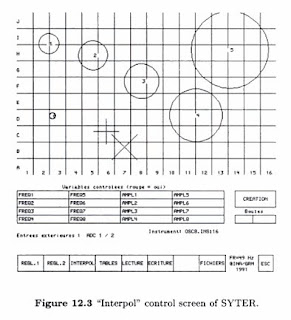
Concrete music and the use of electroacoustic studios had stabilised and modelled a certain number of sound-related operations on the basis of perception-based concepts. For example, an extremely powerful analogue studio process, "micro-editing", involved cutting minute fragments of sound from magnetic tape (using scissors!), which were then stuck end to end to create a new continuity. This principle was very successfully applied by the deferred time software and by Syter, making it possible to reorganise the material into new coherent sequences. This became known as "brewing". But brewing is not the end of the story, because the difficulty lies in controlling the way the brew comes together. Graphical interfaces, which these days are at the very heart of all computer technology, but which at the time were practically unheard of, were used to visualise the sound and the control parameters, and there was even an interpolation screen for exploring the intermediary terrain between two processing states.
Syter was a hit with musicians, both for studio work and instrumental work. In the studio, it could be easily built into the existing environment and breathed new life into the palette of processing possibilities. The system was essentially used for the processing of sound, meaning that the composer would record sounds and then modify them using the processing tools that were already built in, or by creating his own tools. In so doing, he would be faithful to the GRM tradition of processed sound, even though many hybrid processing techniques (between recorded sounds and synthesised sounds) provided entirely new kinds of sound. This material would then become (whether or not mixed with other sounds from other sources) the basis on which the composer would build his work.
Furthermore, at the time there was a unique relationship between composers and technical designers, who thanks to the modular programming techniques and their user-friendliness, could quickly build the tools necessary for creative work. A number of models that were later to become GRM Tools were a result ot this experimental relationship (in particular Doppler and Pitch Accum]. Once they had been built up, these algorithms were simple to implement, and integrated the whole palette of processing tools available in the system (around 40 different algorithms were designed and 15O variants of these basic algorithms).

An approach founded in pedagogy

The philosophy of the GRM has always been that the creator should work independently on his own process of composition, without the assistance of anybody else. Most composers had the training necessary to handle the techniques, to understand and work the analogue studio, and only in very rare cases were they assisted by the technician-musician. There was such a great interest in the deterred time software or the Syter system, and it was aimed at musicians of such varied backgrounds, that a training programme had to be set up in order to help them come to grips with the different systems. Man of these composers who came from an electroacoustic background, and many others were not familiar with studio techniques but who wished to become acquainted with them and develop projects bringing together instrumental and electroacoustic techniques. There were many other professionals from other fields: artists, radio and sound technicians, teachers or musicologists.
Week-long courses with small groups of trainees began to be organised 2 or 3 times a year, involving generally 6 to 8 participants (a total of 20 courses between 1985 and 1993]. During these courses, the system was explained and the participants had the chance to experiment and play with sounds. The objectives of these courses were manifold: the first was to provide composers with the training necessary for them to be autonomous in their work and to enable them to develop a project.
Another objective was to test the system with users. Because it was such an innovative system, using original approaches with regard to algorithms and interfaces, it had to demonstrate that it was up to the task and that the composers could use it easily and efficiently. Around 120 people followed these courses, and 80 works were composed, sometimes several of which were written by the same composer.

From pedagogy to production and concert presentation

Many of the composers were attracted by the possibilities offered in terms of the real time processing of acoustic sounds, and embarked on projects that brought together live instrumentalists, real time processing and recorded sounds. Others used the system in the studio, for acousmatic works, either to complement other existing studio technologies and tools, or sometimes as the sole production tool.
I was personally involved in this pedagogical and production aspect of the Syter system for some ten years. When it was first presented in-house in 1984, everybody underlined the technical prowess it had been to develop a system of that kind, but there was little enthusiasm on the part of the GRM composers, in light of the small number of existing algorithms and the fact that there were no instructions for use. I was fascinated by this approach and I proposed to Jean-François Allouis that I would help him in his project, in particular by explaining to composers how the system worked and by writing up a manual. We then organised the first training sessions in August 1985 and August 1986, and thereafter I took charge of the courses and production associated with the system and the development of variants of the instruments, in response to requests made by composers. I was therefore able to meet everybody who participated in the courses and I followed everything that was produced using Syter. I also played a great many works that involved Syter for the real time processing of instrumental sound Ia task that we became particularly involved in with Richard Bulski, the system technician, especially for moving it and setting it up for concerts).
I was able to gain an extensive and in-depth knowledge of how the system functioned, so much so that I was able to write my PhD dissertation on Syter (The Syter system, its history, development, musical production and implication in contemporary electroacoustic language, presented in December 1998 at the University of Paris VIII). I composed ten pieces on the system, some of which were with instruments, using the system only to produce electroacoustic sound, and others which were acousmatic, where a great deal of the sound creation work was done on Syter from start to finish. I began to move away from the system in around 1993, when it was beginning to become obsolete and when the first versions of GRM Tools were becoming available on Macintosh, designed and built by Hugues Vinet, who took much of his inspiration from the algorithms of Syter. I also realised, in 1993, that my life had been too wrapped up in the system, when a composer asked me seriously whether Syter was an acronym for System Teruggi!

inagrm.com/grmtools

[Prev | 1 | 2 ]

Monday, May 13, 2013

An interview with Mel Wesson

by Matteo Milani - U.S.O. Project, 2013

Mel Wesson received a multi platinum award for his contributions to The Verve's 'Urban Hymns' album and the anthemic single 'Bitter Sweet Symphony'. It was this album Hans Zimmer was listening to in the New Year of 2000 when he spotted Mel's credit and invited him to work on the score for Mission Impossible 2.
Since that time Mel has created his own niche within the movie score genre as 'Ambient Music Designer'. This area of atmospheric sound has weaved its way through many of Hans' scores including Ridley Scott's 'Hannibal' and 'Black Hawk Down', Christopher Nolan's 'Batman' trilogy and most recently Ron Howard's 'Rush', amongst the others.

[photo courtesy of Mel Wesson]

Matteo Milani: Mel, how you got involved in working on motion pictures?

Mel Wesson: Aside from a few piano lessons as a child I had no real formal music training, I learnt most about my approach to music at Art College...  I learn't about keeping an open mind, freedom of expression, things that have stayed with me all my life. I spent my  youth playing with bands, touring and recording. I started getting offers of session work, one thing led to another... I'd known Hans Zimmer since my late teens and he got me involved in a few projects with his mentor Stanley Myers, as well as some of his own early musical projects. Hans and I drifted apart for a few years when he moved to LA and I got more involved in working with recording artists but eventually Hans called out of the blue and asked me to get involved in the score of 'Mission Impossible 2'. That was the start of a new chapter for me.


MM: Would you like to describe your collaboration between composers James Newton Howard and Hans Zimmer?

MW: They're both very different, Hans prefers everything to be in a constant state of flux, whereas James has a more structured approach. I seem to have an approach that works with them both, I'm pretty flexible but I do like make progress through a picture so often I'll leap ahead of wherever  they are in the in movie and  then feed ideas back at them. James often likes to arrive at a cue and find something in place, it might be a soundscape consisting of many cues, or perhaps a rhythmic idea, maybe even a map. Hans tends to assimilate my ideas in his own way, a lot of time things come together at the mix as opposed to the more traditional point of composition, that works for him as he never considers a cue finished until it's in the theatre!


MM: Please explain your role as 'Ambient Music Designer' when working with the composer and other members of the sound editorial.

MW: Well, I really should know the answer to that one but I'm still working on it! The AMD role came about through a few conversations with Hans on 'Hannibal'. People read things into that title, but it's really just a phrase we cooked up to give me a credit on that movie and it stuck! The important thing is I just didn't want to go down the orchestral route (despite what people may think I DO write conventional music occasionally! ) and Hans gave me the opportunity to experiment with sound in a way that crosses the boundaries of music and sound design. A lot of my work is to do with atmospheres, creating a presence, emotions, sometimes through rhythm too. I create bespoke sounds but that's only a part of what I do. I use those sounds to work with picture, that's the real challenge here. The word 'Ambient' can cover a lot of ground in the same way the word 'Orchestral' covers an amount of options... Back to the question, occasionally a composer will have something specific in mind, but a lot of the time I'm left to my own devices and we see what occurs... I enjoy the freedom, it would be rather pointless for everybody if I didn't play  a creative role.


MM: How do you deal with the everlasting collision between sound effect and music?

MW: It's all noise... some noises work together, some don't. I try not to distinguish too much between violins and helicopters, everything has it's place... On Ron Howard's 'Rush' for example there's the most amazing sounding race cars... they're the sound of the movie, the heart and soul the story, yet they'll carve through any music... which is fine by me, I'd far sooner listen to them then an orchestra! Most recently I've been playing with the band 'Node', with producers Flood and Ed Buller, plus electronic artist Dave Bessell. What we do is all about sound, it's all live too, no overdubs, no mix process. The music we're creating crosses a lot of boundaries, there really is no conflict between sound and music in that environment and no one would draw a line between what we do and music. For me it's the ideal band to play with, I'm very excited about our album. 

[photo courtesy of Mel Wesson]

MM: The sounds you've done for 'Inception: the App' are these totally synthesised or is there any usage of reprocessed actual sounds?

MW:
Nearly all of my work on Inception, the score and therefore the App was based of reprocessed sounds, mostly from one sample session, but you'd struggle to recognise the source of the sounds in about 90% of the case. It was a session of natural instruments resonating through a piano soundboard, so we had an amazing amount of harmonics to work with plus the room itself. Then I took my ideas back to Air Lyndhurst and replayed them into the hall and re-recorded them again... we got some amazing material of out that session. There was some live recording in the app too.... like rain on my studio window that became part of the environment. There's been a Dark Knight App since that one too, the same team, but based more around a more interactive way of playing with the score in the real world.


MM: For 'Inception: the Soundscape', you’re credited as composer. It’s your first art installation work. Do you have any additional anecdotes to share?

MW:
That was played on the walk between Grauman's Chinese Theatre in Hollywood, (the US Inception Premiere) and the after show venue where we played a live concert. It was a walkway constructed a few hundred metres long and a really interesting project. I used a lot of ambience from the film, plus some sounds I got from sound designer Richard King, things like the train coming down the centre of the road, waves on the beach etc. It was a lot of fun, I'd love to do more... but really more long term exhibition based... and yes, I'm open to offers! Venice Biennale anyone?


MM: Tell us about the software and hardware production tools in your arsenal...

MW: My studio's based around Logic Pro, for now at least.... I love working in Logic but it's way overdue an update so I'm looking at alternatives. So... within the computer world I have a few favourite toys, MetaSynth has served me well in the past, Reaktor is probably still my favourite plugin, it's just so forward thinking, flexible, origional and most importantly it sounds good... that's  everything you want from a plugin. I use a lot of sounds manipulation devices, things from Izotope, Audio Damage, etc. I like the Waldorf plugins too, the Wave 3 is very good, but the most exciting thing I've seen in a long time is the PPG Wave Generator, it's an iPad app, again it's sounds great and it's innovative. I sometimes process sounds through my modular or the Synthi but I don't use a lot of outboard FX, although I've started using a Kemper Profiling Amp. Obviously that's designed with guitars in mind but there's no rules. I use a lot of vintage synths too, partly because nothing sounds as good and partly because the interface makes you think differently. I'm fortunate to have a large analog modular system that's part Moog 3C, part PPG300, other 'Go to' synths include a  Synthi A, PPG Wave 2. It's not just about the sound though, it's how these devices make you think. I just bought a guitar too, I don't really play, but again I come up with things I'd never think of on a keyboard or computer. 

[photo courtesy of Mel Wesson]


MM: What are your preferred titles you worked on and what kind of sounds you designed?

MW: Well all my sounds are organised within folders so there's the 'BatFlaps', for Batman Trilogy,  there was 'Rage' for the Joker, 'Ice Brass' for Inception. 'Gotham Metal', "BanePane'... it's a long list.  Of course we had  'MetaPiggies' on Hannibal!


MM: Can you reveal us a 'making of' of a very special sound effect(s) or a sound sequence
for 'Green Lantern'?

MW: Ah Green Lantern... we had a vast library of sounds, unusually for me all of my work was created with synthesisers,  We had there's the Green Energy sounds for the good guys and the sound of Yellow Light which was the sound of fear... We did record the extraordinary voice of Grant Gershon and I processed his voice to create various sounds and textures. We had so much fun on that movie, although it was pretty much universally slated which was a shame as the team was great as was the experience. 


MM: How do you deliver your sound elements to the mixing stage?

MW: I master everything in quad, but really all I do is give options, the real work in surround takes place on the dubstage. They have far more to deal with in terms of effects and dialog beyond the music and that team are experts in bringing it all together. My work is all part of the score, it's a common misunderstanding that I deliver stand alone sounds but for me the sounds are only a part of the process. Once I have my pallette I start to use those sounds to compose with, so the work is delivered as mixes and stems, the same as any other cue would be. That said Chris Nolan is very keen to have my material as wide as possible as what we called 'Melements', he likes to swap things around on the dub and experiment. For me it's always an exciting time and I love the way the process is constantly evolving.


MM: What projects are you currently working on?

MW: Well.... I'm a rarity in this industry in that I actively dislike have more than one project ongoing  at the same time... in an ideal world at least!  This year got off to a crazy start. I've been working a couple of old friends, Trevor Morris on 'Olympus Has Fallen' and Ramin Djwadi on 'Pacific Rim', these have been more electronic arrangements and ideas as opposed to ambient work. I've also worked on 'The Secret Life of Walter Mitty' with Teddy Shapiro, plus a few bits for Henry Jackman on 'Captain Phillips' and Chris Bacon's score for 'Bates Motel'. The important thing is at times like that everybody respects everyone else's projects and space... it's not like I have a team around me, I can't and won't delegate which makes things diffiicult at times. A nice Margaux helps though...

[melwesson.com]
[Mel Wesson - IMDb]

Monday, August 27, 2012

An interview with Hamilton Sterling

by Matteo Milani - U.S.O. Project, 2012 

I am happy to continue our series of interviews with Hamilton Sterling - sound designer, supervising sound editor, effects editor, and mixer who has worked on The Dark Knight, War of the Worlds, and Master and Commander: The Far Side of the World, as well as many independent films. He recently cut sound effects on MIB3 and The Host, and worked on Terrence Malick’s To the Wonder, and The Tree of Life. Hamilton was the supervising sound editor, sound designer, and re-recording mixer on Tomorrow You’re Gone by David Jacobson, and has edited sound on the films of P.T. Anderson, Christopher Guest, Andrew Dominick, and Steven Spielberg. To date he has worked on over seventy-nine feature films. 


Recording a Demolition Derby (photo: Michael Dressel)


Matteo Milani: Thanks for your time Hamilton! First of all, could you tell me a bit about your education and musical background?

Hamilton Sterling: I come from a musical family. My mother and aunt sang four, five, and six part harmony by ear. They performed as the Silhouettes on KDKA radio in Pittsburgh, Pennsylvania in the 1930’s. Both were very encouraging of my early musical interests. My aunt, who worked at the local newspaper, often brought home fascinating music: György Ligeti, George Crumb, music from all over the world. I heard the soundtrack to Fellini Satyricon before I ever saw the film. My mother was a jazz fan, and when I was a boy, would take me to listen to local groups. 

In high school I played electric bass in the jazz band and upright bass in orchestra. The musician’s union put together an all-star big band for high school students in which I played, and I also performed in the Allstate Orchestra, becoming principal bassist my senior year. I played my first jazz gig when I was sixteen years old, and entered Arizona State University on a four-year music scholarship, graduating with a BA in jazz and classical performance. 

From a social context, I also benefited from the cold war belief that the arts held importance, and that America had to out-compete the former Soviet Union in creative endeavors. Music education in elementary school and high school was excellent and generously funded. Unfortunately, for the arts and young artists, those days are gone. 


MM: Does your experience as a musician help you in your career in film sound? 

HS: I think a sense of rhythm, melody, and harmony is essential in being able to make interesting sound for film. Recent studies show that human beings are wired for music. In studing jazz, the adage of “learn the music theory, then forget it” allows the right brain freedom to improvise from knowledge. I’ve come to feel that cutting and layering sounds is a slow-motion version of improvisation. 


MM: How did you enter the movie industry? 

HS: Alongside my musical activity, I became obsessed with films. Stanley Kubrick’s 2001: A Space Odyssey became the impulse for much of my early creative life. I saw the film for the first time when I was ten years old. It brought to me an interest in modern classical music, archeology, cosmology, astronomy, AI, cinematography, and special effects. It also appealed to my budding existentialism. That any one object of art could do so much was, to a young mind, amazing. 

It may seem hard to believe, but public television at that time played films by Antonioni, Godard, Fellini, Losey, and Bergman, and the art house cinemas were still going strong. I began making short films in the summer vacations between school from the money I made playing music. When I came to Los Angeles in the early 1980s, sound seemed a natural fit. I began by editing documentaries, Warren Miller ski films, industrial films, until I got my first sound effects editing work on Alan Rudolph’s Trouble in Mind. 


MM: Choosing the right sound(s) to picture. An art form? 

HS: Because sound editing began as a technical blue-collar job, many people had the impression that what we did was nothing special – “A monkey could do it” was the often-heard refrain. Here in America, we never developed a militant artistic union, an aesthetic of labor, if you like. Of course, because many of the corporate films being made today are empty of artistic merit, to say nothing of merited thought, it’s no wonder that art and labor are still dirty words. Choosing the right sound is an artistic, and surprising moral endevour. Thinking back on choosing sounds for films I did twenty-five years ago, if you had a scene in a rough cityscape, one might choose a black voice yelling in the street. The effect of that implying threat (at least to a certain part of the population). And that is a choice that can subtly further social injustice. I’m not saying that an artist should proscribe their work, but one has to very conscious of one’s choices, because in mass entertainments, those choices may reach millions of people, and they have consequences. 


MM: You've frequently shared your nominations with Richard King, Christopher Flick and Michael W. Mitchell. How do you guys collaborate on projects? 

HS: When I worked for Richard King, I did sound design and sound effects editing. Occasionally, I did sound effects recording. The frog rain in Magnolia was re-recorded against the reflections of a cliff in the Angeles National Forest. We set up two speakers facing away from the microphones, and slowly rotated the speakers toward mic, giving the playback the effect of distant frogs falling toward us. Eric Potter and I also put a speaker in a pickup truck to record a playback of previously sampled frog elements. Eric put the truck in neutral and steered into the quiet, distant valley. The sound was incredibly bizarre, and I ruined the heads and tails of multiple takes by laughing. It’s always fun to get out into the world to record, and Richard loves to record. 

Chris Flick did all the programming and cutting of the foley, and we conferred with him on elements that effects needed help with. As to the sound effects editing, Michael Mitchell and I did a lot of heavy lifting. Richard cuts sound effects as well, and in this day and age, I admire him for it. 


MM: Would you like to explain your role when working with the other members of the sound editorial?  

HS: When I’m not supervising, I try to communicate very specifically with the supervisor and my fellow editors: what are the stage delivery requirements, the predub breakdowns, or whether there will even be predubs, who is doing what in terms of special design. Hopefully, the supervisor has been able to spot the film with the director. If there is little in the way of specific information, I get a sense of the aesthetics of the director from what’s on the screen. If what you see is a pack of cliches, you know what to expect. If there are few cliches, you have reason for hope. At the end of the day, your work is only as good as the director’s vision, and their courage to take risks. 


On the Cary Grant stage at Sony on Morning (photo: Leland Orser)


MM: What are the musical tools you use to boost your sound designing workflow? 

HS: A number of years ago I purchased a Kyma sound design system from Symbolic Sound. It is very useful in producing unique sounds. It’s always inspiring. I also use my old Kurzweil K2000 as a midi controller, a Haken Continumm fingerboard, and a PC2R. In studio I use Millennia mic preamps. For field recording I use Schoeps mics and Sound Devices mixers as well as different contact, ribbon, and dynamic mics to gather my sounds. My bass is fitted with a midi pickup that I also use through an Axon to trigger my samples. 


MM: Sound processing: can you give us a description of your studio gear? 

HS: I use Pro Tools HD3, Genelec 5.1 speakers with a MultiMax monitor, and many plug-ins. For picture I project HD through a Decklink card to a nine-foot screen. Aside from Kyma, Haken Continuum Fingerboard, Kurzweil, and Axon, I have on occasion used Beat Detective in Pro Tools to place rhythmic structure onto multiple effects, and Melodyne to re-engineer animal vocals. I just started using Battery as a sampler. Altiverb, Pitch ‘N Time, Lowender, and GRM tools are staples. 


MM: Can you reveal to us a "making of" of a very special sound effect(s) or a sound sequence? 

HS: I’m very proud of the storm sequence in Master and Commander: The Far Side of the World. Making the scene dynamic given the similarity of frequencies both in the water and the wind was an interesting problem. First I began by cataloguing the ocean sounds into frequency ranges from low to high. I catalogued the wind in a similar way. At the time, Warner Bros. had terrible editorial rooms that had not been updated since the 1950s. Not only was there no surround system, but there was no wall treatment of any kind. Anyone who has had to edit endless water and ocean effects knows that in a box-like room with hard surfaces, audio hallucinations in the white noise of the waves can produce boat engines that aren’t there and other weird effects. So I brought sound blankets from home and hammered them into the walls. I scavenged an extra pair of speakers from an adjoining room and built myself a primitive surround system. I cut the sequence in 5.1 tracks that would mirror the mixing console and internally panned and level-set everything. Because the water visual effects were actual layered shots of waves, they changed constantly. But the first time I cut the sequence, I really liked the rhythms I had found. As the sequence changed, I was determined to keep this poetic kind of rhythm, so instead of just cutting up the tracks in conforming them, I took the time to find new rhythms and create the sequence anew each time it changed. I was very tough minded in this approach. Fortunately, I was given the time to do this – something that is unique to this day. I then cut the hard effects in the same 5.1 style and processed the siren’s call of the wind in the rigging through Kyma. When the edit went to the stage in this form, the mixers worked on it for a couple of days, trying to tame it. Much to their kindness, they told me they decided to put it all back the way I had originally laid it out because it had a life to it that their smoothing of the rough edges took away. That’s the way the sequence was released. 


MM: What do you regard as your most important credits in your career thus far? 

HS: The Tree of Life and The Assassination of Jesse James by the Coward Robert Ford are my two favorite films. They’re closest to the feelings I felt as a young man introduced to the great European cinema: thoughtful, unsentimental, mysterious. They capture something of eternity. 


MM: How do you get involved with the movie “The Tree of Life”? What kind of approach did you take on foley? 

HS: I have known the sound supervisor, Craig Berkey, for many years. Erik Adahl had hired me on Transformers: Revenge of the Fallen, and mentioned me to Craig. We fell back together again, which is the way of the film business. Andy Malcolm of Footsteps Studios walked the foley. Realism and proper perspective (using multiple mics) is very important. Because Mr. Malick often uses non-synchronous production takes, foley is used to ground the characters within the scene. It becomes another part of his pallet. When it is absent, that too becomes a color. 


MM: Can you describe how some of those sounds were accomplished? 

HS: Andy originally used his house as a foley studio. It’s out in the middle of the Canadian wilderness – forty-five minutes from Toronto. The stairs really creak, he never sweeps his kitchen. It’s all real. (Just kidding about the kitchen.) Now he has a fabulous studio a stone’s throw from his house, so you get the best of both. 


MM: How was the communication with the director and the rest of the team? 

HS: I was only on stage for a few hours during our first temp mix. But I was struck by Mr. Malick’s graciousness. I truely admire his work, and have since I first saw Days of Heaven as a youth. 


MM: To mix "in the box" in sound editorial before the final dub: what are its pros and cons? 

HS: Unfortunately, schedules now seem to only allow the sound effects to be mixed in-the-box. Even on the most well-financed films, mixing in-the-box is now common. On Knight and Day (James Mangold), we pre-mixed all of the sound effects and ambiences into 5.1 groups and kept them virtual. We had a couple of weeks to adjust these pre-mixes on the mixing stage, as the console on the Cary Grant stage at Sony could mirror Pro Tools. But the number of tracks and the constant changes necessitated having to continually re-mix added elements in-the-box. I recently did some work on MIB3, and at least for the temp mix, the effects were pre-mixed in-the-box, then taken to the stage for final adjustment. Keeping a somewhat traditional separation of elements is helpful for conforming, as well as giving the sound effects mixer creative input. If you set your editing room up correctly, it can work out quite well. Of course, sound editors are not being paid as mixers, so there are ways in which this situation is financially disadvantageous. But it is creatively rewarding. For independent films, the future is here. With the track counts of the new Pro Tools HDX cards, traditionnal mixing facilities will have an increasingly difficult time staying afloat. Unfortunately, many fine mixers will as well. 


MM: A networked environment: can you describe the importance of a client/server architecture in sound post production for a feature film? 

HS: It’s great to have. On Knight and Day we were editing at another facility before we moved to Sony for the mix. Sony has a nice server system for moving your work to and from colleagues as well as mixing stages. Structuring the folder architecture on the server is extremely important. Knowing exactly what elements have come from the mixing stage, what needs to be updated, what needs to be mixed, may seem simple, but with multiple versions, competing creative interests, and huge amounts of data, organization and terminology is paramount. 


MM: Sound effects editing for multichannel-surround: what are you spazialization techniques? 

HS: I edit for the 5.1 pre-mixes. When I do have to spread an effect, I’ll use a little delay, reverb, or the Waves PS22. I’ve recently begun using the Schoeps free DMS plug-in for three channel field recording that decodes to 5.0 surround. I love the Schoeps plug-in. Now I record all my sounds on three channels and decode to 5.0. Even simple sounds, like a light switch, pick up the character of the room. It’s a facinating way of creating a feeling, using these simple multi-channel sounds. If the simple sound creates an interesting space, I’ll work backward, and using Altiverb, try to get the rest of the sounds of the scene into that same environment. Of course if it doesn’t work, you still have the mono or MS stereo recording. 


MM: You made a film in the late ‘90s. Did you do your own sound? 

HS: I supervised it and cut, but I had a number of wonderful friends from the sound editing and mixing worlds who helped me to complete it. Because of current events, I decided to prepare a new version of the film, Faith of Our Fathers, for Blu-ray and DVD, and re-construct the sound for 5.1. As I began to re-assemble all the elements, I realized that we who started in the business in the mid-1980s lived through a radical transition in our work. At the time magnetic film was all there was. But by the time I shot Faith of Our Fathers in 1991, the digital world was just beginning. Faith was originally shot on 16mm film with a 1:1.85 ground glass for theatrical blow-up to 35mm. All the dailies were 16mm. I had obtained from a friend, one of the first Sony D10 Pro DAT recorders in the country. It was strictly grey-market. I thought I could mix and record the production sound to one channel and put a 60 cycle pilot tone on the other so that when transfering to magnetic stock (both 16mm and later 35mm) the transfer machine (“dubber” we called it) would stay in sync. So, over a long period of time, friends and I sunk and coded the 16mm dailies. I cut the picture, and when it was time to prepare the track for 35mm mixing in 1995, I used a 16mm to 35mm synchronizer to phase the new 35mm dialogue to the 16mm worktrack. The dialogue was cut on mag. The backgrounds were a combination of 24 track two-inch and DA-88s (the bane of all mixers at the time). And most of the sound effects were cut on an early version of Pro Tools which were then transfered to DA88. When I decided to do my 5.1 re-mix, I had 35mm mag to transfer to Pro Tools, DA88s (I still have one of those boat anchors which work!), and DATS with original production and music. When I think that the process involved 16mm mag, 35mm mag, Pro Tools, 24 Track, DAT, and DA88s, it becomes evident that the transition from analog to digital was quite messy. The other shocking thing is that I was able to finance my film on a sound editor’s salary (which is the reason it took so long to complete). 


MM: What are your thoughts on the boundaries between music and sound design?

HS: Having recently released Migration, I can tell you that creating a 5.1 programmatic musical soundscape is a wonderful artistic process. Combining a purely aural narrative with the abstraction of music and processed effects blurs the creative experience. I don’t mean just adding a sound effect to a music track, I mean creating the entire living thing as one artistic statement. There is a universe of possibility in the soundscape form, and because of my musical life, the addition of ambiences and effects to create emotion is a fullfillment of who I am. Other examples of soundscapes that I like can be found in the plays of Romeo Castellucci’s Socìetas Raffaello Sanzio and the Wooster Theater Group, both of which I find inspiring. As to the boundaries between music and sound design in film, I would say they have been nearly erased. I just completed the film Tomorrow You’re Gone, with Michelle Monaghan and Stephen Dorff. Kyma was used extensively in creating a very musical soundscape in which to set the traditional effects. 


Recording 5.1 ambience for Tomorrow You're Gone (photo: Cris Lombardi)


MM: About your album releases: do you think that detectable technical processes are an integral aspect of the composition’s overall aesthetic? Is it important in this composition that the listener is aware of the technical processes? 

HS: The album Rise and Fall is made mostly of live loop improvisations featuring fretless bass, acoustic bass guitar, and midi-following synths and effects. It grew out of musical feelings, a very simple midi-synth/live stereo mix chain, and the need to not multi-track, or manipulate the live performance. In that respect, technical qualities like midi delay, or tracking annomilies by the Axon pitch controller, were of secondary importance to the spontanious capture of the music. No meta statement should be implied from these technically primative recordings, other than they were all done with as little post-production as possible. As for Migration, the soundscape album I created with Grammy-winning musician Jimmy Haslip, that is a piece that was conceived and composed for surround. It’s feelings and scope are purposely cinematic. 


MM: What's the most important tip you've ever received regarding sound? 

HS: Often on big films, the amount of audio ideas brought to the process can be overwhelming. Sitting on the mixing stage listening to Steven Spielberg, Michael Kahn, and John Williams discuss how best to tell the story of a scene on War of the Worlds, I was struck by their equanimity toward music and sound effects. For them, it is all about story. Their years together have created a language around this idea. What tells the story in a particular moment, and what elements do you have available to do that? An agreement on what the story is allowed them to know what to emphasize on the track. Other filmmakers see story differently, or dissect story as myth and power, and therefore take a very different approach. I love the sound of Jean-Luc Godard’s films because it is a featured element in the argument. Film Socialisme begins with a line-up tone that moves from speaker to speaker around a 5.1 mix. It introduces his dialectic between sound and picture within the contemporary structure of multi-track films. It’s brilliant and very funny. 


MM: What is the most important topic you would want to talk about to make post sound better? 

HS: Forcing USA corporations, either by massive tax penalties or heavy import tariffs, to hire the workers in their own country. Too many of our sound jobs are being outsourced. Germany has good unions, pays its workers well, and has an export rate second to none. The old saw that in-country labor produces products that can’t compete is obviously not true: Germany has a 7% trade surplus. The sad truth is that USA corporate profit is at an all time high, CEO salaries are at an all time high, and too many people are unemployed. Corporate contempt for basic decency is the primary problem at this moment in history. It will eventually change, one way or another. 


MM: Do you have any advice for anyone who is interested in a career in the sound dept? 

HS: With the technology of audio, music, and picture in an ever-increasing cascade toward the infinitely complex, having the time to learn the programs, plug-ins, hardware, softward, picture formats, and optimal work-flow process, is itself becomming a full-time job. Having the mental space to discover why you want to do it, and what doing it even means, to you and to society, is something that young people should consider. This work used to be the wild west. Most of it, for the time being, now sits inside the corporate world. That is not a world that should be perpetuated. So then it becomes about making art, with no potentially viable means of making a living. Last quarter Migration streamed 2500 times and made 3 cents. So is this a risk you are willing to take? Do you see the world differently, and have something to say about it? If so – and now I’ll paraphrase Stanley Kubrick’s advice to young filmmakers – “Get a camera, as soon as you can, and start making films.”... or music, or soundscapes, or installation art. If you are meant to work on a handful of great films in your career, somehow, with luck, you will make it happen. 


MM: Silence is mentioned a lot when discussing sound. What was your approach in its usage? 

HS: As John Cage pointed out, silence is never truly silent. But one must be silent in order to listen. 


Friday, March 09, 2012

GRM pt.2: the birth of a concept

Daniel Teruggi wrote an interesting article about the Syter system at INA - GRM in the booklet for Archives GRM (CD 4). This whole CD is comprised of works created through Syter.

"To mark and celebrate the thirty years of the INA (Institut National de l'Audiovisuel), the GRM (Groupe des Recheches Musicales) has chosen to bring together an exceptional set of five compact discs, illustrating some of its most remarkable musical archives. These original works, which are often previously unpublished or have been dispersed throughout a host of other publications, are important because of the originality and audacity they testify to in the second half of the 20° century. Some listeners will be pleased to see that there are a number of illustrious composers here who, in the 1950s, frequented the studio of Pierre Schaeffer, and others will discover numerous musicians whose enthusiasm enabled this innovative musical genre to last throughout the following decades."
Emmanuel Hoog, président directeur générale de l'Ina

Daniel Teruggi - The time of real time

From the very beginning, music, whether vocal or instrumental, improvised or written, and up until the invention ol recording processes, was listened to at the precise moment it was produced. The twentieth century changed all that, First of all with the appearance of recording media, which made it possible to listen to sound in a place and at a time other than those at which it was originally produced; then by the widespread use of electricity, which made it possible to invent new instruments and new ways of imagining and making music. Concrete music, electronic music, electroacoustic music, acousmatic music or contemporary electronic musics are all testimony to the same ambition: using electrical, electronic and computer-based technologies to invent the sounds of music. The invention of sounds is the invention of new forms of music, of new ways of looking at music, and is the logical consequence of the new opportunities that technology continues to provide us with. Musicians began to use computer systems a long time ago (1958) in order to synthesise sounds and to develop computer programmes that would enable them to combine sounds into musical works. Progressively it became possible to record these sounds, to process them or to hybridise them with synthetic sounds.
Musical computer technology did not develop fast and was dependent on the way processors and data storage systems evolved; in 1958, a large computer in a research centre was necessary in order to produce a simple synthesised melody, which it was not even possible to record in the memory. These initial technical difficulties brought about the appearance of two concepts which could be described in a historical perspective, but which are often presented as if the were antagonistic: deferred time and real time. Deferred time described the way that the first computer systems were unable to produce an instantaneous result.
Between the moment at which the intention was expressed and the moment when its result become an audible phenomenon, there was always a certain lapse of time.
The user programmed a sound using software, defining its various parameters and timbre, and then the computer calculated the sound and, depending on the complexity of the calculation, produced the result ofter a given interval. The listening time was deferred with respect to intention time.
It was logical that the next technological objective was real time, a concept that describes the possibility of hearing a sound at precisely the some time as the intention to make it is expressed.
Moving over to real time required changes to the command tools. Deferred time was the result of a programming system whereby the user defined, using written language, the result he wished to obtain; moving over to real time made it possible to define the intentions instantaneously and to modify the result as it was being listened to.
Now, most sound production and generation systems work in real time, enabling the user, thanks to various interaction tools (keyboards, mice, screens) to control and modify the sounds created and heard. Nevertheless, in the field of musical creation, and for a relatively long time, this technological evolution was opposed on methodological grounds. Real time obliges the operator to act and react, depending on the result, in a way that is similar to that of the instrumentalist. For many composers, deferred time, because it separated the moment of conception from the moment of listening, created a distance that was necessary for reflection, a situation that is similar to instrumental composition, between the writing of a piece on paper, and its being played.

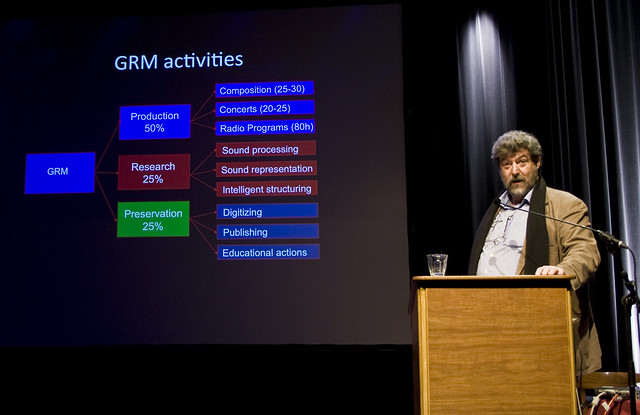
[Daniel Teruggi @ Sonic Acts 2010 - courtesy Rosa Menkman]

  
Deferred time and real time in the GRM

At the beginning of the 1970s, the Groupe de Recherches Musicales began to experiment using computer technologies. At the time, the Group already had 20 years of experience, a major repertoire of musical works, a tradition for profound reflection on music and perception as well as innovative technological research. Little by little, therefore, work was undertaken to look at the possibilities that this new domain, which was already strong in the United States, could offer in France, where it was comparatively little known. Two projects were to follow one another, and then coexist, between 1975 and 1993: the first, from 1975 to 1987, concerned the development of deferred time sound processing tools, the "Studio 123 software programmes", developments that are dealt with in CD 3 of the GRM Archives set. The second project, the Syter system was a major technological development for musical computer programming, so original that its impact can still be felt in the development of processing tools today.
These two projects were vitally important in opening electroacoustic music up to composers from the instrumental world. The main successes of these two projects were to bring electroacoustic music out of the studio, making computer technology accessible, without needing programming skills, and making processing reliable and reproducible. The range of things it was possible to do to sound was considerably widened, using original and unheard of sound processing techniques. These two projects were a unique period for the GRM, the studios opened up to welcome composers with other ideas, concepts and points of view, the dialogue was rich and fruitful, and the understanding and analysis of the music being written there were enhanced.

The Syter project 

With the advent of computer technology, the first idea was to imagine a parametric control of machines using digital tools. For example, synthesisers, while remaining analogue in the way that the sound is generated, could be controlled by digital systems that would provide o greater precision in terms of frequency that traditional rotary buttons. It was thus that the first Syter was born, an acronym for: Synthése en temps réel (real time synthesis), and the objective of which was to build up a digital synthesis system based on a set of oscillators, controlled in real time by specialised gesture-based access or by external signals.
The first prototype that was built was relatively simple, since its only function was to control, in real time, the movements of a sound source between a number of loudspeakers. This prototype, with its delicate control system and laborious programming, was used in concert on 16 March 1977 for the creation of Cristal by Francois Bayle.
The designer of this tool and of its following versions was Jean-François Allouis, an engineer who arrived at the GRM in 1974, and who was fascinated by the potential of computer technology as applied to sound and music, and who had an uncanny inventiveness when it came to finding solutions to new problems and designing original systems. For this first concert, the acronym Syter become: Systéme temps réel (real time system), and was the starting point for a whole 5-year period of development during which Jean-François Allouis contributed to the setting up of the first GRM computer, oversaw the implementation of the deferred time processing system, built the Syter real-time sound processor and the input and output converters, developed programming software for the processor, built one of the first interactive real-time parameter control systems and programmed the first processing tools. In conjunction with computer scientist Jean-Yves Bernier and computer technician Richard Bulski, he needed to build and rebuild the system several times before the first full system was complete, in 1984. The system underwent very few modifications and additions, subsequent to that. Eight systems were built and sold, up until 1988. The software continued to evolve up until 1989, in particular thanks to the impetus of Hugues Vinet, who designed a digital mixing tool, providing the system with all the functions of a Studio. Two systems were in operation at the GRM until 1995, and around 100 works were composed in part or in whole using the system.

Related Posts: 

Friday, June 24, 2011

An interview with Gary Rydstrom

by Matteo Milani and Federico Placidi - U.S.O. Project, 2011 


Gary Rydstrom was born in 1959 in Chicago, IL. He graduated from the University of Southern California - School of Cinematic Arts in 1981. He began his career at Sprocket Systems, formerly Skywalker Sound, in 1983. Offered the job by a college professor, Gary received the opportunity to work with his mentor, Star Wars sound designer Ben Burtt. He created sound for numerous successful films including Backdraft, Terminator 2: Judgment Day, Jurassic Park, Titanic, Saving Private Ryan, Minority Report and Finding Nemo. Through this work he has won 7 Academy Awards.
Rydstrom did his first work for Pixar on the short film Luxo Jr.. John Lasseter has said it was Rydstrom's work on Luxo Jr., such as creating the lamp's voice from the squeak of a lightbulb being screwed in, that taught him how sound can be a partner in the storytelling of a film. In 2006 he has made his directorial debut with the Pixar animated short Lifted. He recently jumped again into the director's chair to create his second animated short Hawaiian Vacation, set to play in front of Cars 2. 


[Rydstrom talks about the first of Pixar's new brand of Toy Story shorts @ AWN] 

For every director and for all of us the goal is at any one moment in a movie to have the audience on the edge of their feet and can't wait to see what happens next. You are moved by these characters, you believe in these characters. All the meticulous and hard work should be completely invisible. We wanted to be involved in the scene and we don’t you to think that Nemo is a bunch of computer layout. We do not want you to think the many hours that took to create that scene. You are just carried away by the scene and every focus in every step of the production that we do at Pixar is about the story. It is about entertaining the audience. - John Lasseter, 66th Venice Film Festival 


USO: Gary, you’re the third person – of our personal “respect-list” – who came from a sound career and crossed over to a director’s chair: Walter Murch did it first, Ben Burtt came after him. They still design their own sound for their works, just as you did for your first short movie Lifted (with a tribute like the Wilhelm Scream at the very end). How did you manage the transition from sound designer/re-recording mixer to director? How about your feelings?

Gary Rydstrom: Working in film sound is a great way to immerse yourself in the rhythms of a movie. Having done sound for so many movies, and so many different kinds of movies, I’m hoping I’ve developed some mysterious “film instinct.” I think the best directors – and best sound designers – work more from their gut than their brain. In other words, to make movies, your gut has to be bigger than your brain… or maybe I should rephrase that?


GR: "It was a little scary but I always wanted to make films and wanted to have opportunities to write and tell stories. So Pixar being old friends, they gave me this opportunity to come over there and do that. So it was a little scary because there were a lot of things I had to learn. But doing sound for so many years, what I found was that the big similarity is that sound is all about rhythm. It’s about using sound, rhythm helps delineate sound effects, sound tracks, and telling a story with these kind of rhythms is really key. Animation is really about rhythms and timing so I think working in sound gave me a great sense of timing. In fact, on Lifted I used, before animation had been started, used a temp soundtrack to express the timing that I wanted to the animators so they had some reference of what I was after. It was a way for me to even communicate to the animators." - CanMag


[Lifted producer Katherine Sarafian and director Gary Rydstrom © AWN Inc]


USO: Did you develop and learn your new craft in sound room working movie by movie?


GR: Central to sound design is finding what feels right for a movie, what matches its look and heart. So every movie I worked on taught me different lessons. I kept thinking I was close to end of my lessons, but they never ended. Turns out that’s what makes working in film fun. It’s never the same twice. 


USO: Being close to first-class directors during all your sound career has thought you well?

GR: I felt like a spy, watching a lot of directors. I’ve been very lucky to have worked with many of the best – Spielberg, Cameron, Lasseter, Redford – and you probably don’t need me to tell you (their movies do) how different in approach they were. One thing the best have in common: they inspire their crews.


GR: "... I've had this long, great relationship with John Lasseter and Pixar. I've felt involved throughout the whole filmmaking process on their films. They offered me an opportunity to develop and direct films, maybe because I bring an outsider's perspective while still being a Pixar guy through and through.
My friends there know that I've had a long-standing love of comedy. When I first told Steven Spielberg and George Lucas that I was doing this, they were touchingly supportive and generous with advice. I'm grateful for my sound career. It gave me the equivalent of 50-yard-line seats, second row, during a fascinating era in film history." - Mix Magazine


USO: Can you describe what you were feeling when you left the Technical Building (where you spent almost 20 years), and all your friends at Lucas Skywalker Sound, to your new life/experience in Emeryville?

GR: Luckily I get back to Skywalker Sound quite often, otherwise I’d REALLY miss my old friends and career. Pixar’s no slouch, but there isn’t a more beautiful place to work than Skywalker Ranch. 


I've known Gary for over 20 years and he's really been a mentor and a role model for me, as to how to do this work. His standard for quality, inventiveness and humor is really always in the back of my mind when I work. No one is a quicker study when you break down a scene or a film in terms of what, soundwise, is the best direction to go to serve the story. - Tom Myers, Skywalker Sound 


USO: What does it mean for you to associate a particular sound to a visual event (identifying it in a vast catalogue as big as the sound library of SkySound)? What are the mental or purely instinctive paths competing in making the choice?

GR: Something magical happens when a sound effect is added to picture – and it’s not predictable. After all my years of doing it, I still depend on experimenting, putting sounds against image and seeing what happens. First time I did this, as a film student, it amazed me how sound could “open up” a movie, how the combination of sound and visual could create something greater than the sum parts. Having a great sound library is essential, but the real secret is how one uses it. 


GR: "I wanted to give the lamps in Luxo Jr. character through sound. I told John (Lasseter) that I'd come up with these voices. He'd never imagined they'd have voices and was wary of the idea. But I experimented with taking real sounds — a lot of it as simple as unscrewing a light bulb or scraping metal. Every once in a while, a sound would be produced that would remind you of sadness or glee. I always think of sound design being like prospecting for gold. Start by, say, goofing around, making lots of sounds, then find the one percent that has something interesting about it. Put this against the film, and there's a magical moment when the sound, if it's right, merges into the image, brings it to life. They were not cartoon-y. They were fun, reality-based sounds. It felt like the birth of something new, even then." - Mix Magazine


USO: Many sound artists working in other domains like electroacoustic music, musique concrete, environmental sounds has been strongly influenced by the contemporary cinema, and by its ability to create stories with the help of sound effects, soundscapes and even to define the personality of some "objects" with unmistakable sounds. How it is possible to interrelate these multiplicity of experience? 

GR: What all sound artists share is a desire to convey emotions, so I certainly was inspired by non-movie sound work. Sound is emotion. Not just music, but all sound. Humans (who can hear) seem to take sound in general for granted, which is frustrating, but liberating. How manipulative can we be when no one’s paying attention! 


USO: While Europe was experiencing electronics and sound design like natural language consequence of the avant-garde of 50's, in the U.S. this journey took place independently in the field of the film industry with other purposes and objectives. You were aware of what was happening in the old continent and its experiments?

GR: I’m certainly aware of the European traditional of producing “soundscapes” (for lack of a better word) for radio. In some ways, I was jealous of sound work that didn’t depend on the visual – how free it seemed! Best I could do was build an “off-screen” world in film. But I always had a movie to be influenced by – how scary to have sound work stand on its own. 


USO: You've been one of the most assiduous "regulars" of the Synclavier, an instrument widely used in various musical fields. Can you describe the creative approach with this tool? What were your procedures? What made it such as a instrument so unique? To create the sound of the engines of the Titanic you and Chris Boyes worked long on the Synclavier to reproduce the effect in question. Do you remember how you did it?

GR: I fell in love with the Synclavier early in my career because it was such a powerful instrument for shaping natural sounds. I never used the FM synthesis – even making electronic sound effects I would try to use natural sounds, just because I find real sounds are more interesting. Sampling sounds and putting them on a keyboard allowed me to quickly experiment with pitch and layering, which are my primary tools for bending real sounds to my will. The Titanic engine sounds took advantage of how the Synclavier could speed up and slow down a sound pattern. For me, nothing beats using a “musical” instrument for creating sound effects.


GR: "The idea of using a sampler for sound effects work had astonishing potential. With sampled sounds in RAM, you can instantly pitch-bend it and layer it and play it and shape it, without using any processing time. You can layer on the same key and very finely manipulate the pitch and delay and merge them together in ways that were harder to do in the tape-to-tape days. It allowed me to create the dinosaurs in Jurassic Park, in which I took several layers and blended different animal sounds into what sounds like one animal.
With the Synclavier, I have a library of sound “parts,” little snippets that are like phonemes in language. Interesting bits of sound that can be rearranged in multitudes of ways. It's a library of raw material, and it's valuable still." - Mix Magazine


USO: How about your relationship with Ben Burtt along your sound career and especially now in Pixar? I mean crosstalk and dialogue, to share ideas. Could you describe him as a mentor, a friend, a colleague, a druid?


GR: All of my approaches and philosophies about sound come from Ben Burtt. At the time he was revolutionizing sound design, I was lucky enough to get a job at Sprocket Systems and see how he did it, how much he knew about film sound history, and most importantly how much he cared about using sound to tell a story. When I started working on Jurassic Park, I remember Ben was away on vacation. I stumbled along until he came back – for all sorts of reasons, psychological and practical, I couldn’t get started until he was in the building.


[Gary Rydstrom Talks About Cinema Sound - via DolbyInsider]


USO: Nowadays many sound designers are working in nonlinear environments like Pro Tools, Nuendo with tons of plug-ins to make everything. One thing we always admired in your work is the exquisite and unfailing "organic" sound and his innate musicality. It seems that sounds "exist" in nature and are not a product of a skilled craftsman. Would you like to talk about that?

GR: There’s a danger in processing sound too much. I believe the best sound effects come from the best raw recordings, and are tweaked as little as possible. The world is so full of amazing sounds – sounds no synthesizer can match – so why not find them and use them?


GR: [...] I remember a scene in the first Mission Impossible in which Tom Cruise breaks into a computer room at the CIA, for which we’d added all these sound details for equipment he was using to lower himself in. Yet the idea was that if he made any sound over a certain level, he would trip the alarm. Brian De Palma ultimately said, “No, take it all out.” And for the most part, that scene plays with nothing on the track. I went to see it with an audience and it had the desired effect: It made everyone lean in, pay closer attention, get nervous. Tension comes from the silence of that scene.
[...] Silence can be thought of as a type of sound. It’s like when somebody years ago figured out that zero was a number. And silence is just as valid as an amazing sound. Every sound editor can’t help but think of how to fill up a track; it’s what we’re paid for. - excerpts from “From here on in, absolute silence.” [via Benjamin Wright]


Thanks Gary... keep up the good work! M&F

Tuesday, May 31, 2011

Ben Burtt on J.J. Abrams' Super 8!

Ben Burtt's latest film as Sound Designer, "Super 8" - written and directed by J.J. Abrams - opens June 10th.


J.J. Abrams: “Ben Burtt did the sound design, and he brought with him one day a copy of this Super 8 film that he made when he was a teenager, that was about a train wreck, a WW2 film, and it so was much like what happened in this movie, it was uncanny. I was jealous, wishing I had a train wreck to go to when I was a kid.”

[courtesy of Empire]
[expect an update to Burtt's IMDb page soon]
[Ben Burtt Receives Charles S. Swartz Award from JJ Abrams]

Tuesday, May 17, 2011

GRM Tools - pt.1: an interview with Emmanuel Favreau

by Matteo Milani - U.S.O. Project, May 2011 

GRM Tools is the result of more than 50 years of cutting-edge research and experimentation at the Groupe de Recherches Musicales de l'Institut National de l'Audiovisuel in Paris.
These plug-ins were realized by a succession of hardware and software engineers, who formulated the algorithms for the original GRM Tools in the 1990s. Over the years the GRM has focused on developing a range of innovative tools to treat and represent the sound.
The new GRM Tools Evolution is the latest powerful and imaginative  bundle of new algorithms for  sound processing. Three new instruments are available: Evolution, Fusion and Grinder. All works in the  frequency-domain and provide powerful ways to manipulate audio in real time. I had the privilege of interviewing Emmanuel Favreau, software developer at INA - GRM. Here we go!


Matteo Milani: How many people are part of the GRM development team at INA?

Emmanuel Favreau: We are two people, working full-time. Adrien Lefevre handles the Acousmographe. I’m on GRM Tools. We welcome regular students.


MM: Can you tell us a brief history of the GRM Tools from the origin until now?

EF: The first version of the GRM Tools was created by Hugues Vinet, who is now scientific director of IRCAM in Paris. This stand-alone version offered a couple of algorithms, using the Digidesign SoundAccelerator/Audiomedia III card. The user interface was made ​​with HyperCard. When I arrived at the GRM in 1994, we took the decision to convert the processing available in the stand-alone version of GRM Tools plugins to TDM for Digidesign Pro Tools III. Treatments were rearranged, some modified, others abandoned. The original GRM Tools Classic bundle dates from this era. Later, the evolution of treatments has been closely following the technological evolution: when the processors became powerful enough for real-time processing, Steinberg introduced the VST architecture and the Digidesign RTAS Pro Tools format. And finally, we developed the ST version - Spectral Transform - when computer processing power allowed us to calculate several simultaneous FFT in real time.

 
[...] Jean-Francois Allouis and Denis Valette pioneered the hardware development of SYTER (SYsteme TEmps Reel / Realtime System) with a series of prototypes produced during the late 1970s, leading in due course to the construction of a complete preproduction version in 1984. Commercial manufacture of this digital synthesizer commenced in 1985, and by the end of the decade a number of these systems had been sold to academic institutions.
Benedict Mailliard developed the original software for SYTER. By the end of the decade, however, it was becoming clear that the processing power of personal computers was escalating at such a rate that many of the SYTER functions could now be run in real-time using a purely software-driven environment. As a result, a selection of these were modified by Hughes Vinet to create a suite of stand-alone signal processing programs. Finally, in 1993, the commercial version of this software, GRM Tools, was released for use with the Apple Macintosh.
The prototypes for SYTER accommodated both synthesis and signal processing facilities, and additive synthesis facilities were retained for the hardware production versions of the system. The aims and objectives of GRM, however, were geared very much toward the processing of naturally generated source material. As a consequence, particular attention was paid to the development of signal processing tools, not only in terms of conventional filtering and reverberation facilities but also more novel techniques such as pitch shifting and time stretching.

[via Electronic and Computer Music by Peter Manning]


MM: About GUI - 2DController. What is the origin of this pioneering, intuitive, but simple performer-instrument "link"?

EF: This type of interface has been widely used at the time of SYTER during the 80’s. It allowed us to regain "analog" access to a digital instrument. Indeed, even the manipulation of a slider with a mouse requires some attention (click in the right place, moving vertically or horizontally without mechanical guide, etc.). With the 2D interface, the entire surface of the screen becomes a controller. To obtain a result as soon as you click, the precision of movement is becoming necessary if you want to tune that.


MM: The mapping of parameters on multi-touch control surfaces free us from the use of a mouse and gives us an expressiveness never achieved before. What do you think of this new generation of controllers?

EF: Of course, these interfaces allow an overall and "analog" control which is not possible with the mouse (although the knob 2D mode or "elastic" are possible solutions to overcome the single pointer limitation). Since the engineering of the SYTER we proposed a system of "interpolator balls" to interpolate between different set of parameters arranged in a two-dimensional space. The multi-point control of such a device is natural: we need both hands to shape and transform the space.
 "Interpol" control screen of SYTER
[via DAFX: Digital Audio Effects - Udo Zölzer, Xavier Amatriain]


MM: Is the SYTER still in use today in Paris?

EF: No, SYTER no longer works. It was composed of several elements (a PDP-11, large hard drives, a vector graphics terminal) which can not be sustained today.


MM: Host-based tools vs. custom DSP engines: will there be a winner or they will continue to peacefully coexist in the business?

EF: For the type of tool that we develop, the winner is clearly the host-based. For very large sessions with dozens of tracks and hundreds of plug-ins, DSP is now the best choice, but they could disappear with the diffusion of multi-core processors.


MM: How long did the Classic Bundle take to get ported from TDM to RTAS?

EF: It's hard to say because it was not done directly. I first made ​​the VST version, and then adapted the RTAS version. The algorithmic part posed no particular problems, the difficulties being rather on the side of the interface between the various plugins and hosts.


MM: How much research was needed to create the Spectral Transform bundle?

EF: The prototypes of the Spectral Transform have been fast enough to achieve. The basic algorithm is the phase vocoder, which has been well known for a long time. What took time was the interface design, the choice of parameters and their mutual consistency, stability and the whole robustness (i.e. avoid audio clicks and saturation of the values ​​of some parameters).


MM: What's the technology behind the bundles?

EF: If we leave aside the TDM - the processing code is written in 56000 assembly language, all plugins are written in C++. The processing codes are fully compatible between Mac and PC. In addition, the portability of the user interface is guaranteed by Juce. All development is done on Mac; PC adaptation is virtually automatic and requires minimal work.


MM: A description of version 3 and its new features: what goals have you achieved during this long period of software development?

EF: Having redesigned the interface and rewritten all the code allowed us to add some new features: resizing the window, MIDI control with automatic learning, agitation mode.
Agitation is a generalization of the Randomize, it can be applied to all parameters of random variations in amplitude and frequency control. Now all the GRM Tools are also available as standalone applications. This easily handles individual sounds, to make quick tests and become familiar with the treatments without having to use host daw and sequencers.


MM: How do you manage feedback from musicians and sound designers to improve sound quality and the graphical interface?

EF: The user feedback comes from various forums and from discussions with users and composers here at the GRM. In response to suggestions, plug-ins will be changed, some features will be added (but always in small numbers to ensure compatibility) or it will create a new treatment that may ultimately prove quite different from the original application. This is what happened to Evolution that comes from improving the freeze that can be achieved with FreqWarp.

[GRM Tools Evolution @ Qwartz 7 - courtesy Alexandra Lebon]


MM: What are the most efficient methods of applications against piracy?

EF: There is none. Whatever the methods, they will be bypassed one day or another. We must find a solution that is not too heavy for the users, while allowing a minimum of protection. We chose the system of Pace iLok because it is very common in musical applications. The recently announced changes should make it more flexible to use.


Thanks for your time Emmanuel, keep up the good work!


[...] Any transformation, no matter how powerful, will never equal or surpass synthesis, if it fails to maintain a causal relationship between the sound resulting from the transformation and the source sound. The practice of sound transformation is not to create a new sound of some type by a fortunate or haphazard modification of a source, but to generate families of correlated sounds, revealing persistent strings of properties, and to compare them with the altered or disappeared properties.
In synthesis, the formalisation of the devices and resulting memorisable abstraction, offer a stable set of references which can be easily transposed from one environment to another. In sound transformation, no abstraction of the available results is possible and neither is generalisation. The result of an experiment is always the product of an operation and a particular sound to which this operation is applied. The composer must be able to add to the sum of knowledge by reproducing a previously proven experiment.
What makes the wealth and functionality of a system is the assembly and convergence of the whole, its ability at any moment to answer the questions imagined. Specific tools built for a single experiment, no matter how prestigious, are sterile if they cannot be applied to other purposes. - Yann Geslin


References:

[Digital Audio Workstation by Colby Leider]
[sounDesign, a blog dedicated to the world of Sound and Audio Design]
[On GRM Tools 3, Part 1 - via designingsound.org]
[GRM Tools 3 review: a classic reborn]
[The GRM: landmarks on a historic route] 
[GRM's current team]
[GRM Tools Store]

You can also read my interviews and reviews on Computer Music Studio (italian only), a monthly magazine by Tecniche Nuove Editore. - Matteo Milani