
Original Sound Effects Libraries, Custom Sound Design, Consulting Audio Content for third party software.
Showing posts with label avant-garde. Show all posts
Showing posts with label avant-garde. Show all posts
Thursday, November 01, 2012
Sonic Screens 2012 - full lineup

Electroacoustic music concert
an event by U.S.O. Project (Matteo Milani, Federico Placidi) in collaboration with O’ and Die Schachtel
Premieres:
Agostino Di Scipio
"Two Sound Pieces with Repertoire String Music"
for any number of bowed string instruments and live electronics
Andrea Valle
"Dispacci dal fronte interno"
for Violin, Cello, spatialized electronics and printers
Federico Placidi
"TimeCapsule"
for Violin, Cello and live electronics
Performed by:
Èdua Amarilla Zádory - Violin
Ana Topalovic - Violoncello
Sound Direction:
Matteo Milani
Live Sets:
Thoranna Bjornsdottir aka Trouble
Massimiliano Viel
O’ | via pastrengo 12 Milan | Italy
Saturday, December 1st - from 8:00 to 22:30 p.m.
Door 5 euro
Sunday, September 09, 2012
New Album 'Unsorted Tales' Just Released!

Composed by U.S.O. Project - Unidentified Sound Object
SYN-007 © 2012 Synesthesia Recordings
Mastered @ Green Movie, Milan (Italy) by Matteo Milani & Federico Placidi
Performers:
Edoardo Carlo Natoli - Violin
Federico Placidi - Violoncello & Flute
TRACKLIST:
1) F'Shima (13.49)
2) Gretel's New Clothes (19.46)
3) Psalm 21 (22.15)
RELEASE INFO:
Artist: U.S.O. Project - Unidentified Sound Object
Title: Unsorted Tales Cat.No: SYN-007
File under: Experimental/Electronic
Format: Digital
Release date: 9.2012
F'Shima
It's night.
There are no precise coordinates, nor recognizable signs that can lead us back to a familiar place.
And yet those sounds remind us, almost pathetically, of a summer night scene, to which we listened countless times.
But that’s not what this is.
The slow and articulated flow of pulsating energy gradually takes a structure, enabling us to be part of something very different.
The flow surrounds us, passes through us.
We can’t see it, nor touch it, but every particle interferes with our body, with our biological substrate. Far away, a storm is coming, perhaps.
It’s neither natural, nor inoffensive. It deceives us with the variety of its harmony of timbres.
The structure suddenly changes, reorganizing itself while turning us into something new.
A breach made of light. It’s oscillating.
Then, silence.
The air stagnates, suspended and motionless.
An electrical impulse.
One more. Others follow, one after another, fainter and more distant.
(Sounds), like petals made of ash.
F'Shima was designed and built around a series of recordings of electromagnetic fields generated by various electronic devices (Hard Drives, iPad, iPhone, Portable Game Consoles ...), recordings made by using old analog phone-captors.
The source material, sometimes fully recognizable, sometimes radically altered, has been digitally processed using the Kyma Sound Design environment.
Gretel's New Clothes
"Nibble, nibble, gnaw,
Who is nibbling at my little house?"
The children answered: "The wind, the wind,
The heaven-born wind."
Gretel's New Clothes is, in a way, an acousmatic reinvention of the famous fairytale by the Brothers Grimm.
It is in the form of a Rondò.
There is no attempt to literally retrace the story, rather to suggest it in a subtle way, through the use of strongly characterized sound materials (footsteps in the woods, the wind, the "sounds" of the night...) which are then dialogically processed during the final Violin and Cello improvisation.
“They walked the whole night and all the next day too from morning till evening, but they did not get out of the forest, and were very hungry, for they had nothing to eat... And as they were so weary that their legs would carry them no longer, they lay down beneath a tree and fell asleep.”
Psalm 21
“...Your hand will find out all your enemies;
your right hand will find out those who hate you.
You will make them as a blazing oven
when you appear.
The Lord will swallow them up in his wrath,
and fire will consume them.”
Psalm21 is not a religious work.
There is no implication of a celebratory or ritual nature.
The dominant and recurring element during the composition of the piece, is the relationship between creation (as a constantly evolving act), creator (of which we ignore existence and features) and creature (as a self-conscious subject that reflects on his nature).
These three elements are the driving force around which the work unfolds.
[Available on CD Baby Music Store]
[Digital booklet: Unsorted_Tales.pdf]
[Available on CD Baby Music Store]
Wednesday, July 25, 2012
Lis10er is now available in the App Store
We would like to introduce you our brand new iPhone app called Lis10er (pronounced
Listener). It's a binaural audio augmented reality iPhone application that creates an
“augmented soundspace”, warping and mixing in realtime the device live
microphone with prerecorded imagined sounds and the elaborated version
of the real-time input, designed by U.S.O. Project (Matteo Milani,
Federico Placidi) and Tue Haste Andersen.
The app is a mobile installation that places the emphasis on the surfaces of the world in which we live. It contains 10
themes: each one is a carefully composed “virtual place”, where the
sonic environment is encapsulated and transformed to invent a new
reality, mixing "Live" sounds and their relative aural context with
designed ones.

How It Works
Step 1: To get started you only need the earphones
or any other external headset with microphone.
Step 2: With the wet/dry slider you can blend the amount of the input source with the processed output.
Step 3: Swipe left and right to switch among 10 themes.
Step 2: With the wet/dry slider you can blend the amount of the input source with the processed output.
Step 3: Swipe left and right to switch among 10 themes.
Compatible with iPhone 3GS, iPhone 4, iPhone 4S. Requires iOS 5.0 or later.
What’s in the next versions:
- New Themes
- Non linear selection and crossfading between Themes
- Background recording
- iTunes file transfer
- Soundcloud integration
- Support for iPhone’s built-in microphone
Sunday, February 05, 2012
Introducing: Ana Topalovic & Èdua Amarilla Zádory
U.S.O. Project is pleased to announce its collaboration for Sonic Screens 2012 with Ana Topalovic & Èdua Amarilla Zádory.
They will be also involved by playing the two selected scores during the evening Concert that will take place in Milan later this November.
Ana Topalovic

As an all-around cellist, Ana is an active member of the musical scene, performing as a soloist, chamber and crossover musician. Besides standard cello repertoire Ana’s concert programs also include less known works which she is very fond of promoting as well as her own arrangements and transcriptions for solo cello and other formations. A very important part of her artistic work is the engagement with the modern music. Ana performed throughout Europe, Americas and Asia as a soloist and with various ensembles (Oltenia Filharmonic Orchestra, Vienna String Duo, Trio Incognito, Ensemble Hombroich, Pierrot Lunaire Ensemble Wien, Burst Trio, Vienna Celloduo, Palestra Trio a. o.). She recorded and broadcasted solo works, chamber music and musicals for RBB, ORF, RTS, TVR and TV Metropolis. Ana Topalovic plays on cello made by R. and A. Gagliano in 1815. She lives and teaches in Vienna, Austria.
Èdua Amarilla Zádory

[www.anatopalovic.com]
[www.eduazadory.net]
Tuesday, December 27, 2011
Call for Works: Sonic Screens 2012
U.S.O. Project is pleased to announce that the 2012 edition of Sonic Screens will be focused entirely to the electro-acoustic music praxis.
Specifically, candidates should produce a composition for instruments and real-time signal processing (live electronics).
Two works will be selected to be played during the concert.
The requirements are as follows:
- The piece must be composed for Violin and Cello as a duo. Scores for solo violin or cello will not be taken into account.
- The Score (in .pdf format) must be graphical and not in traditional notation.
- The interpretational and playing instructions should be made clear, in order for the players to follow them even without the presence of the composer.
- The electronic processing must be developed and implemented using Max/MSP or Kyma (*). The multichannel format for the spatial diffusion must be up to 6.0 (2.0 and 4.0 works are still eligible).
- The type of interaction should follow the "ecosystemic" paradigm and should be as autonomous as possible (no pedals or sensors are allowed).
- The work should not exceed a total duration of 12 minutes.
The evaluation criteria will focus on originality and effectiveness of the interplay between the electronic and instrumental parts.
The deadline for all submissions is set for 30th June, 2012.
Interested composers and sound artists should send the material (Score + Patch) within this date.
The two selected works will be presented during the evening of Sonic Screens in Milan.
The event will be recorded for digital distribution (on Synesthesia Recordings netlabel).
The names of the musicians who will perform the selected scores will be announced in March.
U.S.O. Project, composer Daniele Corsi and the musicians chosen to perform during the concert will form the reading panel which will evaluate the submitted works.
The selected works will be announced in September 2012.
For more information or clarifications, please contact us at our e-mail:
submissions at synesthesiarecordings dot com
(*) Clarification:
We can only accepts patches made with Kyma or Max/MSP due to the fact that we are not able to provide financial support for the two selected composers. To avoid any technical issues, we had chosen the platforms we already use in our daily work, with which we are very familiar.
If the selected composers can confirm their presence for the evening concert at their own expenses, then any piece of software/hardware can be used to perform live electronics.
Thank you for your comprehension.


Sunday, May 01, 2011
An interview with Otto Laske
by Federico Placidi and Matteo Milani - U.S.O. Project, May 2011

Computer Software Based Composition

[works by Otto Laske @ silenteditions.com]
[www.cdemusic.org]
Otto Laske is a composer internationally known for his work in computer-assisted score and sound composition. In the 1980’s, he co-founded and co-directed the New England Computer Arts Association, NEWCOMP, together with Curtis Roads (1981-1991). In 1999, his 25-year long work as a cognitive musicologist was introduced to, and explained to, a larger public in Jerry Tabor’s 1999 Otto Laske: Navigating New Musical Horizons (Contributions to the Study of Music and Dance). The book contains a comprehensive bibliography of Otto’s compositions, poems, and musicological writings.
Otto Laske has always been seen as an innovator, both in theory and composition. After a career in music, he became a knowledge engineer in the 1980s and a psychologist in the 1990s. Since 1999, in addition to his compositional work, he has practiced as a developmental coach and management consultant based on a methodology created by him, called the Constructive Developmental Framework (www.interdevelopmentals.org). This methodology for assessing individual’s developmental potential shares certain global structures with Laske’s cognitive musicology of the 1970s and 1980s, in that it is multi-dimensional, dialectic, and based on empirical research.
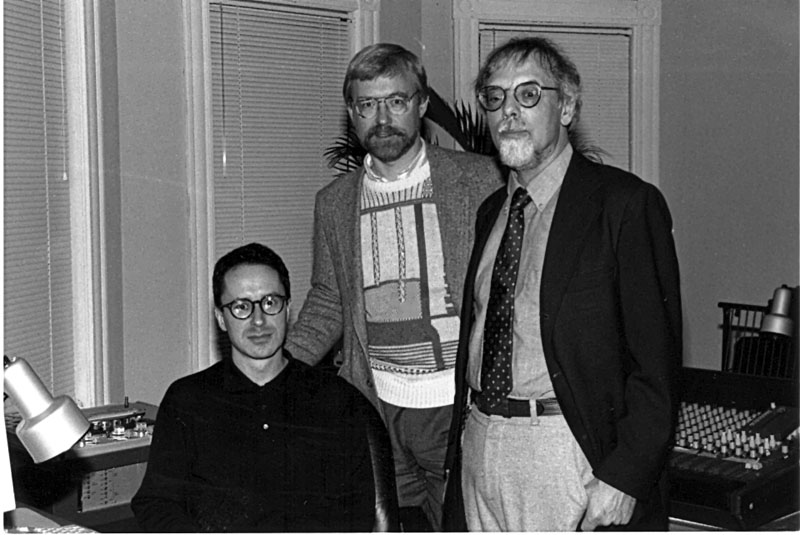
[Barry Truax with Curtis Roads and Otto Laske, Cambridge, MA, 1989 - courtesy Barry Truax]
" [...] a theory of music has to understand not musical results but rather the mental processes that lead to such results." - Otto Laske
"Looking back at 43 years of making electronic music, it's clear to me that ever since I began composing in 1964, the development of music technology strongly shaped my compositional ideas. The artistic task seemed to be to show that new technologies can indeed produce "art." At the same time, these technologies brought forth new compositional ideas not elaborated before. In short, a stark interdependency of compositional thinking and technological possibilities prevailed. When listening to my various compositional adventures today there is, for me, a certainty aesthetic unity that binds all of my pieces together. It will be up to historians (once they have become knowledgeable about the technology underlying these pieces) to judge them from a more balanced perspective than is perhaps possible today." - Otto Laske, January 2010
Computer Software Based Composition
My background is in both philosophy and music, not to speak of poetry. I studied with Adorno in Frankfurt: a philosopher and composer who shaped my thinking for a decade (1956-1966) and also helped me to emigrate to the U.S. in 1966 in order to study computer music. He also made me aware of the Darmstadt Music Festival, at which I met Stockhausen, Gottfried Michael Koenig, Ligeti and Boulez, among others. The first time I went to Darmstadt was the 1963: I was especially taken with Stockhausen as a teacher and with Pierre Boulez' notion of orchestration virtuelle, by which he meant that a professional composition contains elements that are not immediately obvious or even hidden, but have to be there to make a rich composition come to life. This notion of Boulez’s has accompanied me all my life, and not only in music, as much as P. Klee’s Das Bildernische Denken.
My main musical mentor, although not as a teacher of composition, is Gottfried Michael Koenig. I met Koenig in 1964 when he first presented Project 1 to colleagues. While his program was unfamiliar to me, I had previously studied with a German composition teacher (Konrad Lechner) who was very influenced by medieval music, as well as the works by Webern and Stravinsky. He had taught me something called micro-counterpoint by which he meant minutely working-out selected musical elements (such as, e.g., 10 rhythms, tones, or tone colors) and bringing them into the form of a cantus firmus on which to base a larger composition, under the intense influence of the ear.
When I listened to Koenig in his lecture at that time, I understood him to be talking about parametric counterpoint, counterpoint of parameters like pitch, duration, instrument color, register, volume and so forth, as Lechner had done. The difference was his use of computers for composition. What captivated my interest in computers was not the hardware, but the idea that compositions could be designed on the basis of contrapuntal ideas so that different parameter streams (lists) could be merged to create new sounds, either in ideal time (through notation), or in real time (electronically). In all of the computer programs of the sixties, such as those by Xenakis and Mathews, what interested me was expanding my contrapuntal, multi-dimensional way of working.
When I sit down to compose music using a program like Project 1 or Kyma, I find of central interest the feedback loop between the frozen and the living knowledge that is engaged: the frozen knowledge embodied by the computer software, whether it is knowledge of an instrument, waveforms, envelopes or knowledge about deforming and sequencing visual images, and the living knowledge in the composer’s mind. In my writings, including in Computer Music Journal, I always emphasized that a computer used in music (including its interface with the user) should have as much intelligence as possible, including the ability to learn from the user. I was always disappointed that this has been made possible to date by programmers only to a small extent. My notion regarding this was to permit the composer to build new “task environments”, a kind of artistic homesteads in which s(he) could re-use fruitful ideas and presets, or even understand his/her compositional process better.
I think that the new concepts engendered by computers are valid in many artistic fields. When I work with my painting program today, or make animations accompanied by music, I find much greater openness to the idea of having the computer program “know its user”. It seems to me that the visual programs I am using have a higher-level intelligence than present music programs, or so it seems to me. (I am not a live performer of music, where much of the available computer intelligence seems to be located these days.)
In music, I guess, I am an “old-fashioned” composer, in the sense that I typically work from numerical templates such as produced by Koenig’s Projekt 1. I refer to this way of working as “score synthesis” in contrast to “sound synthesis”, whether I am engaged in instrumental, vocal, or electronic composition. Algorithmic composition really never caught on in the US, except perhaps in Milton Babbitt’s work. As to Koenig’s Project 1, it seems I have remained the only composer who used it also in electronic composition, -- although composers like Barry Truax have, of course, been using “algorithmic composition” all their life, much influenced by Koenig’s work as holds for myself.
Score synthesis was a European idea stemming from Xenakis, Koenig and few others like L. Hiller in the US. My goal as composer over 45 years has been to bring score synthesis (the computation of score parameters) and sound synthesis (the computation of acoustic material based on “reading” score parameters) into balance with each other, giving equal attention to both. This meant that I had to always use at least two different programs (not originally made for working together), one for score synthesis and another for sound synthesis. And considering that the algorithmic paradigm of composition requires bringing together “score” and “sound” (whether in CSound or Kyma), the art of composition for me became that of marrying the right set of instruments to the right score by using my listening.
The Project 1 Experience: Interpretative Composition
In the 1960s and 1970s, there came into being very different compositional programs. Some made it easy to create numerical materials but required intensive interpretation by the composer, while others required elaborate inputs (such as Koenig’s Program 2) and their outputs could only either be accepted or rejected.
Koenig's Project 1, like Xenakis's ST/10, is of the former kind. It requires very little input and will give the composer a large amount of data to interpret, either for instruments or for electronic sound. I found that the Project 2 type of program didn't suit me as well as Project 1 because I love the freedom of interpreting data, often using the same score for an electronic as well as an instrumental composition (which probably nobody would hear or needs to know). However, I am still curious about the Project 2 type of program and may use it some time in the future after all.
Both programs show me that it is the composer’s mind that creates music, not the sound or the machine, because the composer can obviously use any kind of template, even – as Stockhausen used to say – a telephone book.
I called my work with Project 1 interpretative composition, because I was interpreting data generated by computer software according to guidelines programmed by a composer. I also refer to it as “rule” rather than “model” based composition, meaning that in each new composition I followed a different set of rules, some inherent in the program, others stipulated by me. It is the feedback loop between my own set of rules and the computer’s that interested me. As to the difference between following rules or models, I thought little of artists following others’ or their own compositions as models. I wanted to start from scratch each time, although I of course brought into being my own tradition over many years of composing.
As an abstract thinker, I was also of the persuasion that one should plan compositions “top down”, by stipulating rules for how a score or set of sounds ought to be created, and not bother about details other than in continued rehearsal of listening to the results, -- Berg’s “Durchhören”. It was a matter of what to control when, and not to control everything but to know what controls one could delegate to a computer slave.
Specifics of Koenig’s Project 1
To be specific, in Koenig’s Project 1 (created in 1967 and continuously refined til the 1990s), a composer works with 7 degrees of change for all parameters (such as pitch, entry delay, pitch, register, volume). Degree 1 represents constant change, while degree 7 stands for minimal change (redundancy), with degree 4 standing in for a compromise between the two.
Now imagine the fun to be able to plan, and carry out, a creative process in terms of the different parameters that need to come together to make a new composition! Should entry delay – the delay between subsequent sound entries – vary according to degree of change 1 or 4 or 7? If you chose 7, then what degree of change do other parameters such as pitch or volume need to follow? If you then in addition to using Project 1 stipulated your own interpretations of what “register 4” or “volume 6” is to stand for, you are in a creator’s paradise because you can model your rule stipulations to whatever strikes your fancy, keeping in mind the limits of the medium – instrumental, vocal, or electronic – you are writing in. Each movement of your composition will have it own unique “parametric signature” that is never repeated anywhere in your life’s output. And with regard to electronic music, you might arrive in a studio other than your own – e.g., at the GMEB in Bourges – and hear your score for the first time in your life -- with 2 weeks left to convert it to sound.
By using Project 1, I was able to plan the FORM of my compositions’ – the main esthetic concern of every composer – in the minutest detail by using a global top-down design based on parametric counterpoint. I was not composing with “tones” but at a meta-level, with“parameters” whose streams coalesced to create novel sound. And I could do so not only for sequencing scores (whose length I determined); I could also MERGE (mix) scores to my heart’s content. (This procedure is found in all of my electronic compositions after 1999).
Of course, the computer (luckily) could not help me sequence or merge different “sub-scores”, as I called them. I was challenged to do so by ear, “rehearsing” pieces like a conductor (without ever needing one). The computer couldn’t even guide me in designing instruments (e.g., in Kyma) that would be ideal for playing a particular score. I was free and obliged to do so myself (which shows that “algorithmic composition” is a very misleading term). And so, I often ended up “orchestrating” a particular score based on different sets of instruments (called “orchestras”), and then would mix different sonic renditions of the same score into a final complex result. It is here that I practiced what Boulez had called orchestration virtuelle because many fine details of a composition could easily be generated by superimposing different instruments (tone colors) slightly varied in their onset in time against each other.
Of course in instrumental composition I could only sequence, not mix, scores, although even here I could (theoretically) have decided to orchestrate the string section with one and the brass section with another score. Ultimately, electronic music won out in my production of music. I could easily produce a final score with 18, 24, or 36 voices per sound entry, by overlaying different scores played by different instruments, and I could vary the “parametrical depth” of the sound from second to second. The compositional freedom I enjoyed using Koenig’s Project 1 and Scaletti’s Kyma was limitless.
I am speaking here of the most recent phase of my work of computer music programs during the first decade of the 21st century. The beginnings of this labor in the 1970s and 1980s were far less idyllic. For one thing, not having access to a computer running Project 1, I would produce my numerical scores manually, by “cutting and pasting” parameter lists from older score printouts I had retained and copied. This allowed me to design new scores in which the 7 degrees of change in Project 1 were quite different from previous scores, whether for instruments, voices, or tape. Then also, there was initially no “translator” for Project 1 scores into the DMX1000 or CSound or Kyma format, so that all of this work had to be done by hand. So it was a breakthrough in the early 21st century when Koenig provided me with a formatting of Project 1 scores that could actually be read by CSound or Kyma, respectively. No longer did one have to wait for a week, as in the 1970s, to hear a short piece one had programmed, by which time one had already forgotten the compositional idea input to the computer a week earlier.
The New England Computer Arts Association (NEWCOMP)
The 1980s were a heady time for “scandaliser le bourgeois” listening to music at Boston Symphony Hall. Curtis Roads was a very good friend of mine at that time, and for nearly a decade we worked together trying to put the focus on the production, rather than the consumption, of music. (It was only at the end of the 1980s that I could finally built my own studio, so that I could experiment with musical ideas any time I pleased, rather than having to travel to Vancouver, Bourges, or Ötwil am See to make a composition.)
I met Curtis (then editor of Computer Music Journal) in 1980 when he came to live in Cambridge, MA. After some talks we decided to form an association of composers, initially for presenting computer music concerts, later expanded to other computer arts, like computer poetry, computer dance and what we then call “visuals”. At that time I was married to a choreographer and I taught her to use Koenig's Project 1 in designing choreographies, which she did using parameter lists for determining “gestural events” for her dancers who collaborated to make a composition.
Curtis and I founded the New England Computer Arts Association in 1981 (which was renamed in 1984 into Computer Arts Association). During the time we worked together, Curtis and I gave about 65 concerts, planning every detail of them. Artists came from around the US to be presented by us. Curtis left NEWCOMP in 1985 and I carried on until 1991 when, not finding a worthy successor, NEWCOMP ceased to exist. We presented concerts not only in Cambridge (Massachusetts), but in also Europe (Warsaw, Stuttgart, Tbilisi). In addition, we sponsored an international computer music competition which became internally known as the NEWCOMP Music Competition.
At that time, both he and I were very sick and tired of the concert music scene in Boston, which was all about consuming music. We felt that what matters was producing, not consuming, music, and so we also presented composition courses for computer music beginners, and symposia for showcasing creative work. Our concert venue was a church in Cambridge, near Harvard University (where during 1992-1995 I would study developmental psychology).
NEWCOMP was a group of about 15 artists and composers which held regular meetings in my house, complete with a President, Vice-President, 2 Artistic Directors, and a Treasurer, -- all volunteers. We invited composer colleagues in the US and Europe – Koenig, Lansky, Ruzicka, and GMEB, and others – to be judges of the works submitted to the competition. NEWCOMP members came together to make the final selection of 3 winners. For ten years, NEWCOMP was the only association in the US that presented regular computer music and mixed computer arts concerts outside of academia. We “schlepped” loudspeakers, advertised, sold tickets, and in this way performed a lot of new music. It was a great pleasure.
Laske's work in Cognitive Musicology
I was always interested in what is knowledge, that is, epistemology. What does it mean to know, how does knowledge develop and work in the world?. As a result, the essential question I posed in my cognitive musicology between 1970 and 1995 (to be published in part in three volumes by Mellen Press by 2013) is "what is musical knowledge"?
As you know, musicologists have formulated hypotheses as to how Beethoven may have composed his string quartets, but they don't have enough data to really establish any sound theories about that. So that was the project that history handed to me. I was tired of the old musicology that I had studied in Frankfurt am Main. In my research after 1970, I was suggesting that, given the existence of computers, the time had come to branch out and study not only musical products – “compositions” – but the mental processes by which living computers brought their works into being. I was especially eager to understand the linkage between the mental process that led to a particular composition – carried out by using computer programs – and the work that resulted: how was musical form actually created? I was convinced that one could never derive the process from an existing work of a dead composer. Even old music was brought to life only through mental processes in the present, and so, in a way, there was no pre-existing music; it all occurred NOW. I also thought that conventional musicologists made too many illicit assumptions, called “interpretations”, that couldn’t be empirically proven and were largely arbitrary; and still think so.
Therefore, when upon Koenig’s (Godsend) invitation I worked in Utrecht between 1970 and 1975, inspired by what he called “composition theory”, I decided to use computer programs to work out empirical theories about how music is thought or “made”, whether in music analysis, conducting, composing, and listening. I rejected notation as a worthwhile medium and started working directly with electronic sound produced by the Institute of Sonology’s PDP-10 computer. Influenced by J. Piaget, the geneticist of knowledge, as well as N. Chomsky’s Transformational Grammar and P. Schaeffer’s Traité des Objets Musicaux, my goal was to understand the musical thinking of children.
" [...] At the Institute of Sonology, Gottfried Michael Koenig and Otto Laske and a host of really excellent teachers were formulating the digital future. That may sound overly dramatic, but they had this wonderful set of analog studios, with a lot of custom made equipment and two and four channel machines for recording it and banks of voltage control equipment that defied description. It was very, very complex. A long way from the Buchla and Moog synthesizers I’d been weened on at UBC. Stan Tempelaars was teaching modern psychoacoustics that he had gotten from Reiner Plomp, which I now realize was pretty cutting edge at the time. Koenig was teaching composition theory but also programming and macro assembly language for the PDP-15, almost as fast as he was learning it himself. And suddenly, for the first time, I found myself with the mini-computer; that’s what they were called, even though they took up one huge wall of a room. But they were single user, not mainframe computers like Max Mathews had. Although the only means of interaction was the teletype terminal, you could have real-time synthesis and interact with it as a composer rather than writing programmes. And I developed this thing called the POD System for interactive composition with synthesis, which was a top down type of approach." - Barry Truax
While in society computers were used to make profit, I looked at the computer as a machine that could strengthen (not replace!) the creative mind, thus working against the grain of technology. I felt artists could finally become independent of the many conventions than bind them in their work and in their performances, and simply satisfy their own criteria for what was “good art” (never mind the conductors who wouldn’t play their work). That was the political background.
Theoretically speaking, I was waking up to Artificial Intelligence as a means to “simulate” creative mental processes. For this reason, when I returned to the US in 1975, I applied for a grant to study with one of the luminaries of A.I., Nobel Prize winner Herbert Simon, at Carnegie-Mellon University, Pittsburgh (himself an excellent cello player). Together with A. Newell, another founder of A.I., Simon had created the first chess computer program that could beat a human player. He had also invented “protocol analysis”, a way of analyzing the intellectual moves of a human computer user engaging with a particular task such as chess and understanding spoken language.
So it was natural to wonder whether a computer program could not also “protocol”, or document, what children did with electronic sound compositionally (as I had been trying to understand in the Utrecht OBSERVER programs built together with B. Truax in FORTRAN), and whether they could not simulate, or at least intellectually support, musical composition, and not only for children. It was an idea that was in the air, so to speak.
As this shows, thinking about composition as a theorist and making music was very closely linked in my work. Not that composition was becoming a “science”, but rather that composers would do well to get out of their studio and sniff the air of science, as many composers began to do (e.g., James Tenney, not to speak of Xenakis and Koenig). I felt the composer needed to know as much as he/she could about computers and composition theory in order to understand his/her own creative process, and become more dynamic and flexible in using new processes rather than following old “models”, even their own.
From documenting children’s work in composition at the Instituut voor Sonologie, Utrecht (1970-75), I proceeded to simulating compositional processes by writing A. I. programs (1975-77) at Carnegie-Mellon. However, to do this was a very large undertaking, and I never managed to obtain the financial funds for working with others on this project which, finally, I had to give up to fully return to composition (1995). EMF is bringing out a 2 CD set “Otto Laske: The Utrecht Years”, which features 9 music pieces I had composed in at the Institute of Sonology over 5 years.
Visual Music

[Lanesville seen by camera - Otto Laske]
My artistic life is far from over. I have often been told that my music is very visual and contains many visual cues. Therefore, in 2009 I began to think: composition is composition, why don’t I extend my compositional work into the visual domain. (I also have written a substantial body of poetry, both in German (1955-1968) and in English (1967-1995)), still unpublished.
In 2008, after having begun work in watercolour and oil, I discovered what today is called visual music through Dennis Miller, a fellow composer living near me, and one of the pioneers of the new medium. (I always meet the right people at the right time, it seems.) Visual Music is a discipline still in its infancy, but has its roots in the 1920's and 1930's, when artists like Oskar Fischinger, Germany, began to experiment with abstract films that were called “absolute film” since they were without narrative and storyline, and rather simply focused on (often geometrical) shapes and colors. The pioneers of visual music had the vision that it was possible, or should be possible, to bring abstract painting in the sense of Kandinsky and Klee to film or video, and link it to music (instrumental music at first, and later electronic music).
In my present work with Studio Artist and Cinema 4D -- the first a program for digital painting and the second for animation -- I have again taken up the practice of using two different programs not initially meant to work with one another. But at least they can “talk” to each other now, which was not the case with early music programs. And so I am gradually learning to go back and forth between these 2 programs, not to mention that I also need to use a sound processor such as Sound Forge, a movie making program such as Vegas Movie Studio, and bring them all together to produce a visual music video.
For the time being, I have produced a gallery of images that will be accessible on www.ottolaske.com in the near future. Even for an experienced composer like myself, learning and using visual programs presents a steep learning curve. I am therefore putting my poetry and music on hold in order to became a digital painter and animator. I have given myself two or three years to learn these programs before I can turn out anything that would satisfy my artistic standards.
Again, the computer is the "leading voice" that challenges me as an artist to bring together music and image after a lifetime of composition. I feel very fortunate to be able to do this at my age (75), additional years permitting.
[works by Otto Laske @ silenteditions.com]
[www.cdemusic.org]
Saturday, April 02, 2011
Out now: "hiSS vol.1" on Synesthesia Recordings

The works included in 'hiSS [Synesthesia Sampler] vol.1' have been produced using only analogue devices and processing tools - such as no input mixers, analogue synthesizers and custom-built or hacked/reconfigured instruments.
Without the use of computers or digital devices, the 4 pieces recall an era from the 1950s-70s, when most of the electronic music makers around the world had limited resources and quite primitive equipment.
The compositional techniques are available in the following document:
[hiSS_vol-1_Press_Release.pdf]
Produced by Matteo Milani, Federico Placidi
Artwork by Kirjava [kirjava.deviantart.com]
SYN-005 | 2011 Synesthesia Recordings
Artists retain copyright to their respective works
RELEASE INFO:
Title: 'hiSS vol.1'
Cat.No: SYN-005
File under: Experimental/Electronic
Format: Digital/Compact Cassette
Release date: 4.2011
Limited edition compact cassettes coming soon! Contact us for more info:
write [at] synesthesiarecordings [dot] com
Digital album available ($ 5, mp3 @ 320 kbps) [here]
Pick other formats (FLAC, AAC, Ogg Vorbis) on BandCamp [here]
ALBUM ARTISTS:
Volker Hennes (GER)
Title of the piece: eromenoi erastai
Duration: 12' 16''
Volker Hennes (b. 1976) is a sound artist and composer. He studied at the Academy Of Media Arts Cologne from 2000 till 2005 – mainly at the Sound Laboratory, at which he was employed as assistant for two years. Focuses on live-electronics, acousmatic and electroacoustic music, computer music, field recordings, multichannel and interactives works, and installations. Works have been performed and presented internationally; e.g. Metamorphoses / Belgium, ICMC / Copenhagen, Concordia University/ Montreal, Música Viva / Portugal, MANTIS Festival / Manchester, Festival Internacional de Música Electroacústica Ai-Maako / Chile, A & A Elektrokonzert / Argentina, Digital Art Weeks / Zürich, SMC, Inventionen / Berlin. In 2003 he founded All Of Orlov with Robert Vater, since then performing duets and duels. Member of the audiovisual performance and improvisation group Frequenzwechsel.
[www.earesistible.de]
Chris Mercer (USA)
Title of the piece: Deification | for 2‐channel tape
Duration: 13' 14''
Chris Mercer received a B.M. in Composition at the North Carolina School of the Arts in 1995, and a Ph.D. in Composition at the University of California, San Diego in 2003. His principal teachers were Chaya Czernowin and Chinary Ung - instrumental music; and Peter Otto and Roger Reynolds - electronic music. He has held artist residencies at Experimentalstudio SWR, Künstlerhaus Schloss Wiepersdorf, and Sound Traffic Control in San Francisco. His music has been performed by The Nonsense Company, Ensemble Ascolta, Ensemble SurPlus, SONOR Ensemble, and Schlagquartett Köln. His most recent electroacoustic music and research have focused on animal communication, especially non-human primate vocalization, with research residencies at the Duke University Lemur Center, the Wisconsin National Primate Research Center, and the Brookfield Zoo.
His instrumental music involves modified conventional instruments, found objects, and instruments of the composer's own design, in combination with amplification, live electronics, and spatialization. He has taught electronic music at UC San Diego, UC Irvine, and CalArts, and is currently coordinator of the Music Technology program at Northwestern University.
[musictechnology.northwestern.edu/Mercer]
Ian Helliwell (UK)
Title of the piece: Convergence
Duration: 14' 02''
Since the start of the 1990s Ian Helliwell has been making films and building and modifying 9v circuitry, developing his unique series of Hellitron tone generators, which are used for live performance and for the soundtracks to over 50 of his experimental super 8 shorts. In 2007 he designed and built an analogue synth, the Hellisizer 2000, and since 2008 he has been producing The Tone Generation, his ongoing radio series which explores the early development of electronic music. In 2010 several of his abstract super 8 films have been included in a major retrospective of direct animation - Celluloid: The Cameraless Film at the Schirn Kunsthalle in Frankfurt.
[ianhelliwell.co.uk]
Jeroen Visser (CH)
Title of the piece: The Spanning
Duration: 13' 41''
Jeroen Visser (1961) is a musician and a composer living in Zürich, Switzerland. His primary instrument is classical piano, and he is also a self-taught woodwinds player. After his study of Sonology in Utrecht, being taught by a.o. G.M. Koenig, J. Vink, and S. Tempelaars, he worked as musician and sound engineer. From 1988-1992 he worked as music technologist at the Sweelinck Electronic Studio in Amsterdam, NL.
After his relocation to Zürich in 1993, he has been composing music for groups and theatre, where he was also responsible, as musical director, for productions, and making musical or sound installations. Recent musical activities, apart from electro-acoustic compositions, include studying ethiopian music, and playing music which investigates the combination of improvisation and musique concrete.
[121234.net]
Product pages:
[synesthesiarecordings.com]
[synesthesiarecordings.bandcamp.com]
Subscribe to:
Posts (Atom)