Showing posts with label Location Recordings. Show all posts

Thursday, March 24, 2011

An Audio Journey into the Rainforests of Mamori

Mamori Sound Project
6th Annual Workshop/Residency for sound artists & composers
@ Mamori Lake (Amazon, Brazil) / October 2011 / 2 weeks


This Kickstarter Project is to assist in funding eight US sound artists to participate in this year's Mamori Sound Project and, by doing so, help this whole exceptional project in the Amazon survive. This project will only be funded if at least $25,500 is pledged by Tuesday May 31, 1:00am EDT.

Mamori Sound Project is an independent residency/workshop that has been carried out in the Brazilian Amazon since 2005 by a small non-profit organization, integrated by sound artist Francisco López and the cultural association Mamori ArtLab, based in Spain and Brazil. Mamori Sound Project supports the local community at Mamori Lake (Amazonas state, Brazil) by providing jobs every year for a significant number of people in this community.

The Mamori Sound Project is a 2-week workshop/residency for professional and semi-professional sound artists and composers with previous experience in the area of sound experimentation and field recordings. It takes place at Mamori Lake, in the middle of the Brazilian Amazon, and involves theoretical/discussion presentations, field work and studio work. The workshop/residency has a special focus on creative approaches to the work with field recordings, through an extensive exploration of natural sound environments. It does not have a technical character but is instead conceived and directed towards the development and realization of a collective project of sonic creation with the interaction of all participant artists/composers. The activities of the workshop/residency include: Introductory theoretical/discussion presentation sessions on field recordings and sound creation, with a historical/philosophical perspective.
  • Field trips (both diurnal and nocturnal) for extensive listening and recording of sound environments.
  • Collective listening and discussion sessions of the sound materials gathered. Sessions of studio work (with laptop) using these materials.
  • Development and realization of a sound piece by each participant (or in small groups), as part of the collective project.
  • Public presentation of the finished pieces for both the participant artists and members of the local community at Mamori Lake.
All these activities are organized in a daily schedule according to the changing sonic environments of the rainforest. This typically involves many hours of field and studio work but there is also flexibility to allow participants to choose from several schedule options and to have the opportunity to carry out other activities related to the daily life in this environment, such as fishing for food or interacting with the local community.

[project home: kickstarter.com]
[franciscolopez.net/amazon.html]

Thursday, October 07, 2010

Live!iXem 2010 - Edition VII

International festival of music, mixed media and experimental electronic art


[a project by AntiTesi (Domenico Sciajno) and U.S.O. Project in collaboration with O' and Die Schachtel]

Live!iXem is a well established event that explores the relationship among sound, music, electronic arts and new technologies. iXem is a project conceived and produced since 2003 by AntiTesi, an organization founded and directed by Domenico Sciajno based in Palermo. Center for self-documentation, research and interdisciplinary development for new forms of Arts, Antitesi focuses on contemporary arts in its diverse expressions, coordinates and organizes cultural events, festivals and exhibitions in music and art.
Festival Live!iXem in October 2010 is divided into two events, a 'preview' in Turin on October 8th, organized with Hiroshima Mon Amour, and the main festival in Milan including live performances, installations and  a workshop, organized in conjunction with O' and Die Schachtel.
The field is transverse. The common denominator is not the genre but the experimentation and research to innovation, helping to explore the variety of approaches to aesthetic guidelines, tools and technological solutions adopted by selected international artists and involved in the contemporary music scene.
After the introductory event in Turin, October 8th - with Live! IXem Preview - the festival appointment in Milan will take place in the Isola area, between the spaces of O', Medionauta and VisualContainer on Friday 29th and Saturday 30th October, from morning until late at night, offering a busy schedule of events.
Among these, the workshop 'Movement of acoustic images' - whose theme is the field recording, its transformations and its reproduction in acousmatic space - will consist of three different phases: the first by a technical approach, the second one by listening to environmental sound sources chosen as points of a hypothetical ideal sound map and the third one with 'on-site' recording of sound events.
This year Live!iXem, is also characterized by a partnership with 'Ear to the Earth 2010 - Water and the World', Festival produced by Electronic Music Foundation/Joel Chadabe, which will take place simultaneously in NYC.

PARTNERS: Roland Italy, SMAP (San Marino Audio Project), MIC (Music Information Centre Norway), Sound Corporation

WHERE: O 'via Pastrengo 12; Medionauta via Confalonieri 2; VisualContainer via Confalonieri 11, Milano | Isola Passante Ferroviario/M2 Garibaldi, M3 Zara, tram 2, 4, 7, 31, bus 82, 70, 43

HOW: All events are free except for the workshop (for which there is a fee of 60 euros) - and for the evenings at Medionauta (5 euro membership card).

INFO:
Antitesi www.antitesi.org 

Full program here: iXem Press ENG (pdf)

Friday, September 17, 2010

Field Recording Workshop: "Movement of acoustic images"

October 29th, 30th | Milan @ Live!iXem 2010 - Edition VII
International festival of music, mixed media and experimental electronic art


Aims of laboratory
  • Explore through the knowledge of digital recording techniques the universe sound belonging to the "places";
  • Discuss some aspects of the use of specific material in electronic and instrumental composition.
Localization of sound in the environment focuses on the theme "sound mapping" as a social and cultural identity and, at the same time, an expression of conscience and personal feelings, whereas its use in music opens important interdisciplinary horizons.

The workshop's aim is to provide an introduction to theory and practice of the main mobile sound recording techniques and the use of sound sources in different fields, from sound design to cinema, from digital editing to the use of digital sources in instrumental composition, electronic music and live electronics. Music compositions and musical excerpts from field recordings will also be introduced, listened and discussed. All members are invited to participate in the soundwalk along the neighborhood "Isola" in Milan and thus contribute during the workshop to the creation of a small sound map of the place. The pieces obtained at the end of the workshop will be diffused through a multi-channel audio speakers setup and then available to the public in the form of soundscape composition.


Speakers: Alessandro Massobrio (ITA), Fabio Orsi (ITA), Natasha Barrett (ENG)
Curated by Matteo Milani, Federico Placidi (U.S.O. Project) and Domenico Sciajno


Documents available online

[Live_iXem_2010_Workshop_ITA.pdf]
[Live_iXem_2010_Workshop_ENG.pdf]


Costs and subscription

To participate in the workshop you must register (spaces are limited) no later than 23/10/2010 and pay the fee (€ 60.00).
For more information about the workshop and registration, please write to workshop [at] antitesi [dot] org or visit the Facebook and Twitter page.


Payment methods
  • PayPal
  • Money transfer

Level

All subjects and activities of the workshop/laboratory are addressed at the introductory and preliminary level, combining theory and practice with some helpful audiovisual material. Members are encouraged to get involved actively, having discussion and bringing in their experience. Participants will be guided, if weather conditions permit, in a short sound-geo path through the "Isola" neighborhood in Milan and invited to contribute to the creation of a work of the soundwalk. It does not require any special technical knowledge and/or music. However, the knowledge of digital audio recording/editing basics can be an advantage.


Recipients

The workshop is devoted for those sound designers, musicians, composers, sound engineers and experts who would consolidate and compare their experience in an environment of exchange and sharing, to all the "listening lovers" and those who have interest and curiosity about soundscape and electronic compositions.


Entry requirements

There are no special requirements. The workshop is open to all without any age limit. Entries remain open until all available seats have been booked.


Devices
  • Mac/PC laptop (useful but not essential during the editing and sound processing sessions)
  • owners of a portable recorder are asked to take it for the soundwalk in the neighborhood "Isola"
  • Roland Italy will provide participants two digital recorders - R-09HR and R-05

Location

The workshop will be held at:

O' | residences | photography | sound | performance
non-profit association | via Pastrengo 12, 20159 Milan (Italy)
tel +39 02 6682 3357
website: www.o-artoteca.org

O 'is a non profit organization for the promotion of artistic research, founded in May 2001 by Sara Serighelli and Angelo Colombo as O'artoteca (O' since 2008). Its activity is divided into a large exhibition space, an area of consultation and archive, and an outside lab, L.A.B.-LaboratorioArtibovisa for the production related to photography and printing. It developes exhibition projects and discussions, performances, concerts, lectures, publications; it's a place where artists can experiment, test and compete with their work.

Saturday, February 06, 2010

Ann Kroeber | Sound Mountain

If you don’t know Ann Kroeber’s name, you certainly have heard her work. In 1999 she formed a company called Sound Mountain and has recorded and or provided sound effects for such films as The Star Wars Trilogy, The Lord of the Rings: The Return of The King, Pirates of the Caribbean, The Lion, The Witch and The Wardrobe, Gladiator, The English Patient, The Horse Whisperer, A Bug’s Life, K-19, Polar Express, The Village, Hidalgo etc. and many games.
Although she is often called upon to supply sounds from her huge collection of animal noises/vocalizations, she is also renowned for her unusual recordings of sounds from everyday life, many recorded with a FRAP (Frequency Response Audio Pickup) contact microphone custom-made many years ago by an English audio guru named Arnie Lazarus. In fact the Hollywood Edge FX library (@Hollywood_Edge) even put out a disc of her FRAP recordings--Common Sounds Heard in Uncommon Ways--as part of a three-CD set called Sounds of a Different Realm. The other two of the discs are dominated by the work of her late husband, Oscar-winning FX designer/editor Alan Splet, who did groundbreaking work with Carroll Ballard, David Lynch, and other directors before his untimely passing in 1995.
His incredible archive of effects recordings was passed down to Ann, who had been an integral part of his recording life since they met while working on The Black Stallion (which won an Academy Award for Sound Fx Editing), where she was an effects recordist. Kroeber quickly established herself as a masterful sound editor, as well, on such films as The Elephant Man, Dune, Never Cry Wolf, The Unbearable Lightness of Being, The Mosquito Coast, and Dead Poets Society. She was also the production mixer on Blue Velvet and sound designer on Carroll Ballard’s Duma at the Saul Zaentz Film Center in Berkeley.
The Saul Zaentz Film Center, along with American Zoetrope and Lucasfilm, it was one of only three major film production facilities in Northern California. By 2005, it has largely shut down its post-production facilities, except for the foley recording studio, which is part of the still-active Fantasy Recording Studios. The film center was sold in 2007 and, after renovations, became the Zaentz Media Center.
[colemanfilm.com]
[en.wikipedia.org]

[Ann Kroeber @ Linkedin]

"Discovery of Sound Mountain is like finding a new star cluster within the Star Wars Universe. Ann offered unique original audio from which I designed many new and fascinating Star Wars aliens and machines."
[Ben Burtt]


Sound Mountain - Reel from Michael Coleman on Vimeo.

"Ann Kroeber has a unique ability to provide one-of-a-kind sound effects. Both as a recordist, and as the knowledgeable gatekeeper of a vast, reknowed library. Ann has given me great sounds that lead to great ideas. When we are searching for something nobody's heard before, Ann can help us find it."
[Gary Rydstrom]

Dont'miss:
[Directors on working with Alan Splet - via musicofsound.co.nz]

Friday, June 26, 2009

An interview with Christina Kubisch

by Matteo Milani, U.S.O. Project / Eng: Valeria Grillo / Img: courtesy Christina Kubisch

Christina Kubisch, one of the most important sound artists on the European scene, began to work in 2003 on a project called Electrical Walks. This project uses custom-built headphones which transduce electromagnetic fields into audio signals, through an interaction between force fields which allow the audience to listen to a concert of ambient sounds in public spaces specifically projected.

Christina Kubisch's activity consists therefore in mapping a territory, in order to detect hot spots where audio signals are especially strong or interesting. The audience wearing the headphones takes part this way to the discovery of new acoustic spaces, by means of an aural itinerary through a thick net of electromagnetic information which are invisible and omnipresent. Actually, the activity of the German sound artist is much more varied and it has started many years ago: in the 1970's for example, she had many performances, even if she has always declared to be "unhappy with the predetermined or limited time for the audience to take advantage of the works".

Also for this reason, Christina Kubisch has always desired to do something more open, where people could manage their own time, without stopping too long in front of the work of art or the artist himself. Still today, her work is tied to different elements, and resumes some interests related to the work with light, coming from her experiences with theatre and dance. Light has in fact for Christina Kubisch the same qualities of sound, being a non-material phenomenon that can, and has to be, used as a narrative element; sound and light are for the artist two interlaced elements, so that the first can be used for the visualization of the second (like in the case of ultraviolet light, normally not visible), and vice versa (like in her most renown work, Licht Himmel (2006), which she created for the magnificent ex-gasometer of the city of Berlin).

Christina Kubisch lived in Milan from 1973 to 1987, and our encounter with her took place at the Palazzo della Triennale, during the Milan show of her touring project called "Electrical Walks", invited by the gallery O' and by Die Schachtel for the project realized for InContemporanea and Uovo performing arts festival, which I thank for their collaboration they gave me for this interview.


Matteo Milani: Christina, could you tell us about your background, and how you arrived, through your career, to conceive the "Electrical Walks" project?

Christina Kubisch: When people asks me what I am, what do I do, I always struggle to answer. I am an artist, a composer, I work with magnetic inductance, but I also write pieces for other musicians. I am a performer, I draw. It's hard to define me. I was a flautist, I studied Composition with Franco Donatoni at the "G.Verdi" Conservatory of Milan, and also Electronic Music with Angelo Paccagnini. At the end of my studies at the Milan Conservatory, I started a much more personal and effective research, attending for 2 years night courses in Electronics. During these courses, I discovered a telephonic amplifier, a small cube, from which came curious sounds. This cube had inside some coils, and it amplified the magnetic sounds close by. Fascinated by this system, I had 50 special cubes built, and with them I created my first installations.
Sometimes at night I go through electronics catalogs and ask myself what I can change, subvert, using some components in an improper manner. Then I discovered headphones. I had them built in Bologna, after having projected them with an engineer. I still use them, only the internal components are different, but the exterior of the headphones is authentic, dates back to the first years of the 1980's. Obviously, the listening is easier than with the cubes: it is more comfortable now to go around with wireless headphones. It is interesting to see how people move, some run around in the space, some go around slowly: the more people move around, the more interesting are the things they hear. Each movement of the head produces big changes in timber and amplitude to the sound people listens to through the headphones.


MM: This project is an important document to understand the state of electromagnetic saturation on our planet, it is a study on the "invisible" noise pollution.

CK: In every city, especially in the big ones, an incredible number of electromagnetic waves is hidden; they're everywhere, we can't hear them but they're here! Everyday there's a bigger amount of digital communication on one side, and all the security systems on another, and they all bear substantial magnetic fields. I began to plan routes in the big cities, just when I started to receive in my headphones disturbances I couldn't analyze (very strange buzzes & rhythms): actually, for some years (since the beginning of the 1990's) I had to stop doing my walks because my gear was broken and I could repair it only with the help of a sponsor. In 1999 I found the sponsor, but during those few years of interruption, the world of magnetic fields had grown exponentially! For this reason, I decided to use those disturbances like sounds to explore: one of the first cities I explored was Tokyo. I also gave my headphones to Alvin Lucier, who was there for a festival, he had a long walk with them and than he told me: "This is a concert!"
The city is both an individual and globalized element, and with this experience I could expand both aspects, documenting them through pictures as well as video: lighting systems, transformers, ATMs , electronic security systems, surveillance cameras, computers, antennas, navigation systems, cash registers... the city itself can become a concert.
The oldest sounds (trams, train stations), the ones dating back to the last century, are also the most musical. This is what I define "Electromagnetic Anthropology", in the sense that each and every station has its own distinctive sound, usually connected to the date of its construction. The Stazione Centrale in Milan , for example, is fantastic, I almost got crazy when I went there, and I will be back soon to do some more recordings! In Milan you can actually hear the trams from far away, not only when the listener is close by.


MM: Are there places where you actively look for "hidden" sounds, and others where you instead wait for aural information which renew periodically?

CK: Sure, there are sounds I exactly know where to find, in places like banks, or close to light signs. Lights actually emit curious sounds, just like LCD or plasma TVs. Internet or Bluetooth antennas emit very strong and annoying sounds, but they are part of our life. It is always nice to find something new, very strange sounds, but their source remains unknown. In some Countries, especially in North Europe and the USA , it is mandatory for stations to have induction systems for hearing-impaired people, so every kind of announcement can be broadcasted . These systems often are in places where they shouldn't be. For example, it happened that while I was walking around a street, I could hear everything that was going on inside an office, including voices and computer activities. I have a collection of hundreds of hours of recordings in my archive: I don't know if this is music or noise, but I'm always fascinated by this aural universe halfway between heavy metal and pop music!


MM: What are your analogue and digital work instruments?

CK: All the sounds I record with my headphones are so interesting that I don't need to transform them much. I mainly work with Pro Tools for editing and pitch-shifting. Besides, I use filters in the frequency domain, with which I can do many things, finding sounds hidden behind other sounds. I have always been fascinated by some instruments which cannot be immediately recognized. On this subject, I published several records using the Glassharmonica, an instrument invented by Benjamin Franklin in 1761, and Diapasons. Some of these instruments are quite big and they reach very low frequencies, up to 40 Hz. I also used signal bells used in underground excavations: they are partly electric, partly acoustic.
Furthermore, I like to work on spatial, four-channel diffusion systems, where I can obtain remarkable results. Nowadays, we think we have any sound at our disposal on the Internet: my students for example rarely record anything, they look for sound files directly online. They do not realize that the offer is limited, pre -determined. This is why I always use field recording in my compositions, so I can show a world still existing today; working with field recordings has become more intense lately.


MM: Which cities surprised you the most on an electromagnetic level?

CK: In Oslo I found beautiful, strange things, that I couldn't find anywhere else. This is the real pleasure of going around like in a safari, especially at night. It may sound like a joke, but the kind of sound I prefer is that of Perfumery lighting systems (for example in Via Dante, Milan ). Banks instead have a very high pitched, sinusoidal-like sound. Never heard such high and strident sounds! The map of Electrical Walks for me is like a score: until now I made 23 walks, and the next stops will be Copenhagen and Leeds . In 2010 I'll be invited to map the Ruhr region, one of the biggest urban areas in Europe , which will also be the European city of culture in 2010. I'll follow a walking route in several cities, but also by car, train and even bicycle.
For this, I'm trying to enhance the headphones by building an instrument I can carry in my backpack so that I can listen to high-tension lines in the countryside, some kind of electromagnetic Land Art. By using very strong and heavy coils, I could pick up many magnetic fields, thus breaking the limits of the present receivers.


MM: What are your considerations on the present situation of Sound Art?

CK: What's really new today is the desire to create art which not only sits on the wall, but which instead can be a deep personal experience. Sound Art, when it's good, allows this experience through an individual listening, which arouses ideas and memories, different for each of us. Furthermore, Sound Art moves through time, and this makes it more difficult to use it as a collectible object, as it often happens today.

[christinakubisch.de]
[soundohm.com]
[dieschachtel.com]
[interview also available on the issue of DIGIMAG 45/JUNE 2009]

Wednesday, January 28, 2009

An interview with Natasha Barrett, pt.3

by Matteo Milani, Federico Placidi - U.S.O. Project, January 2009

(Continued from Page 2)

USO: Pier Paolo Pasolini said that progress without a true cultural development is irrilevant. What is for you the actual relationship between technological progress and the living electroacoustic music community?

NB: One needs to be careful not to confuse cultural development and technological progress. They are of course tightly linked but not exactly the same thing. Cultural development is more complex to define than technological progress (which is also problematic and it is maybe better to discuss ‘technological change’). During recent years, technological change, which has made tools easier to use, has had a two-fold effect. We see a greater interest in non-pop electroacoustic music (everyone is ‘hands on’ for a small cost) - which we can say is good, coupled to a wave of similar sounding works - which we can say is not necessarily bad because the people who are active clearly have a lot of fun! But its difficult sifting out the really good work - simply the number of hours of music you need to listen to before funding a gem. Another change is in the music storage and distribution system. Currently Internet distribution is open and easy, which we could view as both a technological and cultural development. But as new laws and market forces come into place these changes may involve a cultural recession.


USO: What is it that makes your collaboration with
Tanja Orning (DR.OX) particularly inspiring?

NB: I find that working with a real, responsive person in an improvisation setting demands a different way of working and thinking to when sitting alone composing. This variety I find important. For someone else to throw in ideas that aren’t your own always makes collaborations interesting, but specifically to my live electronics improvisation it means I have to think very fast – and that’s fun! I also have similar project with a Swedish guitarist Stefan Ostersjo.


USO: What is the main difference between composing for a fixed medium and for a live performance involving real players?

NB: There is a lot to say about this, but here are some points concerning only acousmatic versus live electroacoustic music with visual performers. I leave out lap-top performance as that opens up a slightly different discussion.

The point of the acousmatic is that there is nothing to perceive via our eyes that will concretise the original sounding object, nor where the sound came from, nor the situational context in which the sound was made. In the visual context we receive a layer of visual information that renders the sound concrete.

Acousmatic listening is part of our everyday. Listening, understanding and ‘getting into’ acousmatic music is simply to focus on the acousmatic experience within a realm where human experiences are moulded, reconfigured and reconnected by the composer. Listening to acousmatic music is therefore natural. The perception of complex structures requires no understanding of Western instrumental music – no training beyond life in general. When we involve an instrumental performer, even if we avoid connection to history in our compositional material, the listener on the other hand identifies the instrument and enters a listening mode based on their understanding of instrumental music – at least to some extent.

Visual electroacoustic music may incorporate pre-made sound material and create ‘live’ electroacoustic material from sound or data derived from the live performance act. We need to consider the many relationships between these layers and the live instrument.

When a live performer is introduced the composition needs to consider this performer – to understand where human limits lie, to understand and take advantage of the live act, to incorporate the live human element in the fixed composition.


USO: What's on your schedule at the moment?

NB: Over the next week I must complete the score for a live-electronics work called “Zone-1” (for percussion, piano, clarinet and a sizeable live electronics part). This work will be tested early January ready for premier in February. I also set up an old installation Microclimates III-VI and complete a new CD project with Swedish guitarist Stefan Ostersjo. March I’ll be in the UK to perform a concert and lectures, then finally (hurrah!) getting stuck into the new commission from the Giga-Hertz competition.

[ Prev | 1 | 2| 3 ]

www.natashabarrett.org
www.giga-hertz.de
www.bvm.museum.no
www.nymusikk.no

An interview with Natasha Barrett, pt.2

by Matteo Milani, Federico Placidi - U.S.O. Project, January 2009

(Continued from Page 1)

USO: In the latest years you received a lot of commissions by many institutions. Did their request influence your ideas and work itself?

NB: Normally I am free to compose what I wish within two types of guideline. The first is whether the work is acousmatic or involves live instrumental performers. The second is the duration and an agreed degree of involvement reflected in the time the work takes to compose. Even for a commission that is part of a thematic festival I am normally able to specify what I would like to do. Only in few cases am I strictly controlled. For example last year I composed some sound materials for a visual artist where the requirements were clearly specified.


USO: Which software resources are you using for composing your pieces? What make them specials?

NB: Well, as I mentioned above it’s easier to talk about the ‘why’ rather than the ‘how’ as I use any software that is appropriate – and probably the same as everyone else. It’s all down to how you use the tools! 14 years ago I would maybe have discussed how I use university mainframe systems or software that was non-commercial and custom made. Now, most non-commercial sound transformation algorithms we used in the mid-late 90’s are embedded in commercial software, which is accessible to all and significantly easier to use than the buggy programmes of the last decade. Even if we build a custom-made Max/MSP patch we are still working within a defined collection of Max/MSP objects (which I do quite a lot). We can of course write our own programmes and our own objects but are nevertheless mainly coding existing algorithms. I can however talk about one main area that I find interesting, and that is the difference between software intended for haptic ‘real-time’ control and software more suited to scripting and ‘out-of-time’ control. For many reasons ‘real-time’ and ‘out-of-time’ control of the same algorithm can produce markedly different results.


USO: What's the importance of Ambisonics in your works?

NB: I first used Ambisonics in 1999 and discovered how three-dimensional spatial structures (rather than stereo phantom images) may be transmitted directly to the listener without the need for headphones. Prior to this time, for me, three-dimensional sound lived either metaphorically in the stereo phantom image or in concert sound-diffusion performance over a large loudspeaker orchestra. In my work since 2000 Ambisonics has opened up a new layer of compositional potential in terms of both sound and temporal structure. I should point that I am referring to 3-D sound through the spatial continuum, rather than sound being positioned on specific loudspeaker points. I do however regularly perform traditional sound-diffusion.


USO: Can you talk about your menthors and how they affected your work?

NB: Hmm. Well mentors change, don’t they? Maybe I don’t really have any mentors, rather people whom I admire, or works that I admire or find inspiring – and the list grows all the time, spanning electronic music, instrumental music and visual art. To throw in a few classics: The early works of Stockhausen. Xenakis. Luc Ferrari. François Bayle. Brian Ferneyhough. Early electronic and tape works from the 50’s to 70’s – some are inspiring for the composition, others for the pioneering spirit and shear commitment to the immensely time-consuming process of the time.


USO: What does it mean to be an electroacoustic music composer in Norway today?

NB: I guess the same as anywhere else in Europe – one needs to be open-minded and active in a broad definition of electroacoustic music as composition and as art involving sound, while staying true to personal beliefs and knowledge.


USO: How should a composer survive nowadays in the global community, where the market and profits determine the reality that surround us, acting like a natural selection process, leaving the outsider thinkers behind?

NB: If you give in to market and profits then you may be able to live through working with sound, but then you need to ask yourself if you are surviving in what you believe in and what you find fun? The point is that no contemporary marginal art-forms survive in a free market economy. But there is rarely a completely free market. Public funds and private grants are there for marginal art-forms. In some counties they are of course very sparse, tricky to get and unfortunately sometimes distributed on a collegial basis. Collaboration can be both interesting on creative terms and useful in opening up new funding opportunities. I would say to be faithful to your ideas yet to be flexible enough to imagine how an idea could function in an alternative setting or framework.


USO: Is there room for a contemporary music scene in our western culture?

NB: Yes. There will always be people who wish to be actively stimulated by music or art rather than simply ‘absorbing’ or using music as a function for example to dance or work to. I know I am not alone in finding intellectual experience one spice of life and contemporary music is one area that offers such an experience.

[ Prev |1 | 2 | 3| Next ]

An interview with Natasha Barrett, pt.1

by Matteo Milani, Federico Placidi - U.S.O. Project, January 2009

U.S.O. Project had reached composer Natasha Barrett to talk about her winning acousmatic piece 'Kongsberg Silver Mines' at the 'Giga-Hertz-Award for electronic music 2008' and more.

Natasha Barrett (1972) works fore-mostly with composition and creative uses of sound. Her output spans concert composition through to sound-art, large sound-architectural installations, collaboration with experimental designers and scientists, acousmatic performance interpretation and more recently live electroacoustic improvisation. Whether writing for live performers or electroacoustic forces, the focus of this work stems from an acousmatic approach to sound, the aural images it can evoke and an interest in techniques that reveal detail the ear will normally miss. The spatio-musical potential of acousmatic sound features strongly in her work. Barrett studied in England with Jonty Harrison and Denis Smalley for masters and doctoral degrees in composition. Both degrees were funded by the humanities section of the British Academy. Since 1999 Norway has been her compositional and research base for an international platform.


USO: Can you reveal us the history of your winning acousmatic piece 'Kongsberg Silver Mines' at the GIGA-HERTZ-AWARD (field recording, processing and composing)?

NB: It was in fact the work ‘Sub Terra’ that won the prize. For the award-concert they needed a sorter composition due to the already rather lengthy programme. ‘Kongsberg Silver Mines’ was originally one of three sound-art installations used as a prelude to ‘Sub Terra’. The other two installations are ‘Under the Sea Floor (Coring and Strata)’ and ‘Sand Island’. Each of these three installations zoom in on sounds unique to three locations under Norwegian ground, creating surreal semi-narrative journeys. In the full ‘Sub Terra’ cycle the installation sites lead the visitor through underground or enclosed sound-worlds, gradually closer to the concert space. The concert work Sub Terra then crystallises into a musical form that which is most abstract from the installations. The version of ‘Kongsberg Silver Mines’ played at the award-concert was a special concert remix of the installation. This version was designed to play over the ZKM ‘Klangdom’ – a dome of 43 loudspeakers. The remix intends to create as a self-contained work, to be listened to from beginning to end, rather than with open-time characteristic of the installation.

Sub Terra was commissioned by Ny Musikk Rogaland, which is an organisation working with contemporary music and art in the southwest of Norway. Long before the title and idea were set, the plan was to explore interesting features of sound-worlds hidden from everyday experience. For concerts and other events Nymusikk Rogaland often use an old brewery, which was partly converted into an arts venue. In the basement of this building you find enormous storage cellars, and it was for this space the installations were initially intended (although in the end the installations were spread out over the Norwegian town Stavanger). The pitch-blackness and crazy acoustics in the cellars started the ‘underground’ chain of thought and eventually pointed to the type of field recordings that I would make.

The sounds for ‘Kongsberg Silver Mines’ are recorded during a journey into ‘Kongsberg Silver Mines’ – an enormous mine complex dating from the 1700’s, extending over 1km downwards and several km into a mountain. For access to the mines I tagged onto a group of geologists who were visiting for a research conference. I made a recording of the 2 km journey on the original old miner's train, which was used to transport silver ore and miners in and out of the mines. The deafening sound and immense vibrations of the old trucks were amazing. It was necessary to wear earplugs and so I had to guess on the recording by looking at level meters and hedging my bets on the how the microphones were responding. Inside the mines we were met by a Norwegian guide. In shaky English he explained the local history and demonstrated some of original lift machines still in operation. I recorded almost everything and soaked-up the complete atmosphere so that later I could try to re-inject the total experience into the composed work.


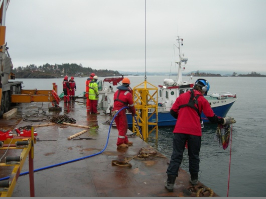
In ‘Under the sea floor (Coring and Strata)’ I was looking for sounds literally under the sea floor. At this time the University of Oslo was undertaking a research project where a 10-meter long core-sample would be taken from a “pockmark” in the Oslo Fjord, 32 meters below sea level. I slipped onto this trip via a friend and was not completely sure of what to expect apart from that I had to be careful not to get in the way! So for two days I hovered in the background on a cold, wet drilling vessel, recording sounds from on deck, below water and on the sea floor (and luckily bought hydrophones with 40 meter long cables!).

In ‘Under the sea floor (Coring and Strata)’ there are also two more sets of sounds. The first originates not from field recordings but from a seismic shot created by a large TNT blast recorded by an array of 2000 geophones spread over tens of kilometers. The sound on each geophone is about 15 seconds long and records the response from the Earth's crust and well into the mantle. The impulse and responses are very low frequency - well below 50 Hz. I obtained the geophone recordings as a seismic data set. After various tests I found that by using data from every 100th geophone the geological information was preserved while reducing the data set into a workable size. Each of these 20 data streams was converted into audible sound at the original sampling frequency of just 125 Hz. After pitch-shifting the sound was finally in a useful audible range. Using the seismic data as control data created the next set of sounds. The data mainly controlled frequency and volume modulation of sine tones. By selecting a suitable time step (speed) and modulation width (pitch variation), the simultaneous playback of the 20 data streams sonifies the seismic response. Audible interferences and correlations were also used as points of departure for compositional development.

For recordings in the third installation ‘Sand Island’ I simply buried two hydrophones under the sand in the tidal zone of a small bay on Søndre Sandøy in Hvaler, Norway. After 4 hours the tide lifts the hydrophones out of the sand and carries them into a floating bed of seaweed.

When it comes to processing it’s easier to talk about the ‘why’ rather than the ‘how’ as I use any technique and software that is appropriate. Whether it’s techniques originating in traditional ‘tape methods’ such as editing, mixing and montage or the latest spectral manipulation software, for me the point is to explore that which I find most interesting and important to the composition. This process normally begins by exploring on the one hand a sound’s spectrum, temporal and spatial shapes (the intrinsic content), and on the other hand the way the sound directly and abstractly connects to our experiences (the extrinsic content). Composition then involves making sense of the discovered information, further transformations to reinforce emerging connections, exploring counterpoints and motions and so forth. Specifically in the installations it was important to maintain compositional narrative journeys and a tight connection to my own original experiences during the field recording.


USO: How did you decide which sounds to use for this particular work called 'Sub Terra'?

NB: The installations were not originally intended for concert performance, even though now there exist concert remixes. Each installation is intended to be open for a listener entering and leaving as they wish, while the concert work ‘Sub Terra’ requires the listener to be attentive to the complete 16-minute work – an approach with involved somewhat different approaches to sound and structure. I wanted to tie narrative and recognisable sounds to the installations while the concert work would be more abstract and ‘intrinsic’. Here we have a paradox which I hope creates some degree of tension in the listening process: the installations are semi-narrative yet non-linear enough to allow a listener stay as long as they wish, while the concert work is more abstract, yet contains a level of detail and structural connections that require a continuous and concentrated listening process. For Sub Terra I created a new network from the more abstract installation materials. You may also hear materials clearly referencing the installations, but their development is somewhat different.

[ 1 | 2 | 3| Next ]

Saturday, November 08, 2008

Kim Cascone: the grain of the auditory field

Kim Cascone on diffusing field recordings outside of a performance space:

[...] Everyday auditory fields are complex aggregations, pools of sound, local and asynchronous interlocking fields of cyclic patterns; loosely intersecting, meshing and mixing into a contiguous background. The local habits and routines of people fuse into a rhythmic din, a tapestry woven from minute activities. Sounds are shaped into a seemingly random structure; we hear but don't listen to it.

[...] Each smaller zone of noise forms an aural or auditory field that we circumscribe with a perceptual horizon. If we were able to zoom out and see an acoustic map we would see many smaller fields intersecting with one another. There are no acoustic walls or boundaries in an open space. We store these structures as acoustic mementos or snapshots in time.

[...] This led to the idea of creating a new field in an existing field by diffusing sounds already present or by adding new unexpected sounds. By using an array of speakers placed in strategic positions within a field one could diffuse sounds and move them in space.

[...] One solution would be to borrow from the practice of acousmatic diffusion and diminish the role of the artist by physically locating them somewhere where they wouldn't be visible. Another way to prevent bracketing is to not announce it as an event with a location and start time. This way the people who visit the space would be in their usual non-linear listening mode for that environment and receive any sounds heard as being part of the soundscape.

[...] If the growing movement of field recording makes its focus the sublimity of the auditory field then work needs to progress on not falling into formulaic formats because they are standard and easy to interface with. If field recording is to escape the ghetto of sound souvenir or audio puzzle then break the habits which end up relying on technology to make it interesting.
Auditory fields are not music and by trying to present them as such we end up depleting them of their grain and deadening their soul, leaving little of value to share with the listener.

[excerpts from ‘the grain of the auditory field’ - pdf - by Kim Cascone]

Field diffusion


[via kitchenbudapest]

Thursday, October 23, 2008

Rob Nokes - Sound Seminar Q & A - Part 1&2

Rob Nokes, Owner of Sounddogs.com, Sound Effect Field Recordist, Supervising Sound Editor answers:

What is the job of a sound editor?
In your job what audio is expected of you to deliver?
What happens if you steal sounds?
How do you prove copyright?
In your job what audio is expected of you to deliver?
What bit depth do you record at?
Detail the sound equipment you actually use.
How did you make monster sounds sound real?
What makes a good sound?
Why is it best to record clean?
Is it better to have actors do adr?
Is there another way to avoid adr?
What is 'smoothing' or EQ?
Do you process while you record?


Is it better to have actors do adr?
Is there another way to avoid adr?
What is 'smoothing' or EQ?
Do you process while you record?
What is a series?
How best to record gunshots?
How do you make a sound bigger?
How close to the sound or actor do you record?
Do you change your levels while recording?
How best do you cut background sounds in?
What mic technique would you use to record a room?
How can you control loud sounds?
What is your underwater technique?
How did you create your favourite sound?
Do you record everything?


[via sounddogs]

Wednesday, July 16, 2008

Ben Burtt: collecting sounds for years

'Another time I went to Alaska to record glaciers breaking apart. I was taken way out in the wilderness in a helicopter and left alone on this rocky promontory 50 miles from the nearest village. About a mile away was this glacier, breaking apart and falling into the ocean. Great sounds which I used for one of the spaceships in "The Phantom Menace" as it landed.

[read the full interview - via timeout.com]

Tuesday, April 08, 2008

Frank Serafine @ Surround Broadcast Conference

The Fifth Annual Surround Broadcast Conference will be held April 16 from 9:30 a.m. to 5:30 p.m. at the Las Vegas Convention Center.

At the conference, Frank Serafine will present 5.1 On Your Shoulder: Single System EFP Camera Miking For Surround. A sound designer and remote recordist specializing in audio-for-video and post production, Serafine will explore his use of the Holophone H4 SuperMINI mic for a variety of projects. Serafine will demonstrate his setup, play examples of his work, and discuss ongoing projects.

Serafine is owner of Serafine Inc, located in the countryside of Simi Valley, California, just northwest of Los Angeles, from where he and his staff provide comprehensive post-production solutions including original music, sound design, sound editorial and supervision, dialogue editing, ADR, Foley and sound mixing.

[Surround Broadcast Conference 2008]

Friday, February 15, 2008

Mamori Sound Project


Mamori Sound Project
Workshop/residency for sound artists at Mamori Lake (Amazon, Brazil)
November - December 2008 - 2 weeks

Conceived and directed by Francisco López
"Mamori Sound Project" is a 2-week workshop/residency for professional and semi-professional artists with previous experience in the area of sound experimentation and field recordings. It takes place at Mamori Lake, in the middle of the Brazilian Amazon, and involves theoretical/discussion presentations, field work and studio work. The workshop/residency has a special focus on creative approaches to the work with field recordings, through an extensive exploration of natural sound environments. It does not have a technical character but is instead conceived and directed towards the development and realization of a collective project of sonic creation with the interaction of all participant artists.

Francisco López, director of “Mamori Sound Project”, is internationally recognized as one of the major figures of the experimental music and sound art scene. He is also a Ph.D. ecosystem biologist, with regular teaching activity in Spain and Latin America. His experience in the field of sound creation and work with environmental recordings spans over a period of more than 25 years. His work has been released by more than 170 record labels worldwide and he has been awarded three times with honorary mentions at the competition of Ars Electronica Festival. He has realized hundreds of field recording projects, commissions, live performances, sound installations and workshops, as well as research in entomology and ecosystem dynamics, in 50 countries in the five
continents, with a particular emphasis on tropical areas in the Americas, Africa and Australasia. He has carried out similar workshops at Mamori Lake over the past few years and has a detailed sonic knowledge on its surrounding environments.

Anyone interested, please contact Francisco López directly:
www.franciscolopez.net

Deadline for applications: March 31st, 2008

[malab.net]