Showing posts with label Classical. Show all posts

Sunday, February 05, 2012

Introducing: Ana Topalovic & Èdua Amarilla Zádory

U.S.O. Project is pleased to announce its collaboration for Sonic Screens 2012 with Ana Topalovic & Èdua Amarilla Zádory. 
They will be also involved by playing the two selected scores during the evening Concert that will take place in Milan later this November. 


Ana Topalovic 


As an all-around cellist, Ana is an active member of the musical scene, performing as a soloist, chamber and crossover musician. Besides standard cello repertoire Ana’s concert programs also include less known works which she is very fond of promoting as well as her own arrangements and transcriptions for solo cello and other formations. A very important part of her artistic work is the engagement with the modern music. Ana performed throughout Europe, Americas and Asia as a soloist and with various ensembles (Oltenia Filharmonic Orchestra, Vienna String Duo, Trio Incognito, Ensemble Hombroich, Pierrot Lunaire Ensemble Wien, Burst Trio, Vienna Celloduo, Palestra Trio a. o.). She recorded and broadcasted solo works, chamber music and musicals for RBB, ORF, RTS, TVR and TV Metropolis. Ana Topalovic plays on cello made by R. and A. Gagliano in 1815. She lives and teaches in Vienna, Austria.


Èdua Amarilla Zádory


“Édua Amarilla” Zádory, which means „glistening moonrise“ in Hungarian, was born in 1974, in the southern Hungarian town of Kecskemét. Her professional life in Vienna has been marked by numerous concert engagements. Whether performing solos in the Golden Hall of the Wiener Musikverein, serving as lead chair of the Vienna Chamber Orchestra, or playing alongside the other members of her „young“ Hungaria Piano Trio, Édua’s expressive and beautiful music expertly fuses Hungarian soul with the traditional Viennese sound. As of September 2012, Edua holds the status of Guest professor at the All-Quds University college of Music in Jerusalem. Édua Amarilla Zádory plays a masterpiece of a violin dating from 1801 and crafted by Joseph and Antonio Gagliano.

[www.anatopalovic.com]
[www.eduazadory.net]

Thursday, January 29, 2009

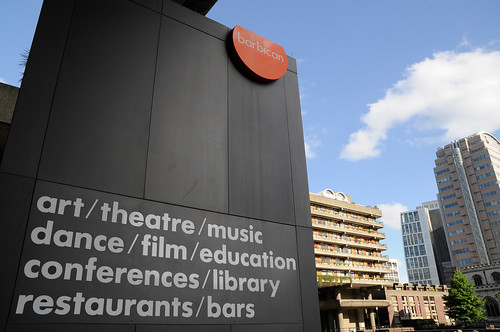
Le Corbusier at the Barbican Centre


Film & Music seasons

The film season, Visions of Utopia explores the vision and legacy of Le Corbusier through film, a medium embraced by the legendary architect himself in his integrated approach to architecture and the arts.

[via barbican.org.uk]

With the music season Total Immersion: Iannis Xenakis the BBC Symphony Orchestra celebrate the music of the extraordinary composer and architect Iannis Xenakis, who studied with Le Corbusier and worked with him on several projects, with a day of concerts, films, talks and free events.

Saturday 7 March 2009

[visit bbc.co.uk/symphonyorchestra for full details]

Wednesday, August 27, 2008

An interview with Valerio Adami

I had the pleasure of interviewing Valerio Adami in Meina (20th July 2008).

Valerio Adami (b. March 17, 1935) is an Italian painter. Educated at the Accademia di Brera in Milan, he has since worked in both London and Paris. His art carries obvious influence from Pop Art.

[source: Wikipedia]


MM: Can you talk about the relationship with the music in your painting research?

VA: When I was a child my mother told me: "Singing will help you forget." I come basically from an uneducated family, where however music was part of daily and social life. My mother was an amateur piano player, my father was an amateur violin player, my grandmother played the mandolin and my grandfather played the guitar. During the days before the war, we were accompanied by these musical rites.
In my studio in Monte Carlo I have an old Erard piano, which unfortunately was destroyed by a craftsman who tuned the strings with a modern tension; it was an instrument of 1830 and the strings had a lower tension. The grand pianos at that time entered into mass production, an impressive number.
For example, during the war, we spent days and nights in a cellar in Milan, in Via del Caravaggio, and one of the strongest memories of my youth was the descent of a grand piano from the third floor into the cellar, under the bombing. In fact my mother thought that if we could have music in the cellar, it would have protected us from fear.
In the nearby house there was the Wermacht's control station and when the officers knew that in our cellar there were amateur concerts, they invited us to go in their cellar during the air raids - it was much deeper and more protective.
I remember my brother at the piano, playing Chopin without ever having studied a note. While I'm not having any musical ear and ability, this musical passion, this need to bring the music in my life was very strong and has continued until today.
At the end of the fifties, which musicology's models could be inspirational for a boy? Theodor Adorno, for example. Musically speaking, he had an enemy, who was Jean Sibelius.
Staying for a long period in Finland, one day I listened to Sibelius and fell in love with his music. What do I have to do to take off the guilt of having refused without having ever heard him? Therefore, I did a large painting entitled "Finland", a tribute to his symphony Finland.
When one boy is desperately searching for a style, a painting thought, a form of representation, as was the entire search of my work, the objective is to find the most free and more traditional metaphor, allegory (that today is lost), which are key parts of the whole Western culture and art.
It was important for me to seek the shape and structure in dodecaphonic music by Anton Webern. From then on I developed a musical affinity and an unconditional love for all that is a difficult to listen to.


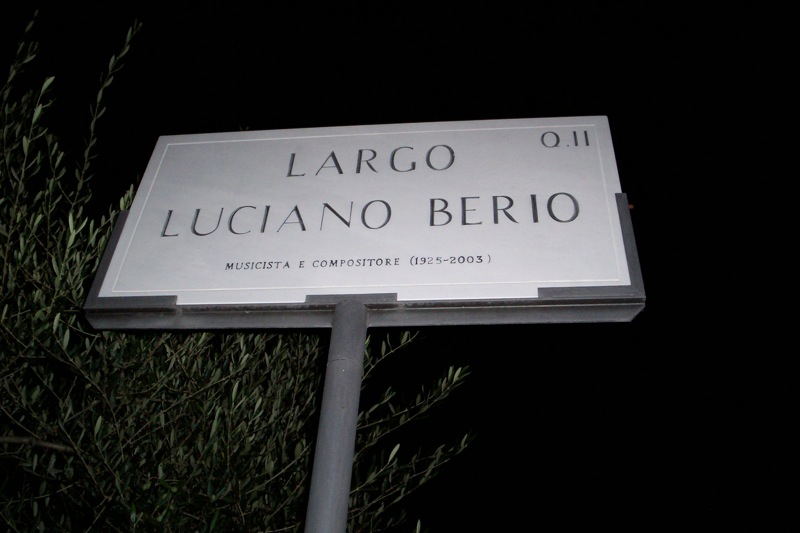
MM: How was your friendship with Luciano Berio and how did you meet him?

VA: I remember that my encounter with Luciano Berio date back to the creation of the magazine "Incontri Musicali", in 1956. This led me afterwards to Bruno Maderna and Cathy Berberian.
Luciano was one of my greatest friends, a musical genius. He brought with him an extraordinary wealth and talent. The absolute space of his life was music, without being an intellectual space, although it was a great expert (see, for example, all the Mahler's inserts in Sinfonia).
Luciano had what the Greeks called the Daemon, a genius that he brought with himself. I have loved Luigi Nono and Pierre Boulez (Mitterand himself asked me to do a portrait of Boulez), they are great composers, but perhaps they lack Luciano's continuous artistic expression.
We lived together when he was in Paris, he was always with me before he married Talia Pecker. Well, each time he departed from his home from Ventimiglia and once aboard the airplane, he began to write music. He got off the airplane, took a taxi, came to my house and immediately continued to write until late evening, to resume early the following day. Luciano was a kind of absolute consumer of what was his musical demand, his life and his nature. He fed himself from writing music.


MM: What do you think about the abstractness of sound phenomenon, the desire to transcend from reality?

VA: Music has helped me a lot during my working time. In order to listen, you must think note for note. At the same time there is a body listening. The Egyptians said that every part of your body thinks, I would say that every part of the body 'listens'.
I am very tied to a definition of painting given by the writer and philosopher Hermann Broch. The birth of painting and image, according to the greek-Roman mythology, occurred when the love of a potter in Corinth, saw the shadow of the face of his beloved, projected on the wall and drew the profile on the wall.
Hermann Broch upset all this by saying that the image was born from music: the rhythm of a primitive music is the shape of the tattoo, as a dance that is on your body. One day the tattoo came out from the body, became representation, and becoming representation, gave birth to painting.
Creativity is something that happens by an abandonment of ourselves, entering into a sort of expectation of revelation. I could define this only turning 60 years old. When you see what you draw and what you do, you say, "It's not me that I thought of it, that I did it." A revelation is happening in the creative process, especially when you realize and better define the creative process, like a musical revelation, a form, a color. We must abandon ourselves and find this moment of great expectation, where something appears and takes place. A mystical without God, but at the same time a revelation of a divine. The path of poetical sentiment comes from the heart, as well as the feeling of love, of truth and piety.


MM: Can you explain us the application of musical principles contained in painting to the design and structuring of space?

VA: At the Teatro di San Carlo (Naples), in 2004, after an absolute study of the global concept of Wagner, I realized the scenes for The Flying Dutchman (Der fliegende Holländer), an extraordinary and unforgettable experience. Wagner is perhaps the only composer for whom the image and music are becoming the same thing, a pictorial-polyphonic concert of colors and notes.
Stravinsky spoke clearly about the envy by the musician to imagine that a painter has in front a model, something to which he refers constantly. On the other hand, the painting is faced with this sort of non-model that is music. Michelangelo said that to be a good painter, you must have knowledge of music.


MM: Today The electronic music composer can build sound worlds without the need of a score. Is it necessary to codify the auditory experience?

VA: The Bible was handed down from memory. They have begun to change it when the Bible was transcribed. Before, the memory corresponded to a biblical truth much less exposed to transformation.
Those complex immense symbolic representations of the sounds escape me. An affinity between painting and music are the Ragas, which in Sanskrit means "what colors your mind". The Indian music, for example, is an unwritten music. The Indian musician must live 25 years in absolute symbiosis with his Guru. To hand down a musical memory is a complex structure, much more of our western music and it's stronger then the writing itself.
In Indian music there is a part that gives you headroom to the interpretation, but always within fixed schemes. It gives qualities to music and sound that are beyond us and that we can't assign to our music.

Interview by Matteo Milani for Unidentified Sound Object.

[original italian version - pdf]

Wednesday, June 11, 2008

Concert for the XXIII World Congress of Architects UIA

Turin - Italy
Rai Auditorium Arturo Toscanini
Wednesday, July 2, 2008
19 pm- Award Ceremony
21 pm - Concert

The manuscript of the original version of Metastaseis by composer and architect Iannis Xenakis now becomes music to listen to, in first execution at the RAI Turin, dedicated to the participants of the XXIII World Congress of Architects Uia in their evening gala.
In addition to Metastaseis, the programme provides Shaar for string orchestra and two compositions by Edgar Varése : Offrandes for soprano and chamber orchestra and Amériques for large orchestra.

Arturo Tamayo director

Carole Louis soprano

Iannis Xenakis
Shaar for large string orchestra

Edgar Varèse
Offrandes for soprano and chamber orchestra

Iannis Xenakis
Metastaseis
(absolute first execution of the original version)

Edgar Varèse
Amériques for large orchestra

[orchestrasinfonica.rai.it]
[uia2008torino.org]

Tuesday, February 05, 2008

Music Review: Berio’s “Sequenzas”


The New York Philharmonic is paying a great deal of attention this season to the Italian avant-garde composer Luciano Berio, who died in 2003. Last week Lorin Maazel delivered a commanding account of “Sinfonia,” a tumultuous 1969 work for orchestra with amplified voices. Still ahead are performances of Berio’s “Folk Songs” (in March) and “Rendering” (in May).

[read more - via nytimes.com]

Saturday, January 05, 2008

Maurizio Pollini Prospettive

A highlight of the 2007/2008 season, Maurizio Pollini's new project will launch the new year at The Accademia Nazionale di Santa Cecilia and enliven most of the month of January: no less than nine evenings with five different programs, featuring music that ranges from Brahms to Maderna, Schönberg to Chopin and Debussy to Nono.

Five years after the Progetto Pollini - the stimulating 2003 concert series that made the rounds of New York, Vienna, Tokyo, Paris and the Accademia di Santa Cecilia - the Pollini Prospettive series has been launched with the intention of setting very different musical genres in relation with one another, suggesting contrasts and oppositions while at the same time revealing unexpected and surprising assonances. Five evenings in January, on both the symphonic and chamber calendars. Two Brahms concerts, with Pollini himself at the piano directed for the first time by Antonio Pappano on the podium with the Accademia Orchestra, will include other greatly contrasting works, each one representative of its own time: Aura by Maderna, a mature masterpiece by the Venetian composer; Notations by Pierre Boulez, an emblematic work by one of the greatest living composers. Equally bold and invigorating is the pairing of piano music by Chopin with two works by Luigi Nono, Sofferte Onde Serene and the rediscovered La Floresta è Jovem e Cheja de Vida, resonant with political connotations (the electronic elements will be performed by Frieburg's Experimentalstudio). Among other friends who have joined in Pollini's project are composer and conductor Peter Eötvos, the Viennese group Klangforum and the Hagen Quartet, all of whom will give life to a fascinating journey backwards in time beginning with Karlheinz Stockhausen and winding up at Quintet Op. 34 by Brahms. Sealing and symbolizing the idea underlying the entire series, Maurizio Pollini's own recital will include music by Debussy, Boulez and Webern.

[The Accademia Nazionale di Santa Cecilia]

Friday, December 07, 2007

Working to capture a sound that rings true

Immortalizing a performance takes more than hanging a mike and hitting 'record.' There's an art to these engineers' science.

Rick Rubin, George Martin, Timbaland, Brian Eno, Phil Spector -- the average pop music fan, if asked, could probably come up with at least a handful of names of notable recording personnel. It seems fair to say, though, that the typical consumer of orchestral and chamber music recordings, faced with the same question, would draw a blank.

Yet just as in rock 'n' roll or hip-hop, the engineer for such music -- who is often, though not always, the producer as well -- is the person who makes or breaks an audio performance. He chooses and then places the microphones for a recording session and later meticulously splices various takes -- in the old days with a razor blade and tape, today on a computer -- to achieve the best possible version of a composition. It's a version that may well reach far more listeners than live performances of the work did even many years after its premiere.
...
While you can eliminate mechanical imperfections, you can't make someone an artist by making 400 splices," he says. "You can't give a violinist a more beautiful tone or a better conception of the music or a better idea of the tempo. You can make it sound mechanically and technically solid, but all the things that make 'music' can't be fabricated."

By Constance Meyer, latimes.com
December 2, 2007

Saturday, September 22, 2007

MITO International Music Festival


Museo Diocesano

5 p.m.

Helmut Lachenmann
Gran Torso
Reigen seliger Geister
Grido

Quatuor Diotima
Naaman Sluchin, violin
Yun-Peng Zhao, violin
Franck Chevalier, viola
Pierre Morlet, cello

Introduced by Helmut Lachenmann

free admission

[Settembre Musica]

----------------------------------------

Museo Diocesano
ore 17

Helmut Lachenmann
Gran Torso
Reigen seliger Geister
Grido

Quatuor Diotima
Naaman Sluchin, violino
Yun-Peng Zhao, violino
Franck Chevalier, viola
Pierre Morlet, violoncello

Introduce Helmut Lachenmann

ingresso gratuito

[Settembre Musica]

Friday, September 21, 2007

30th Anniversary of Star Wars: 8-CD Box Set


To celebrate the 30th anniversary of the first Star Wars movie, Sony Classical is releasing a one-time deluxe edition of Williams' lush, timeless themes on Tuesday, November 6, 2007. The Music of Star Wars: 30th Anniversary Collector's Edition is housed in an elegant numbered box set featuring new cover art depicting the main Star Wars characters. The box contains eight CDs.


[read more - via soundtrack.net]

[Music of Star Wars: 30TH Anniversary Collectors Edition
]