Showing posts with label Books. Show all posts

Wednesday, January 04, 2012

Ben Burtt about the genesis of the TIE fighter sounds

[an excerpt from The Sounds of Star Wars - © Chronicle Books]

The genesis of the TIE fighter sounds is another story, one that began with Ben Burtt's search for the laser gun effect.


Originally, George Lucas had seen a British documentary on PBS about the Battle of Stalingrad in World War II and had noted that the firing sound of some strange Nazi rockets was quite weird and interesting. Lucas mentioned that it might make a great sound for the laser gun and Burtt managed to find a copy of the documentary. He then set about finding sources that could emulate that sound. Luckily, at Twentieth Century Fox Studios, Don Hall let Burtt go through the Fox sound library, where he found recordings of some elephants that had been done for an Errol Flynn movie The Roots of Heaven [1958]. In that film, elephants stampeded and bellowed. with an almost shrieking sound (the same sounds were used for the dinosaurs in Journey to the Center of the Earth).
After making a copy of that recording, Burtt realized that when he slowed it down and stretched it out, he ended up with a sound similar to the rocket one in the PBS documentary.


[The Lost World - 1960]

But it wasn't quite right, so Burtt took the sound of the elephant and mixed it with pass-bys he'd recorded of cars during a rainstorm as they sped through puddles in front of a motel where he was staying (a pass-by is when a vehicle comes toward the viewer, passes by, and then speeds away).
"Swoosh, the car would come by, and you heard this car plowing through the water," he says. "I took that sound still thinking that I was making a laser of some kind." The key "a-ha" moment occurred during temp track auditions, as shots started coming in from ILM of the gunport sequence.
"When we did temp mixes and played it back for the crew at Park Way, I would take advantage of the fresh audience, because the editors hadn't heard anything with sound," Burtt explains.
"The gunport sequence came along with the first trial shots of actual TIEs in motion. There was pressure to just get some temporary sound in for a screening, so I grabbed a random set of sounds I liked and cut in a different one each time a TIE fighter zoomed by," continues Burtt. "One sound was the elephant shriek, the next one was a slowed-down World War II warbird, the next a processed jet or rocket."
After the screening was over, the only talk in the room was about that elephant swoosh sound. "That was the greatest sound for those ships you could have possibly picked!" Of course, I was saying, "Oh yeah, of course". I’d really put it in because I had no other altemative, but it got great reviews, so naturally it became the sound ofthe TIE fighters."
"ln World War II, the super dive bombers had an artificially created siren wail created by air ducts," explains Joe Johnston, visual effects art director. "They didn't serve any purpose except to create this noise, which would terrify people. It was intended that the TIE should achieve the same effect."

Wednesday, October 15, 2008

SoundDroid pt.1: the Timeline

Here's the organized output of my researches about the early days of the digital audio workstations. You can track the sources at the end of each excerpts.

Before Skywalker Sound there was Lucasfilm's Sprocket Systems, which opened in 1979 at 321 San Anselmo Avenue in San Anselmo. Film editors worked upstairs on "Raiders of the Lost Ark" and "The Empire Strikes Back" while sound editors downstairs worked on "Alien" and "E.T." Kentfield resident Pat Walsh, discovered while shopping at Seawood Photo, provided the voice for the loveable alien, with the help of actress Debra Winger. Sprocket's parking lot was also notable: It's where Harrison Ford practiced snapping a bullwhip for his role in "Raiders." Sprocket's work on "The Return of the Jedi" came to a halt when the Flood of 1982 ruined equipment. The division moved to Lucafilm's Kerner complex in March of that year.

At the peak of San Anselmo's post-production era, another space was rented on Tunstead Avenue to house Lucasfilm's new Computer Division, located initially on Bank Street. The division would move to the Industrial Light and Magic complex in San Rafael before it was spun off in 1986, relocated to Point Richmond, and became what it is today, the Oscar-winning Pixar Animation Studios.

[sananselmohistory.org]

In 1984, Lucasfilm and Convergence Corp. formed The Droid Works, and under the leadership of James A. Moorer, showed its SoundDroid workstation at NAB in 1985. The product was years ahead of its time and too expensive for the typical studio.

[mixonline.com]

The ASP hardware–based audio processor, designed by Andy Moorer after his work on the legendary Hydra at Stanford's CCRMA, was a proof of concept for what is now considered a digital audio workstation. The ASP's design started life in 1980 and was designed for real–time, multichannel EQ and mixing. SoundDroid, an in–house project of Lucasfilm's Ltd.'s Sprocket Systems that was later spun off as part of The Droid Works, was a hard disk–based, non–linear, 2nd generation digital audio workstation that leveraged the research done on the ASP. Though the SoundDroid project was never commercialized and The Droid Works was later sold to Avid, the audio development team went on to first create the NoNOISE restoration system in 1987, hosted on a Motorola–powered SUN 1, the first true computer "workstation," which had been developed in cooperation with Lucasfilm.

[sonicstudio.com]

The landmark invention of the horizontal timeline for the EditDroid and visible sound waveforms in the SoundDroid, "soft" mixing functions, a "spotting" system for searching sound effects libraries and digital signal processing and noise reduction for the SoundDroid were even bigger milestones.

[editorsguild.com]

The big guys like Lucas had the Sound Droid, which not only edited audio to picture, but performed noise reduction for noisey film sound tracks. I approached Andy Moorer about licensing the noise reduction software to clean up old masters for record companies. CDs were still new, and the record companies did not yet realize the value of their old catalogs (and I am finding out that they still don't). Andy Moorer and Bob Doris went on to form Sonic Solutions and offer No-Noise software that runs on a Mac based DSP card. The rest is history.

[rogernichols.com]

------------------------

George Lucas in his own words:

In the days when punch-in recording and high-speed rewind were on the leading edge, you went from being a user to becoming involved in the development of high technology, such as the EditDroid and SoundDroid systems in the early '80s. Could you talk about that transition?
I started putting together a computer division right after Star Wars and as one of the centerpieces of that division, I wanted to build a new [picture] editing system that was nonlinear and disk-based. It was not done like the CMX and other systems that were out at that time, which were simply designed around the offline/online [tape-based] television post process. I wanted to build something that actually included and focused on the art of editing as I learned it in school. When we did the SoundDroid, one of the things we included was the ability to see the striations [waveforms] of everything just like an optical track so that we could use some of the advantages that optical cutting had. You can see where the words are and see where the sounds are and cut accordingly, which a lot of the older editors really thought was great.

How about the transition to actually manufacturing EditDroid and SoundDroid?

When we were about to go to the next level, I realized I didn't want to be in the hardware business and run a company that built machines and things. We decided to sell EditDroid to Avid and have its ideas incorporated into the Media Composer [picture editing system]. I was very focused on wanting to have an integrated sound system so that the sound editing and the picture editing could be integrated. Unfortunately, I'm still fighting that fight.
[Larry Blake via mixonline.com]
more soon! MM
P.S. Sam shows you his love for Skywalker Sound @ skywalkersound.blogspot.com, it's an unofficial blog and it's not formally related to Skywalker Sound (or LucasFilm) in any way.

Wednesday, January 30, 2008

Understanding the Art of Sound Organization


The art of sound organization, also known as electroacoustic music, uses sounds not available to traditional music making, including pre-recorded, synthesized, and processed sounds. The body of work of such sound-based music (which includes electroacoustic art music, turntable composition, computer games, and acoustic and digital sound installations) has developed more rapidly than its musicology. Understanding the Art of Sound Organization proposes the first general foundational framework for the study of the art of sound organization, defining terms, discussing relevant forms of music, categorizing works, and setting sound-based music in interdisciplinary contexts.

Leigh Landy's goal in this book is not only to create a theoretical framework but also to make sound-based music more accessible--to give a listener what he terms "something to hold on to," for example, by connecting elements in a work to everyday experience. Landy considers the difficulties of categorizing works and discusses such types of works as sonic art and electroacoustic music, pointing out where they overlap and how they are distinctive. He proposes a "sound-based music paradigm" that transcends such traditional categories as art and pop music. Landy defines patterns that suggest a general framework and places the study of sound-based music in interdisciplinary contexts, from acoustics to semiotics, proposing a holistic research approach that considers the interconnectedness of a given work's history, theory, technological aspects, and social impact.

The author's ElectroAcoustic Resource Site, the architecture of which parallels this book's structure, offers updated bibliographic resource abstracts and related information.

[mitpress.mit.edu
]


Preface
Download Chapter as PDFSample Chapter - Download PDF (43 KB)

Introduction
Download Chapter as PDF Sample Chapter - Download PDF (76 KB)

Index
Download Chapter as PDF Sample Chapter - Download PDF (72 KB)

Monday, December 24, 2007

The Complete Making of Indiana Jones

The Complete Making of Indiana Jones will be released on May 22, 2008, the same day the fourth Indy adventure is set to hit theaters. This new book will cover the making of all four Indy movies, including Indiana Jones and the Kingdom of the Crystal Skull.
[via starwars.com]

Saturday, November 17, 2007

Manifesto for Silence - Stuart Sim

[Noise is derived from the Latin ‘nausea’, meaning seasickness]

I bought this book a short time ago and I was planning to write a topic about it soon. I decided to post these few thoughts on the blog today, after I had been to a live electronics gig by the acclaimed duo "Pan Sonic", here in Milan. My ears started to ring after the first minute of very loud playback and I went away soon.
(Sound) Art that is ‘busy’ (like this latest experience) becomes a means of filling up space so that the void is kept at bay, trying to distract us from our fears of being exposed to silence or emptiness, said the author Stuart Sim. I agree.

Silence matters.
We live in an increasingly noisy society in which silence is a threatened phenomenon. Noise and silence are locked in conflict in contemporary existence, with noise pollution becoming a major problem of the developed world.

More and more, it is coming to seem that a life of noise is our destiny. Just as there is a politics of noise, so there can, and should, be an opposed politics of silence. It is possible to speak of the virtues of silence in a general sense and to wish to preserve them in an era where the environment is being scarred by noise pollution.

Contemplation is a matter of solitude and silence, and it is very much against the grain of modern existence, which, particularly in the West, demands activity and ‘busyness’ from us as a demonstration of our social usefulness.

Noise sells.
To export technology is also to export noise. If you cannot escape from the noise, then it is an imposition, an invasion of your space and a transgression of your rights.

Silence as a living presence. Music is unthinkable without silence, which is an integral aspect of all musical composition.

Fortunately, both writing and reading this blog are essentially silent activities which do not contribute to noise pollution.


[Amazon.com]
[books.google.com]
[review - FT.com]

Thursday, August 02, 2007

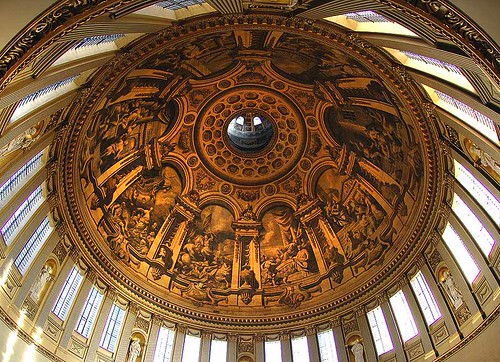
Around the world: "Whispering Galleries"

Wallace Clement Sabine (1868 - 1919), was an american physicist, who founded the field of architectural acoustics, the science of controlling sound within buildings. Sabine was acoustical architect of Boston's Symphony Hall, widely considered one of the two or three best concert halls in the world for its acoustics.

He described numerous examples of whispering galleries.

What is a whispering gallery? It's a gallery beneath a dome or vault or enclosed in a circular or elliptical area in which whispers can be heard clearly in other parts of the building.

[St Paul's Cathedral, London]

A whispering gallery is usually constructed in the form of an ellipsoid, with an accessible point at each focus. When a visitor stands at one focus and whispers, the line of sound emanating from this focus reflects directly to the dish/focus at the other end of the room, and to the other person. Circular whispering galleries may provide "communication" from any part on the circumference to the diametrically-opposite point on the circumference.

The most famous ones in Sabine's time included:

"Most, if not all, of these galleries are architectural accidents resulting from curved surfaces presumably designed for their visual impact. If you are the visitor, the sound of a distant speaker's voice is focused directly to you, as if the speaker were right next to you. The experience is unforgettable."

[source: Spaces Speak, Are You Listening?: Experiencing Aural Architecture - by Barry Blesser, Linda-Ruth Salter]
[take a photo tour via flickr.com]

Friday, July 20, 2007

Sunday, July 15, 2007

The loudest noise heard on earth

Krakatoa is a volcanic island in the Sunda Strait between Java and Sumatra in Indonesia. It has erupted repeatedly, massively and with disastrous consequences throughout recorded history. The best known eruption culminated in a series of massive explosions on August 26-27, 1883.
The 1883 eruption generated the loudest sound historically reported: the cataclysmic explosion was distinctly heard as far away as Perth in Australia (approx. 1930 miles or 3100 km), and the island of Rodrigues near Mauritius (approx. 3000 miles or 4800 km).
On no other occasion have sounds been perceived at such great distances (over 1/13th of the earth's surface).

It is difficult for the human being to imagine an apocalyptic noise as it is for him to imagine a definitive silence. Both experiences exist in theory only for the living since the set limits to life itself, though they may become unconscious goals toward which the aspirations of different societies are drawn.
[The Soundscape - R. Murray Schafer]

[What happened in the Krakatoa eruption in the 1800's? - via Volcano World]
[Discovery Channel: Explore the 1883 eruption]
[geology.sdsu.edu]

Tuesday, July 10, 2007

Monday, April 23, 2007

The Making of Star Wars


The Making of Star Wars by J. W. Rinzler comes out April 24 in both a hardcover ($75) and trade paperback version. The foreword by Peter Jackson chronicles how the future Lord of the Rings director was immediately encouraged by the original Star Wars to pick up a camera and start filming.

[order The Making of Star Wars: The Definitive Story Behind the Original Film via Amazon.com]

[exclusive photo gallery > via Wired]