Showing posts with label Education. Show all posts

Tuesday, July 01, 2014

From Organs to Organs — KISS2014: Organic Sound

From organs (biological) to organs (musical), this year’s Kyma International Sound Symposium (#KISS2014), to be held in Lübeck Germany on 25-28 September 2014, will explore multiple meanings of the phrase “organic sound” through technical talks, live performances, and hands-on workshops. 


Events will kick off with the unveiling of a major new release of the Kyma software and feature technical/philosophical sessions on topics ranging from voice processing, to sonification of organic chemicals and the Internet, to organic growth and decay, to how to build your own performance controller and use it to control Kyma via OSC, to presentations by individual composer/performers detailing how they utilize Kyma in their live performances and installations. 


Check out the lineup of presenters, composers, performers and Kyma experts here: http://kiss2014.symbolicsound.com/presenters-and-performers 

Discounts are available for students and for anyone registering before 1 August 2014. 

For travel and lodging information, please visit: http://kiss2014.symbolicsound.com/travel-and-lodging 

More information 

Saturday, October 13, 2012

Randy Thom @ VIEW Conference 2011


On Friday, Oct. 28, 2011 VIEW Conference hosted a Master Class with Randy Thom, Director of Sound Design at Skywalker Sound. He is a firm believer that the sooner the sound designer is involved in the pre-production, the better the story can be told. Randy illustrated how sound can shape a film, talking about how doors can be opened to sound. He also shared clips from movies where this kind of early collaboration has happened. Here's an excerpt of his talk during the workshop.

Sound as a full collaborator to make better films 

Alan Splet, Walter Murch and Ben Burtt where the three people who lived within about 20 miles each other near San Francisco who really brought a new revolution into American film sound during 70s. I was lucky enough to work with all three of them and “steal” some of their best ideas. One of the first things that you learn as a sound designer is not think to literally about sound, so one aspect of training your ear is to interpret sound in emotional terms. Subjectivity in filmmaking is a playground for sound: when the audience understand that they don’t figure out consciously, but what they seeing and hearing is being filtered through a character’s or filmmaker’s point of view in a subjective way. Very often working on a sequence for a film what you want to do is think of how you want the sound to make people feel and you analyze what it is about that sound makes you feel certain way and you go looking for sounds or raw material that have those qualities. 


Apocalypse Now

If there was ever a film where sound and image were treated more or less equally and allow to affect each other certainly is Apocalypse now. The first sound that you hear in the film - before any music or any dialogue - is a very odd, electronically synthesized helicopter sound - the Ghost Helicopter. Captain Willard is hearing the memory of the helicopter that he has. What you’re listening to is this guy’s brain. He’s remembering things, he’s hallucinating, he’s dreaming, he’s drunk and under the influence of drugs, he’s listening to his brain operate. The opening sequence is the launching point for all story, immediately the audience is put in a frame of mind that anything can happen, this is going to be a very strange ride. As he stands at the window looking outside he might heard a little fly buzzing: it took me a week to record that fly (laugh). At first he hears - and we hear - the sound of Saigon outside (car horns, Vespas, police whistles). Those sounds morph into the sound of the jungle: each one of those individual city sounds turns into specific jungle sound. Physically for the all sequence he’s still in his hotel room, but in his mind he moves back into the jungle.


Once upon a time in the West 

Sergio Leone decided early on that they will record all the music for this movie before they started shooting the film and they used the music during the shooting to help the actors and essentially to inform how the film is going to be shot. They were struggling how to make music and sound working together before shooting the sequence. Ennio Morricone, the composer, happened to go to a musique concrete concert - a genre involved using real world sounds, rather than traditional musical instruments - by a guy who played a latter, banging and scraping on it. Then he called Leone and said: “There’s should be no conventional music at all in the beginning of the film: instead you perhaps should shoot around the sound effects.” Leone went shooting the sequence thinking about how the sound of this little train station were going to work in the storytelling.

I think that’s a tragedy that very few studios these days will have the guts to allow a filmmaker to do a sequence like that. They say: “People are going to be bored, we have to fill up with uptempo music through the all thing”. Some budget filmmaking these days is “fear based”, it’s not an attempt to do something new, interesting and unusual, to open people imagination. It’s an attempt to avoid boring people, which is never a good motivation in art.

One of the things that these two scenes have in common is a very strong sense of point of view. Camera angle are very important to sound, believe it or not. The kind of shot, where an actor looking at nothing in particular, is another open door for creative, subjective sound, because the audience knows intuitively that they’re going inside the character’s head. It’s an open door for sound designers to put almost any kind of sound that we want. Having some ambiguity or mystery about the visual image makes it easier for me to do something useful with the sound. Extreme close-ups get across the idea of subjectivity. Long duration shot opens the door for sound, too. The character’s closing eyes is also an opportunity for sound to do something interesting (imaging, remembering...). The most difficult kind of shot is a brightly-lit medium shot, because you’re not focusing on anything in particular and there’s no mystery there, there’s nothing that invites the ear to help figure out what’s going on.

Another element they’ve in common is sparse dialogue. I’m certainly not against dialogue in film - dialogue will always has a role. Dialogue and sound design generally don’t go well together, because there’s something about the human voice that the human ear want to attempt to.
If someone is talking - no matter how hard a director ask me to try to push sound effects during that sequence - it will distract you from the dialogue, which the audience is trying to hear. The way to solve that problem is to design the sequence in a way that there are moments for the dialogue and moments for sound effects. A compromised has to be made, you can’t as a filmmaker try to fire all your bullets at the same time, it’s not going to work. One category of sound tends to dominate at a time - it’s dialogue, it’s music or it’s sound effects. Another bad tendency in contemporary filmmaking is to try to set it up so that all three dominates simultaneously, it will never works. Lazy filmmakers will just call the composer: “make some very strange music telling the audience that this is a very strange place”. As a sound designer you try to do things and variations in the same way a music composer, to use sound in pure musical way: tempo, harmony and rhythm to evoke emotion. Think about what elements in a set could generate the sound useful for the storytelling: this will be more powerful at the end, it’s not a decoration, that’s a very organic way of telling the audience “this is a very strange place”.


Sound-friendly scripts

Most writers are obsessed with words, and they tend to think words should dominate every sequence, with wall-to-wall dialogue.
Filmmakers simply don’t think about how to use sound in that way before start shooting the sequence. Think about what the characters hear. Think about how the things they hear affects them and how character changes over time. I often found people who come from visual/light background - which David Lynch did - have very interesting sound ideas. He demands you to be creative all the time.

Another thing I told to directors is: during rehearsal in a live action scene, play with your actors in terms to find things in the space that can make sound that will be useful to the story.
As a sound designer, try to imagine ways that sound could playing in an interesting but organic, truthful way to help the storytelling in the sequence. Try to think to other powerful sounds that the audience doesn’t expect. Part of your job as a sound person - I think - is to help the director make the best film possible. If you have interesting ideas - and you should have them - about the way of film shooting that allow you to do something you couldn’t do otherwise, of course you should talk about it.


Sound for Animation 

Thanks to big aesthetic jumps in animation, more contemporary animation directors want movies should sound like a live-action movie. For “How to Train Your Dragon” I come up very early on with some speculative vocalizations for the dragons that will help the animators to animate to those elements. I tried to use real-world animal sounds - tiger growls, elephant, whales, goats, camel, dogs - to cover a wide range of emotions, allowing sound to influence the animation. The challenge is how to make the transition from one to another, which needs a lot of work and experimentation with pitch-changing techniques.


Sound Mixing 

Mix is about to choose right or most powerful sound in any given moment. In a moment when you need to hear the dialogue you try to artfully lower or eliminate sets of other sounds that are competing with the dialogue at that moment. Space can make sounds useful to the story: there are a lot of others tricks like moving the sound effects and the music into the side loudspeakers and have the voices mostly come out from the center speaker, which make a little bit easier to understand the lines of dialogue. Sound is more powerful if comes from a place we doesn't expect. You need to think of sound in terms of spectrum and frequencies and tailor those for a given moment.


Related Post:

Monday, August 27, 2012

An interview with Hamilton Sterling

by Matteo Milani - U.S.O. Project, 2012 

I am happy to continue our series of interviews with Hamilton Sterling - sound designer, supervising sound editor, effects editor, and mixer who has worked on The Dark Knight, War of the Worlds, and Master and Commander: The Far Side of the World, as well as many independent films. He recently cut sound effects on MIB3 and The Host, and worked on Terrence Malick’s To the Wonder, and The Tree of Life. Hamilton was the supervising sound editor, sound designer, and re-recording mixer on Tomorrow You’re Gone by David Jacobson, and has edited sound on the films of P.T. Anderson, Christopher Guest, Andrew Dominick, and Steven Spielberg. To date he has worked on over seventy-nine feature films. 


Recording a Demolition Derby (photo: Michael Dressel)


Matteo Milani: Thanks for your time Hamilton! First of all, could you tell me a bit about your education and musical background?

Hamilton Sterling: I come from a musical family. My mother and aunt sang four, five, and six part harmony by ear. They performed as the Silhouettes on KDKA radio in Pittsburgh, Pennsylvania in the 1930’s. Both were very encouraging of my early musical interests. My aunt, who worked at the local newspaper, often brought home fascinating music: György Ligeti, George Crumb, music from all over the world. I heard the soundtrack to Fellini Satyricon before I ever saw the film. My mother was a jazz fan, and when I was a boy, would take me to listen to local groups. 

In high school I played electric bass in the jazz band and upright bass in orchestra. The musician’s union put together an all-star big band for high school students in which I played, and I also performed in the Allstate Orchestra, becoming principal bassist my senior year. I played my first jazz gig when I was sixteen years old, and entered Arizona State University on a four-year music scholarship, graduating with a BA in jazz and classical performance. 

From a social context, I also benefited from the cold war belief that the arts held importance, and that America had to out-compete the former Soviet Union in creative endeavors. Music education in elementary school and high school was excellent and generously funded. Unfortunately, for the arts and young artists, those days are gone. 


MM: Does your experience as a musician help you in your career in film sound? 

HS: I think a sense of rhythm, melody, and harmony is essential in being able to make interesting sound for film. Recent studies show that human beings are wired for music. In studing jazz, the adage of “learn the music theory, then forget it” allows the right brain freedom to improvise from knowledge. I’ve come to feel that cutting and layering sounds is a slow-motion version of improvisation. 


MM: How did you enter the movie industry? 

HS: Alongside my musical activity, I became obsessed with films. Stanley Kubrick’s 2001: A Space Odyssey became the impulse for much of my early creative life. I saw the film for the first time when I was ten years old. It brought to me an interest in modern classical music, archeology, cosmology, astronomy, AI, cinematography, and special effects. It also appealed to my budding existentialism. That any one object of art could do so much was, to a young mind, amazing. 

It may seem hard to believe, but public television at that time played films by Antonioni, Godard, Fellini, Losey, and Bergman, and the art house cinemas were still going strong. I began making short films in the summer vacations between school from the money I made playing music. When I came to Los Angeles in the early 1980s, sound seemed a natural fit. I began by editing documentaries, Warren Miller ski films, industrial films, until I got my first sound effects editing work on Alan Rudolph’s Trouble in Mind. 


MM: Choosing the right sound(s) to picture. An art form? 

HS: Because sound editing began as a technical blue-collar job, many people had the impression that what we did was nothing special – “A monkey could do it” was the often-heard refrain. Here in America, we never developed a militant artistic union, an aesthetic of labor, if you like. Of course, because many of the corporate films being made today are empty of artistic merit, to say nothing of merited thought, it’s no wonder that art and labor are still dirty words. Choosing the right sound is an artistic, and surprising moral endevour. Thinking back on choosing sounds for films I did twenty-five years ago, if you had a scene in a rough cityscape, one might choose a black voice yelling in the street. The effect of that implying threat (at least to a certain part of the population). And that is a choice that can subtly further social injustice. I’m not saying that an artist should proscribe their work, but one has to very conscious of one’s choices, because in mass entertainments, those choices may reach millions of people, and they have consequences. 


MM: You've frequently shared your nominations with Richard King, Christopher Flick and Michael W. Mitchell. How do you guys collaborate on projects? 

HS: When I worked for Richard King, I did sound design and sound effects editing. Occasionally, I did sound effects recording. The frog rain in Magnolia was re-recorded against the reflections of a cliff in the Angeles National Forest. We set up two speakers facing away from the microphones, and slowly rotated the speakers toward mic, giving the playback the effect of distant frogs falling toward us. Eric Potter and I also put a speaker in a pickup truck to record a playback of previously sampled frog elements. Eric put the truck in neutral and steered into the quiet, distant valley. The sound was incredibly bizarre, and I ruined the heads and tails of multiple takes by laughing. It’s always fun to get out into the world to record, and Richard loves to record. 

Chris Flick did all the programming and cutting of the foley, and we conferred with him on elements that effects needed help with. As to the sound effects editing, Michael Mitchell and I did a lot of heavy lifting. Richard cuts sound effects as well, and in this day and age, I admire him for it. 


MM: Would you like to explain your role when working with the other members of the sound editorial?  

HS: When I’m not supervising, I try to communicate very specifically with the supervisor and my fellow editors: what are the stage delivery requirements, the predub breakdowns, or whether there will even be predubs, who is doing what in terms of special design. Hopefully, the supervisor has been able to spot the film with the director. If there is little in the way of specific information, I get a sense of the aesthetics of the director from what’s on the screen. If what you see is a pack of cliches, you know what to expect. If there are few cliches, you have reason for hope. At the end of the day, your work is only as good as the director’s vision, and their courage to take risks. 


On the Cary Grant stage at Sony on Morning (photo: Leland Orser)


MM: What are the musical tools you use to boost your sound designing workflow? 

HS: A number of years ago I purchased a Kyma sound design system from Symbolic Sound. It is very useful in producing unique sounds. It’s always inspiring. I also use my old Kurzweil K2000 as a midi controller, a Haken Continumm fingerboard, and a PC2R. In studio I use Millennia mic preamps. For field recording I use Schoeps mics and Sound Devices mixers as well as different contact, ribbon, and dynamic mics to gather my sounds. My bass is fitted with a midi pickup that I also use through an Axon to trigger my samples. 


MM: Sound processing: can you give us a description of your studio gear? 

HS: I use Pro Tools HD3, Genelec 5.1 speakers with a MultiMax monitor, and many plug-ins. For picture I project HD through a Decklink card to a nine-foot screen. Aside from Kyma, Haken Continuum Fingerboard, Kurzweil, and Axon, I have on occasion used Beat Detective in Pro Tools to place rhythmic structure onto multiple effects, and Melodyne to re-engineer animal vocals. I just started using Battery as a sampler. Altiverb, Pitch ‘N Time, Lowender, and GRM tools are staples. 


MM: Can you reveal to us a "making of" of a very special sound effect(s) or a sound sequence? 

HS: I’m very proud of the storm sequence in Master and Commander: The Far Side of the World. Making the scene dynamic given the similarity of frequencies both in the water and the wind was an interesting problem. First I began by cataloguing the ocean sounds into frequency ranges from low to high. I catalogued the wind in a similar way. At the time, Warner Bros. had terrible editorial rooms that had not been updated since the 1950s. Not only was there no surround system, but there was no wall treatment of any kind. Anyone who has had to edit endless water and ocean effects knows that in a box-like room with hard surfaces, audio hallucinations in the white noise of the waves can produce boat engines that aren’t there and other weird effects. So I brought sound blankets from home and hammered them into the walls. I scavenged an extra pair of speakers from an adjoining room and built myself a primitive surround system. I cut the sequence in 5.1 tracks that would mirror the mixing console and internally panned and level-set everything. Because the water visual effects were actual layered shots of waves, they changed constantly. But the first time I cut the sequence, I really liked the rhythms I had found. As the sequence changed, I was determined to keep this poetic kind of rhythm, so instead of just cutting up the tracks in conforming them, I took the time to find new rhythms and create the sequence anew each time it changed. I was very tough minded in this approach. Fortunately, I was given the time to do this – something that is unique to this day. I then cut the hard effects in the same 5.1 style and processed the siren’s call of the wind in the rigging through Kyma. When the edit went to the stage in this form, the mixers worked on it for a couple of days, trying to tame it. Much to their kindness, they told me they decided to put it all back the way I had originally laid it out because it had a life to it that their smoothing of the rough edges took away. That’s the way the sequence was released. 


MM: What do you regard as your most important credits in your career thus far? 

HS: The Tree of Life and The Assassination of Jesse James by the Coward Robert Ford are my two favorite films. They’re closest to the feelings I felt as a young man introduced to the great European cinema: thoughtful, unsentimental, mysterious. They capture something of eternity. 


MM: How do you get involved with the movie “The Tree of Life”? What kind of approach did you take on foley? 

HS: I have known the sound supervisor, Craig Berkey, for many years. Erik Adahl had hired me on Transformers: Revenge of the Fallen, and mentioned me to Craig. We fell back together again, which is the way of the film business. Andy Malcolm of Footsteps Studios walked the foley. Realism and proper perspective (using multiple mics) is very important. Because Mr. Malick often uses non-synchronous production takes, foley is used to ground the characters within the scene. It becomes another part of his pallet. When it is absent, that too becomes a color. 


MM: Can you describe how some of those sounds were accomplished? 

HS: Andy originally used his house as a foley studio. It’s out in the middle of the Canadian wilderness – forty-five minutes from Toronto. The stairs really creak, he never sweeps his kitchen. It’s all real. (Just kidding about the kitchen.) Now he has a fabulous studio a stone’s throw from his house, so you get the best of both. 


MM: How was the communication with the director and the rest of the team? 

HS: I was only on stage for a few hours during our first temp mix. But I was struck by Mr. Malick’s graciousness. I truely admire his work, and have since I first saw Days of Heaven as a youth. 


MM: To mix "in the box" in sound editorial before the final dub: what are its pros and cons? 

HS: Unfortunately, schedules now seem to only allow the sound effects to be mixed in-the-box. Even on the most well-financed films, mixing in-the-box is now common. On Knight and Day (James Mangold), we pre-mixed all of the sound effects and ambiences into 5.1 groups and kept them virtual. We had a couple of weeks to adjust these pre-mixes on the mixing stage, as the console on the Cary Grant stage at Sony could mirror Pro Tools. But the number of tracks and the constant changes necessitated having to continually re-mix added elements in-the-box. I recently did some work on MIB3, and at least for the temp mix, the effects were pre-mixed in-the-box, then taken to the stage for final adjustment. Keeping a somewhat traditional separation of elements is helpful for conforming, as well as giving the sound effects mixer creative input. If you set your editing room up correctly, it can work out quite well. Of course, sound editors are not being paid as mixers, so there are ways in which this situation is financially disadvantageous. But it is creatively rewarding. For independent films, the future is here. With the track counts of the new Pro Tools HDX cards, traditionnal mixing facilities will have an increasingly difficult time staying afloat. Unfortunately, many fine mixers will as well. 


MM: A networked environment: can you describe the importance of a client/server architecture in sound post production for a feature film? 

HS: It’s great to have. On Knight and Day we were editing at another facility before we moved to Sony for the mix. Sony has a nice server system for moving your work to and from colleagues as well as mixing stages. Structuring the folder architecture on the server is extremely important. Knowing exactly what elements have come from the mixing stage, what needs to be updated, what needs to be mixed, may seem simple, but with multiple versions, competing creative interests, and huge amounts of data, organization and terminology is paramount. 


MM: Sound effects editing for multichannel-surround: what are you spazialization techniques? 

HS: I edit for the 5.1 pre-mixes. When I do have to spread an effect, I’ll use a little delay, reverb, or the Waves PS22. I’ve recently begun using the Schoeps free DMS plug-in for three channel field recording that decodes to 5.0 surround. I love the Schoeps plug-in. Now I record all my sounds on three channels and decode to 5.0. Even simple sounds, like a light switch, pick up the character of the room. It’s a facinating way of creating a feeling, using these simple multi-channel sounds. If the simple sound creates an interesting space, I’ll work backward, and using Altiverb, try to get the rest of the sounds of the scene into that same environment. Of course if it doesn’t work, you still have the mono or MS stereo recording. 


MM: You made a film in the late ‘90s. Did you do your own sound? 

HS: I supervised it and cut, but I had a number of wonderful friends from the sound editing and mixing worlds who helped me to complete it. Because of current events, I decided to prepare a new version of the film, Faith of Our Fathers, for Blu-ray and DVD, and re-construct the sound for 5.1. As I began to re-assemble all the elements, I realized that we who started in the business in the mid-1980s lived through a radical transition in our work. At the time magnetic film was all there was. But by the time I shot Faith of Our Fathers in 1991, the digital world was just beginning. Faith was originally shot on 16mm film with a 1:1.85 ground glass for theatrical blow-up to 35mm. All the dailies were 16mm. I had obtained from a friend, one of the first Sony D10 Pro DAT recorders in the country. It was strictly grey-market. I thought I could mix and record the production sound to one channel and put a 60 cycle pilot tone on the other so that when transfering to magnetic stock (both 16mm and later 35mm) the transfer machine (“dubber” we called it) would stay in sync. So, over a long period of time, friends and I sunk and coded the 16mm dailies. I cut the picture, and when it was time to prepare the track for 35mm mixing in 1995, I used a 16mm to 35mm synchronizer to phase the new 35mm dialogue to the 16mm worktrack. The dialogue was cut on mag. The backgrounds were a combination of 24 track two-inch and DA-88s (the bane of all mixers at the time). And most of the sound effects were cut on an early version of Pro Tools which were then transfered to DA88. When I decided to do my 5.1 re-mix, I had 35mm mag to transfer to Pro Tools, DA88s (I still have one of those boat anchors which work!), and DATS with original production and music. When I think that the process involved 16mm mag, 35mm mag, Pro Tools, 24 Track, DAT, and DA88s, it becomes evident that the transition from analog to digital was quite messy. The other shocking thing is that I was able to finance my film on a sound editor’s salary (which is the reason it took so long to complete). 


MM: What are your thoughts on the boundaries between music and sound design?

HS: Having recently released Migration, I can tell you that creating a 5.1 programmatic musical soundscape is a wonderful artistic process. Combining a purely aural narrative with the abstraction of music and processed effects blurs the creative experience. I don’t mean just adding a sound effect to a music track, I mean creating the entire living thing as one artistic statement. There is a universe of possibility in the soundscape form, and because of my musical life, the addition of ambiences and effects to create emotion is a fullfillment of who I am. Other examples of soundscapes that I like can be found in the plays of Romeo Castellucci’s Socìetas Raffaello Sanzio and the Wooster Theater Group, both of which I find inspiring. As to the boundaries between music and sound design in film, I would say they have been nearly erased. I just completed the film Tomorrow You’re Gone, with Michelle Monaghan and Stephen Dorff. Kyma was used extensively in creating a very musical soundscape in which to set the traditional effects. 


Recording 5.1 ambience for Tomorrow You're Gone (photo: Cris Lombardi)


MM: About your album releases: do you think that detectable technical processes are an integral aspect of the composition’s overall aesthetic? Is it important in this composition that the listener is aware of the technical processes? 

HS: The album Rise and Fall is made mostly of live loop improvisations featuring fretless bass, acoustic bass guitar, and midi-following synths and effects. It grew out of musical feelings, a very simple midi-synth/live stereo mix chain, and the need to not multi-track, or manipulate the live performance. In that respect, technical qualities like midi delay, or tracking annomilies by the Axon pitch controller, were of secondary importance to the spontanious capture of the music. No meta statement should be implied from these technically primative recordings, other than they were all done with as little post-production as possible. As for Migration, the soundscape album I created with Grammy-winning musician Jimmy Haslip, that is a piece that was conceived and composed for surround. It’s feelings and scope are purposely cinematic. 


MM: What's the most important tip you've ever received regarding sound? 

HS: Often on big films, the amount of audio ideas brought to the process can be overwhelming. Sitting on the mixing stage listening to Steven Spielberg, Michael Kahn, and John Williams discuss how best to tell the story of a scene on War of the Worlds, I was struck by their equanimity toward music and sound effects. For them, it is all about story. Their years together have created a language around this idea. What tells the story in a particular moment, and what elements do you have available to do that? An agreement on what the story is allowed them to know what to emphasize on the track. Other filmmakers see story differently, or dissect story as myth and power, and therefore take a very different approach. I love the sound of Jean-Luc Godard’s films because it is a featured element in the argument. Film Socialisme begins with a line-up tone that moves from speaker to speaker around a 5.1 mix. It introduces his dialectic between sound and picture within the contemporary structure of multi-track films. It’s brilliant and very funny. 


MM: What is the most important topic you would want to talk about to make post sound better? 

HS: Forcing USA corporations, either by massive tax penalties or heavy import tariffs, to hire the workers in their own country. Too many of our sound jobs are being outsourced. Germany has good unions, pays its workers well, and has an export rate second to none. The old saw that in-country labor produces products that can’t compete is obviously not true: Germany has a 7% trade surplus. The sad truth is that USA corporate profit is at an all time high, CEO salaries are at an all time high, and too many people are unemployed. Corporate contempt for basic decency is the primary problem at this moment in history. It will eventually change, one way or another. 


MM: Do you have any advice for anyone who is interested in a career in the sound dept? 

HS: With the technology of audio, music, and picture in an ever-increasing cascade toward the infinitely complex, having the time to learn the programs, plug-ins, hardware, softward, picture formats, and optimal work-flow process, is itself becomming a full-time job. Having the mental space to discover why you want to do it, and what doing it even means, to you and to society, is something that young people should consider. This work used to be the wild west. Most of it, for the time being, now sits inside the corporate world. That is not a world that should be perpetuated. So then it becomes about making art, with no potentially viable means of making a living. Last quarter Migration streamed 2500 times and made 3 cents. So is this a risk you are willing to take? Do you see the world differently, and have something to say about it? If so – and now I’ll paraphrase Stanley Kubrick’s advice to young filmmakers – “Get a camera, as soon as you can, and start making films.”... or music, or soundscapes, or installation art. If you are meant to work on a handful of great films in your career, somehow, with luck, you will make it happen. 


MM: Silence is mentioned a lot when discussing sound. What was your approach in its usage? 

HS: As John Cage pointed out, silence is never truly silent. But one must be silent in order to listen. 


Monday, June 04, 2012

OnMedia - GRM Tools Workshop

Milan - Saturday, June 9th 10:00 to 12:00 and 13:00 to 17:00

Fifth round of the cycle, 'European centers of research on sound and new media'

Focus FRANCE: Ina-GRM_Groupe de Recherches Musicales, Paris
Guest speakers: Emmanuel Favreau (Chief Engineer for the Development of GRM Tools), Francois Bonnet (Research, Teaching and Curating activities)

[Pierre Schaeffer and Bernard Parmegiani, courtesy of Ina-GRM]

Ina-GRM (Institut National de l'Audiovisual - Groupe de Recherches Musicales) in Paris is a pioneering organization for musique concrete, acousmatic and electro-acoustic music, whose history dates back to the '50s, when it was founded by Pierre Schaeffer. Always engaged in the development of creative activity, research, preservation and dissemination in field of music and recorded sound, the GRM is an experimental laboratory unique in the world. In response to expectations and needs of musicians, composers and sound designers, it is highly specialized in the development of a range of innovative tools to treat and represent the sound: the GRM Tools and the Acousmographe. The activities of music creation and production are mainly grouped at Studio 116 in the Maison de la Radio in Paris.

Grm Tools Workshop
Up to 10 participants.
Bring your own laptop and headphones.
The workshop is free and is held in Italian by Emmanuel Favreau along with Francois Bonnet. During the seminar, after outlining a brief history, Emmanuel Favreau will explore the possibilities of digital sound processing with the latest Tools developed by GRM; he will also deal with issues related on how to interact with the musician.
These notions will be illustrated by demonstrations in real time and musical examples from the repertory of electroacoustic music. After the workshop Francois Bonnet will present the lecture 'Music and sound in space, an introduction to multichannel compositions'. The meeting is open to public, and will present the research activities of the Centre in Paris plays through spatialized listening sessions and projections.

For information and registration: on@on-o.org

OnMedia is focused - from September 2011 and throughout 2012 - in a wide range of events including a series of conferences dedicated to the most important European centers for research on multimedia sound, art and technology, a series of workshops on subversive listening, presentation of international visual artists and authors who use different media and languages, concerts and performances.

[More info: on-o.org]

Related Posts:

Sunday, December 04, 2011

Pixar Animation Master Class at 66th Venice Festival

On Sunday, Sept. 6, 2009 George Lucas presented John Lasseter, Andrew Stanton, Brad Bird, Pete Docter and Lee Unkrich with the Golden Lion for Lifetime Achievement at Venice Film Festival. This is the first time in the Festival’s history that the Lifetime Achievement award has gone not to an individual filmmaker, but to a team of filmmakers. The next day, the Festival hosted a Pixar Animation Master Class on storytelling: during this rare and exciting panel dedicated to the Pixar filmmaking process, the directors discussed the various aspects of bringing their stories to life.

 
[Photo credit: graphicalSound]  

John Lasseter 

Animation is the most collaborative among art forms; one of the things that is very special about Pixar is the collaboration, never has a studio been so collaborative.
At Pixar we make films to entertain our audiences, all across the world, both children and adults. We make movies for ourselves, the kind of movies we would like to watch. We all have kids, we all love movies and we all love animation and this is what we wanted to do from the beginning as filmmakers. We (the creative Brain Trust) get together to help each director to make the movie the best it can be, and the director knows that. And so he takes the notes that make the movie better.
One of the things I remember more clearly of when I was a very new animator at Walt Disney, is a great professional called Ollie Johnston, a fabulous animator. I was not a great drawing person, my students were a lot better than me. At that time, when I was struggling drawing in a scene, he took my stack of papers and started flipping it. And I thought he was going to start talking about the drawing. But he turned to me and he simply asked: “What is the character thinking”? That simple statement from this guy hit me so strongly, that it became kind of a foundation of everything I have done after that point.
When you look for “animation” into the dictionary, one of the definitions is “to give life to”. The thing that I have always loved about animation is creating life. In our films the animator and the animation are the act. An animator must animate a character so that every single movement appears driven by that character thought process. That is when it becomes a thinking character.
You are moved by these characters, you believe in these characters. All the meticulous and hard work should be completely invisible. We wanted the audience to be involved in the scene and not to think that Nemo is a bunch of computer layouts. We do not want you to think about the many hours that took to create that scene. You are just carried away by the scene and every focus in every step of the production that we do at Pixar is about the story. It is about entertaining the audience.
We are constantly changing and growing, trying to make things differently. One of the things I stress in animation, is that you have to show your stuff really early: every single morning each animator shows his stuff so we can be sure they are on the right track. I also get inspired by what the animators do without telling them to. In Pixar we have a room with a video camera and mirrors so they can actually try out the acting of the character.
Walt Disney once said: “for every laugh there should be a tear.” This is the foundation of every Pixar film. This is not about animation, it’s about making films. I say something to my sons: “I want you to choose a profession that you love, because if you do you’ll never lose a day in your life.” And this is true for everybody, we work so hard, many long hours, but we so dearly love what we do.
Now we are going step by step through the entire process on how we make a movie, on how we develop stories and on how we can tell a story visually. 


Andrew Stanton 

In Pixar there is no politics, we are all employees, we do not have agents, no creative executives, no deal-making. We are very similar to the old studio systems where the artists work under one group on multiple projects: I’d like to call it a film school without the teacher. It’s a filmmaker driven studio, we invest in people. As John has previously described, we have a creative Brain Trust where the directors get together sort or like doctors conferring on another doctor’s operation. And we also have in-house original ideas, based either on ideas that the directors had, or stories the directors like or want to invest in. We pick one idea and we hammer on it. Again and again, until it finally is good enough to show other people.
First of all it is not just for kids: basically we make the movies we would like to see, we are film-goers first and filmmakers second.
We work hard on making movies as original as we can, in other words we think more like our own audience, what I’d like to see if I were the audience who wants to enjoy themselves as much as they did on the last film, but every time in a new way.
Being stupid is only possible if you are in a creative estate environment. So the truth is that we are not good at getting it right at Pixar, but we are really good at getting it together when we are getting it wrong in fixing our mistakes. And I think that’s really where our specialty lies. And the variable is that we have discovered something fresh from having made those mistakes. So we don’t try to avoid it, we embrace the idea to make mistakes.
The script is not the end of developing a story, it is the beginning of it: to me screenwriting is not writing, it is an intermediary form, it’s a way of passing all the ideas in your head to the screen. It’s also what I’d like to call cinematic dictation. You’re just basically notating what you have seen in your head, when you are trying to catch the visual aspect of something.
We just wanna tell 2 + 2 and let the audience decide on what 4 is. And that’s really the way to construct anything. The way dialogue is done, the way actors act. The way scenes are put together. I think you can apply it to any aspect of film-making. It is all about audience participation. Movie-making is all about manipulation, but it is only truly successful if your audience has no idea that they-re being manipulated. In most cases 2 + 2 gives you a greater sum than 4.
How you tell the story becomes as much important as the story itself. Even a great joke can be murdered by a bad joke teller. So the joke and the joke telling are equally important.
Personally I think you have to develop both characters and plot simultaneously. Plotting to me is your means of discovering the character. Then once you have found what that character is, you have to link them together, one begets the other.


Brad Bird 

If we are going to talk about breaking the rules, we have to know what the rules are. And this is what storyboarding was traditionally used for, it was used to work out business for the characters, what the characters were doing.
I got my first opportunity to do my first feature film, it was Iron Giant. I had a third of the money and a third of the time I had for the other animated films of our competitors. So I dealt with something unfamiliar with animation, this was Warner Brothers, not Disney. They had limited power with visual imagination, so we had to find a quick and relatively cheap way of getting closer to what we were envisioning. We spent a larger percentage of our budget on storyboarding, because it was the cheapest place to make the stage. We couldn’t afford to do anything else, we got to look and know exactly what we were doing before we did it.
When I came on to Pixar to do The Incredibles, we had a different sort of problem. It was to enlarge the scope without enlarging the resources. I had way more resources than I had for Iron Giant, but the scope of the film was so huge.
The Incredibles was a fast cutting film, large location to a large shot camera, the only way to wrap our heads around it was to figure it out early. The downside of that is that you’re kind of locked in. The upside of it is that you know much more about the rhythm of the film and the specific needs of each shot.
Film is alive, it is a medium, it is a dream medium and dreams are unpredictable. There is a difference between sleeping and dreaming. One is active and one is throwing yourself off balance. Don’t take anything for granted: it’s a way to keep your company, your movies and yourself alive.


Pete Docter 

Everything you see on the screen has an emotional charge. Characters, locations and the props in there exist for very specific story reasons. This is the primary job of the set designer. The first question a production designer should ask himself is: “what is the story about emotionally”? Designing for computer animation has no accidents, everything you see has to be intentionally designed, built, shaded and lighted.
Film-making is discovery. We do not just start drawing, we do a lot of research. The sense of authenticity really helped us capture an emotion. We wanted to look authentic.
The primary job of the lighting is to direct the eye. There is a whole lot of tricks to make sure people are looking where we want. The second job of lighting is emotion. And John (Lasseter) says that light is much like music and can really emotionally affect the eye. We are all trying to get inside the head of the character. Use light to represent how that character is feeling.
Lighting really works the same way it does in live action, so you have lights everywhere to get the final shot. Lighting is not left to chance, everything is planned for an impact. The quality of work is due to the fact that we are working with some of the best professionals in the world. The ultimate goal of lighting is to make the audience feel something.

Related Post:

Pixar: 25 Years of Animation Exhibition


The Pixar exhibit that was originally displayed in 2005-2006 at the Museum of Modern Art in New York City has been touring the world. Now, it's running from November 23rd 2011 to February 14th, 2012 at PAC (Padiglione d'Arte Contemporanea), Milan (Italy).

 [www.mostrapixarmilano.it]

[follow @leeunkrich, @andrewstanton, @Pixar_Mi on Twitter]

Monday, October 03, 2011

Richard Beggs @ P.A.I.F.F.

From Apocalypse Now to Twixt: Sound Design with Richard Beggs

I have a masters in painting and it remains the motif of my work. I am an audio painter. #

I work thematically I like sounds that are motific. #

I have a very idiosyncratic work style... I like to be involved w/ every aspect of the track as the picture moves forward. #

Very important to be on the set, to absorb the feelings of the whole crew & to be in tune w/ the sensibility of the Director. #

The film exists on 2 levels: the sound that you see and sound that you don't see. #

I am in the biz of manipulating people. Sound can do that. #

Sound can convey emotional complexity without music, just with pure sound. #

When someone wants to work with me, I always asks "Why?" Because it informs what they know about me + what they like. #

On a smaller pictures you're given a lot of latitude, on the other hand limited resources make things challenging. #


courtesy of
paiff.net
twitter.com/PaloAltoIFF
twitter.com/Dolby
facebook.com/PaloAltoInternationalFilmFestival

Related Posts:

Friday, August 26, 2011

Rome Calling – The Audio and Loudness Seminar of 2011

In June 2011, some of the most respected audio authorities – including George Massenburg, Bob Katz, Florian Camerer and Thomas Lund – gathered in Rome, Italy, to share their thoughts and experiences on loudness measurement in connection with recording, mixing, mastering and broadcasting. The speakers at the seminar in Rome included such capacities as Simone Corelli, Alessandro Travaglini, Richard van Everdingen, among the others.
The first day of the seminar focused on post-production, while the second day concentrated on professional broadcasting and particularly the radical changes happening in production and distribution of broadcast, film and music as a consequence of new ITU and EBU standards.
The groundbreaking and comprehensive EBU R128 loudness recommendation was investigated from a multitude of angles, as was the just updated ITU-R BS.1770-2 broadcast standard.
Tc Electronic documented the event and on this page they have gathered some of the footage form the seminar. First up are Florian Camerer and Richard van Everdingen from EBU’s PLOUD Group.
Florian provides a general overview of EBU’s R128 broadcast standard presented with great enthusiasm and a twist of humor. New videos will be available soon!


Sunday, May 01, 2011

An interview with Otto Laske

by Federico Placidi and Matteo Milani - U.S.O. Project, May 2011

Otto Laske is a composer internationally known for his work in computer-assisted score and sound composition. In the 1980’s, he co-founded and co-directed the New England Computer Arts Association, NEWCOMP, together with Curtis Roads (1981-1991). In 1999, his 25-year long work as a cognitive musicologist was introduced to, and explained to, a larger public in Jerry Tabor’s 1999 Otto Laske: Navigating New Musical Horizons (Contributions to the Study of Music and Dance). The book contains a comprehensive bibliography of Otto’s compositions, poems, and musicological writings.

Otto Laske has always been seen as an innovator, both in theory and composition. After a career in music, he became a knowledge engineer in the 1980s and a psychologist in the 1990s. Since 1999, in addition to his compositional work, he has practiced as a developmental coach and management consultant based on a methodology created by him, called the Constructive Developmental Framework (www.interdevelopmentals.org). This methodology for assessing individual’s developmental potential shares certain global structures with Laske’s cognitive musicology of the 1970s and 1980s, in that it is multi-dimensional, dialectic, and based on empirical research.

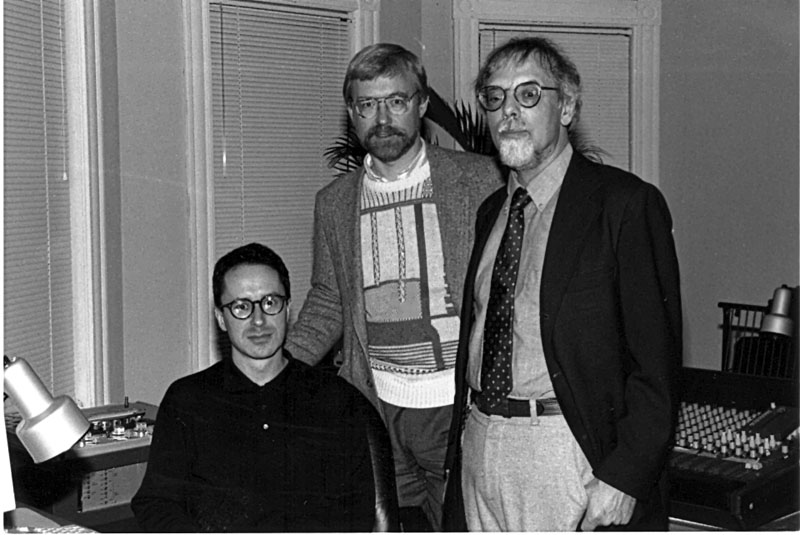
[Barry Truax with Curtis Roads and Otto Laske, Cambridge, MA, 1989 - courtesy Barry Truax]

" [...] a theory of music has to understand not musical results but rather the mental processes that lead to such results." - Otto Laske

"Looking back at 43 years of making electronic music, it's clear to me that ever since I began composing in 1964, the development of music technology strongly shaped my compositional ideas. The artistic task seemed to be to show that new technologies can indeed produce "art." At the same time, these technologies brought forth new compositional ideas not elaborated before. In short, a stark interdependency of compositional thinking and technological possibilities prevailed. When listening to my various compositional adventures today there is, for me, a certainty aesthetic unity that binds all of my pieces together. It will be up to historians (once they have become knowledgeable about the technology underlying these pieces) to judge them from a more balanced perspective than is perhaps possible today." - Otto Laske, January 2010


Computer Software Based Composition

My background is in both philosophy and music, not to speak of poetry. I studied with Adorno in Frankfurt: a philosopher and composer who shaped my thinking for a decade (1956-1966) and also helped me to emigrate to the U.S. in 1966 in order to study computer music. He also made me aware of the Darmstadt Music Festival, at which I met Stockhausen, Gottfried Michael Koenig, Ligeti and Boulez, among others. The first time I went to Darmstadt was the 1963: I was especially taken with Stockhausen as a teacher and with Pierre Boulez' notion of orchestration virtuelle, by which he meant that a professional composition contains elements that are not immediately obvious or even hidden, but have to be there to make a rich composition come to life. This notion of Boulez’s has accompanied me all my life, and not only in music, as much as P. Klee’s Das Bildernische Denken.

My main musical mentor, although not as a teacher of composition, is Gottfried Michael Koenig. I met Koenig in 1964 when he first presented Project 1 to colleagues. While his program was unfamiliar to me, I had previously studied with a German composition teacher (Konrad Lechner) who was very influenced by medieval music, as well as the works by Webern and Stravinsky. He had taught me something called micro-counterpoint by which he meant minutely working-out selected musical elements (such as, e.g., 10 rhythms, tones, or tone colors) and bringing them into the form of a cantus firmus on which to base a larger composition, under the intense influence of the ear.

When I listened to Koenig in his lecture at that time, I understood him to be talking about parametric counterpoint, counterpoint of parameters like pitch, duration, instrument color, register, volume and so forth, as Lechner had done. The difference was his use of computers for composition. What captivated my interest in computers was not the hardware, but the idea that compositions could be designed on the basis of contrapuntal ideas so that different parameter streams (lists) could be merged to create new sounds, either in ideal time (through notation), or in real time (electronically). In all of the computer programs of the sixties, such as those by Xenakis and Mathews, what interested me was expanding my contrapuntal, multi-dimensional way of working.

When I sit down to compose music using a program like Project 1 or Kyma, I find of central interest the feedback loop between the frozen and the living knowledge that is engaged: the frozen knowledge embodied by the computer software, whether it is knowledge of an instrument, waveforms, envelopes or knowledge about deforming and sequencing visual images, and the living knowledge in the composer’s mind. In my writings, including in Computer Music Journal, I always emphasized that a computer used in music (including its interface with the user) should have as much intelligence as possible, including the ability to learn from the user. I was always disappointed that this has been made possible to date by programmers only to a small extent. My notion regarding this was to permit the composer to build new “task environments”, a kind of artistic homesteads in which s(he) could re-use fruitful ideas and presets, or even understand his/her compositional process better.

I think that the new concepts engendered by computers are valid in many artistic fields. When I work with my painting program today, or make animations accompanied by music, I find much greater openness to the idea of having the computer program “know its user”. It seems to me that the visual programs I am using have a higher-level intelligence than present music programs, or so it seems to me. (I am not a live performer of music, where much of the available computer intelligence seems to be located these days.)

In music, I guess, I am an “old-fashioned” composer, in the sense that I typically work from numerical templates such as produced by Koenig’s Projekt 1. I refer to this way of working as “score synthesis” in contrast to “sound synthesis”, whether I am engaged in instrumental, vocal, or electronic composition. Algorithmic composition really never caught on in the US, except perhaps in Milton Babbitt’s work. As to Koenig’s Project 1, it seems I have remained the only composer who used it also in electronic composition, -- although composers like Barry Truax have, of course, been using “algorithmic composition” all their life, much influenced by Koenig’s work as holds for myself.

Score synthesis was a European idea stemming from Xenakis, Koenig and few others like L. Hiller in the US. My goal as composer over 45 years has been to bring score synthesis (the computation of score parameters) and sound synthesis (the computation of acoustic material based on “reading” score parameters) into balance with each other, giving equal attention to both. This meant that I had to always use at least two different programs (not originally made for working together), one for score synthesis and another for sound synthesis. And considering that the algorithmic paradigm of composition requires bringing together “score” and “sound” (whether in CSound or Kyma), the art of composition for me became that of marrying the right set of instruments to the right score by using my listening.

The Project 1 Experience: Interpretative Composition

In the 1960s and 1970s, there came into being very different compositional programs. Some made it easy to create numerical materials but required intensive interpretation by the composer, while others required elaborate inputs (such as Koenig’s Program 2) and their outputs could only either be accepted or rejected. 

Koenig's Project 1, like Xenakis's ST/10, is of the former kind. It requires very little input and will give the composer a large amount of data to interpret, either for instruments or for electronic sound. I found that the Project 2 type of program didn't suit me as well as Project 1 because I love the freedom of interpreting data, often using the same score for an electronic as well as an instrumental composition (which probably nobody would hear or needs to know). However, I am still curious about the Project 2 type of program and may use it some time in the future after all.

Both programs show me that it is the composer’s mind that creates music, not the sound or the machine, because the composer can obviously use any kind of template, even – as Stockhausen used to say – a telephone book.

I called my work with Project 1 interpretative composition, because I was interpreting data generated by computer software according to guidelines programmed by a composer. I also refer to it as “rule” rather than “model” based composition, meaning that in each new composition I followed a different set of rules, some inherent in the program, others stipulated by me. It is the feedback loop between my own set of rules and the computer’s that interested me. As to the difference between following rules or models, I thought little of artists following others’ or their own compositions as models. I wanted to start from scratch each time, although I of course brought into being my own tradition over many years of composing.

As an abstract thinker, I was also of the persuasion that one should plan compositions “top down”, by stipulating rules for how a score or set of sounds ought to be created, and not bother about details other than in continued rehearsal of listening to the results, -- Berg’s “Durchhören”. It was a matter of what to control when, and not to control everything but to know what controls one could delegate to a computer slave.

Specifics of Koenig’s Project 1

To be specific, in Koenig’s Project 1 (created in 1967 and continuously refined til the 1990s), a composer works with 7 degrees of change for all parameters (such as pitch, entry delay, pitch, register, volume). Degree 1 represents constant change, while degree 7 stands for minimal change (redundancy), with degree 4 standing in for a compromise between the two.

Now imagine the fun to be able to plan, and carry out, a creative process in terms of the different parameters that need to come together to make a new composition! Should entry delay – the delay between subsequent sound entries – vary according to degree of change 1 or 4 or 7? If you chose 7, then what degree of change do other parameters such as pitch or volume need to follow? If you then in addition to using Project 1 stipulated your own interpretations of what “register 4” or “volume 6” is to stand for, you are in a creator’s paradise because you can model your rule stipulations to whatever strikes your fancy, keeping in mind the limits of the medium – instrumental, vocal, or electronic – you are writing in. Each movement of your composition will have it own unique “parametric signature” that is never repeated anywhere in your life’s output. And with regard to electronic music, you might arrive in a studio other than your own – e.g., at the GMEB in Bourges – and hear your score for the first time in your life -- with 2 weeks left to convert it to sound.

By using Project 1, I was able to plan the FORM of my compositions’ – the main esthetic concern of every composer – in the minutest detail by using a global top-down design based on parametric counterpoint. I was not composing with “tones” but at a meta-level, with“parameters” whose streams coalesced to create novel sound. And I could do so not only for sequencing scores (whose length I determined); I could also MERGE (mix) scores to my heart’s content. (This procedure is found in all of my electronic compositions after 1999).

Of course, the computer (luckily) could not help me sequence or merge different “sub-scores”, as I called them. I was challenged to do so by ear, “rehearsing” pieces like a conductor (without ever needing one). The computer couldn’t even guide me in designing instruments (e.g., in Kyma) that would be ideal for playing a particular score. I was free and obliged to do so myself (which shows that “algorithmic composition” is a very misleading term). And so, I often ended up “orchestrating” a particular score based on different sets of instruments (called “orchestras”), and then would mix different sonic renditions of the same score into a final complex result. It is here that I practiced what Boulez had called orchestration virtuelle because many fine details of a composition could easily be generated by superimposing different instruments (tone colors) slightly varied in their onset in time against each other.

Of course in instrumental composition I could only sequence, not mix, scores, although even here I could (theoretically) have decided to orchestrate the string section with one and the brass section with another score. Ultimately, electronic music won out in my production of music. I could easily produce a final score with 18, 24, or 36 voices per sound entry, by overlaying different scores played by different instruments, and I could vary the “parametrical depth” of the sound from second to second. The compositional freedom I enjoyed using Koenig’s Project 1 and Scaletti’s Kyma was limitless. 


I am speaking here of the most recent phase of my work of computer music programs during the first decade of the 21st century. The beginnings of this labor in the 1970s and 1980s were far less idyllic. For one thing, not having access to a computer running Project 1, I would produce my numerical scores manually, by “cutting and pasting” parameter lists from older score printouts I had retained and copied. This allowed me to design new scores in which the 7 degrees of change in Project 1 were quite different from previous scores, whether for instruments, voices, or tape. Then also, there was initially no “translator” for Project 1 scores into the DMX1000 or CSound or Kyma format, so that all of this work had to be done by hand. So it was a breakthrough in the early 21st century when Koenig provided me with a formatting of Project 1 scores that could actually be read by CSound or Kyma, respectively. No longer did one have to wait for a week, as in the 1970s, to hear a short piece one had programmed, by which time one had already forgotten the compositional idea input to the computer a week earlier.

The New England Computer Arts Association (NEWCOMP)

The 1980s were a heady time for “scandaliser le bourgeois” listening to music at Boston Symphony Hall. Curtis Roads was a very good friend of mine at that time, and for nearly a decade we worked together trying to put the focus on the production, rather than the consumption, of music. (It was only at the end of the 1980s that I could finally built my own studio, so that I could experiment with musical ideas any time I pleased, rather than having to travel to Vancouver, Bourges, or Ötwil am See to make a composition.)

I met Curtis (then editor of Computer Music Journal) in 1980 when he came to live in Cambridge, MA. After some talks we decided to form an association of composers, initially for presenting computer music concerts, later expanded to other computer arts, like computer poetry, computer dance and what we then call “visuals”. At that time I was married to a choreographer and I taught her to use Koenig's Project 1 in designing choreographies, which she did using parameter lists for determining “gestural events” for her dancers who collaborated to make a composition.

Curtis and I founded the New England Computer Arts Association in 1981 (which was renamed in 1984 into Computer Arts Association). During the time we worked together, Curtis and I gave about 65 concerts, planning every detail of them. Artists came from around the US to be presented by us. Curtis left NEWCOMP in 1985 and I carried on until 1991 when, not finding a worthy successor, NEWCOMP ceased to exist. We presented concerts not only in Cambridge (Massachusetts), but in also Europe (Warsaw, Stuttgart, Tbilisi). In addition, we sponsored an international computer music competition which became internally known as the NEWCOMP Music Competition.

At that time, both he and I were very sick and tired of the concert music scene in Boston, which was all about consuming music. We felt that what matters was producing, not consuming, music, and so we also presented composition courses for computer music beginners, and symposia for showcasing creative work. Our concert venue was a church in Cambridge, near Harvard University (where during 1992-1995 I would study developmental psychology).

NEWCOMP was a group of about 15 artists and composers which held regular meetings in my house, complete with a President, Vice-President, 2 Artistic Directors, and a Treasurer, -- all volunteers. We invited composer colleagues in the US and Europe – Koenig, Lansky, Ruzicka, and GMEB, and others – to be judges of the works submitted to the competition. NEWCOMP members came together to make the final selection of 3 winners. For ten years, NEWCOMP was the only association in the US that presented regular computer music and mixed computer arts concerts outside of academia. We “schlepped” loudspeakers, advertised, sold tickets, and in this way performed a lot of new music. It was a great pleasure.

Laske's work in Cognitive Musicology

I was always interested in what is knowledge, that is, epistemology. What does it mean to know, how does knowledge develop and work in the world?. As a result, the essential question I posed in my cognitive musicology between 1970 and 1995 (to be published in part in three volumes by Mellen Press by 2013) is "what is musical knowledge"?

As you know, musicologists have formulated hypotheses as to how Beethoven may have composed his string quartets, but they don't have enough data to really establish any sound theories about that. So that was the project that history handed to me. I was tired of the old musicology that I had studied in Frankfurt am Main. In my research after 1970, I was suggesting that, given the existence of computers, the time had come to branch out and study not only musical products – “compositions” – but the mental processes by which living computers brought their works into being. I was especially eager to understand the linkage between the mental process that led to a particular composition – carried out by using computer programs – and the work that resulted: how was musical form actually created? I was convinced that one could never derive the process from an existing work of a dead composer. Even old music was brought to life only through mental processes in the present, and so, in a way, there was no pre-existing music; it all occurred NOW. I also thought that conventional musicologists made too many illicit assumptions, called “interpretations”, that couldn’t be empirically proven and were largely arbitrary; and still think so.

Therefore, when upon Koenig’s (Godsend) invitation I worked in Utrecht between 1970 and 1975, inspired by what he called “composition theory”, I decided to use computer programs to work out empirical theories about how music is thought or “made”, whether in music analysis, conducting, composing, and listening. I rejected notation as a worthwhile medium and started working directly with electronic sound produced by the Institute of Sonology’s PDP-10 computer. Influenced by J. Piaget, the geneticist of knowledge, as well as N. Chomsky’s Transformational Grammar and P. Schaeffer’s Traité des Objets Musicaux, my goal was to understand the musical thinking of children.


" [...] At the Institute of Sonology, Gottfried Michael Koenig and Otto Laske and a host of really excellent teachers were formulating the digital future. That may sound overly dramatic, but they had this wonderful set of analog studios, with a lot of custom made equipment and two and four channel machines for recording it and banks of voltage control equipment that defied description. It was very, very complex. A long way from the Buchla and Moog synthesizers I’d been weened on at UBC. Stan Tempelaars was teaching modern psychoacoustics that he had gotten from Reiner Plomp, which I now realize was pretty cutting edge at the time. Koenig was teaching composition theory but also programming and macro assembly language for the PDP-15, almost as fast as he was learning it himself. And suddenly, for the first time, I found myself with the mini-computer; that’s what they were called, even though they took up one huge wall of a room. But they were single user, not mainframe computers like Max Mathews had. Although the only means of interaction was the teletype terminal, you could have real-time synthesis and interact with it as a composer rather than writing programmes. And I developed this thing called the POD System for interactive composition with synthesis, which was a top down type of approach." - Barry Truax


While in society computers were used to make profit, I looked at the computer as a machine that could strengthen (not replace!) the creative mind, thus working against the grain of technology. I felt artists could finally become independent of the many conventions than bind them in their work and in their performances, and simply satisfy their own criteria for what was “good art” (never mind the conductors who wouldn’t play their work). That was the political background.

Theoretically speaking, I was waking up to Artificial Intelligence as a means to “simulate” creative mental processes. For this reason, when I returned to the US in 1975, I applied for a grant to study with one of the luminaries of A.I., Nobel Prize winner Herbert Simon, at Carnegie-Mellon University, Pittsburgh (himself an excellent cello player). Together with A. Newell, another founder of A.I., Simon had created the first chess computer program that could beat a human player. He had also invented “protocol analysis”, a way of analyzing the intellectual moves of a human computer user engaging with a particular task such as chess and understanding spoken language.

So it was natural to wonder whether a computer program could not also “protocol”, or document, what children did with electronic sound compositionally (as I had been trying to understand in the Utrecht OBSERVER programs built together with B. Truax in FORTRAN), and whether they could not simulate, or at least intellectually support, musical composition, and not only for children. It was an idea that was in the air, so to speak.

As this shows, thinking about composition as a theorist and making music was very closely linked in my work. Not that composition was becoming a “science”, but rather that composers would do well to get out of their studio and sniff the air of science, as many composers began to do (e.g., James Tenney, not to speak of Xenakis and Koenig). I felt the composer needed to know as much as he/she could about computers and composition theory in order to understand his/her own creative process, and become more dynamic and flexible in using new processes rather than following old “models”, even their own.
From documenting children’s work in composition at the Instituut voor Sonologie, Utrecht (1970-75), I proceeded to simulating compositional processes by writing A. I. programs (1975-77) at Carnegie-Mellon. However, to do this was a very large undertaking, and I never managed to obtain the financial funds for working with others on this project which, finally, I had to give up to fully return to composition (1995). EMF is bringing out a 2 CD set “Otto Laske: The Utrecht Years”, which features 9 music pieces I had composed in at the Institute of Sonology over 5 years.

Visual Music

[Lanesville seen by camera - Otto Laske]

My artistic life is far from over. I have often been told that my music is very visual and contains many visual cues. Therefore, in 2009 I began to think: composition is composition, why don’t I extend my compositional work into the visual domain. (I also have written a substantial body of poetry, both in German (1955-1968) and in English (1967-1995)), still unpublished.

In 2008, after having begun work in watercolour and oil, I discovered what today is called visual music through Dennis Miller, a fellow composer living near me, and one of the pioneers of the new medium. (I always meet the right people at the right time, it seems.) Visual Music is a discipline still in its infancy, but has its roots in the 1920's and 1930's, when artists like Oskar Fischinger, Germany, began to experiment with abstract films that were called “absolute film” since they were without narrative and storyline, and rather simply focused on (often geometrical) shapes and colors. The pioneers of visual music had the vision that it was possible, or should be possible, to bring abstract painting in the sense of Kandinsky and Klee to film or video, and link it to music (instrumental music at first, and later electronic music).

In my present work with Studio Artist and Cinema 4D -- the first a program for digital painting and the second for animation -- I have again taken up the practice of using two different programs not initially meant to work with one another. But at least they can “talk” to each other now, which was not the case with early music programs. And so I am gradually learning to go back and forth between these 2 programs, not to mention that I also need to use a sound processor such as Sound Forge, a movie making program such as Vegas Movie Studio, and bring them all together to produce a visual music video.

For the time being, I have produced a gallery of images that will be accessible on www.ottolaske.com in the near future. Even for an experienced composer like myself, learning and using visual programs presents a steep learning curve. I am therefore putting my poetry and music on hold in order to became a digital painter and animator. I have given myself two or three years to learn these programs before I can turn out anything that would satisfy my artistic standards.

Again, the computer is the "leading voice" that challenges me as an artist to bring together music and image after a lifetime of composition. I feel very fortunate to be able to do this at my age (75), additional years permitting.

[works by Otto Laske @ silenteditions.com]
[www.cdemusic.org]