Showing posts with label filters. Show all posts

Friday, November 06, 2015

GRM pt.3: What made Syter original

(Continued from pt.2)

an excerpt from the booklet about the Syter system at INA - GRM | Archives GRM (CD 4) - by Daniel Teruggi

Looking back on it now, it is not easy to describe just how original the tool was for the time. It was at this time that the first "black boxes" were beginning to appear in the shops, at very high prices, enabling users to do a limited amount of processing to sounds. It was impossible to programme these devices. They had a certain number of parameters which were determined in advance and could be controlled using buttons and potentiometers to simulate analogue devices. At the same time, the first samplers were appearing, enabling users to record a sound just a few seconds long into memory and then to replay it, by transposing it and modifying certain parameters.
Syter was all of that and much more besides: processing and synthesis tools, rapid memories, the possibility of reading and recording sounds in real time on a hard disk (500 Mb, which was considered to be absolutely fabulous at the time) and above all, the possibility of reprogramming the processing tools and building new ones to your heart's desire, using a modular programming approach. Syter was the potential book of magic on the basis of which all the existing processing and synthesis methods could be rethought and new processes imagined and designed. All of this had a cost, and the price of the system was such that only one institution was able to buy it (although it was only about 10 times the cost of a synthesiser or a digital processing box at the time), and it required maintenance engineers to keep it running.
The originality came from the fact that processing methods that had come from studio work, and which had been used from the outset for GRM concrete music, were made readily available, without the need to learn programming languages or to have an assistant constantly on hand. In other words, the real originality was to be found in the algorithms and the interfaces.
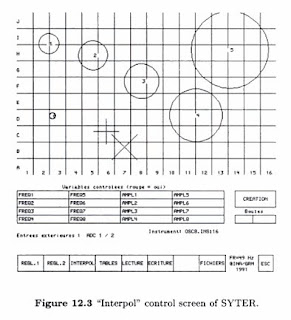
Concrete music and the use of electroacoustic studios had stabilised and modelled a certain number of sound-related operations on the basis of perception-based concepts. For example, an extremely powerful analogue studio process, "micro-editing", involved cutting minute fragments of sound from magnetic tape (using scissors!), which were then stuck end to end to create a new continuity. This principle was very successfully applied by the deferred time software and by Syter, making it possible to reorganise the material into new coherent sequences. This became known as "brewing". But brewing is not the end of the story, because the difficulty lies in controlling the way the brew comes together. Graphical interfaces, which these days are at the very heart of all computer technology, but which at the time were practically unheard of, were used to visualise the sound and the control parameters, and there was even an interpolation screen for exploring the intermediary terrain between two processing states.
Syter was a hit with musicians, both for studio work and instrumental work. In the studio, it could be easily built into the existing environment and breathed new life into the palette of processing possibilities. The system was essentially used for the processing of sound, meaning that the composer would record sounds and then modify them using the processing tools that were already built in, or by creating his own tools. In so doing, he would be faithful to the GRM tradition of processed sound, even though many hybrid processing techniques (between recorded sounds and synthesised sounds) provided entirely new kinds of sound. This material would then become (whether or not mixed with other sounds from other sources) the basis on which the composer would build his work.
Furthermore, at the time there was a unique relationship between composers and technical designers, who thanks to the modular programming techniques and their user-friendliness, could quickly build the tools necessary for creative work. A number of models that were later to become GRM Tools were a result ot this experimental relationship (in particular Doppler and Pitch Accum]. Once they had been built up, these algorithms were simple to implement, and integrated the whole palette of processing tools available in the system (around 40 different algorithms were designed and 15O variants of these basic algorithms).

An approach founded in pedagogy

The philosophy of the GRM has always been that the creator should work independently on his own process of composition, without the assistance of anybody else. Most composers had the training necessary to handle the techniques, to understand and work the analogue studio, and only in very rare cases were they assisted by the technician-musician. There was such a great interest in the deterred time software or the Syter system, and it was aimed at musicians of such varied backgrounds, that a training programme had to be set up in order to help them come to grips with the different systems. Man of these composers who came from an electroacoustic background, and many others were not familiar with studio techniques but who wished to become acquainted with them and develop projects bringing together instrumental and electroacoustic techniques. There were many other professionals from other fields: artists, radio and sound technicians, teachers or musicologists.
Week-long courses with small groups of trainees began to be organised 2 or 3 times a year, involving generally 6 to 8 participants (a total of 20 courses between 1985 and 1993]. During these courses, the system was explained and the participants had the chance to experiment and play with sounds. The objectives of these courses were manifold: the first was to provide composers with the training necessary for them to be autonomous in their work and to enable them to develop a project.
Another objective was to test the system with users. Because it was such an innovative system, using original approaches with regard to algorithms and interfaces, it had to demonstrate that it was up to the task and that the composers could use it easily and efficiently. Around 120 people followed these courses, and 80 works were composed, sometimes several of which were written by the same composer.

From pedagogy to production and concert presentation

Many of the composers were attracted by the possibilities offered in terms of the real time processing of acoustic sounds, and embarked on projects that brought together live instrumentalists, real time processing and recorded sounds. Others used the system in the studio, for acousmatic works, either to complement other existing studio technologies and tools, or sometimes as the sole production tool.
I was personally involved in this pedagogical and production aspect of the Syter system for some ten years. When it was first presented in-house in 1984, everybody underlined the technical prowess it had been to develop a system of that kind, but there was little enthusiasm on the part of the GRM composers, in light of the small number of existing algorithms and the fact that there were no instructions for use. I was fascinated by this approach and I proposed to Jean-François Allouis that I would help him in his project, in particular by explaining to composers how the system worked and by writing up a manual. We then organised the first training sessions in August 1985 and August 1986, and thereafter I took charge of the courses and production associated with the system and the development of variants of the instruments, in response to requests made by composers. I was therefore able to meet everybody who participated in the courses and I followed everything that was produced using Syter. I also played a great many works that involved Syter for the real time processing of instrumental sound Ia task that we became particularly involved in with Richard Bulski, the system technician, especially for moving it and setting it up for concerts).
I was able to gain an extensive and in-depth knowledge of how the system functioned, so much so that I was able to write my PhD dissertation on Syter (The Syter system, its history, development, musical production and implication in contemporary electroacoustic language, presented in December 1998 at the University of Paris VIII). I composed ten pieces on the system, some of which were with instruments, using the system only to produce electroacoustic sound, and others which were acousmatic, where a great deal of the sound creation work was done on Syter from start to finish. I began to move away from the system in around 1993, when it was beginning to become obsolete and when the first versions of GRM Tools were becoming available on Macintosh, designed and built by Hugues Vinet, who took much of his inspiration from the algorithms of Syter. I also realised, in 1993, that my life had been too wrapped up in the system, when a composer asked me seriously whether Syter was an acronym for System Teruggi!

inagrm.com/grmtools

[Prev | 1 | 2 ]

Wednesday, October 10, 2012

Augmented Listening

By Tue Haste Andersen - October 9, 2012

reBlogged from: design mind
 

Stop for a second and listen. Close your eyes, use your ears, and just listen.

Whether you are in a quiet office environment or out on a busy street, you'll be amazed by how many sounds there are around you. Most of us do not pay attention to the ambient sounds that surround us. Our brains filter them out and we don't listen. Yet the sounds we miss can be very enjoyable.

Designed Sounds

Today, what we hear in our daily lives is often designed sound- music and sound effects carefully crafted for games, devices, and products. For example, mission-critical products, such as heart rate monitors used during medical surgery or a plane’s flight deck controls, use distinctive alarming sounds that are designed to be easy to perceive and raise a sense of urgency or danger.
In interfaces for everyday tasks, sound is used to create engaging and beautiful experiences. Sounds can generate a special feeling or underline brand identity while simultaneously providing cues that a command has been received by the system. Most smart phones today come with subtle sounds that indicate the pressing of a touch screen’s virtual buttons. Since there is no way to feel if a virtual button has been pressed, the sounds reinforce the action for the user. Another example can be found in industrial design, where the latest electric cars are being designed with artificial motor sounds. The sounds alert pedestrians to the car as well as reinforce the sense of driving a powerful vehicle. These examples underline the overall trend of sound being used to create an aesthetic experience rather than serving as purely a functional aid to improve interaction.


Blurring the Border Between Listening and Composition

While systems and products are becoming more enjoyable and pleasant to listen to, they are usually not intentionally designed for sound interaction. The emergence of accessible music software on computers and mobile devices is changing this. These programs allow for easy modification of sound by the average user and blur the border between listening and sound creation. The small form and limited complexity of mobile interfaces has forced music software designers to reduce the complexity of their products, resulting in music software that is widely used by average mobile phone users.
Music apps are often top sellers. Popular applications allow people to become mobile DJs, to transform sounds, and to design ringtones.
I was interested in exploring the blur between sound creation and listening when my friend and colleague Matteo Penzo put me in contact with Matteo Milani from the U.S.O. Project sound art group. The ideas and compositions of the U.S.O. Project revolve around the use of noise and ambient sound as a foundation for sound installations and music composition. Together we wanted to create a mobile experience that would support active listening to the everyday sounds that surround us, making the listener a part of a personal sound installation. Instead of creating a tool for recording and transforming sound, we wanted to start from the sounds themselves. Our goal was to reinforce the sounds of the listener’s environment while blending them with more musical sounds. Together the sounds would form a unique experience that could be enjoyed by anybody that has an interest in sound and art.  


Early Experiments

We started with a small prototype app for iOS using simple sound algorithms to blend U.S.O. music with live recording from the iPhone microphone. The prototype was tested with real use cases that included listening to the app while taking a long walk as well as while sitting at the computer in the office. We added many parameters for the user to be able to tweak and play with the sound transformation.The parameters were mapped to on-screen sliders and buttons and to sensors like the accelerometer.
While doing the informal tests we found that the users were struggling to understand the relationship between the parameters and the sound output. Also, in most cases they would end up spending time experimenting with the parameters to discover how they work. The visual interface and controls were clearly distracting, taking attention away from the app’s original goal of reinforcing ambient sounds for the listener.  
Following these early experiments, we decided to take a drastically different approach. We limited the visual interface as much as possible and provided a set of sound themes in the app for the listener to select. This worked much better. All of a sudden the users would pick up the app and, once started, would tuck it away in a pocket while listening to the sounds. Each theme takes sounds from the microphone and blends them with sounds composed by U.S.O. Project. The sounds are blended using sound algorithms, unique to each theme. Each algorithm is carefully calibrated to replicate the work and skill that goes into producing a great listening experience.

Lis10er

The result is Lis10er (pronounced Listener), an augmented sound installation app. Sounds are blended from the listener’s surroundings, creating dynamic music that changes while maintaining its identity. Lis10er provides users with a creative way of listening to their environment and a unique experience with every listen. 


Tue Haste Andersen is Senior Software Architect based in frog’s Milan studio. Tue is a Human Computer Interaction and Computer Music expert, with research ranging from DJ work practices to the use of sound and music in common interaction tasks. He is also the founder and original author of the popular open source DJ software, Mixxx.

Tuesday, May 29, 2012

"Digital Re-Working / Re-Appropriation of Electro-Acoustic Music"


What is DREAM

DREAM is a EU funded project, aimed at preserving, reconstructing, and exhibiting the devices and the music of the Studio di Fonologia Musicale della Rai di Milano. During the 1950s and 1960s, this was one of the leading places in Europe for the production of electroacustic music, together with Paris and Cologne.
During the project, part of the equipment of the Studio (oscillators and non-linear filters) has been virtually reconstructed and will become part of the permanent exhibit at the Museum of Musical Instruments in Milan.

The aim of this one-day symposium is to present to the public the main results of the DREAM project, including the installation that recreates part of the original devices of the Studio di Fonologia di Milano della Rai, as well as the book “The Studio di Fonologia – A musical journey”, edited by Maria Maddalena Novati and John Dack, and published by Ricordi.

The event is comprised of two parts.
The morning will be devoted to the workshop Conservare, mostrare, interagire: per un museo da toccare [Preserve, exhibit, interact: for a tangible museum]. During the workshop, DREAM researchers and invited speakers will discuss applications of novel interactive technologies to museum exhibits, with particular reference to music and musical instruments museums.
The afternoon session will present to the large public the results of the DREAM project, through the movie Avevamo 9 oscillatori [We used to have 9 oscillators], additional talks by DREAM researchers, and two musical performances that make use of sonic materials produced at the Studio di Fonologia.

Program
[http://dream.dei.unipd.it/?page_id=645]

Friday, June 15, 2012
Castello Sforzesco, Museo degli Strumenti Musicali, Sala della Balla Milano 
Free of charge, limited places available

Friday, March 09, 2012

GRM pt.2: the birth of a concept

Daniel Teruggi wrote an interesting article about the Syter system at INA - GRM in the booklet for Archives GRM (CD 4). This whole CD is comprised of works created through Syter.

"To mark and celebrate the thirty years of the INA (Institut National de l'Audiovisuel), the GRM (Groupe des Recheches Musicales) has chosen to bring together an exceptional set of five compact discs, illustrating some of its most remarkable musical archives. These original works, which are often previously unpublished or have been dispersed throughout a host of other publications, are important because of the originality and audacity they testify to in the second half of the 20° century. Some listeners will be pleased to see that there are a number of illustrious composers here who, in the 1950s, frequented the studio of Pierre Schaeffer, and others will discover numerous musicians whose enthusiasm enabled this innovative musical genre to last throughout the following decades."
Emmanuel Hoog, président directeur générale de l'Ina

Daniel Teruggi - The time of real time

From the very beginning, music, whether vocal or instrumental, improvised or written, and up until the invention ol recording processes, was listened to at the precise moment it was produced. The twentieth century changed all that, First of all with the appearance of recording media, which made it possible to listen to sound in a place and at a time other than those at which it was originally produced; then by the widespread use of electricity, which made it possible to invent new instruments and new ways of imagining and making music. Concrete music, electronic music, electroacoustic music, acousmatic music or contemporary electronic musics are all testimony to the same ambition: using electrical, electronic and computer-based technologies to invent the sounds of music. The invention of sounds is the invention of new forms of music, of new ways of looking at music, and is the logical consequence of the new opportunities that technology continues to provide us with. Musicians began to use computer systems a long time ago (1958) in order to synthesise sounds and to develop computer programmes that would enable them to combine sounds into musical works. Progressively it became possible to record these sounds, to process them or to hybridise them with synthetic sounds.
Musical computer technology did not develop fast and was dependent on the way processors and data storage systems evolved; in 1958, a large computer in a research centre was necessary in order to produce a simple synthesised melody, which it was not even possible to record in the memory. These initial technical difficulties brought about the appearance of two concepts which could be described in a historical perspective, but which are often presented as if the were antagonistic: deferred time and real time. Deferred time described the way that the first computer systems were unable to produce an instantaneous result.
Between the moment at which the intention was expressed and the moment when its result become an audible phenomenon, there was always a certain lapse of time.
The user programmed a sound using software, defining its various parameters and timbre, and then the computer calculated the sound and, depending on the complexity of the calculation, produced the result ofter a given interval. The listening time was deferred with respect to intention time.
It was logical that the next technological objective was real time, a concept that describes the possibility of hearing a sound at precisely the some time as the intention to make it is expressed.
Moving over to real time required changes to the command tools. Deferred time was the result of a programming system whereby the user defined, using written language, the result he wished to obtain; moving over to real time made it possible to define the intentions instantaneously and to modify the result as it was being listened to.
Now, most sound production and generation systems work in real time, enabling the user, thanks to various interaction tools (keyboards, mice, screens) to control and modify the sounds created and heard. Nevertheless, in the field of musical creation, and for a relatively long time, this technological evolution was opposed on methodological grounds. Real time obliges the operator to act and react, depending on the result, in a way that is similar to that of the instrumentalist. For many composers, deferred time, because it separated the moment of conception from the moment of listening, created a distance that was necessary for reflection, a situation that is similar to instrumental composition, between the writing of a piece on paper, and its being played.

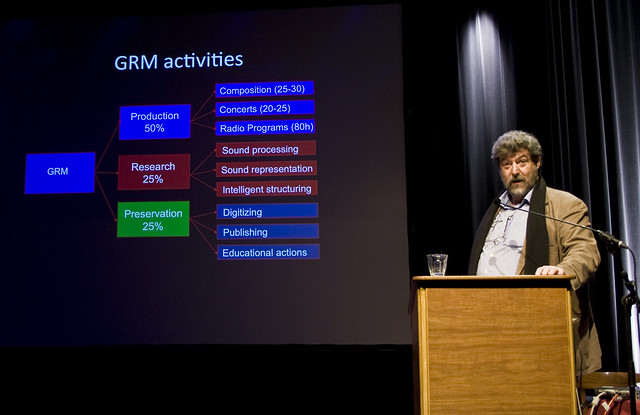
[Daniel Teruggi @ Sonic Acts 2010 - courtesy Rosa Menkman]

  
Deferred time and real time in the GRM

At the beginning of the 1970s, the Groupe de Recherches Musicales began to experiment using computer technologies. At the time, the Group already had 20 years of experience, a major repertoire of musical works, a tradition for profound reflection on music and perception as well as innovative technological research. Little by little, therefore, work was undertaken to look at the possibilities that this new domain, which was already strong in the United States, could offer in France, where it was comparatively little known. Two projects were to follow one another, and then coexist, between 1975 and 1993: the first, from 1975 to 1987, concerned the development of deferred time sound processing tools, the "Studio 123 software programmes", developments that are dealt with in CD 3 of the GRM Archives set. The second project, the Syter system was a major technological development for musical computer programming, so original that its impact can still be felt in the development of processing tools today.
These two projects were vitally important in opening electroacoustic music up to composers from the instrumental world. The main successes of these two projects were to bring electroacoustic music out of the studio, making computer technology accessible, without needing programming skills, and making processing reliable and reproducible. The range of things it was possible to do to sound was considerably widened, using original and unheard of sound processing techniques. These two projects were a unique period for the GRM, the studios opened up to welcome composers with other ideas, concepts and points of view, the dialogue was rich and fruitful, and the understanding and analysis of the music being written there were enhanced.

The Syter project 

With the advent of computer technology, the first idea was to imagine a parametric control of machines using digital tools. For example, synthesisers, while remaining analogue in the way that the sound is generated, could be controlled by digital systems that would provide o greater precision in terms of frequency that traditional rotary buttons. It was thus that the first Syter was born, an acronym for: Synthése en temps réel (real time synthesis), and the objective of which was to build up a digital synthesis system based on a set of oscillators, controlled in real time by specialised gesture-based access or by external signals.
The first prototype that was built was relatively simple, since its only function was to control, in real time, the movements of a sound source between a number of loudspeakers. This prototype, with its delicate control system and laborious programming, was used in concert on 16 March 1977 for the creation of Cristal by Francois Bayle.
The designer of this tool and of its following versions was Jean-François Allouis, an engineer who arrived at the GRM in 1974, and who was fascinated by the potential of computer technology as applied to sound and music, and who had an uncanny inventiveness when it came to finding solutions to new problems and designing original systems. For this first concert, the acronym Syter become: Systéme temps réel (real time system), and was the starting point for a whole 5-year period of development during which Jean-François Allouis contributed to the setting up of the first GRM computer, oversaw the implementation of the deferred time processing system, built the Syter real-time sound processor and the input and output converters, developed programming software for the processor, built one of the first interactive real-time parameter control systems and programmed the first processing tools. In conjunction with computer scientist Jean-Yves Bernier and computer technician Richard Bulski, he needed to build and rebuild the system several times before the first full system was complete, in 1984. The system underwent very few modifications and additions, subsequent to that. Eight systems were built and sold, up until 1988. The software continued to evolve up until 1989, in particular thanks to the impetus of Hugues Vinet, who designed a digital mixing tool, providing the system with all the functions of a Studio. Two systems were in operation at the GRM until 1995, and around 100 works were composed in part or in whole using the system.

Related Posts: 

Tuesday, May 17, 2011

GRM Tools - pt.1: an interview with Emmanuel Favreau

by Matteo Milani - U.S.O. Project, May 2011 

GRM Tools is the result of more than 50 years of cutting-edge research and experimentation at the Groupe de Recherches Musicales de l'Institut National de l'Audiovisuel in Paris.
These plug-ins were realized by a succession of hardware and software engineers, who formulated the algorithms for the original GRM Tools in the 1990s. Over the years the GRM has focused on developing a range of innovative tools to treat and represent the sound.
The new GRM Tools Evolution is the latest powerful and imaginative  bundle of new algorithms for  sound processing. Three new instruments are available: Evolution, Fusion and Grinder. All works in the  frequency-domain and provide powerful ways to manipulate audio in real time. I had the privilege of interviewing Emmanuel Favreau, software developer at INA - GRM. Here we go!


Matteo Milani: How many people are part of the GRM development team at INA?

Emmanuel Favreau: We are two people, working full-time. Adrien Lefevre handles the Acousmographe. I’m on GRM Tools. We welcome regular students.


MM: Can you tell us a brief history of the GRM Tools from the origin until now?

EF: The first version of the GRM Tools was created by Hugues Vinet, who is now scientific director of IRCAM in Paris. This stand-alone version offered a couple of algorithms, using the Digidesign SoundAccelerator/Audiomedia III card. The user interface was made ​​with HyperCard. When I arrived at the GRM in 1994, we took the decision to convert the processing available in the stand-alone version of GRM Tools plugins to TDM for Digidesign Pro Tools III. Treatments were rearranged, some modified, others abandoned. The original GRM Tools Classic bundle dates from this era. Later, the evolution of treatments has been closely following the technological evolution: when the processors became powerful enough for real-time processing, Steinberg introduced the VST architecture and the Digidesign RTAS Pro Tools format. And finally, we developed the ST version - Spectral Transform - when computer processing power allowed us to calculate several simultaneous FFT in real time.

 
[...] Jean-Francois Allouis and Denis Valette pioneered the hardware development of SYTER (SYsteme TEmps Reel / Realtime System) with a series of prototypes produced during the late 1970s, leading in due course to the construction of a complete preproduction version in 1984. Commercial manufacture of this digital synthesizer commenced in 1985, and by the end of the decade a number of these systems had been sold to academic institutions.
Benedict Mailliard developed the original software for SYTER. By the end of the decade, however, it was becoming clear that the processing power of personal computers was escalating at such a rate that many of the SYTER functions could now be run in real-time using a purely software-driven environment. As a result, a selection of these were modified by Hughes Vinet to create a suite of stand-alone signal processing programs. Finally, in 1993, the commercial version of this software, GRM Tools, was released for use with the Apple Macintosh.
The prototypes for SYTER accommodated both synthesis and signal processing facilities, and additive synthesis facilities were retained for the hardware production versions of the system. The aims and objectives of GRM, however, were geared very much toward the processing of naturally generated source material. As a consequence, particular attention was paid to the development of signal processing tools, not only in terms of conventional filtering and reverberation facilities but also more novel techniques such as pitch shifting and time stretching.

[via Electronic and Computer Music by Peter Manning]


MM: About GUI - 2DController. What is the origin of this pioneering, intuitive, but simple performer-instrument "link"?

EF: This type of interface has been widely used at the time of SYTER during the 80’s. It allowed us to regain "analog" access to a digital instrument. Indeed, even the manipulation of a slider with a mouse requires some attention (click in the right place, moving vertically or horizontally without mechanical guide, etc.). With the 2D interface, the entire surface of the screen becomes a controller. To obtain a result as soon as you click, the precision of movement is becoming necessary if you want to tune that.


MM: The mapping of parameters on multi-touch control surfaces free us from the use of a mouse and gives us an expressiveness never achieved before. What do you think of this new generation of controllers?

EF: Of course, these interfaces allow an overall and "analog" control which is not possible with the mouse (although the knob 2D mode or "elastic" are possible solutions to overcome the single pointer limitation). Since the engineering of the SYTER we proposed a system of "interpolator balls" to interpolate between different set of parameters arranged in a two-dimensional space. The multi-point control of such a device is natural: we need both hands to shape and transform the space.
 "Interpol" control screen of SYTER
[via DAFX: Digital Audio Effects - Udo Zölzer, Xavier Amatriain]


MM: Is the SYTER still in use today in Paris?

EF: No, SYTER no longer works. It was composed of several elements (a PDP-11, large hard drives, a vector graphics terminal) which can not be sustained today.


MM: Host-based tools vs. custom DSP engines: will there be a winner or they will continue to peacefully coexist in the business?

EF: For the type of tool that we develop, the winner is clearly the host-based. For very large sessions with dozens of tracks and hundreds of plug-ins, DSP is now the best choice, but they could disappear with the diffusion of multi-core processors.


MM: How long did the Classic Bundle take to get ported from TDM to RTAS?

EF: It's hard to say because it was not done directly. I first made ​​the VST version, and then adapted the RTAS version. The algorithmic part posed no particular problems, the difficulties being rather on the side of the interface between the various plugins and hosts.


MM: How much research was needed to create the Spectral Transform bundle?

EF: The prototypes of the Spectral Transform have been fast enough to achieve. The basic algorithm is the phase vocoder, which has been well known for a long time. What took time was the interface design, the choice of parameters and their mutual consistency, stability and the whole robustness (i.e. avoid audio clicks and saturation of the values ​​of some parameters).


MM: What's the technology behind the bundles?

EF: If we leave aside the TDM - the processing code is written in 56000 assembly language, all plugins are written in C++. The processing codes are fully compatible between Mac and PC. In addition, the portability of the user interface is guaranteed by Juce. All development is done on Mac; PC adaptation is virtually automatic and requires minimal work.


MM: A description of version 3 and its new features: what goals have you achieved during this long period of software development?

EF: Having redesigned the interface and rewritten all the code allowed us to add some new features: resizing the window, MIDI control with automatic learning, agitation mode.
Agitation is a generalization of the Randomize, it can be applied to all parameters of random variations in amplitude and frequency control. Now all the GRM Tools are also available as standalone applications. This easily handles individual sounds, to make quick tests and become familiar with the treatments without having to use host daw and sequencers.


MM: How do you manage feedback from musicians and sound designers to improve sound quality and the graphical interface?

EF: The user feedback comes from various forums and from discussions with users and composers here at the GRM. In response to suggestions, plug-ins will be changed, some features will be added (but always in small numbers to ensure compatibility) or it will create a new treatment that may ultimately prove quite different from the original application. This is what happened to Evolution that comes from improving the freeze that can be achieved with FreqWarp.

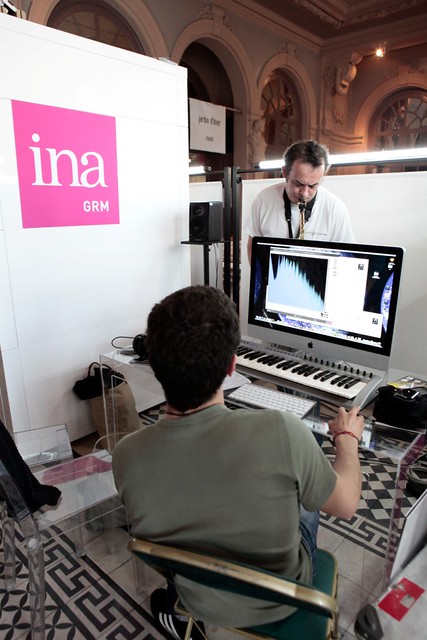
[GRM Tools Evolution @ Qwartz 7 - courtesy Alexandra Lebon]


MM: What are the most efficient methods of applications against piracy?

EF: There is none. Whatever the methods, they will be bypassed one day or another. We must find a solution that is not too heavy for the users, while allowing a minimum of protection. We chose the system of Pace iLok because it is very common in musical applications. The recently announced changes should make it more flexible to use.


Thanks for your time Emmanuel, keep up the good work!


[...] Any transformation, no matter how powerful, will never equal or surpass synthesis, if it fails to maintain a causal relationship between the sound resulting from the transformation and the source sound. The practice of sound transformation is not to create a new sound of some type by a fortunate or haphazard modification of a source, but to generate families of correlated sounds, revealing persistent strings of properties, and to compare them with the altered or disappeared properties.
In synthesis, the formalisation of the devices and resulting memorisable abstraction, offer a stable set of references which can be easily transposed from one environment to another. In sound transformation, no abstraction of the available results is possible and neither is generalisation. The result of an experiment is always the product of an operation and a particular sound to which this operation is applied. The composer must be able to add to the sum of knowledge by reproducing a previously proven experiment.
What makes the wealth and functionality of a system is the assembly and convergence of the whole, its ability at any moment to answer the questions imagined. Specific tools built for a single experiment, no matter how prestigious, are sterile if they cannot be applied to other purposes. - Yann Geslin


References:

[Digital Audio Workstation by Colby Leider]
[sounDesign, a blog dedicated to the world of Sound and Audio Design]
[On GRM Tools 3, Part 1 - via designingsound.org]
[GRM Tools 3 review: a classic reborn]
[The GRM: landmarks on a historic route
[GRM's current team]
[GRM Tools Store]

You can also read my interviews and reviews on Computer Music Studio (italian only), a monthly magazine by Tecniche Nuove Editore. - Matteo Milani

Saturday, April 02, 2011

Out now: "hiSS vol.1" on Synesthesia Recordings


The works included in 'hiSS [Synesthesia Sampler] vol.1' have been produced using only analogue devices and processing tools - such as no input mixers, analogue synthesizers and custom-built or hacked/reconfigured instruments.
Without the use of computers or digital devices, the 4 pieces recall an era from the 1950s-70s, when most of the electronic music makers around the world had limited resources and quite primitive equipment.

The compositional techniques are available in the following document:

[hiSS_vol-1_Press_Release.pdf]

Produced by Matteo Milani, Federico Placidi
Artwork by Kirjava [kirjava.deviantart.com]
SYN-005 | 2011 Synesthesia Recordings
Artists retain copyright to their respective works


RELEASE INFO:

Title: 'hiSS vol.1'
Cat.No: SYN-005
File under: Experimental/Electronic
Format: Digital/Compact Cassette
Release date: 4.2011

Limited edition compact cassettes coming soon! Contact us for more info:

write [at] synesthesiarecordings [dot] com

Digital album available ($ 5, mp3 @ 320 kbps) [here]
Pick other formats (FLAC, AAC, Ogg Vorbis) on BandCamp [here]

ALBUM ARTISTS:

Volker Hennes (GER)
Title of the piece: eromenoi erastai
Duration: 12' 16''

Volker Hennes (b. 1976) is a sound artist and composer. He studied at the Academy Of Media Arts Cologne from 2000 till 2005 – mainly at the Sound Laboratory, at which he was employed as assistant for two years. Focuses on live-electronics, acousmatic and electroacoustic music, computer music, field recordings, multichannel and interactives works, and installations. Works have been performed and presented internationally; e.g. Metamorphoses / Belgium, ICMC / Copenhagen, Concordia University/ Montreal, Música Viva / Portugal, MANTIS Festival / Manchester, Festival Internacional de Música Electroacústica Ai-Maako / Chile, A & A Elektrokonzert / Argentina, Digital Art Weeks / Zürich, SMC, Inventionen / Berlin. In 2003 he founded All Of Orlov with Robert Vater, since then performing duets and duels. Member of the audiovisual performance and improvisation group Frequenzwechsel.

[www.earesistible.de]


Chris Mercer (USA)
Title of the piece: Deification | for 2‐channel tape
Duration: 13' 14''

Chris Mercer received a B.M. in Composition at the North Carolina School of the Arts in 1995, and a Ph.D. in Composition at the University of California, San Diego in 2003. His principal teachers were Chaya Czernowin and Chinary Ung - instrumental music; and Peter Otto and Roger Reynolds - electronic music. He has held artist residencies at Experimentalstudio SWR, Künstlerhaus Schloss Wiepersdorf, and Sound Traffic Control in San Francisco. His music has been performed by The Nonsense Company, Ensemble Ascolta, Ensemble SurPlus, SONOR Ensemble, and Schlagquartett Köln. His most recent electroacoustic music and research have focused on animal communication, especially non-human primate vocalization, with research residencies at the Duke University Lemur Center, the Wisconsin National Primate Research Center, and the Brookfield Zoo.
His instrumental music involves modified conventional instruments, found objects, and instruments of the composer's own design, in combination with amplification, live electronics, and spatialization. He has taught electronic music at UC San Diego, UC Irvine, and CalArts, and is currently coordinator of the Music Technology program at Northwestern University.

[musictechnology.northwestern.edu/Mercer]


Ian Helliwell (UK)
Title of the piece: Convergence
Duration: 14' 02''

Since the start of the 1990s Ian Helliwell has been making films and building and modifying 9v circuitry, developing his unique series of Hellitron tone generators, which are used for live performance and for the soundtracks to over 50 of his experimental super 8 shorts. In 2007 he designed and built an analogue synth, the Hellisizer 2000, and since 2008 he has been producing The Tone Generation, his ongoing radio series which explores the early development of electronic music. In 2010 several of his abstract super 8 films have been included in a major retrospective of direct animation - Celluloid: The Cameraless Film at the Schirn Kunsthalle in Frankfurt.

[ianhelliwell.co.uk]


Jeroen Visser (CH)
Title of the piece: The Spanning
Duration: 13' 41''

Jeroen Visser (1961) is a musician and a composer living in Zürich, Switzerland. His primary instrument is classical piano, and he is also a self-taught woodwinds player. After his study of Sonology in Utrecht, being taught by a.o. G.M. Koenig, J. Vink, and S. Tempelaars, he worked as musician and sound engineer. From 1988-1992 he worked as music technologist at the Sweelinck Electronic Studio in Amsterdam, NL.
After his relocation to Zürich in 1993, he has been composing music for groups and theatre, where he was also responsible, as musical director, for productions, and making musical or sound installations. Recent musical activities, apart from electro-acoustic compositions, include studying ethiopian music, and playing music which investigates the combination of improvisation and musique concrete.

[121234.net]

Product pages:
[synesthesiarecordings.com]
[synesthesiarecordings.bandcamp.com]