Showing posts with label Acoustics. Show all posts

Tuesday, December 27, 2011

Call for Works: Sonic Screens 2012


U.S.O. Project is pleased to announce that the 2012 edition of Sonic Screens will be focused entirely to the electro-acoustic music praxis.

Specifically, candidates should produce a composition for instruments and real-time signal processing (live electronics).

Two works will be selected to be played during the concert.

The requirements are as follows:
  1. The piece must be composed for Violin and Cello as a duo. Scores for solo violin or cello will not be taken into account. 
  2.  The Score (in .pdf format) must be graphical and not in traditional notation. 
  3. The interpretational and playing instructions should be made ​​clear, in order for the players to follow them even without the presence of the composer. 
  4. The electronic processing must be developed and implemented using Max/MSP or Kyma (*). The multichannel format for the spatial diffusion must be up to 6.0 (2.0 and 4.0 works are still eligible). 
  5. The type of interaction should follow the "ecosystemic" paradigm and should be as autonomous as possible (no pedals or sensors are allowed). 
  6. The work should not exceed a total duration of 12 minutes
The evaluation criteria will focus on originality and effectiveness of the interplay between the electronic and instrumental parts.

The deadline for all submissions is set for 30th June, 2012.

Interested composers and sound artists should send the material (Score + Patch) within this date.

The two selected works will be presented during the evening of Sonic Screens in Milan.

The event will be recorded for digital distribution (on Synesthesia Recordings netlabel).

The names of the musicians who will perform the selected scores will be announced in March.

U.S.O. Project, composer Daniele Corsi and the musicians chosen to perform during the concert will form the reading panel which will evaluate the submitted works.

The selected works will be announced in September 2012.

For more information or clarifications, please contact us at our e-mail:

submissions at synesthesiarecordings dot com


(*) Clarification:
We can only accepts patches made with Kyma or Max/MSP due to the fact that we are not able to provide financial support for the two selected composers. To avoid any technical issues, we had chosen the platforms we already use in our daily work, with which we are very familiar. If the selected composers can confirm their presence for the evening concert at their own expenses, then any piece of software/hardware can be used to perform live electronics. Thank you for your comprehension. 

Friday, April 30, 2010

Audioscan: the alchemy of noise transmuted into music

audioscan is an artistic project conceived by Giorgio Sancristoforo, produced by AGON in collaboration with basemental. The project consists of a multimedia interactive installation and of a live performance combining music and video. Both are based on the sound mapping of Milan.
At the basis of audioscan there are 1.580 recordings and phonometric surveys gathered within the perimeter contained in the main ring road of Milan.
A process of meeting and exchange between contemporary art, music and environmental themes, a meditation on soundscape and the auditive dimension of human experience, both on an aesthetic and a social perspective.
An ambitious cataloguing work and an environmental awakening project through the transformation of a waste product of technological society – noise – into an artwork.


" [...] Essentially, noise is an ambiguous entity, setting up in a fluctuating reality, whose definition changes according to the coordinate system used to measure it.
Sounds can be sculpted. We can use noise as raw material to start with. Noise is at the same time “no sound” and all the possible sounds. Just as white light contains all the colours, noise contains countless sounds.
Therefore, instead of using musical instruments we have ground and crumbled noise in very fine components, building from these elements orchestras made up of roads and airplanes, people and cars. We have created music from a scrap of our society.
Everything is transformed. Nothing resembles anymore its former essence. Airplanes become microscopic percussions, cars are turned into metallic pianos and rubbery basses, hollow murmurs and waterish illusions.
Braking and tailpipes screeches become tides of the thinnest strings.
We have animated a deep transformation, resembling closely the alchemic processes: actually, we have performed the alchemy of noise transmuted into music.
The city, unaware of the transformations undergone, perpetuates its rhythms and mood intact. This is why those sounds, even if unrecognizable, still describe Milan, with its chaotic passages and deep breaths, with its syncopated rhythms and the feeling, peculiar to an ocean, of being constantly wound by countless mutations."

Audioscan (#1) MILANO - FULL by Giorgio Sancristoforo

"I listen to the music of Audioscan again, and I realize how much it’s melancholic.
Milan is melancholic. Not sad. A gloom which could belong to Calvino works, a blues pervading the streets, in the morning, creeping like a cat between porches and boulevards, between old mansions and post-war eyesores. The same melancholy that smoothes the cold when I stroll around, ravished by the decadence of Civic Aquarium or sitting on the lawns of San Lorenzo Basilica, while besides me the city keeps darting in sound tidal waves." - Giorgio Sancristoforo

[audioscan.it]

Friday, June 26, 2009

An interview with Christina Kubisch

by Matteo Milani, U.S.O. Project / Eng: Valeria Grillo / Img: courtesy Christina Kubisch

Christina Kubisch, one of the most important sound artists on the European scene, began to work in 2003 on a project called Electrical Walks. This project uses custom-built headphones which transduce electromagnetic fields into audio signals, through an interaction between force fields which allow the audience to listen to a concert of ambient sounds in public spaces specifically projected.

Christina Kubisch's activity consists therefore in mapping a territory, in order to detect hot spots where audio signals are especially strong or interesting. The audience wearing the headphones takes part this way to the discovery of new acoustic spaces, by means of an aural itinerary through a thick net of electromagnetic information which are invisible and omnipresent. Actually, the activity of the German sound artist is much more varied and it has started many years ago: in the 1970's for example, she had many performances, even if she has always declared to be "unhappy with the predetermined or limited time for the audience to take advantage of the works".

Also for this reason, Christina Kubisch has always desired to do something more open, where people could manage their own time, without stopping too long in front of the work of art or the artist himself. Still today, her work is tied to different elements, and resumes some interests related to the work with light, coming from her experiences with theatre and dance. Light has in fact for Christina Kubisch the same qualities of sound, being a non-material phenomenon that can, and has to be, used as a narrative element; sound and light are for the artist two interlaced elements, so that the first can be used for the visualization of the second (like in the case of ultraviolet light, normally not visible), and vice versa (like in her most renown work, Licht Himmel (2006), which she created for the magnificent ex-gasometer of the city of Berlin).

Christina Kubisch lived in Milan from 1973 to 1987, and our encounter with her took place at the Palazzo della Triennale, during the Milan show of her touring project called "Electrical Walks", invited by the gallery O' and by Die Schachtel for the project realized for InContemporanea and Uovo performing arts festival, which I thank for their collaboration they gave me for this interview.


Matteo Milani: Christina, could you tell us about your background, and how you arrived, through your career, to conceive the "Electrical Walks" project?

Christina Kubisch: When people asks me what I am, what do I do, I always struggle to answer. I am an artist, a composer, I work with magnetic inductance, but I also write pieces for other musicians. I am a performer, I draw. It's hard to define me. I was a flautist, I studied Composition with Franco Donatoni at the "G.Verdi" Conservatory of Milan, and also Electronic Music with Angelo Paccagnini. At the end of my studies at the Milan Conservatory, I started a much more personal and effective research, attending for 2 years night courses in Electronics. During these courses, I discovered a telephonic amplifier, a small cube, from which came curious sounds. This cube had inside some coils, and it amplified the magnetic sounds close by. Fascinated by this system, I had 50 special cubes built, and with them I created my first installations.
Sometimes at night I go through electronics catalogs and ask myself what I can change, subvert, using some components in an improper manner. Then I discovered headphones. I had them built in Bologna, after having projected them with an engineer. I still use them, only the internal components are different, but the exterior of the headphones is authentic, dates back to the first years of the 1980's. Obviously, the listening is easier than with the cubes: it is more comfortable now to go around with wireless headphones. It is interesting to see how people move, some run around in the space, some go around slowly: the more people move around, the more interesting are the things they hear. Each movement of the head produces big changes in timber and amplitude to the sound people listens to through the headphones.


MM: This project is an important document to understand the state of electromagnetic saturation on our planet, it is a study on the "invisible" noise pollution.

CK: In every city, especially in the big ones, an incredible number of electromagnetic waves is hidden; they're everywhere, we can't hear them but they're here! Everyday there's a bigger amount of digital communication on one side, and all the security systems on another, and they all bear substantial magnetic fields. I began to plan routes in the big cities, just when I started to receive in my headphones disturbances I couldn't analyze (very strange buzzes & rhythms): actually, for some years (since the beginning of the 1990's) I had to stop doing my walks because my gear was broken and I could repair it only with the help of a sponsor. In 1999 I found the sponsor, but during those few years of interruption, the world of magnetic fields had grown exponentially! For this reason, I decided to use those disturbances like sounds to explore: one of the first cities I explored was Tokyo. I also gave my headphones to Alvin Lucier, who was there for a festival, he had a long walk with them and than he told me: "This is a concert!"
The city is both an individual and globalized element, and with this experience I could expand both aspects, documenting them through pictures as well as video: lighting systems, transformers, ATMs , electronic security systems, surveillance cameras, computers, antennas, navigation systems, cash registers... the city itself can become a concert.
The oldest sounds (trams, train stations), the ones dating back to the last century, are also the most musical. This is what I define "Electromagnetic Anthropology", in the sense that each and every station has its own distinctive sound, usually connected to the date of its construction. The Stazione Centrale in Milan , for example, is fantastic, I almost got crazy when I went there, and I will be back soon to do some more recordings! In Milan you can actually hear the trams from far away, not only when the listener is close by.


MM: Are there places where you actively look for "hidden" sounds, and others where you instead wait for aural information which renew periodically?

CK: Sure, there are sounds I exactly know where to find, in places like banks, or close to light signs. Lights actually emit curious sounds, just like LCD or plasma TVs. Internet or Bluetooth antennas emit very strong and annoying sounds, but they are part of our life. It is always nice to find something new, very strange sounds, but their source remains unknown. In some Countries, especially in North Europe and the USA , it is mandatory for stations to have induction systems for hearing-impaired people, so every kind of announcement can be broadcasted . These systems often are in places where they shouldn't be. For example, it happened that while I was walking around a street, I could hear everything that was going on inside an office, including voices and computer activities. I have a collection of hundreds of hours of recordings in my archive: I don't know if this is music or noise, but I'm always fascinated by this aural universe halfway between heavy metal and pop music!


MM: What are your analogue and digital work instruments?

CK: All the sounds I record with my headphones are so interesting that I don't need to transform them much. I mainly work with Pro Tools for editing and pitch-shifting. Besides, I use filters in the frequency domain, with which I can do many things, finding sounds hidden behind other sounds. I have always been fascinated by some instruments which cannot be immediately recognized. On this subject, I published several records using the Glassharmonica, an instrument invented by Benjamin Franklin in 1761, and Diapasons. Some of these instruments are quite big and they reach very low frequencies, up to 40 Hz. I also used signal bells used in underground excavations: they are partly electric, partly acoustic.
Furthermore, I like to work on spatial, four-channel diffusion systems, where I can obtain remarkable results. Nowadays, we think we have any sound at our disposal on the Internet: my students for example rarely record anything, they look for sound files directly online. They do not realize that the offer is limited, pre -determined. This is why I always use field recording in my compositions, so I can show a world still existing today; working with field recordings has become more intense lately.


MM: Which cities surprised you the most on an electromagnetic level?

CK: In Oslo I found beautiful, strange things, that I couldn't find anywhere else. This is the real pleasure of going around like in a safari, especially at night. It may sound like a joke, but the kind of sound I prefer is that of Perfumery lighting systems (for example in Via Dante, Milan ). Banks instead have a very high pitched, sinusoidal-like sound. Never heard such high and strident sounds! The map of Electrical Walks for me is like a score: until now I made 23 walks, and the next stops will be Copenhagen and Leeds . In 2010 I'll be invited to map the Ruhr region, one of the biggest urban areas in Europe , which will also be the European city of culture in 2010. I'll follow a walking route in several cities, but also by car, train and even bicycle.
For this, I'm trying to enhance the headphones by building an instrument I can carry in my backpack so that I can listen to high-tension lines in the countryside, some kind of electromagnetic Land Art. By using very strong and heavy coils, I could pick up many magnetic fields, thus breaking the limits of the present receivers.


MM: What are your considerations on the present situation of Sound Art?

CK: What's really new today is the desire to create art which not only sits on the wall, but which instead can be a deep personal experience. Sound Art, when it's good, allows this experience through an individual listening, which arouses ideas and memories, different for each of us. Furthermore, Sound Art moves through time, and this makes it more difficult to use it as a collectible object, as it often happens today.

[christinakubisch.de]
[soundohm.com]
[dieschachtel.com]
[interview also available on the issue of DIGIMAG 45/JUNE 2009]

Friday, May 08, 2009

JoAnn Kuchera-Morin: Tour the AlloSphere

JoAnn Kuchera-Morin demos the AlloSphere, a new way to see, hear and interpret scientific data. Dive into the brain, feel electron spin, hear the music of the elements ... and detect previously unseen patterns that could lead to new discoveries.

Composer JoAnn Kuchera-Morin works on the Allosphere, one of the largest scientific and artistic instruments in the world. Based at UCSB, the Allosphere and its 3D immersive theater maps complex data in time and space. Kuchera-Morin founded the Center for Research in Electronic Art Technology (CREATE) and has been the director since its birth in 1986. In 2000 she began work on a Digital Media Center within the California NanoSystems Institute at Santa Barbara. Her fascinations include gestural interfaces for performance and the expression of complex data in nontraditional forms.

[Mapping terrain in space and time: Exclusive interview with JoAnn Kuchera-Morin of the AlloSphere]

[allosphere.ucsb.edu]

Friday, March 27, 2009

Not So Silent Spring


Via the Acoustic Ecology Institute, I discovered this article about the effects of noise on wildlife.
Some excerpts:

A male European blackbird was terrorizing the neighborhood. For several months, he started singing at around 5 a.m. each day, but this was no ordinary song. The bird imitated the sounds of ambulance sirens and car alarms at a jarringly life-like volume. It even produced cell-phone ring tones that went unanswered for hours.

Hans Slabbekoorn, an assistant professor of behavioral biology at Leiden University in The Netherlands, [...] started asking people to send him recordings of the off-kilter blackbirds. Sure enough, what he got back was pitch-perfect imitations of urban noises, including not just sirens and car alarms but even the distinctive sound of a golf cart backing up—mimicked by blackbirds living near a golf course.

Living amid a growing cacophony of man-made noises, the blackbirds started incorporating human sounds into their repertoire.

Blackbirds aren’t the only animals changing their tunes. As human noise intrudes on nature—from freeway traffic noise to jets screaming over the rainforest—scientists are starting to believe the acoustic environment is far more intricate and fragile than they ever imagined. Long regarded as a random collection of bird songs and animal cries, the natural soundscape might actually be a coordinated symphony, with animal calls spread carefully across the acoustic spectrum. Now, researchers are getting the first glimpses of what happens when humanity’s choir drowns out whole sections of that spectrum. Animals ranging from blackbirds to beluga whales are changing their calls or switching them to new frequencies. Others are adapting in ways so powerful that they may be triggering the first steps in an evolutionary shakeup. And some animals are disappearing altogether.

[read more - via Conservation Magazine]

Sunday, September 07, 2008

The Murder of Crows: a sound installation

Sound and mixed-media installation with audio speakers, amplifiers, computer, electronics.

Since the 1990s, the experimental art of Canadians Janet Cardiff and George Bures Miller has been a fascinating exploration of how sound affects and shapes our experience. World-premiering at the 2008 Biennale is their largest installation to date, The Murder of Crows – an astounding 100-speaker artwork that envelops the viewer/listener in the experience of the sculptural and physical qualities of sound. The large and cavernous space of Pier 2/3 is filled with speakers mounted on stands, chairs and walls, creating a minimalist ‘flock’. The installation is structured like a play or film, but with images created only by voice, music and sound effects. Inspired by Goya’s The Sleep of Reason Produces Monsters – from the series of etchings called ‘Caprichos’ (c. 1799), which was a denunciation of the evils of society in Spain in his day – the artists have placed a lone megaphone horn on a table in the middle of the space. Out of this horn comes Cardiff’s voice reciting dreams and thoughts as if, like Goya’s sleeper, she is absorbed in her own nightmares. Using multiple soundscapes, as well as compositions by Freida Abtan, Tilman Ritter and Titus Maderlechner, the artists create a ‘sound play’ that physically envelops the listener in a moving field of sound and music.

(This artwork has a 30-minute duration. Seating provided.)


[cityofsound.com]
[www.bos2008.com]
[vimeo.com]

Wednesday, July 23, 2008

Pierre Henry: an hour walk

The Festival Paris Quartier d’Eté is a summer festival in Ile-de-France from the 14th July till the 15th August.
On occasion of its 19th edition, the festival invites you to share the intimacy of Pierre Henry’s house, the place where he lives and creates, for an hour of unique musical experience. After a monumental concert offered at the Parvis de la Défense in 2007 for Paris Quartier d’Eté, this summer Pierre Henry will open the doors of his house to the audience. Every day, thirteen people will enter in his “House of Sounds” to listen to his music and discover his pictorial universe. A new way to listen to the electronic music of Pierre Henry in a multitude of acoustics. It is a privilege to accept this invitation. More than that, a unique experience.

Monday, August 4 - Friday, August 15 (except on Sunday, August 10), 4:30 pm & 6:30 pm At Pierre Henry’s house (Paris 12e) The venue will be communicated upon purchase of your ticket – Reservation required Price: 15 € / 12 € Running time : 1h

[pqe2008_brochure_en.pdf]

Wednesday, June 04, 2008

The Quietest Place on Earth


The
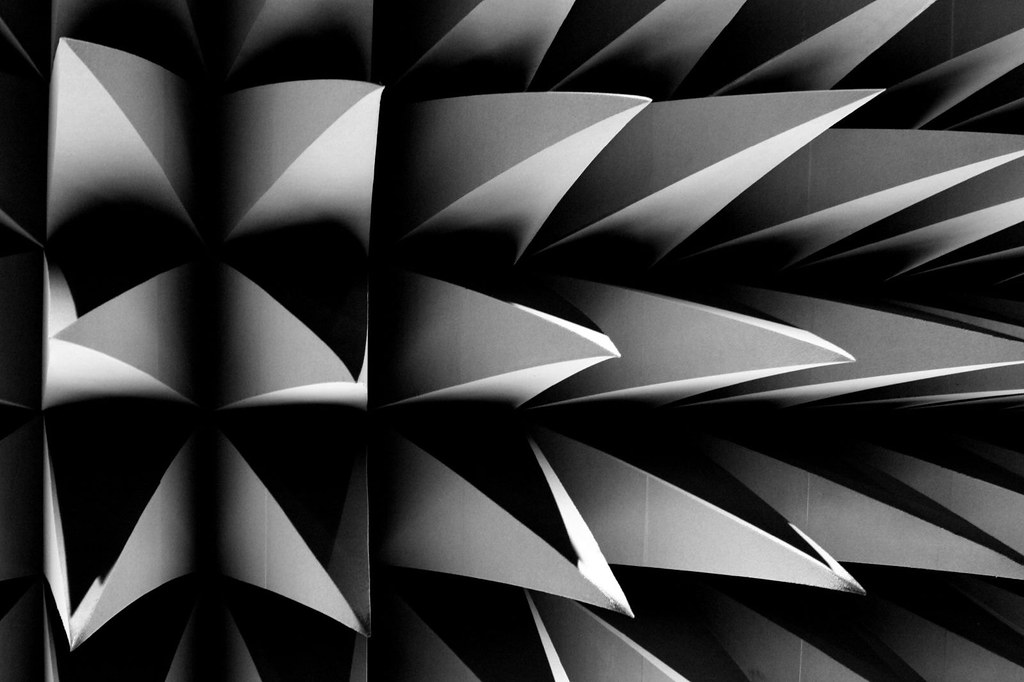
Anechoic Chamber is a room which is acoustically like being high above the ground in the open air because there are no reflections from the walls, floor or ceiling. This means it is ideal for testing the response of loudspeakers ormicrophones because the room doesn’t affect the measurements. It is also the best place for virtual acoustics - generating auralisations of concert halls, city streets and other spaces. The anechoic chamber is immensely quiet which makes it ideal for testing very quiet products or people hearing very quiet sounds.

Orfield Labs Anechoic Chamber (tour)


[Orfield Labs]
[via soundesign.info]
[John Cage visits the anechoic chamber]
[more: The World's Largest Anechoic Chamber]
[a Flickr search]

Thursday, May 01, 2008

Auralex Interactive Kit Calculator

The Auralex Interactive Kit Calculator is a nice web-app that allows you to quickly find the ideal complete treatment system to solve the sound control requirements of any standard rectangular room (registration required).

US-Standard Interactive Kit Calculator.
Metric Interactive Kit Calculator.

Wednesday, April 02, 2008

Highlight: Helmut Lachenmann

Where I Have Never Been Before: The Composer Helmut Lachenmann

Goethe-Institut
5750 Wilshire Boulevard, Suite 100, Los Angeles, CA 90036


Director: Bettina Ehrhardt. 2006, 87 minutes, in German with English subtitles.
Discover how the German composer creates a music that is beautiful in the most unexpected ways, exploring uncharted sonic territory while engaging the great Western tradition.

Post-screening Q&A with director Bettina Ehrhardt and Helmut Lachenmann.
Live performance of Lachenmann's Dal Niente by Shizuyo Oka, clarinetist of the ensemble recherche.

Tickets available at the door only, at the Goethe-Institut Media Lounge. Price: $5 per person, free for subscribers.

[via mondayeveningconcerts.org]
[The Music of Helmut Lachenmann]

Thursday, March 27, 2008

Mimmo Paladino | Brian Eno: a work for the Ara Pacis


11 March - 11 May 2008

The Ara Pacis Museum, the first piece of contemporary architecture to appear in the historic centre of Rome since the 1940s, is hosting this contemporary arts event between Brian Eno and Mimmo Paladino.

Brian Eno – "a non-musician kind of musician” as he likes to describe himself, is the man behind “Generative Music”, the precursor to New Age music, as well as a video-artist, sculptor, artist, and music philosopher who is also a more than capable player of a variety of musical instruments.
The two men have put their heads and combined talents together and come up with a unique work designed to fits the spaces inside the Ara Pacis Museum.
For his part, Brian Eno wanted to create a musical background that has no words, no melody, no rhythm and never plays over in exactly the same way twice. The music and sounds he produces are a long way from being a mere soundtrack that runs behind Paladino’s sculptures and artwork but are rather something that is completely separate from them and yet somehow also strongly connected to them. Unlike classical music, where the sounds are organised in a precise pattern, Eno works with musical values that waft through the air independently of each other.

The starting point for both Eno and Paladino is the concept of deconstructing their work and repeating modules that typify their creative inspiration. By stretching and flattening single sounds or themes and putting all the pieces together the two artists manage to obtain a harmonious whole.

[Eno. The music of the mind]

[Paladino/Eno at Ara Pacis]

[a conversation with Paladino]

Tuesday, February 12, 2008

Davide Tidoni: "I noitasi inoi"


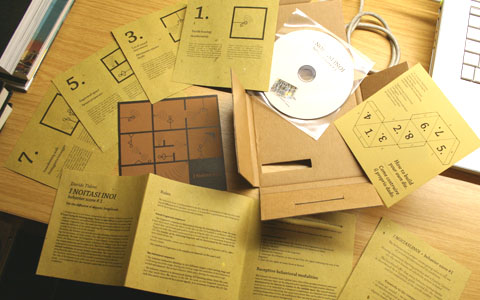
I notasi inoi is a listening kit. It permits you to create your own listening experience. The package contains an audio cd, 8 listening cards and a die with 8 sides.

By following the instructions on the card, the listener can organize sound diffusion and his/her spatial setting. Practicing different listening modes, the listener can experience new approaches to music and sound phenomena.

Inoitasi inoi was first published by Torvarobato Records in 2007. A new edition is currently in the process of being republished.

[to listen: davidetidoni.name]

Sunday, December 09, 2007

TMH Sound System: next generation surround sound

5.1 was named by Tomlinson Holman in 1987 and came out on film in 1992 and became popular since then. What comes after this is the addition of more channels and from that comes the 10.2 sound system which is twice as good as 5.1. How far the number of channels can go is known and largely speculated but the most logical answer at the moment is 10.2.
The purpose of 10.2 is to allow much greater flexibility for sound designers and create a far more immersive environment for the audience. With these channels, it is possible to recreate the acoustics of nearly any location with astonishing realism. Holman found that the second most important sound wave to hit the audience - after the one from the source - is the one that comes from a point on the ceiling, halfway between them. This is because most rooms have hard and reflective ceilings, but the walls are semi-absorptive due to objects in the room; while the floor, usually covered with carpet, absorbs most of the reflected sound. So this first, overhead reflection reaches the ear at a slightly different time, allowing the brain to both localize the primary sound and compute the size of the room. By placing two speakers 45° above and to the left and right the audience, this key sound wave can be recreated. The other speakers can fill in the other major reverberations from the sides and off the back of the room, recreating a full acoustic signature. The strength of traditional 5.1 surround is that its left and right surround speakers are diffuse; they spread the sound around the entire area. This helps to prevent the " Exit Sign Effect" - audience members looking away from the screen at the source of a localized sound, not realizing it is part of the movie. However, this diffusion carries a cost in flexibility. Therefore 10.2 augments the LS (left surround) and RS (right surround) channels by two point surround channels that can more finely manipulate sound - allowing the mixer to shift sounds in a distinct 360° circle around the movie watcher.
The .2 of the 10.2 refers to the addition of a second subwoofer. The system is bass managed such that all the speakers on the left side use the left sub and all the speakers on the right use the right sub. The Center and Back Surround speaker are split between the two subs. The two subs also serve as two discrete LFE (Low Frequency Effects) channels. Although low frequencies are not localizable, it was found that splitting the bass on either side of the audience increases the sense of envelopment.

[read the full article - via uscsoundconscious]
[tmhlabs.com]

Monday, October 01, 2007

John Cage - A Dip in the Lake

EMF presents the New York premiere of John Cage's A Dip in the Lake. Performed only once before, A Dip in the Lake is the exploration of a city by means of a 'random' soundmap that leads performers, listeners, or participants to places they may never have been before. The score identifies up of 427 locations within a city. The 'locations' are either very specific (such as the intersection of two streets), or more general (such as 'a park' or 'Lake Ontario'). Recordings are made at each of these locations, and divided into 10 groups of 2 (quicksteps), 61 groups of 3 (waltzes) and 56 groups of 4 (marches). These groups of recordings are then mixed live by the performers.
Originally scored for the city of Chicago, this performance, created by George Boski, Bill Blakeney, and Gayle Young, will use sounds recorded throughout Toronto, Canada. The three performers will each control four channels of sound, distributed throughout the Judson Church Meeting Room. The audience is then invited to walk around the space to hear the piece from different sonic perspectives.

Friday, October 12, 8:30pm

Judson Church
55 Washington Square South
New York City

Thursday, September 20, 2007

Toronto's Lost Subway Station

Sound installation: The Ghost Station, 2007

by Kristen Roos


[photo by matthewpiers]

Lower Bay Station, Toronto's ghost station, is used as a vessel to contain sounds that are within and below the threshold of human hearing - infrasound and tactile sound - where sound is felt rather than heard. Low frequencies created by cars and subways are contributors to the cacophony of infrasonic noise that exists deep below the rumbling of the city. These tactile sounds have also been associated with paranormal activity and ghost sightings.

Kristen Roos' audio art is informed by aspects of acoustic ecology, radio art and phonography.

[ghoststation.blogspot.com]

[Transit Toronto]

[nuit blanche]

Thursday, August 02, 2007

Around the world: "Whispering Galleries"

Wallace Clement Sabine (1868 - 1919), was an american physicist, who founded the field of architectural acoustics, the science of controlling sound within buildings. Sabine was acoustical architect of Boston's Symphony Hall, widely considered one of the two or three best concert halls in the world for its acoustics.

He described numerous examples of whispering galleries.

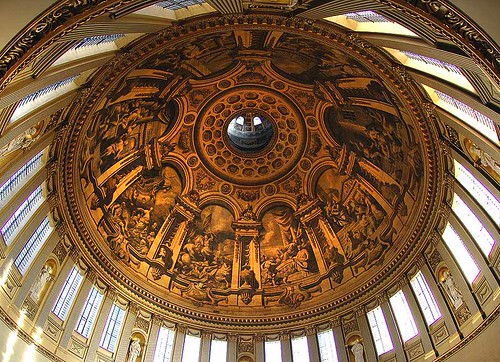
What is a whispering gallery? It's a gallery beneath a dome or vault or enclosed in a circular or elliptical area in which whispers can be heard clearly in other parts of the building.

[St Paul's Cathedral, London]

A whispering gallery is usually constructed in the form of an ellipsoid, with an accessible point at each focus. When a visitor stands at one focus and whispers, the line of sound emanating from this focus reflects directly to the dish/focus at the other end of the room, and to the other person. Circular whispering galleries may provide "communication" from any part on the circumference to the diametrically-opposite point on the circumference.

The most famous ones in Sabine's time included:

"Most, if not all, of these galleries are architectural accidents resulting from curved surfaces presumably designed for their visual impact. If you are the visitor, the sound of a distant speaker's voice is focused directly to you, as if the speaker were right next to you. The experience is unforgettable."

[source: Spaces Speak, Are You Listening?: Experiencing Aural Architecture - by Barry Blesser, Linda-Ruth Salter]
[take a photo tour via flickr.com]

Tuesday, July 24, 2007

Natasha Barrett recording in the sandpit


Natasha Barrett is a freelance composer, researcher and performer of acousmatic and live electroacoustic music. She works with diverse approaches ranging from installation to concert works, interactive art and multi-media collaborations as well as composing for instrumental forces. All energy stems from her acousmatic approach to sound, focusing on the ear and the different listening strategies we use when finding meaning away from visual stimuli. Since 1995 the spatio-musical potential of sound has been a focus of her output and research.

[from jorgenlarssson]
[Sleppet - The Sound of Norwegian Spring]

Friday, June 01, 2007

Favorite Intermissions - C. DeLaurenti

Music Before and Between Beethoven - Stravinsky - Holst


Secretly recorded at orchestral concerts across the country, this collection of intermissions teems with unusual soundscapes, startling (and unintended) collective improvisations, and surprising, sometimes gritty sonic detail from the sacred space of the concert hall.

[listen to SF Variations - 4'31"]
[delaurenti.net]
[nytimes.com]

Saturday, May 12, 2007

Multiphonies GRM 2007: Akousma

In 1958, Pierre Schaeffer, with Francois Bayle, Luc Ferrari, Iannis Xenakis, and others, organized the Groupe de Recherches Musicales (GRM). In 1966, Bayle was appointed director. In 1974, he created the Acousmonium, a loudspeaker orchestra designed to project sound in space through multiple loudspeakers. It contained eighty speakers of different sizes placed across a stage at varying heights and distances. Their placement was based on their range, their power, their quality, and their directional characteristics. In his words, "It puts you inside the sound. It's like the interior of a sound universe."

During our stay @ CCMIX, thanks to his director
Gérard Pape, Sunday 6th May 2007 we went to Radio France (home of the GRM) for 'Akousma'. We listened to the following artists, where they performed live 'spatialisation' of their tapes:

Jean-Louis Dhermy, Affleurements,
Philippe Jubard, Ecouter, création,
Jacques Stibler, Champs d'ombre, création,
André Dion, Symphonie Indo-européenne : 3e mouvement Cuchulain, création,
Alexandre Yterce, Soleils d'abymes, création.

(These pieces will be available soon on GRM Webradio)

In the photo, François Bayle (seen from behind) seated at the Acousmonium control panel in the Salle Olivier Messiaen, Maison de Radio France, Paris, in 1980.
[via arts-electric.org]

Maison de Radio France
116 Avenue du Président Kennedy
75220 Paris Cedex 16

[Listen to GRM Webradio]
[Ina-GRM on Last.fm]
[Pictures of Acousmonium via flickr]