Showing posts with label Vintage Audio. Show all posts

Tuesday, May 29, 2012

"Digital Re-Working / Re-Appropriation of Electro-Acoustic Music"


What is DREAM

DREAM is a EU funded project, aimed at preserving, reconstructing, and exhibiting the devices and the music of the Studio di Fonologia Musicale della Rai di Milano. During the 1950s and 1960s, this was one of the leading places in Europe for the production of electroacustic music, together with Paris and Cologne.
During the project, part of the equipment of the Studio (oscillators and non-linear filters) has been virtually reconstructed and will become part of the permanent exhibit at the Museum of Musical Instruments in Milan.

The aim of this one-day symposium is to present to the public the main results of the DREAM project, including the installation that recreates part of the original devices of the Studio di Fonologia di Milano della Rai, as well as the book “The Studio di Fonologia – A musical journey”, edited by Maria Maddalena Novati and John Dack, and published by Ricordi.

The event is comprised of two parts.
The morning will be devoted to the workshop Conservare, mostrare, interagire: per un museo da toccare [Preserve, exhibit, interact: for a tangible museum]. During the workshop, DREAM researchers and invited speakers will discuss applications of novel interactive technologies to museum exhibits, with particular reference to music and musical instruments museums.
The afternoon session will present to the large public the results of the DREAM project, through the movie Avevamo 9 oscillatori [We used to have 9 oscillators], additional talks by DREAM researchers, and two musical performances that make use of sonic materials produced at the Studio di Fonologia.

Program
[http://dream.dei.unipd.it/?page_id=645]

Friday, June 15, 2012
Castello Sforzesco, Museo degli Strumenti Musicali, Sala della Balla Milano 
Free of charge, limited places available

Wednesday, January 05, 2011

An interview with Frank Serafine (via Tron Wiki)

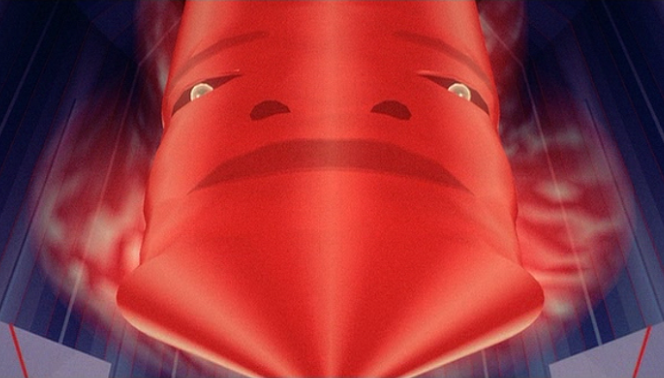
Tron Wiki founder Max Petrosky discussed with Frank Serafine - who was the sound designer on the original Tron film - about how some of the movie's most memorable sounds were created and how they were put together using technology no one have ever used before for sound editing.


Max Petrosky: I want to discuss about how you created some of the sound effects. I remember you were telling me earlier that the Lightcycle was created by using a Prophet-5 synthesizer. What it just a Prophet-5 or was it motorcycle sounds mixed in with the Prophet-5?

Frank Serafine: Yeah, it was a combination of Sequential Prophet-5, Minimoog, and then motorcycles that I recorded out in the field with Mike Fremer. We went out to this place called, The Rock Store, it's like the only place in Southern California where you can come and race in motorcycle racing, because it's so far out there in the middle of nowhere, and hard to get to that the only way they can catch people is by helicopter. So, they leave everybody alone out there and these guys go out there by the hundreds and race. We got these guys to come and do some incredible stuff for us. You know, all of their "crotch rockets" and racing through the hills and then we were able to mount the microphones onto the motorcycles and have them drive around and Michael Fremer had this interesting Saab Sonett 4-cylinder sports car and we put microphones inside the engine and went, you know, that same day, went riding around with his car and we ended up using a lot of that as well.


MP: How did you make the sound of the Recognizers?

FS: That was a program I created on the Prophet-5. It was kinda derived from a helicopter preset that was one of the original presets in the Prophet-5 and then I modified it and came up with the Recognizer sound.
I performed it by pitch wheel and modulation wheel right down to 24-track, so all of the Doppler effects and everything I did electronically.

[Recognizers]

MP: How did you make the sound effects for the disk flying through the air?

FS: That was a combination of a monkey scream backwards processed through a flanger and it was also another one of those weird synthesizer effects that I was able to create through the modulator and also I took a big wire cable spin and that was the whooshing element. The monkey was kinda like the element that was suppose to come around your head because we were doing a lot of surround effects with that disk throw stuff and we wanted it to be kinda like something that flew around your head and really scare you, you know, monkeys are kinda freaky sounding. So, I turned it backwards and you couldn't recognize that it was a monkey scream really. I affect the pitch the little bit, you know, what I like to do was back then I was using 1/4" tape recorders so I able to create really interesting elements by just turning the speed up and down on the tape recorder. That's the thing, a lot of the new digital work stations don't get you the sort of controllers and things we had back then to create special sound effects. They don't exist in the digital world right now. I'm creating a plug-in called the Serafine FX Tron from Sonic Reality and it's going to be a plug-in that you can play either through Pro Tools, Logic or Soundtrack Pro and you'll have all the fun stuff that we had back then: turning the sound backwards, affecting the pitch, manipulating all the elements and having a really strong search database engine to find all the effects in the library quickly and then you'll be able to perform on a keyboard, the same way I did it in Tron. We're developing that right now because it doesn't exist and it's very hard for people, they just basically take sounds out of a library and stick it into Pro Tools and that's it.


MP: How was the voice of the MCP created?

FS: It was processed through an Eventide Harmonizer and I able to lower his voice down like almost an octave, to make him sound like God, you know? And then, we had the Lexicon 224 Reverbs and that's how we created the massive "canyon-effect" that he was in. It was real heavy processing on the stage and they had him going through all 6 channels and it was a custom patch that I did, in order to get that big deep sound. And I was the one that had the Harmonizer. Now, every body's got one, but back then they were so expensive that the mixing stage didn't have one, so anytime they wanted to do special effects on the dub stage they called me in and I did all the processing on the stage. Like for instance, all the footsteps, you know like how it sounded when they walked, like a flanging kinda delay. It was a sneaker on cement with processing and that's what we basically came up with and that was used on the dub stage when we did our pre-dubs. We went and we processed all of the footsteps in a way that we all decided that was the best sound for the world and then I did all that processing on those foley effects.

[Master Control Program]

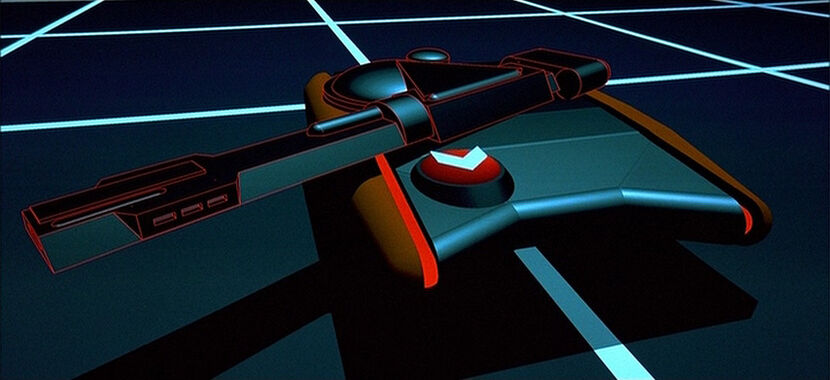
MP: How was the sound for the Tank was created?

FS: The Tank, again, was my Prophet-5 and I just basically performed them like I did the Lightcycles. I came up with a really cool, buzzy electronicy, "tanky" effect and then I created a bunch of them because every tank had to have a different sound. I had to go through and create different sounding tanks every time they started up so it didn't sound like a clone. It was a lot of design work on a lot of those tanks. As they lit up and everything, that was a special effect that I created using Minimoog stuff, you know, like a flash element like a pink noise flash through a flanger. 

[Tank]
[read more: tron.wikia.com]

Sunday, November 21, 2010

Time Machine - part IV: Sound Tricks of Mickey Mouse


Through study and experimentation Walt Disney and his engineers have found that by introducing music or various sounds and noise frequencies into the cartoon, the response of the audience is varied and controlled. By combining noises of certain pitches or tempos the psychological values of the cartoon music is emphasized in keeping with the story requirements.
[...]
Stories are told by sound. Vance DeBar "Pinto" Colvig, who wrote the lyrics for “The Three Little Pigs” and who does many of the sound “imitations” for automobiles, airplanes, or machines when they assume human characteristics, is able to convey a whole story by sound. For example, he caricatured a steam roller at work by suitable noises, pops, puffs, razzes, and wheezes. Vocally, without the aid of mechanical devices, he depicted a narrative episode of a very busy steam roller that worked hard, then got tired and stopped. To do this he made a picture on paper of the sound by working out the suitable suggestive sounds and inflections which he set down on music paper according to the desired effects, tonal range, and tempo which brought to life the pen and ink steam shovel. “Pinto” Colvig with the aid of a trombone and vocal sounds can make an airplane do all sorts of antics. Real airplane sounds cannot be controlled to musical tempo for cartoon effects. Each sound in a cartoon film is the result of much thought. Such things as bugs, all sizes, getting the hiccoughs which happened in “Mickey’s Garden” when Mickey sprayed them with “bug eliminator” required hours of rehearsal before the sound was recorded. For some sounds hours are required in rehearsal, and fifty or sixty hours are required to make the sound for the average cartoon.


While much of the sound is made vocally, mechanical devices and various materials are also used. One kind of slow-burning fire noise is made by crinkling cellophane, while a more crackling fire sound is gained by twisting a bundle of bamboo strips. A train getting under way is obtained by a tin can in which is a handful of gravel. By shaking the can and gravel up and down, the noise of a real railroad train is created. Another “train noise maker” consists of a number of wires held at one end by hand. The other end of the wires is rubbed over a sheet of corrugated tin. Thunder claps of various kinds are obtained by cowhides and sheets of metal, while wind noises are made by rapidly revolving a wheel with wire spokes. Another hollow ghostly wind noise is made by revolving a wooden drum against taut silk. Rain noises are made in a drum in which are stretched piano wires. Particles of glass dropping against the wire when the drum is revolved creates the sound.
[...]
Many devices are specially constructed in order that certain sound frequencies are dampened so the “imitator” has a better control over the pitch and volume of the noise. Special resonators in the pianos, doors set in elaborate resonating jams so “door-closing” noises may be made for cartoon purposes, and many other constructions are necessary.
Walt Disney, who knows the dramatic value of various sounds and musical tempos, has constructed many novel devices in order to produce the necessary sounds.
The background orchestral music is valuable in directing the emotional responses of the audience, and is used to elaborate on the cartoon story by what Walt Disney prefers to call the “earical illusion.”
[...]
Music and sound has become an exact science with Walt Disney. The music and sound effects in his cartoon psychologically tell the film story for the ears as the picture on the screen does for the eyes.

[read more: blog.modernmechanix.com]
[Time Machine - part I: Murray Spivak]
[Time Machine - part II: Mel Blanc]
[Time Machine - part III: Jimmy MacDonald]

Friday, November 12, 2010

Robby the Robot: Engineering a Sci-Fi Icon featurette

An examination of Robby's design, creation, and pop-cultural impact, a celebrity status that no other robot received until C-3PO and R2-D2 hit the screen.


This short documentary can be found on the "Forbidden Planet - 50th Anniversary Special Edition Dvd (disc 2)". It features interviews with Ben Burtt, director Joe Dante, Leslie Nielsen, and others.

[IMDb]

Tuesday, August 31, 2010

The RAI Studio of Musical Phonology: "XXth Century lute shop"

by Matteo Milani - U.S.O. Project, 2010


"The RAI Studio of Musical Phonology is the outcome of the matching between music and the possible new means of analyzing and processing that sound has" - Luciano Berio

After more than fifty years since the birth of analog magnetic recording, on the 17th of September 2008 at the Castello Sforzesco's Museum of Music Instruments in Milan, took place the inauguration of a new space dedicated to Rai Studio of Musical Phonology - "musical instrument of the 20th Century, extension of human thought". Such an event was made possible thanks to the International Music Festival MITO, in collaboration with the Civic Museum of Musical Instruments and RAI.

Maddalena Novati, RAI Radiophonic Production's musical consultant and responsible for the Phonology archive - thanks to the decisive contribution from Doctor Massimo Ferrario, Director of RAI TV Production Centre (Milan) - was able to transfer all the Studio equipment from Rai Turin to Milan headquarters. This is the very first plan of recovery, storing and refurbishing electrophonic musical instruments.

Maddalena Novati does in fact describe this niche of the Museum as the "20th Century lute shop". The idea of conceiving this space as a sole instrument in its whole, is moving: there are so many experiences enclosed in those devices that it is actually still possible to perceive the residual energy that characterized the entire handcraft process of sound-writing. The Milan Institute of Musical Phonology, designed by physicist Alfredo Lietti, was created in June 1955 at the RAI headquarter in Corso Sempione 27, by Luciano Berio and Bruno Maderna. During that year, Milan was on the verge of becoming a pivotal point in the international electroacoustic music post-war scene, through a new expressive language, which was a synthesis of the concrete and electronic experiences happening in Europe at the Studio für Elektronische Musik (WDR) in Cologne and at the Groupe de Recherches Musicales (GRM) in Paris. Among the electronic music experimental productions at the Studio of Phonology, we must mention works such as Visage by Luciano Berio, Notturno by Bruno Maderna, Fontana Mix by John Cage and Omaggio ad Emilio Vedova, the only entirely electronic work created by Luigi Nono.


"...in the opaque Milan of the '50s, Berio and Maderna found a hostile, apathetic environment, while opening the Phonology Studio. In a completely different situation from the newborn Studio in Cologne, the two masters, built their ideas on the strong basis of their French experiences, through a different technical method which was free and imaginative. Creatively, it has been the most relevant experience in the whole Old continent…" - Giacomo Manzoni


I always close my eyes and try to jump backwards in time, inside that Studio, imagining the noises, dialogues and sounds coming out the loudspeakers: living and breathing the miracles happening in that far age. We now have the possibility to touch by hand what I always used to see only in photographs and videos, how many protagonists of that time have lived (eminent musicians like Luigi Nono, Giacomo Manzoni, Aldo Clementi, Henri Pousseur, John Cage). In fact, in room XXXVI of the Museum of Music instruments, thanks to a glass structure designed by the architect Michele De Lucchi, the back of the eight famous frames containing the circuits are open for everyone to enjoy, allowing spectators to get the heart of the analog technologies with a 360° vision. Based on original pictures and videos from the time, the atmosphere of those years has been recreated.

Further information about the sounds that characterized the second half of last century, are available to the public of devotees and researchers, thanks to four computer stations with multimedia applications, and a digital library with photographs, footage, sound examples and scores (cured by the LIM Laboratory of the Università Statale di Milano).

The Studio, a patrimony fundamental to understand electroacoustic music writing, in the beginning has been experienced by composers as a mean to emancipate themselves from traditional instruments, with its 9 oscillators, the noise generators, different modulators, filters and the Tempophon (a device with rotating heads that allowed to vary the duration of the playback of a previously recorded sound, while maintaining the original pitch).

Those were the times of technicians in white lab coats, yet one particular person changed this professional's profile: Marino Zuccheri. Born on the 28th of February 1923, he was hired by EIAR in 1942; in the following year he left his job because of the war, but was re-hired a few years later by the new-founded RAI.

"... I like remembering Marino in his Phonology Studio, master among masters, master of sound among masters of music, because sound for him did not have any secrets, since he was trained in auditoriums while working for the Radio together with the most famous directors of the time. He would always recall how he begun working in Phonology by chance, but it is certain that it wasn't because of chance that he continued during the years, considering he's been the only holder of the Studio from when it was created (1955) until it closed down (1983)." - Giovanni Belletti, "Marino Zuccheri in Fonologia", 2008

He did not have any obligation to give advice, contributions or suggestions, yet musicians would follow his instructions on how to realize musical compositions: without him, much of last century's music would have never been born.

[Marino Zuccheri and Luigi Nono - courtesy of Fondazione Archivio LN]

"... All the protagonists of Neue Musik passed through the Studio, and it is fair to say this: many of them were in Milan through scholarships, and had to present a final composition at the end of their term, and sometimes the stay had not been long enough to master the nine oscillators' secrets, so the great Marino Zuccheri would put together an acceptable composition with a few touches, thus many of electronic music "incunabula" are his works, and not of those who signed them." - Umberto Eco, La Repubblica, 29 ottobre 2008

That has been an amazing adventure for many years, until 1983 to be precise, year of his retirement (Zuccheri then passed away in Milan, 10th of March 2005).

"Marino Zuccheri's demise was a great loss, not only for what he meant for Contemporary Music, but moreover for what he still could have done: he was to be involved in an important project by RAI, in order to catalog tapes (as himself defined the work) that would have given us a fundamental technical, artistic, musical and cultural insight on the history of the Phonology adventure (another of his own definitions), but not to restore the sound itself (which could be done by others when needed), rather to revive the ideas and technical intuitions that made possible the creation of that sound: Marino (along with the composers) was the only one that could help us!" - Giovanni Belletti, "Marino Zuccheri in Fonologia", 2008


"[..] Two of the first electronic works in my record collection - Berio's Visage from 1961, and John Cage's Fontana Mix from 1958 - were created there with Zuccheri. Even today, both of these pieces sound impressively vivid and dynamic, and what we should now recognise is that such qualities should be attributed to the technician as much as to the composer. 
[..] Zuccheri appears to fit the profile: Parete 1967, composed for painter Emilio Vedova for the Italian Pavilion at Montreal Expo, 1967, was his only known work. [..] Luigi Nono was his first choice as composer, but Nono's schedule prevented that, so Zuccheri stepped in to assemble a 30 minute continuous work using previously recorded sounds built up from long intersecting tape loops. Zuccheri's modest opinion of himself was that he was no composer. Certainly there's very little sense of form in Parete 1967, but the dramatic contrasts of harsh noise, perhaps sourced from piano strings and struck metal, and shifting, modulating drones suggestive of vocal choruses, have something in common with the ritualistic side of Iannis Xenakis, or the best horror movie soundtracks. To the regret of his label Die Schachtel, who have produced another of their sumptuous limited edition vinyl releases here, Zuccheri died before seeing the publication of his only record." - David Toop, The Wire, 2008


After the Studio closed down, the equipments were disassembled and exhibited in Venice for a short period, on the occasion of the temporary exhibition called Nuova Atlantide, organized in 1986 by the Biennale (with the collaboration of Roberto Doati and Alvise Vidolin) and in Milan for I piaceri della città - Iconografia delle sensazioni urbane in 2001, where Il risveglio di una città was displayed through music thanks to the futurist composition of the same name by Luigi Russolo, and to Ritratto di città, the first electroacoustic composition of the Fifties (voice and tapes by Luciano Berio and Bruno Maderna, lyrics by Roberto Leydi) created in order to convince the direction of RAI to create the Studio.

At the end of the Eighties, there still was no awareness of what the Phonology Studio had meant historically, at the point that all the documentations had been deposited (packed and cataloged) in a storage room at the RAI Museo della Radio in Turin, together with all sorts of disused equipments such as video-cameras, tape recorders, record players, microphones, with no plans to be restored or rebuilt.

Thanks to Maddalena Novati's interest, in 1996 the Studio devices were displayed in Turin's Music Salon and in 2003 they were brought back to RAI in Milan and located in a room on the fifth floor which is adjacent to the one where the Phonology Studio originally was. On June 20, 2008 they were officially transferred to the Castello Sforzesco.


It was a great pleasure for me to interview Maddalena Novati to talk about what the unique experience of the Milan Institute of Musical Phonology was and meant, and to understand what consequences and developments this process of recovery could lead to.


Matteo Milani: Maddalena Novati, why in your opinion the Studio became a myth?

Maddalena Novati: In 1955, to own 9 oscillators tuned on different frequencies, as opposed to the single one that was in Cologne, was like having a "whole orchestra" at your disposal, that could generate many sounds simultaneously like in a chord. This way, you already had a handful, a palette of sounds that killed production times. Human ear was the only judge which decided whether a sound was good or not, and after several attempts and mistakes, interesting tapes would be recorded and stored and this process would continue until a result was achieved. Berio would broadcast on radio each new composition from other Studios around Europe in order to spread the repertoire. The 11 TV episodes of C'è Musica e Musica (1972) on the history and ways of making music, sound fascinating with explanations by Luciano (Berio, n.d.a.). He was a great teacher on top of being a great composer, a person that could communicate and bring music to large audiences.
Berio developed an intense activity as a teacher in the United States and Europe, offering courses of composition in Tanglewood (1960 and '62), in Dartington Summer School (1961 and '62) in Mills College in California (1962 and '63), in Darmstadt, Cologne, Harvard University and, from 1965 to '72, in Juilliard School of Music in New York. From 1974 to '79 he collaborated with IRCAM in Paris. Berio's "Un ricordo al futuro - Lezioni americane" published by Einaudi is a beautiful book, which collects the lectures on aesthetics he gave in the US.


MM: When and how did Phonology's decadence period began?

MN: After the Sixties, at the beginning of the Seventies, radio is not anymore the core of research (not being an experimental mean anymore). Computers came up, and research centers moved elsewhere: large calculators are owned by universities and musicians depend on the physics and science departments. The computing machines had to function day and night, and only when physicists would leave their workplaces, musicians could take their place at night in order to perform calculations for their compositions. The radio was not involved anymore, as the broadcasting media did not yet use computers and their respective courses were different. Due to the lack of updates to its equipments and technology, the Phonology Studio was less and less attended by composers. Moreover the defection of some big names (Berio moved to the IRCAM of Paris, Luigi Nono to Fribourg, Maderna passed away prematurely in 1973) had an influence on an inevitable decline.


Active Conservation

It’s again Maddalena Novati who tells us that today the archives (original master copies) of the Phonology Studio, hold 391 ¼ inch-audio tapes with one or two tracks, as well as one inch tapes with four tracks, plus 232 digital copies from acquisitions (copies of works coming from other studios, centers for electronic music, recordings or concerts or plays of the main authors and interpreters who frequented the Studio during its active years). Since 1995 the custody of tapes continues to be her primary objective as well as their cataloging and digitalization in cooperation with Casa Ricordi (the oldest and most important Italian editor), together with the central Nastroteca of RAI and Mirage Laboratory of the Gorizia University.
No real decay of the tapes has occurred, thanks to the good quality of the tapes from BASF, that were selected instead of other brands like Scotch or Agfa. Survival of the audio documents is possible only by separating them from their physical support, and periodically transferring them to new supports. The second digital transfer at 96 khz/24 bit is currently ongoing at the Centro di Produzione TV and Produzione Radiofonia of Rai Milano, in cooperation with Mirage laboratory.


Restoration of recorded music
by Alvise Vidolin 

As for the restoration, the most common task is the elimination of noise of the analog tapes and, according to the tape conditions and the specific nature of the music, there are other interventions to be decided on a case by case basis. As a start, one has to perform an initial search, in order to detect the possible existence of other copies of the same music, as it would then be possible to exploit the best parts from each copy, and with suitable techniques, improve the effectiveness of the cleaning work.
In many works of electronic music, the original tape contains scratches and joints glued with adhesive tape whose glue loses its adhesive properties after a few years. Therefore it often happens that one has to paste various pieces of tape before copying it on a new support. On some tapes, it happens that there are some detached magnetic fragments, while on others, parts of material or protective film might have melted, and therefore deposited on the sound head thus blocking the progress of the tape. On top of these mechanical problems, there might occur electromagnetic problems or problems due to the type of equalization used during recording, and the fact that the oldest tapes could only support a proportionally lesser quantity of magnetization.


Reconstructing the laboratories

As I already had the chance to point out, very often the production of electronic music is not linked to a specific instrument like it happens with traditional music, but rather to a whole of equipments commonly called a system. Hence the conservation of a single element of a system does not give a full testimony of the modus operandi of a musician in a given period. Without doubt, the most effective solution is reconstructing a lab where one can reproduce all the phases of the production process of a musical work. In Cologne for instance, they reconstructed and brought back into function a lab for electronic music with the same configuration it had in the Fifties. In a similar way, this is what is happening at the Aja museum for the study of Sonology Institute of Utrecht University in the Sixties. In Paris at the Parc de la Villette, they are setting up a large section dedicated to the musical electrophonic instruments, until the experiences of computer music in real time of the Eighties.

[Vidolin A., "Conservazione e restauro dei beni musicali elettronici", in Le fonti musicali in Italia - Studi e Ricerche, CIDIM, year 6, pp. 151-168, 1992]

[the italian version of the article is also available @Digimag 55]
[listen: Ricordo di Marino Zuccheri | ITA - via Radio3 Suite]

Wednesday, February 24, 2010

Time Machine - part III: Jimmy MacDonald

“Animation inspires the most inventive world of audio illusions, for it demands the highest performance from dialogue, music and sound effects.” – Ben Burtt


John James "Jimmy" MacDonald (May 19, 1906 - February 1, 1991) was a Scottish voice actor and the original head of the Disney sound effects department, and the voice of Mickey Mouse from 1947 to 1977.
In 1947, Walt Disney was getting too busy and too hoarse from smoking to continue voicing Mickey Mouse, so he passed the torch to MacDonald. MacDonald voiced the mouse on a regular basis until 1953 and a recurring one until 1977, passing the torch to young Disney sound effects man Wayne Allwine for Mickey's Christmas Carol. His voice repertoire included yodeling, whistling and sneezing for the Dwarfs in Snow White and the Seven Dwarfs, barks for Pluto, and the excitable, high-pitched voices of Chip 'n Dale on many occasions. MacDonald also did the voice of Bruno, Gus and Jaques  in Cinderella. He developed many original inventions to achieve expressive sounds for characters like the train Casey Jr. from Dumbo (1941) and the bees in Winnie the Pooh and the Honey Tre. For the 1977 animated feature The Rescuers, he came out of retirement to provide sounds for the feisty dragonfly, Evinrude. 

Sound Stage Mysterious Place

Recording sound effects at the cartoon studio is more than just interesting. It is like a scene in an old alchemist's laboratory. You hear the director asking for a dog bark, or a dog sniff, for a kiss or shivery growl. Perhaps a door slam. The kisses are made by a musician who kisses the back of his hand. A bottle and a cork in their hands can be made to sound like a monkey chattering. A tin car with a resin covered string sounds like Mickey's trousers tearing. They have dog barks in all pitches, deep barks for big dogs, little barks for little dogs, and yips for frightened dogs. These sounds are made by the imitators who have specialized in voice control or by special apparatus designed for the purpose.

[via mouseplanet.com]
[more @ hollywoodlostandfound.net]
[James MacDonald @ IMDb]

In the following videos, legendary sound designer Ben Burtt and Joe Herrington, the keeper of MacDonald's “old stuff", explored historic props and sound-making devices, looking back on the early days of Disney. The featurette will also include footage with MacDonald at work in these classic animated films.

Videos:  "Animation Sound Design: Building Worlds from the Sound Up"
 [part 1]
 [part 2]

Joe Herrington at the Academy of Motion Picture Arts and Sciences

Herrington also demonstrated various types of sound effects equipment and their uses at "The Sound Behind the Image: Now Hear This!" in 2008. 
"The audience gasped in delight as strange devices made from cans, tubing, metal, wood, leather and wire suddenly croaked like frogs and buzzed like flies, creating the bizarre but familiar sounds they’d heard so many times as children. A bundle of bamboo became the sound of Bambi’s fire. From the sound of a million marching ants, to making the mainspring of a clock talk in a human voice, MacDonald did it."

Friday, December 11, 2009

Time Machine - part II: Mel Blanc


"The man of a thousand voices"

Melvin Jerome "Mel" Blanc (1908 – 1989) was an American voice actor and comedian. Blanc is best remembered for his work with Warner Bros. during the so-called "Golden Age of American animation" (and later for Hanna-Barbera television productions) as the voice of such well-known characters as Bugs Bunny, Daffy Duck, Porky Pig, Sylvester the Cat, Beaky Buzzard, Tweety Bird, Foghorn Leghorn, Yosemite Sam, Wile E. Coyote, Barney Rubble, Mr. Spacely, and hundreds of others.

[Read: Mel Blanc @ IMDb]
[Watch: The Voices of Mel Blanc on YouTube]

Some Video Goodies:

Mel blanc on Latenight with Letterman circa 1981


Mel Blanc on The Tonight Show with Johnny Carson


Mel Blanc 1908-1989


Listen (.m4a) to a recording of a speech by Blanc at the 1966 Annual Awards Luncheon of the Station Representatives Association. Titled "Mel Blanc Takes A Humorous Look At Commercials: Past, Present and Future (Who The Hell Is Mel Blanc?)", this record is a hilarious glimpse at both the advertising industry and a little known aspect of the career of one of the most famous voice actors of all time.
[via animationarchive.org]

Trivia: Mel Blanc was auditioned by director George Lucas to provide the voice for the C-3PO character, and it was he who ultimately suggested that the producers utilize Anthony Daniels' own voice in the role.

Related Post: Time Machine - part I: Murray Spivak

Wednesday, August 26, 2009

Herbert Brün

Herbert Brün began his work as an electronic music composer in the late 1950s, in Paris, at the WDR (Cologne) and at the Siemens studio (Munich). He continued his work in the electronic studio at the faculty of the University of Illinois and began research on composition with computers, which resulted in pieces for tape and instruments, tape alone, and graphics (some to be performed by interpreters). In the late 1960s, Brün created his own programs in FORTRAN. Brün took a new direction in 1972, leading to his 'Sawdust' compositions. The goal was to create sounds that were unfamiliar and new.
He was a pioneer in the development of computer music, recognized as a thinker who focused on musical process, creativity, language and thought, performance and everyday life. His concerns included the social functions of composer and listener, communication, originality, and the human implications of various compositional processes. You can find Brün's important lectures and articles (with excerpts from his book 'When Music Resists Meaning') here:

[Herbert Brün - Interviews, Articles, Public Talks, and Skits]

"It is one thing to search for events that will produce the sound one wants, and quite another to discover the sound of the events one wants. In the first case the wanted sound renders desirable the necessary events; in the second the wanted events are the standard for the desirability of the resulting sound. These are not only two different approaches to the composition of music, but also two different political attitudes."


SAWDUST is the fourth in a series of four CDs containing the complete works of Herbert Brün. This CD contains Brün's music with sounds generated largely by his computer program 'Sawdust', which he wrote in the 1970s.

"The computer program which I called SAWDUST allows me to work with the smallest parts of waveforms, to link them and to mingle or merge them with one another. Once composed, the links and mixtures are treated, by repetition, as periods, or by various degrees of continuous change, as passing moments of orientation in a process of transformations."

[SAWDUST samples - via emfmedia.org]

Wednesday, October 29, 2008

Oscillators behind the glass

Between 1955 and 1983, in Milan is developing one of the most important musical experiences of the 20th century. It is called Studio di Fonologia Musicale and collect, as well as the most technologically advanced machines of the time, even the finest musicians, who converged there to produce the first real electronic music in Italy that has ever been produced.

[leggi l'articolo - read the full article]
[download the interview with Maddalena Novati - mp3]
[inside Rai Musical Phonology Studio]

[via altremusiche.it - by Michele Coralli]

Wednesday, September 17, 2008

Inside the RAI Musical Phonology Studio

The Phonology Studio, a musical instrument of the twentieth century, an extension of human thought, has now found its ideal home in the Museo degli Strumenti Musicali of Castello Sforzesco, Milan.

RACK 1
  • Patchbay (made by RAI)

RACK 2
  • Brüel & Kjær 1011 beat oscillator
  • 6 Wavetek 110 oscillators
  • 2 Wavetek 115 oscillators
  • Heathkit AG 10 oscillator
  • General Radio 1398-A tone burst generator

RACK 3
  • Brüel & Kjær 1402 white-noise generator
  • SIAE 431A oscillator
  • Elit MOD 201/D millivoltmeter amplifier
  • Nine-input mixer (made by RAI)
  • Comparator (made by RAI)
  • 2 continuous-loop Appel 311 cassette players

RACK 4
  • Unit with 7 slots:
  • 2 ring modulators (made by RAI)
  • 1 amplitude selector (made by RAI)
  • 2 ring modulators for the frequency transposer (made by RAI)
  • 1 electronic selector switch (made by RAI)
  • 1 empty
  • Dynamic modulator (made by RAI)
  • Amplitude selector (made by RAI)
  • Frequency transposer (made by RAI)

RACK 5
  • Unit with 7 slots:
  • 1 amplifier Auso Siemens ELA 75-0 for 8-input mixer (made by RAI)
  • 5 empty
  • 1 power supply Auso Siemens ELA 23-03
  • Hewlett-Packard 3591 selective voltmeter + Hewlett-Packard 3594A oscillator with frequency meter
  • Patchbay (made by RAI)
  • Eight-input mixer (made by RAI)
  • Band-pass frequency filter Krohn-Hite 310-A
  • Band-pass frequency filter Krohn-Hite 310-AB

RACK 6
  • Octave filter bank (made by RAI)
  • Bass-pass filter bank (made by RAI)
  • Treble-pass filter bank (made by RAI)

RACK 7
  • For future improvements
RACK 8
  • 5 OSAE P20 T amplifiers
  • Patchbay
  • 2 OSAE P20 T amplifiers

Tuesday, September 16, 2008

Sneak Preview: RAI Phonology Studio

In 1955, the Radio Italiana (Rai) established the Studio di Fonologia Musicale at RAI Center in Corso Sempione 27, Milan (Italy). Physicist Dr. Alfredo Lietti builded the famous “nine oscillators”, the white noise generator, the amplitude selector, the dynamic modulator, the ring modulators, the frequency shifter, the pulse modulator, the electronic fader, the “toc” generator, the cathodic comparer, the octave filters and the third octave filters.
Almost half a century later, the museum of Musical Instruments in the Castello Sforzesco now houses the equipment on which Luciano Berio and Bruno Maderna conducted the first experiments in electronic music.
An innovative digital library service allows the public to obtain informations and to listen to short excerpts from the rich archive of compositions carried out in such machines.

Maddalena Novati found about 400 tapes for 200 hours of listening, which she has been cataloguing, restoring and converting with the help of Laboratorio MIRAGE (Università di Udine) and Laboratorio Audio Rai (Milan).

I suggest you the following reading: "Technology and Technics: Alfredo Lietti and Marino Zuccheri", written by Giovanni Belletti [pdf].
Some excerpts from original footage:

[RAI Studio of Musical Phonology: historical footage #1]
[RAI Studio of Musical Phonology: historical footage #2]
[2007/04/rai-electronic-music-studio]
[2007/05/rai-studio-of-musical-phonology-pt-2]
[2007/05/rai-studio-of-musical-phonology-pt-3]

MM

more soon!

Tuesday, August 19, 2008

Audio Restoration for 'The Godfather Trilogy'

Mark Berger, Francis Coppola, and Walter Murch mixing Godfather II (1974).

POP Sound in Santa Monica, Calif. recently completed audio restoration work and 5.1 surround sound mixing for Paramount Home Entertainment’s release of The Godfather: The Coppola Restoration DVD Collection on DVD and Blu-ray.

POP Sound spent nearly eight months on the project, working in concert with Walter Murch, the original re-recording mixer on The Godfather, Parts II & III. For the first two films, POP Sound worked from the films’ original mono stems, as well as the original multitrack recordings of their musical scores. POP Sound had access to the original stereo elements for The Godfather, Part III. The re-recording mixer on the project for POP Sound was the late Ted Hall. Much of Hall's attention was devoted to eliminating artifacts that had affected the soundtrack over the years and addressing audio issues that were impossible to address when the films were made.

“We had a lot of cleanup to do to make these films sound fluid in transitions—the original mono tracks were very rough, with hard transitions,” recalls POP Sound's Director of Home Theater, Moksha Bruno. “There was a massive amount of de-humming, de-clicking, as well as time alignment issues we had to deal with. The original laser disc mix had a constant hum that wasn’t apparent at the time, but with the better home theater systems of today you begin to hear things of that nature."

[read the full article - via mixonline.com]

Saturday, August 02, 2008

The Pioneers Of Sampling [part 1]

Before digital sampling, sound manipulation was seen as a subversive and avante garde activity. Composers were ostracized for experimenting with found sound sources and a belief that music could exist outside the strict confines of the classical or popular domain.


[via sonicstate.com]

Wednesday, June 11, 2008

Analog Oscillator Comparison

Here is a comparison between the various waveforms available on three of the most popular analog synthesizers:


[via tv.sonicstate.com]

Friday, May 30, 2008

RAI Studio of Musical Phonology: rebirth

Castello Sforzesco
Museum of Musical Instruments
Sala della Balla
06:00 p.m.

MITO has promoted the transfer of the RAI Studio of Musical Phonology at the Museum of Musical Instruments in Milan to make its equipment and electronic archives available to the public.
The priceless musical heritage and technology is for the first time assembled and exhibited in its entirety in a museum.
Luciano Berio, Bruno Maderna and Luigi Nono's experimental music will live again in their original environment and an innovative digital library will disclose its contents.

Free admission

[mitosettembremusica]

Friday, April 25, 2008

WHAT THE FUTURE SOUNDED LIKE


Film teaser for the documentary What The Future Sounded Like - the story of the Electronic Music Studios and their impact on music history.

www.myspace.com/whatthefuturesoundedlike