Showing posts with label Historical. Show all posts

Friday, November 06, 2015

GRM pt.3: What made Syter original

(Continued from pt.2)

an excerpt from the booklet about the Syter system at INA - GRM | Archives GRM (CD 4) - by Daniel Teruggi

Looking back on it now, it is not easy to describe just how original the tool was for the time. It was at this time that the first "black boxes" were beginning to appear in the shops, at very high prices, enabling users to do a limited amount of processing to sounds. It was impossible to programme these devices. They had a certain number of parameters which were determined in advance and could be controlled using buttons and potentiometers to simulate analogue devices. At the same time, the first samplers were appearing, enabling users to record a sound just a few seconds long into memory and then to replay it, by transposing it and modifying certain parameters.
Syter was all of that and much more besides: processing and synthesis tools, rapid memories, the possibility of reading and recording sounds in real time on a hard disk (500 Mb, which was considered to be absolutely fabulous at the time) and above all, the possibility of reprogramming the processing tools and building new ones to your heart's desire, using a modular programming approach. Syter was the potential book of magic on the basis of which all the existing processing and synthesis methods could be rethought and new processes imagined and designed. All of this had a cost, and the price of the system was such that only one institution was able to buy it (although it was only about 10 times the cost of a synthesiser or a digital processing box at the time), and it required maintenance engineers to keep it running.
The originality came from the fact that processing methods that had come from studio work, and which had been used from the outset for GRM concrete music, were made readily available, without the need to learn programming languages or to have an assistant constantly on hand. In other words, the real originality was to be found in the algorithms and the interfaces.
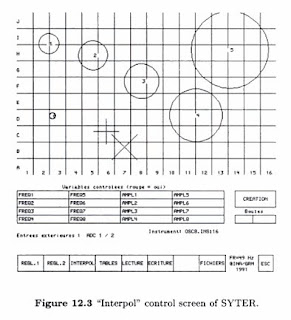
Concrete music and the use of electroacoustic studios had stabilised and modelled a certain number of sound-related operations on the basis of perception-based concepts. For example, an extremely powerful analogue studio process, "micro-editing", involved cutting minute fragments of sound from magnetic tape (using scissors!), which were then stuck end to end to create a new continuity. This principle was very successfully applied by the deferred time software and by Syter, making it possible to reorganise the material into new coherent sequences. This became known as "brewing". But brewing is not the end of the story, because the difficulty lies in controlling the way the brew comes together. Graphical interfaces, which these days are at the very heart of all computer technology, but which at the time were practically unheard of, were used to visualise the sound and the control parameters, and there was even an interpolation screen for exploring the intermediary terrain between two processing states.
Syter was a hit with musicians, both for studio work and instrumental work. In the studio, it could be easily built into the existing environment and breathed new life into the palette of processing possibilities. The system was essentially used for the processing of sound, meaning that the composer would record sounds and then modify them using the processing tools that were already built in, or by creating his own tools. In so doing, he would be faithful to the GRM tradition of processed sound, even though many hybrid processing techniques (between recorded sounds and synthesised sounds) provided entirely new kinds of sound. This material would then become (whether or not mixed with other sounds from other sources) the basis on which the composer would build his work.
Furthermore, at the time there was a unique relationship between composers and technical designers, who thanks to the modular programming techniques and their user-friendliness, could quickly build the tools necessary for creative work. A number of models that were later to become GRM Tools were a result ot this experimental relationship (in particular Doppler and Pitch Accum]. Once they had been built up, these algorithms were simple to implement, and integrated the whole palette of processing tools available in the system (around 40 different algorithms were designed and 15O variants of these basic algorithms).

An approach founded in pedagogy

The philosophy of the GRM has always been that the creator should work independently on his own process of composition, without the assistance of anybody else. Most composers had the training necessary to handle the techniques, to understand and work the analogue studio, and only in very rare cases were they assisted by the technician-musician. There was such a great interest in the deterred time software or the Syter system, and it was aimed at musicians of such varied backgrounds, that a training programme had to be set up in order to help them come to grips with the different systems. Man of these composers who came from an electroacoustic background, and many others were not familiar with studio techniques but who wished to become acquainted with them and develop projects bringing together instrumental and electroacoustic techniques. There were many other professionals from other fields: artists, radio and sound technicians, teachers or musicologists.
Week-long courses with small groups of trainees began to be organised 2 or 3 times a year, involving generally 6 to 8 participants (a total of 20 courses between 1985 and 1993]. During these courses, the system was explained and the participants had the chance to experiment and play with sounds. The objectives of these courses were manifold: the first was to provide composers with the training necessary for them to be autonomous in their work and to enable them to develop a project.
Another objective was to test the system with users. Because it was such an innovative system, using original approaches with regard to algorithms and interfaces, it had to demonstrate that it was up to the task and that the composers could use it easily and efficiently. Around 120 people followed these courses, and 80 works were composed, sometimes several of which were written by the same composer.

From pedagogy to production and concert presentation

Many of the composers were attracted by the possibilities offered in terms of the real time processing of acoustic sounds, and embarked on projects that brought together live instrumentalists, real time processing and recorded sounds. Others used the system in the studio, for acousmatic works, either to complement other existing studio technologies and tools, or sometimes as the sole production tool.
I was personally involved in this pedagogical and production aspect of the Syter system for some ten years. When it was first presented in-house in 1984, everybody underlined the technical prowess it had been to develop a system of that kind, but there was little enthusiasm on the part of the GRM composers, in light of the small number of existing algorithms and the fact that there were no instructions for use. I was fascinated by this approach and I proposed to Jean-François Allouis that I would help him in his project, in particular by explaining to composers how the system worked and by writing up a manual. We then organised the first training sessions in August 1985 and August 1986, and thereafter I took charge of the courses and production associated with the system and the development of variants of the instruments, in response to requests made by composers. I was therefore able to meet everybody who participated in the courses and I followed everything that was produced using Syter. I also played a great many works that involved Syter for the real time processing of instrumental sound Ia task that we became particularly involved in with Richard Bulski, the system technician, especially for moving it and setting it up for concerts).
I was able to gain an extensive and in-depth knowledge of how the system functioned, so much so that I was able to write my PhD dissertation on Syter (The Syter system, its history, development, musical production and implication in contemporary electroacoustic language, presented in December 1998 at the University of Paris VIII). I composed ten pieces on the system, some of which were with instruments, using the system only to produce electroacoustic sound, and others which were acousmatic, where a great deal of the sound creation work was done on Syter from start to finish. I began to move away from the system in around 1993, when it was beginning to become obsolete and when the first versions of GRM Tools were becoming available on Macintosh, designed and built by Hugues Vinet, who took much of his inspiration from the algorithms of Syter. I also realised, in 1993, that my life had been too wrapped up in the system, when a composer asked me seriously whether Syter was an acronym for System Teruggi!

inagrm.com/grmtools

[Prev | 1 | 2 ]

Sunday, February 17, 2013

Project Genesis, a sound design story

by Matteo Milani


What if the history books have it wrong? What if the tool is the master of its maker? Did Mac create Man?  Project Genesis, a short film by Alessio Fava about a world populated only by old Apple computers, has arrived! Cult of Mac presented the International Premiere of the short film.


Project Genesis // shortfilm sub ita from project genesis on Vimeo.

To create a world populated by computer, it was essential to define the role of sound during the process of writing the script, to support the story. To make the actors credible and alive - like the old Apple Macintosh Classic and Lisa - each one with its own details, it was a thrilling creative work. During the first meetings with director Alessio Fava we looked for the "voice" of each character - of course with a west-coast American accent. For example - thanks to my friend Ann Kroeber @ soundmountain.com - we chose actor Michael Navarra for the role of the CEO "ACME I", not just for his timbre, but especially for his outstanding acting skills. Since all computers are equipped only with an eye on their front screen - animated by the team of artists who supervised the visual effects - we needed incisive voices, with a lot of inflections, but somehow also enigmatic. A graphic equalizer which moves in synchronization with the voice increases the intensity of the expressions of the characters: in this case the production method was identical to that of an animated film, where the dialog is recorded before the “lip-sync” animation process.

By contrast, I have treated the original dialog without digital tools, instead using the technique of "worldizing" broadcasting FM sentences of each actor to old radio receivers, simulating the sound as if it came from the chassis of the computer, more precisely from the speaker located inside the Mac. 

The goal has always been - according to Alessio - to get results in a vintage and analog "flavor", anything but futuristic. To invent the sound of the propulsion system that allows these intelligent machines to move on the location of the short film, I used an electric razor as a main source, which with its continuous vibration resonates in the cavity of a metal lid, picked up by a contact microphone to have a more defined and organic timbre without interference from the surrounding environment (it’s an homage to Ben Burtt, who did it previously for “Star Wars: Episode I The Phantom Menace” to create the sound of the hovering battle tanks). The result is a "concert" of different signals, which modulate at different pitches, placed in different spatial positions. Kyma also was used to generate ambiences and backgrounds throughout the film. To make the presence of each character more vibrant - each one animated with the “stop motion” technique - and further emphasize every action on the screen, I added not only individual mechanical noises to emulate the chronological age of each computer, but also noises picked up the activity of a failing hard drive. Working alongside composers Giovanni Dettori and Lorenzo Dal Ri, we have achieved an excellent balance between dialogue, sound effects and musical contributions to an immersive sound continuum, in both 5.1 surround and stereo format. 


Project Genesis // Creating voices from project genesis on Vimeo.

[facebook.com/followgenesis]

Tuesday, May 29, 2012

"Digital Re-Working / Re-Appropriation of Electro-Acoustic Music"


What is DREAM

DREAM is a EU funded project, aimed at preserving, reconstructing, and exhibiting the devices and the music of the Studio di Fonologia Musicale della Rai di Milano. During the 1950s and 1960s, this was one of the leading places in Europe for the production of electroacustic music, together with Paris and Cologne.
During the project, part of the equipment of the Studio (oscillators and non-linear filters) has been virtually reconstructed and will become part of the permanent exhibit at the Museum of Musical Instruments in Milan.

The aim of this one-day symposium is to present to the public the main results of the DREAM project, including the installation that recreates part of the original devices of the Studio di Fonologia di Milano della Rai, as well as the book “The Studio di Fonologia – A musical journey”, edited by Maria Maddalena Novati and John Dack, and published by Ricordi.

The event is comprised of two parts.
The morning will be devoted to the workshop Conservare, mostrare, interagire: per un museo da toccare [Preserve, exhibit, interact: for a tangible museum]. During the workshop, DREAM researchers and invited speakers will discuss applications of novel interactive technologies to museum exhibits, with particular reference to music and musical instruments museums.
The afternoon session will present to the large public the results of the DREAM project, through the movie Avevamo 9 oscillatori [We used to have 9 oscillators], additional talks by DREAM researchers, and two musical performances that make use of sonic materials produced at the Studio di Fonologia.

Program
[http://dream.dei.unipd.it/?page_id=645]

Friday, June 15, 2012
Castello Sforzesco, Museo degli Strumenti Musicali, Sala della Balla Milano 
Free of charge, limited places available

Friday, March 09, 2012

GRM pt.2: the birth of a concept

Daniel Teruggi wrote an interesting article about the Syter system at INA - GRM in the booklet for Archives GRM (CD 4). This whole CD is comprised of works created through Syter.

"To mark and celebrate the thirty years of the INA (Institut National de l'Audiovisuel), the GRM (Groupe des Recheches Musicales) has chosen to bring together an exceptional set of five compact discs, illustrating some of its most remarkable musical archives. These original works, which are often previously unpublished or have been dispersed throughout a host of other publications, are important because of the originality and audacity they testify to in the second half of the 20° century. Some listeners will be pleased to see that there are a number of illustrious composers here who, in the 1950s, frequented the studio of Pierre Schaeffer, and others will discover numerous musicians whose enthusiasm enabled this innovative musical genre to last throughout the following decades."
Emmanuel Hoog, président directeur générale de l'Ina

Daniel Teruggi - The time of real time

From the very beginning, music, whether vocal or instrumental, improvised or written, and up until the invention ol recording processes, was listened to at the precise moment it was produced. The twentieth century changed all that, First of all with the appearance of recording media, which made it possible to listen to sound in a place and at a time other than those at which it was originally produced; then by the widespread use of electricity, which made it possible to invent new instruments and new ways of imagining and making music. Concrete music, electronic music, electroacoustic music, acousmatic music or contemporary electronic musics are all testimony to the same ambition: using electrical, electronic and computer-based technologies to invent the sounds of music. The invention of sounds is the invention of new forms of music, of new ways of looking at music, and is the logical consequence of the new opportunities that technology continues to provide us with. Musicians began to use computer systems a long time ago (1958) in order to synthesise sounds and to develop computer programmes that would enable them to combine sounds into musical works. Progressively it became possible to record these sounds, to process them or to hybridise them with synthetic sounds.
Musical computer technology did not develop fast and was dependent on the way processors and data storage systems evolved; in 1958, a large computer in a research centre was necessary in order to produce a simple synthesised melody, which it was not even possible to record in the memory. These initial technical difficulties brought about the appearance of two concepts which could be described in a historical perspective, but which are often presented as if the were antagonistic: deferred time and real time. Deferred time described the way that the first computer systems were unable to produce an instantaneous result.
Between the moment at which the intention was expressed and the moment when its result become an audible phenomenon, there was always a certain lapse of time.
The user programmed a sound using software, defining its various parameters and timbre, and then the computer calculated the sound and, depending on the complexity of the calculation, produced the result ofter a given interval. The listening time was deferred with respect to intention time.
It was logical that the next technological objective was real time, a concept that describes the possibility of hearing a sound at precisely the some time as the intention to make it is expressed.
Moving over to real time required changes to the command tools. Deferred time was the result of a programming system whereby the user defined, using written language, the result he wished to obtain; moving over to real time made it possible to define the intentions instantaneously and to modify the result as it was being listened to.
Now, most sound production and generation systems work in real time, enabling the user, thanks to various interaction tools (keyboards, mice, screens) to control and modify the sounds created and heard. Nevertheless, in the field of musical creation, and for a relatively long time, this technological evolution was opposed on methodological grounds. Real time obliges the operator to act and react, depending on the result, in a way that is similar to that of the instrumentalist. For many composers, deferred time, because it separated the moment of conception from the moment of listening, created a distance that was necessary for reflection, a situation that is similar to instrumental composition, between the writing of a piece on paper, and its being played.

[Daniel Teruggi @ Sonic Acts 2010 - courtesy Rosa Menkman]

  
Deferred time and real time in the GRM

At the beginning of the 1970s, the Groupe de Recherches Musicales began to experiment using computer technologies. At the time, the Group already had 20 years of experience, a major repertoire of musical works, a tradition for profound reflection on music and perception as well as innovative technological research. Little by little, therefore, work was undertaken to look at the possibilities that this new domain, which was already strong in the United States, could offer in France, where it was comparatively little known. Two projects were to follow one another, and then coexist, between 1975 and 1993: the first, from 1975 to 1987, concerned the development of deferred time sound processing tools, the "Studio 123 software programmes", developments that are dealt with in CD 3 of the GRM Archives set. The second project, the Syter system was a major technological development for musical computer programming, so original that its impact can still be felt in the development of processing tools today.
These two projects were vitally important in opening electroacoustic music up to composers from the instrumental world. The main successes of these two projects were to bring electroacoustic music out of the studio, making computer technology accessible, without needing programming skills, and making processing reliable and reproducible. The range of things it was possible to do to sound was considerably widened, using original and unheard of sound processing techniques. These two projects were a unique period for the GRM, the studios opened up to welcome composers with other ideas, concepts and points of view, the dialogue was rich and fruitful, and the understanding and analysis of the music being written there were enhanced.

The Syter project 

With the advent of computer technology, the first idea was to imagine a parametric control of machines using digital tools. For example, synthesisers, while remaining analogue in the way that the sound is generated, could be controlled by digital systems that would provide o greater precision in terms of frequency that traditional rotary buttons. It was thus that the first Syter was born, an acronym for: Synthése en temps réel (real time synthesis), and the objective of which was to build up a digital synthesis system based on a set of oscillators, controlled in real time by specialised gesture-based access or by external signals.
The first prototype that was built was relatively simple, since its only function was to control, in real time, the movements of a sound source between a number of loudspeakers. This prototype, with its delicate control system and laborious programming, was used in concert on 16 March 1977 for the creation of Cristal by Francois Bayle.
The designer of this tool and of its following versions was Jean-François Allouis, an engineer who arrived at the GRM in 1974, and who was fascinated by the potential of computer technology as applied to sound and music, and who had an uncanny inventiveness when it came to finding solutions to new problems and designing original systems. For this first concert, the acronym Syter become: Systéme temps réel (real time system), and was the starting point for a whole 5-year period of development during which Jean-François Allouis contributed to the setting up of the first GRM computer, oversaw the implementation of the deferred time processing system, built the Syter real-time sound processor and the input and output converters, developed programming software for the processor, built one of the first interactive real-time parameter control systems and programmed the first processing tools. In conjunction with computer scientist Jean-Yves Bernier and computer technician Richard Bulski, he needed to build and rebuild the system several times before the first full system was complete, in 1984. The system underwent very few modifications and additions, subsequent to that. Eight systems were built and sold, up until 1988. The software continued to evolve up until 1989, in particular thanks to the impetus of Hugues Vinet, who designed a digital mixing tool, providing the system with all the functions of a Studio. Two systems were in operation at the GRM until 1995, and around 100 works were composed in part or in whole using the system.

Related Posts: 

Wednesday, January 04, 2012

Ben Burtt about the genesis of the TIE fighter sounds

[an excerpt from The Sounds of Star Wars - © Chronicle Books]

The genesis of the TIE fighter sounds is another story, one that began with Ben Burtt's search for the laser gun effect.


Originally, George Lucas had seen a British documentary on PBS about the Battle of Stalingrad in World War II and had noted that the firing sound of some strange Nazi rockets was quite weird and interesting. Lucas mentioned that it might make a great sound for the laser gun and Burtt managed to find a copy of the documentary. He then set about finding sources that could emulate that sound. Luckily, at Twentieth Century Fox Studios, Don Hall let Burtt go through the Fox sound library, where he found recordings of some elephants that had been done for an Errol Flynn movie The Roots of Heaven [1958]. In that film, elephants stampeded and bellowed. with an almost shrieking sound (the same sounds were used for the dinosaurs in Journey to the Center of the Earth).
After making a copy of that recording, Burtt realized that when he slowed it down and stretched it out, he ended up with a sound similar to the rocket one in the PBS documentary.


[The Lost World - 1960]

But it wasn't quite right, so Burtt took the sound of the elephant and mixed it with pass-bys he'd recorded of cars during a rainstorm as they sped through puddles in front of a motel where he was staying (a pass-by is when a vehicle comes toward the viewer, passes by, and then speeds away).
"Swoosh, the car would come by, and you heard this car plowing through the water," he says. "I took that sound still thinking that I was making a laser of some kind." The key "a-ha" moment occurred during temp track auditions, as shots started coming in from ILM of the gunport sequence.
"When we did temp mixes and played it back for the crew at Park Way, I would take advantage of the fresh audience, because the editors hadn't heard anything with sound," Burtt explains.
"The gunport sequence came along with the first trial shots of actual TIEs in motion. There was pressure to just get some temporary sound in for a screening, so I grabbed a random set of sounds I liked and cut in a different one each time a TIE fighter zoomed by," continues Burtt. "One sound was the elephant shriek, the next one was a slowed-down World War II warbird, the next a processed jet or rocket."
After the screening was over, the only talk in the room was about that elephant swoosh sound. "That was the greatest sound for those ships you could have possibly picked!" Of course, I was saying, "Oh yeah, of course". I’d really put it in because I had no other altemative, but it got great reviews, so naturally it became the sound ofthe TIE fighters."
"ln World War II, the super dive bombers had an artificially created siren wail created by air ducts," explains Joe Johnston, visual effects art director. "They didn't serve any purpose except to create this noise, which would terrify people. It was intended that the TIE should achieve the same effect."

Tuesday, May 17, 2011

GRM Tools - pt.1: an interview with Emmanuel Favreau

by Matteo Milani - U.S.O. Project, May 2011 

GRM Tools is the result of more than 50 years of cutting-edge research and experimentation at the Groupe de Recherches Musicales de l'Institut National de l'Audiovisuel in Paris.
These plug-ins were realized by a succession of hardware and software engineers, who formulated the algorithms for the original GRM Tools in the 1990s. Over the years the GRM has focused on developing a range of innovative tools to treat and represent the sound.
The new GRM Tools Evolution is the latest powerful and imaginative  bundle of new algorithms for  sound processing. Three new instruments are available: Evolution, Fusion and Grinder. All works in the  frequency-domain and provide powerful ways to manipulate audio in real time. I had the privilege of interviewing Emmanuel Favreau, software developer at INA - GRM. Here we go!


Matteo Milani: How many people are part of the GRM development team at INA?

Emmanuel Favreau: We are two people, working full-time. Adrien Lefevre handles the Acousmographe. I’m on GRM Tools. We welcome regular students.


MM: Can you tell us a brief history of the GRM Tools from the origin until now?

EF: The first version of the GRM Tools was created by Hugues Vinet, who is now scientific director of IRCAM in Paris. This stand-alone version offered a couple of algorithms, using the Digidesign SoundAccelerator/Audiomedia III card. The user interface was made ​​with HyperCard. When I arrived at the GRM in 1994, we took the decision to convert the processing available in the stand-alone version of GRM Tools plugins to TDM for Digidesign Pro Tools III. Treatments were rearranged, some modified, others abandoned. The original GRM Tools Classic bundle dates from this era. Later, the evolution of treatments has been closely following the technological evolution: when the processors became powerful enough for real-time processing, Steinberg introduced the VST architecture and the Digidesign RTAS Pro Tools format. And finally, we developed the ST version - Spectral Transform - when computer processing power allowed us to calculate several simultaneous FFT in real time.

 
[...] Jean-Francois Allouis and Denis Valette pioneered the hardware development of SYTER (SYsteme TEmps Reel / Realtime System) with a series of prototypes produced during the late 1970s, leading in due course to the construction of a complete preproduction version in 1984. Commercial manufacture of this digital synthesizer commenced in 1985, and by the end of the decade a number of these systems had been sold to academic institutions.
Benedict Mailliard developed the original software for SYTER. By the end of the decade, however, it was becoming clear that the processing power of personal computers was escalating at such a rate that many of the SYTER functions could now be run in real-time using a purely software-driven environment. As a result, a selection of these were modified by Hughes Vinet to create a suite of stand-alone signal processing programs. Finally, in 1993, the commercial version of this software, GRM Tools, was released for use with the Apple Macintosh.
The prototypes for SYTER accommodated both synthesis and signal processing facilities, and additive synthesis facilities were retained for the hardware production versions of the system. The aims and objectives of GRM, however, were geared very much toward the processing of naturally generated source material. As a consequence, particular attention was paid to the development of signal processing tools, not only in terms of conventional filtering and reverberation facilities but also more novel techniques such as pitch shifting and time stretching.

[via Electronic and Computer Music by Peter Manning]


MM: About GUI - 2DController. What is the origin of this pioneering, intuitive, but simple performer-instrument "link"?

EF: This type of interface has been widely used at the time of SYTER during the 80’s. It allowed us to regain "analog" access to a digital instrument. Indeed, even the manipulation of a slider with a mouse requires some attention (click in the right place, moving vertically or horizontally without mechanical guide, etc.). With the 2D interface, the entire surface of the screen becomes a controller. To obtain a result as soon as you click, the precision of movement is becoming necessary if you want to tune that.


MM: The mapping of parameters on multi-touch control surfaces free us from the use of a mouse and gives us an expressiveness never achieved before. What do you think of this new generation of controllers?

EF: Of course, these interfaces allow an overall and "analog" control which is not possible with the mouse (although the knob 2D mode or "elastic" are possible solutions to overcome the single pointer limitation). Since the engineering of the SYTER we proposed a system of "interpolator balls" to interpolate between different set of parameters arranged in a two-dimensional space. The multi-point control of such a device is natural: we need both hands to shape and transform the space.
 "Interpol" control screen of SYTER
[via DAFX: Digital Audio Effects - Udo Zölzer, Xavier Amatriain]


MM: Is the SYTER still in use today in Paris?

EF: No, SYTER no longer works. It was composed of several elements (a PDP-11, large hard drives, a vector graphics terminal) which can not be sustained today.


MM: Host-based tools vs. custom DSP engines: will there be a winner or they will continue to peacefully coexist in the business?

EF: For the type of tool that we develop, the winner is clearly the host-based. For very large sessions with dozens of tracks and hundreds of plug-ins, DSP is now the best choice, but they could disappear with the diffusion of multi-core processors.


MM: How long did the Classic Bundle take to get ported from TDM to RTAS?

EF: It's hard to say because it was not done directly. I first made ​​the VST version, and then adapted the RTAS version. The algorithmic part posed no particular problems, the difficulties being rather on the side of the interface between the various plugins and hosts.


MM: How much research was needed to create the Spectral Transform bundle?

EF: The prototypes of the Spectral Transform have been fast enough to achieve. The basic algorithm is the phase vocoder, which has been well known for a long time. What took time was the interface design, the choice of parameters and their mutual consistency, stability and the whole robustness (i.e. avoid audio clicks and saturation of the values ​​of some parameters).


MM: What's the technology behind the bundles?

EF: If we leave aside the TDM - the processing code is written in 56000 assembly language, all plugins are written in C++. The processing codes are fully compatible between Mac and PC. In addition, the portability of the user interface is guaranteed by Juce. All development is done on Mac; PC adaptation is virtually automatic and requires minimal work.


MM: A description of version 3 and its new features: what goals have you achieved during this long period of software development?

EF: Having redesigned the interface and rewritten all the code allowed us to add some new features: resizing the window, MIDI control with automatic learning, agitation mode.
Agitation is a generalization of the Randomize, it can be applied to all parameters of random variations in amplitude and frequency control. Now all the GRM Tools are also available as standalone applications. This easily handles individual sounds, to make quick tests and become familiar with the treatments without having to use host daw and sequencers.


MM: How do you manage feedback from musicians and sound designers to improve sound quality and the graphical interface?

EF: The user feedback comes from various forums and from discussions with users and composers here at the GRM. In response to suggestions, plug-ins will be changed, some features will be added (but always in small numbers to ensure compatibility) or it will create a new treatment that may ultimately prove quite different from the original application. This is what happened to Evolution that comes from improving the freeze that can be achieved with FreqWarp.

[GRM Tools Evolution @ Qwartz 7 - courtesy Alexandra Lebon]


MM: What are the most efficient methods of applications against piracy?

EF: There is none. Whatever the methods, they will be bypassed one day or another. We must find a solution that is not too heavy for the users, while allowing a minimum of protection. We chose the system of Pace iLok because it is very common in musical applications. The recently announced changes should make it more flexible to use.


Thanks for your time Emmanuel, keep up the good work!


[...] Any transformation, no matter how powerful, will never equal or surpass synthesis, if it fails to maintain a causal relationship between the sound resulting from the transformation and the source sound. The practice of sound transformation is not to create a new sound of some type by a fortunate or haphazard modification of a source, but to generate families of correlated sounds, revealing persistent strings of properties, and to compare them with the altered or disappeared properties.
In synthesis, the formalisation of the devices and resulting memorisable abstraction, offer a stable set of references which can be easily transposed from one environment to another. In sound transformation, no abstraction of the available results is possible and neither is generalisation. The result of an experiment is always the product of an operation and a particular sound to which this operation is applied. The composer must be able to add to the sum of knowledge by reproducing a previously proven experiment.
What makes the wealth and functionality of a system is the assembly and convergence of the whole, its ability at any moment to answer the questions imagined. Specific tools built for a single experiment, no matter how prestigious, are sterile if they cannot be applied to other purposes. - Yann Geslin


References:

[Digital Audio Workstation by Colby Leider]
[sounDesign, a blog dedicated to the world of Sound and Audio Design]
[On GRM Tools 3, Part 1 - via designingsound.org]
[GRM Tools 3 review: a classic reborn]
[The GRM: landmarks on a historic route
[GRM's current team]
[GRM Tools Store]

You can also read my interviews and reviews on Computer Music Studio (italian only), a monthly magazine by Tecniche Nuove Editore. - Matteo Milani

Monday, May 09, 2011

Out now: U.S.O. Project - Functions (binaural)


[Free Download]

Between 1967 and 1969 Gottfried Michael Koenig devoted himself to compose electronic music, producing a series of works entitled Funktionen.
The instrument that inspired and made ​​possible these compositions was the Variable Function Generator, designed by Stan Tempelaars at the Institute of Sonology, Utrecht.
Koenig used the VFG not only to produce the basic sounds (waveforms), but employed it as a modulator and control instrument in order to dynamically manipulate the elaboration processes which were carried out on materials (ring modulation, volume curves, filtering and reverberation).
The idea behind the experiment was to entirely produce the sound material and its structural implementation using only the VFG (this led to the creation of Funktion Grün, Funktion Gelb, Funktion Orange, Funktion Rot).

For a detailed analysis of Gottfried Michael Koenig’s Funktionen, please see the document on his official website:

Analytical Descriptions (1971) [Download]

The works presented in U.S.O. Project’s Functions explicitly refer to a series of works that with an extraordinary vision Koenig realized in those years.
The main challenge was both philological and aesthetical. The idea was to create an automated composition by exploiting the computing power of modern computers and by a sufficiently widespread and flexible software in order to re-program the original algorithms.
The Patches used in the prototyping of the generative software environment were assembled using a specially written program that provided in text format - using serial procedures - how the various modules should be combined with each other - i.e.:

Mel / empty / reverb
Basis / ring+mod / Empty
Pulses / empty / reverb
Basis / mod / filter-reverb
Mel / ring / filter
Pulses / ring+mod / reverb
Basis / empty / filter
Mel / ring / filter-reverb
Pulses / mod / Empty
Basis / ring+mod / Empty
Mel / ring / filter-reverb
Pulses / mod / reverb
Mel / empty / filter


Once we had identified the blocks, they were displayed in the form of flow charts - i.e.:


The various Patches were then implemented as Abstraction in Max/MSP:


In order to manage all the modules in parallel, plus the sends to the reverberation units and so forth, we constructed a matrix, that automatically reconfigures itself according to strict procedures based on serial techniques:


The implemented automata procedures have in fact "created" the composition itself.
In the end, the multichannel final master was obtained with Kyma/Pacarana’s surround Objects.
As you can deduce from a listening comparing the work of Koenig and U.S.O. Project, there are many differences, both in the aesthetic and formal domain.
It was clear to us since the beginning that we didn’t want to repeat Koenig’s compositional experiment in every detail, but to build - and then understand - something new produced using the same modus operandi that convinced him to make those works. At the same time we wanted to preserve an historical legacy with those works (something that is easily recognizable especially in the first piece). It was also interesting to us to empirically verify the effectiveness and efficiency of the procedures in terms of timbre and formal development using the serial approach.

The actual distributed version is rendered using U.S.O. Project’s custom binaural techniques for headphone listening only.

Beyond any reference to Koenig’s original works, Functions is a spontaneous self-reflection about the different states of sound matter and the exploitation of its possible configurations, shaped and imagined through a dialogical process between the machine and its operator.

Matteo Milani, Federico Placidi

[Functions Press Release - pdf]

Sunday, May 01, 2011

An interview with Otto Laske

by Federico Placidi and Matteo Milani - U.S.O. Project, May 2011

Otto Laske is a composer internationally known for his work in computer-assisted score and sound composition. In the 1980’s, he co-founded and co-directed the New England Computer Arts Association, NEWCOMP, together with Curtis Roads (1981-1991). In 1999, his 25-year long work as a cognitive musicologist was introduced to, and explained to, a larger public in Jerry Tabor’s 1999 Otto Laske: Navigating New Musical Horizons (Contributions to the Study of Music and Dance). The book contains a comprehensive bibliography of Otto’s compositions, poems, and musicological writings.

Otto Laske has always been seen as an innovator, both in theory and composition. After a career in music, he became a knowledge engineer in the 1980s and a psychologist in the 1990s. Since 1999, in addition to his compositional work, he has practiced as a developmental coach and management consultant based on a methodology created by him, called the Constructive Developmental Framework (www.interdevelopmentals.org). This methodology for assessing individual’s developmental potential shares certain global structures with Laske’s cognitive musicology of the 1970s and 1980s, in that it is multi-dimensional, dialectic, and based on empirical research.

[Barry Truax with Curtis Roads and Otto Laske, Cambridge, MA, 1989 - courtesy Barry Truax]

" [...] a theory of music has to understand not musical results but rather the mental processes that lead to such results." - Otto Laske

"Looking back at 43 years of making electronic music, it's clear to me that ever since I began composing in 1964, the development of music technology strongly shaped my compositional ideas. The artistic task seemed to be to show that new technologies can indeed produce "art." At the same time, these technologies brought forth new compositional ideas not elaborated before. In short, a stark interdependency of compositional thinking and technological possibilities prevailed. When listening to my various compositional adventures today there is, for me, a certainty aesthetic unity that binds all of my pieces together. It will be up to historians (once they have become knowledgeable about the technology underlying these pieces) to judge them from a more balanced perspective than is perhaps possible today." - Otto Laske, January 2010


Computer Software Based Composition

My background is in both philosophy and music, not to speak of poetry. I studied with Adorno in Frankfurt: a philosopher and composer who shaped my thinking for a decade (1956-1966) and also helped me to emigrate to the U.S. in 1966 in order to study computer music. He also made me aware of the Darmstadt Music Festival, at which I met Stockhausen, Gottfried Michael Koenig, Ligeti and Boulez, among others. The first time I went to Darmstadt was the 1963: I was especially taken with Stockhausen as a teacher and with Pierre Boulez' notion of orchestration virtuelle, by which he meant that a professional composition contains elements that are not immediately obvious or even hidden, but have to be there to make a rich composition come to life. This notion of Boulez’s has accompanied me all my life, and not only in music, as much as P. Klee’s Das Bildernische Denken.

My main musical mentor, although not as a teacher of composition, is Gottfried Michael Koenig. I met Koenig in 1964 when he first presented Project 1 to colleagues. While his program was unfamiliar to me, I had previously studied with a German composition teacher (Konrad Lechner) who was very influenced by medieval music, as well as the works by Webern and Stravinsky. He had taught me something called micro-counterpoint by which he meant minutely working-out selected musical elements (such as, e.g., 10 rhythms, tones, or tone colors) and bringing them into the form of a cantus firmus on which to base a larger composition, under the intense influence of the ear.

When I listened to Koenig in his lecture at that time, I understood him to be talking about parametric counterpoint, counterpoint of parameters like pitch, duration, instrument color, register, volume and so forth, as Lechner had done. The difference was his use of computers for composition. What captivated my interest in computers was not the hardware, but the idea that compositions could be designed on the basis of contrapuntal ideas so that different parameter streams (lists) could be merged to create new sounds, either in ideal time (through notation), or in real time (electronically). In all of the computer programs of the sixties, such as those by Xenakis and Mathews, what interested me was expanding my contrapuntal, multi-dimensional way of working.

When I sit down to compose music using a program like Project 1 or Kyma, I find of central interest the feedback loop between the frozen and the living knowledge that is engaged: the frozen knowledge embodied by the computer software, whether it is knowledge of an instrument, waveforms, envelopes or knowledge about deforming and sequencing visual images, and the living knowledge in the composer’s mind. In my writings, including in Computer Music Journal, I always emphasized that a computer used in music (including its interface with the user) should have as much intelligence as possible, including the ability to learn from the user. I was always disappointed that this has been made possible to date by programmers only to a small extent. My notion regarding this was to permit the composer to build new “task environments”, a kind of artistic homesteads in which s(he) could re-use fruitful ideas and presets, or even understand his/her compositional process better.

I think that the new concepts engendered by computers are valid in many artistic fields. When I work with my painting program today, or make animations accompanied by music, I find much greater openness to the idea of having the computer program “know its user”. It seems to me that the visual programs I am using have a higher-level intelligence than present music programs, or so it seems to me. (I am not a live performer of music, where much of the available computer intelligence seems to be located these days.)

In music, I guess, I am an “old-fashioned” composer, in the sense that I typically work from numerical templates such as produced by Koenig’s Projekt 1. I refer to this way of working as “score synthesis” in contrast to “sound synthesis”, whether I am engaged in instrumental, vocal, or electronic composition. Algorithmic composition really never caught on in the US, except perhaps in Milton Babbitt’s work. As to Koenig’s Project 1, it seems I have remained the only composer who used it also in electronic composition, -- although composers like Barry Truax have, of course, been using “algorithmic composition” all their life, much influenced by Koenig’s work as holds for myself.

Score synthesis was a European idea stemming from Xenakis, Koenig and few others like L. Hiller in the US. My goal as composer over 45 years has been to bring score synthesis (the computation of score parameters) and sound synthesis (the computation of acoustic material based on “reading” score parameters) into balance with each other, giving equal attention to both. This meant that I had to always use at least two different programs (not originally made for working together), one for score synthesis and another for sound synthesis. And considering that the algorithmic paradigm of composition requires bringing together “score” and “sound” (whether in CSound or Kyma), the art of composition for me became that of marrying the right set of instruments to the right score by using my listening.

The Project 1 Experience: Interpretative Composition

In the 1960s and 1970s, there came into being very different compositional programs. Some made it easy to create numerical materials but required intensive interpretation by the composer, while others required elaborate inputs (such as Koenig’s Program 2) and their outputs could only either be accepted or rejected. 

Koenig's Project 1, like Xenakis's ST/10, is of the former kind. It requires very little input and will give the composer a large amount of data to interpret, either for instruments or for electronic sound. I found that the Project 2 type of program didn't suit me as well as Project 1 because I love the freedom of interpreting data, often using the same score for an electronic as well as an instrumental composition (which probably nobody would hear or needs to know). However, I am still curious about the Project 2 type of program and may use it some time in the future after all.

Both programs show me that it is the composer’s mind that creates music, not the sound or the machine, because the composer can obviously use any kind of template, even – as Stockhausen used to say – a telephone book.

I called my work with Project 1 interpretative composition, because I was interpreting data generated by computer software according to guidelines programmed by a composer. I also refer to it as “rule” rather than “model” based composition, meaning that in each new composition I followed a different set of rules, some inherent in the program, others stipulated by me. It is the feedback loop between my own set of rules and the computer’s that interested me. As to the difference between following rules or models, I thought little of artists following others’ or their own compositions as models. I wanted to start from scratch each time, although I of course brought into being my own tradition over many years of composing.

As an abstract thinker, I was also of the persuasion that one should plan compositions “top down”, by stipulating rules for how a score or set of sounds ought to be created, and not bother about details other than in continued rehearsal of listening to the results, -- Berg’s “Durchhören”. It was a matter of what to control when, and not to control everything but to know what controls one could delegate to a computer slave.

Specifics of Koenig’s Project 1

To be specific, in Koenig’s Project 1 (created in 1967 and continuously refined til the 1990s), a composer works with 7 degrees of change for all parameters (such as pitch, entry delay, pitch, register, volume). Degree 1 represents constant change, while degree 7 stands for minimal change (redundancy), with degree 4 standing in for a compromise between the two.

Now imagine the fun to be able to plan, and carry out, a creative process in terms of the different parameters that need to come together to make a new composition! Should entry delay – the delay between subsequent sound entries – vary according to degree of change 1 or 4 or 7? If you chose 7, then what degree of change do other parameters such as pitch or volume need to follow? If you then in addition to using Project 1 stipulated your own interpretations of what “register 4” or “volume 6” is to stand for, you are in a creator’s paradise because you can model your rule stipulations to whatever strikes your fancy, keeping in mind the limits of the medium – instrumental, vocal, or electronic – you are writing in. Each movement of your composition will have it own unique “parametric signature” that is never repeated anywhere in your life’s output. And with regard to electronic music, you might arrive in a studio other than your own – e.g., at the GMEB in Bourges – and hear your score for the first time in your life -- with 2 weeks left to convert it to sound.

By using Project 1, I was able to plan the FORM of my compositions’ – the main esthetic concern of every composer – in the minutest detail by using a global top-down design based on parametric counterpoint. I was not composing with “tones” but at a meta-level, with“parameters” whose streams coalesced to create novel sound. And I could do so not only for sequencing scores (whose length I determined); I could also MERGE (mix) scores to my heart’s content. (This procedure is found in all of my electronic compositions after 1999).

Of course, the computer (luckily) could not help me sequence or merge different “sub-scores”, as I called them. I was challenged to do so by ear, “rehearsing” pieces like a conductor (without ever needing one). The computer couldn’t even guide me in designing instruments (e.g., in Kyma) that would be ideal for playing a particular score. I was free and obliged to do so myself (which shows that “algorithmic composition” is a very misleading term). And so, I often ended up “orchestrating” a particular score based on different sets of instruments (called “orchestras”), and then would mix different sonic renditions of the same score into a final complex result. It is here that I practiced what Boulez had called orchestration virtuelle because many fine details of a composition could easily be generated by superimposing different instruments (tone colors) slightly varied in their onset in time against each other.

Of course in instrumental composition I could only sequence, not mix, scores, although even here I could (theoretically) have decided to orchestrate the string section with one and the brass section with another score. Ultimately, electronic music won out in my production of music. I could easily produce a final score with 18, 24, or 36 voices per sound entry, by overlaying different scores played by different instruments, and I could vary the “parametrical depth” of the sound from second to second. The compositional freedom I enjoyed using Koenig’s Project 1 and Scaletti’s Kyma was limitless. 


I am speaking here of the most recent phase of my work of computer music programs during the first decade of the 21st century. The beginnings of this labor in the 1970s and 1980s were far less idyllic. For one thing, not having access to a computer running Project 1, I would produce my numerical scores manually, by “cutting and pasting” parameter lists from older score printouts I had retained and copied. This allowed me to design new scores in which the 7 degrees of change in Project 1 were quite different from previous scores, whether for instruments, voices, or tape. Then also, there was initially no “translator” for Project 1 scores into the DMX1000 or CSound or Kyma format, so that all of this work had to be done by hand. So it was a breakthrough in the early 21st century when Koenig provided me with a formatting of Project 1 scores that could actually be read by CSound or Kyma, respectively. No longer did one have to wait for a week, as in the 1970s, to hear a short piece one had programmed, by which time one had already forgotten the compositional idea input to the computer a week earlier.

The New England Computer Arts Association (NEWCOMP)

The 1980s were a heady time for “scandaliser le bourgeois” listening to music at Boston Symphony Hall. Curtis Roads was a very good friend of mine at that time, and for nearly a decade we worked together trying to put the focus on the production, rather than the consumption, of music. (It was only at the end of the 1980s that I could finally built my own studio, so that I could experiment with musical ideas any time I pleased, rather than having to travel to Vancouver, Bourges, or Ötwil am See to make a composition.)

I met Curtis (then editor of Computer Music Journal) in 1980 when he came to live in Cambridge, MA. After some talks we decided to form an association of composers, initially for presenting computer music concerts, later expanded to other computer arts, like computer poetry, computer dance and what we then call “visuals”. At that time I was married to a choreographer and I taught her to use Koenig's Project 1 in designing choreographies, which she did using parameter lists for determining “gestural events” for her dancers who collaborated to make a composition.

Curtis and I founded the New England Computer Arts Association in 1981 (which was renamed in 1984 into Computer Arts Association). During the time we worked together, Curtis and I gave about 65 concerts, planning every detail of them. Artists came from around the US to be presented by us. Curtis left NEWCOMP in 1985 and I carried on until 1991 when, not finding a worthy successor, NEWCOMP ceased to exist. We presented concerts not only in Cambridge (Massachusetts), but in also Europe (Warsaw, Stuttgart, Tbilisi). In addition, we sponsored an international computer music competition which became internally known as the NEWCOMP Music Competition.

At that time, both he and I were very sick and tired of the concert music scene in Boston, which was all about consuming music. We felt that what matters was producing, not consuming, music, and so we also presented composition courses for computer music beginners, and symposia for showcasing creative work. Our concert venue was a church in Cambridge, near Harvard University (where during 1992-1995 I would study developmental psychology).

NEWCOMP was a group of about 15 artists and composers which held regular meetings in my house, complete with a President, Vice-President, 2 Artistic Directors, and a Treasurer, -- all volunteers. We invited composer colleagues in the US and Europe – Koenig, Lansky, Ruzicka, and GMEB, and others – to be judges of the works submitted to the competition. NEWCOMP members came together to make the final selection of 3 winners. For ten years, NEWCOMP was the only association in the US that presented regular computer music and mixed computer arts concerts outside of academia. We “schlepped” loudspeakers, advertised, sold tickets, and in this way performed a lot of new music. It was a great pleasure.

Laske's work in Cognitive Musicology

I was always interested in what is knowledge, that is, epistemology. What does it mean to know, how does knowledge develop and work in the world?. As a result, the essential question I posed in my cognitive musicology between 1970 and 1995 (to be published in part in three volumes by Mellen Press by 2013) is "what is musical knowledge"?

As you know, musicologists have formulated hypotheses as to how Beethoven may have composed his string quartets, but they don't have enough data to really establish any sound theories about that. So that was the project that history handed to me. I was tired of the old musicology that I had studied in Frankfurt am Main. In my research after 1970, I was suggesting that, given the existence of computers, the time had come to branch out and study not only musical products – “compositions” – but the mental processes by which living computers brought their works into being. I was especially eager to understand the linkage between the mental process that led to a particular composition – carried out by using computer programs – and the work that resulted: how was musical form actually created? I was convinced that one could never derive the process from an existing work of a dead composer. Even old music was brought to life only through mental processes in the present, and so, in a way, there was no pre-existing music; it all occurred NOW. I also thought that conventional musicologists made too many illicit assumptions, called “interpretations”, that couldn’t be empirically proven and were largely arbitrary; and still think so.

Therefore, when upon Koenig’s (Godsend) invitation I worked in Utrecht between 1970 and 1975, inspired by what he called “composition theory”, I decided to use computer programs to work out empirical theories about how music is thought or “made”, whether in music analysis, conducting, composing, and listening. I rejected notation as a worthwhile medium and started working directly with electronic sound produced by the Institute of Sonology’s PDP-10 computer. Influenced by J. Piaget, the geneticist of knowledge, as well as N. Chomsky’s Transformational Grammar and P. Schaeffer’s Traité des Objets Musicaux, my goal was to understand the musical thinking of children.


" [...] At the Institute of Sonology, Gottfried Michael Koenig and Otto Laske and a host of really excellent teachers were formulating the digital future. That may sound overly dramatic, but they had this wonderful set of analog studios, with a lot of custom made equipment and two and four channel machines for recording it and banks of voltage control equipment that defied description. It was very, very complex. A long way from the Buchla and Moog synthesizers I’d been weened on at UBC. Stan Tempelaars was teaching modern psychoacoustics that he had gotten from Reiner Plomp, which I now realize was pretty cutting edge at the time. Koenig was teaching composition theory but also programming and macro assembly language for the PDP-15, almost as fast as he was learning it himself. And suddenly, for the first time, I found myself with the mini-computer; that’s what they were called, even though they took up one huge wall of a room. But they were single user, not mainframe computers like Max Mathews had. Although the only means of interaction was the teletype terminal, you could have real-time synthesis and interact with it as a composer rather than writing programmes. And I developed this thing called the POD System for interactive composition with synthesis, which was a top down type of approach." - Barry Truax


While in society computers were used to make profit, I looked at the computer as a machine that could strengthen (not replace!) the creative mind, thus working against the grain of technology. I felt artists could finally become independent of the many conventions than bind them in their work and in their performances, and simply satisfy their own criteria for what was “good art” (never mind the conductors who wouldn’t play their work). That was the political background.

Theoretically speaking, I was waking up to Artificial Intelligence as a means to “simulate” creative mental processes. For this reason, when I returned to the US in 1975, I applied for a grant to study with one of the luminaries of A.I., Nobel Prize winner Herbert Simon, at Carnegie-Mellon University, Pittsburgh (himself an excellent cello player). Together with A. Newell, another founder of A.I., Simon had created the first chess computer program that could beat a human player. He had also invented “protocol analysis”, a way of analyzing the intellectual moves of a human computer user engaging with a particular task such as chess and understanding spoken language.

So it was natural to wonder whether a computer program could not also “protocol”, or document, what children did with electronic sound compositionally (as I had been trying to understand in the Utrecht OBSERVER programs built together with B. Truax in FORTRAN), and whether they could not simulate, or at least intellectually support, musical composition, and not only for children. It was an idea that was in the air, so to speak.

As this shows, thinking about composition as a theorist and making music was very closely linked in my work. Not that composition was becoming a “science”, but rather that composers would do well to get out of their studio and sniff the air of science, as many composers began to do (e.g., James Tenney, not to speak of Xenakis and Koenig). I felt the composer needed to know as much as he/she could about computers and composition theory in order to understand his/her own creative process, and become more dynamic and flexible in using new processes rather than following old “models”, even their own.
From documenting children’s work in composition at the Instituut voor Sonologie, Utrecht (1970-75), I proceeded to simulating compositional processes by writing A. I. programs (1975-77) at Carnegie-Mellon. However, to do this was a very large undertaking, and I never managed to obtain the financial funds for working with others on this project which, finally, I had to give up to fully return to composition (1995). EMF is bringing out a 2 CD set “Otto Laske: The Utrecht Years”, which features 9 music pieces I had composed in at the Institute of Sonology over 5 years.

Visual Music

[Lanesville seen by camera - Otto Laske]

My artistic life is far from over. I have often been told that my music is very visual and contains many visual cues. Therefore, in 2009 I began to think: composition is composition, why don’t I extend my compositional work into the visual domain. (I also have written a substantial body of poetry, both in German (1955-1968) and in English (1967-1995)), still unpublished.

In 2008, after having begun work in watercolour and oil, I discovered what today is called visual music through Dennis Miller, a fellow composer living near me, and one of the pioneers of the new medium. (I always meet the right people at the right time, it seems.) Visual Music is a discipline still in its infancy, but has its roots in the 1920's and 1930's, when artists like Oskar Fischinger, Germany, began to experiment with abstract films that were called “absolute film” since they were without narrative and storyline, and rather simply focused on (often geometrical) shapes and colors. The pioneers of visual music had the vision that it was possible, or should be possible, to bring abstract painting in the sense of Kandinsky and Klee to film or video, and link it to music (instrumental music at first, and later electronic music).

In my present work with Studio Artist and Cinema 4D -- the first a program for digital painting and the second for animation -- I have again taken up the practice of using two different programs not initially meant to work with one another. But at least they can “talk” to each other now, which was not the case with early music programs. And so I am gradually learning to go back and forth between these 2 programs, not to mention that I also need to use a sound processor such as Sound Forge, a movie making program such as Vegas Movie Studio, and bring them all together to produce a visual music video.

For the time being, I have produced a gallery of images that will be accessible on www.ottolaske.com in the near future. Even for an experienced composer like myself, learning and using visual programs presents a steep learning curve. I am therefore putting my poetry and music on hold in order to became a digital painter and animator. I have given myself two or three years to learn these programs before I can turn out anything that would satisfy my artistic standards.

Again, the computer is the "leading voice" that challenges me as an artist to bring together music and image after a lifetime of composition. I feel very fortunate to be able to do this at my age (75), additional years permitting.

[works by Otto Laske @ silenteditions.com]
[www.cdemusic.org]

Sunday, November 21, 2010

Time Machine - part IV: Sound Tricks of Mickey Mouse


Through study and experimentation Walt Disney and his engineers have found that by introducing music or various sounds and noise frequencies into the cartoon, the response of the audience is varied and controlled. By combining noises of certain pitches or tempos the psychological values of the cartoon music is emphasized in keeping with the story requirements.
[...]
Stories are told by sound. Vance DeBar "Pinto" Colvig, who wrote the lyrics for “The Three Little Pigs” and who does many of the sound “imitations” for automobiles, airplanes, or machines when they assume human characteristics, is able to convey a whole story by sound. For example, he caricatured a steam roller at work by suitable noises, pops, puffs, razzes, and wheezes. Vocally, without the aid of mechanical devices, he depicted a narrative episode of a very busy steam roller that worked hard, then got tired and stopped. To do this he made a picture on paper of the sound by working out the suitable suggestive sounds and inflections which he set down on music paper according to the desired effects, tonal range, and tempo which brought to life the pen and ink steam shovel. “Pinto” Colvig with the aid of a trombone and vocal sounds can make an airplane do all sorts of antics. Real airplane sounds cannot be controlled to musical tempo for cartoon effects. Each sound in a cartoon film is the result of much thought. Such things as bugs, all sizes, getting the hiccoughs which happened in “Mickey’s Garden” when Mickey sprayed them with “bug eliminator” required hours of rehearsal before the sound was recorded. For some sounds hours are required in rehearsal, and fifty or sixty hours are required to make the sound for the average cartoon.


While much of the sound is made vocally, mechanical devices and various materials are also used. One kind of slow-burning fire noise is made by crinkling cellophane, while a more crackling fire sound is gained by twisting a bundle of bamboo strips. A train getting under way is obtained by a tin can in which is a handful of gravel. By shaking the can and gravel up and down, the noise of a real railroad train is created. Another “train noise maker” consists of a number of wires held at one end by hand. The other end of the wires is rubbed over a sheet of corrugated tin. Thunder claps of various kinds are obtained by cowhides and sheets of metal, while wind noises are made by rapidly revolving a wheel with wire spokes. Another hollow ghostly wind noise is made by revolving a wooden drum against taut silk. Rain noises are made in a drum in which are stretched piano wires. Particles of glass dropping against the wire when the drum is revolved creates the sound.
[...]
Many devices are specially constructed in order that certain sound frequencies are dampened so the “imitator” has a better control over the pitch and volume of the noise. Special resonators in the pianos, doors set in elaborate resonating jams so “door-closing” noises may be made for cartoon purposes, and many other constructions are necessary.
Walt Disney, who knows the dramatic value of various sounds and musical tempos, has constructed many novel devices in order to produce the necessary sounds.
The background orchestral music is valuable in directing the emotional responses of the audience, and is used to elaborate on the cartoon story by what Walt Disney prefers to call the “earical illusion.”
[...]
Music and sound has become an exact science with Walt Disney. The music and sound effects in his cartoon psychologically tell the film story for the ears as the picture on the screen does for the eyes.

[read more: blog.modernmechanix.com]
[Time Machine - part I: Murray Spivak]
[Time Machine - part II: Mel Blanc]
[Time Machine - part III: Jimmy MacDonald]