Showing posts with label Max/MSP. Show all posts

Friday, November 27, 2020

"Back and Forth", a new Scratch and Turntable Sound Effects Kit


Back and Forth was born of an idea with my pal Lorenzo di Tria (aka Dj Mate), thinking on how to build an intuitive and great sounding music tool for contemporary producers and sound designers.
Based on Lorenzo’s experience on the art of turntablism, this library is now an easy way to add real scratch and turntable performances to your musical and audiovisual projects, and finally make them sounds better then ever before.

Back and Forth differs from any other scratch library on the galaxy for its 400 samples recorded entirely in the studio only with real vinyls, plus a unique Ableton Live Instrument (.amxd): the Scratch Machine. It’s a magical sample-based scratch improvisator that combines many different scratch combos with criteria. With the ability to choose six different classic samples (THA, FRESH, TWAI, AYE, YE, YO), the Scratch Machine adds a timeless and authentic turntablist to any type of production, from the most old school Breakbeat, to the freshest Trap Vibe.
But wait, there’s more: THE QnA LOOPER – VOL.1 is included in the package and it’s free! It’s a new way of thinking the scratch looper. Now you can easily improve your dj skills using just this Max/MSP standalone application (for Mac and PC) and practice on 18 different beats with an automated scratch engine! With 900 sample-based answers, the QnA Looper makes easier and smarter your training sessions.
 
Use coupon code "bf2020" to get 25% off on all our libraries until November 30th [Find out more]

Sunday, February 05, 2012

Introducing: Ana Topalovic & Èdua Amarilla Zádory

U.S.O. Project is pleased to announce its collaboration for Sonic Screens 2012 with Ana Topalovic & Èdua Amarilla Zádory. 
They will be also involved by playing the two selected scores during the evening Concert that will take place in Milan later this November. 


Ana Topalovic 


As an all-around cellist, Ana is an active member of the musical scene, performing as a soloist, chamber and crossover musician. Besides standard cello repertoire Ana’s concert programs also include less known works which she is very fond of promoting as well as her own arrangements and transcriptions for solo cello and other formations. A very important part of her artistic work is the engagement with the modern music. Ana performed throughout Europe, Americas and Asia as a soloist and with various ensembles (Oltenia Filharmonic Orchestra, Vienna String Duo, Trio Incognito, Ensemble Hombroich, Pierrot Lunaire Ensemble Wien, Burst Trio, Vienna Celloduo, Palestra Trio a. o.). She recorded and broadcasted solo works, chamber music and musicals for RBB, ORF, RTS, TVR and TV Metropolis. Ana Topalovic plays on cello made by R. and A. Gagliano in 1815. She lives and teaches in Vienna, Austria.


Èdua Amarilla Zádory


“Édua Amarilla” Zádory, which means „glistening moonrise“ in Hungarian, was born in 1974, in the southern Hungarian town of Kecskemét. Her professional life in Vienna has been marked by numerous concert engagements. Whether performing solos in the Golden Hall of the Wiener Musikverein, serving as lead chair of the Vienna Chamber Orchestra, or playing alongside the other members of her „young“ Hungaria Piano Trio, Édua’s expressive and beautiful music expertly fuses Hungarian soul with the traditional Viennese sound. As of September 2012, Edua holds the status of Guest professor at the All-Quds University college of Music in Jerusalem. Édua Amarilla Zádory plays a masterpiece of a violin dating from 1801 and crafted by Joseph and Antonio Gagliano.

[www.anatopalovic.com]
[www.eduazadory.net]

Tuesday, December 27, 2011

Call for Works: Sonic Screens 2012


U.S.O. Project is pleased to announce that the 2012 edition of Sonic Screens will be focused entirely to the electro-acoustic music praxis.

Specifically, candidates should produce a composition for instruments and real-time signal processing (live electronics).

Two works will be selected to be played during the concert.

The requirements are as follows:
  1. The piece must be composed for Violin and Cello as a duo. Scores for solo violin or cello will not be taken into account. 
  2.  The Score (in .pdf format) must be graphical and not in traditional notation. 
  3. The interpretational and playing instructions should be made ​​clear, in order for the players to follow them even without the presence of the composer. 
  4. The electronic processing must be developed and implemented using Max/MSP or Kyma (*). The multichannel format for the spatial diffusion must be up to 6.0 (2.0 and 4.0 works are still eligible). 
  5. The type of interaction should follow the "ecosystemic" paradigm and should be as autonomous as possible (no pedals or sensors are allowed). 
  6. The work should not exceed a total duration of 12 minutes
The evaluation criteria will focus on originality and effectiveness of the interplay between the electronic and instrumental parts.

The deadline for all submissions is set for 30th June, 2012.

Interested composers and sound artists should send the material (Score + Patch) within this date.

The two selected works will be presented during the evening of Sonic Screens in Milan.

The event will be recorded for digital distribution (on Synesthesia Recordings netlabel).

The names of the musicians who will perform the selected scores will be announced in March.

U.S.O. Project, composer Daniele Corsi and the musicians chosen to perform during the concert will form the reading panel which will evaluate the submitted works.

The selected works will be announced in September 2012.

For more information or clarifications, please contact us at our e-mail:

submissions at synesthesiarecordings dot com


(*) Clarification:
We can only accepts patches made with Kyma or Max/MSP due to the fact that we are not able to provide financial support for the two selected composers. To avoid any technical issues, we had chosen the platforms we already use in our daily work, with which we are very familiar. If the selected composers can confirm their presence for the evening concert at their own expenses, then any piece of software/hardware can be used to perform live electronics. Thank you for your comprehension. 

Wednesday, November 23, 2011

Sonic Screens 2011

Electroacoustic music concert

an event by U.S.O. Project | Matteo Milani & Federico Placidi
in collaboration with O’ and DieSchachtel

Sound direction: Matteo Milani
Max/MSP programming: Federico Placidi
Visuals: Franz Rosati

O’ | via pastrengo 12 Milan | Italy

Saturday, November 26th - from 7 to 9 p-m.


Free admission

Sonic Screens aims to render the endless possibilities of life and its surroundings experienceable in our conscious activity, trying to deal with the possible infinites of the listening experience, both in their objective and manufactured dimensions. This journey related to the pure immersive listening will take advantage of Ambisonics sound diffusion practice, creating an immersive sound flow between different electroacoustic works by these selected international artists:

1. Benjamin Taylor - Keen Awareness
2. Daniel Blinkhorn - anthozoa
3. Daniel Courville - Variations on Vater unser im Himmelreich
4. Diana Salazar - Spindlesong
5. Jon Christopher Nelson - Just After The Rain
6. Josh Goldman - Hexagonal (Facets 1-6)
7. Kotoka Suzuki - Automata
8. Panayiotis Kokoras - Anechoic Pulse
9. Tae Hong Park - 48 13 N, 16 20 O

At the end of the evening, a/v live-set:

Franz Rosati - Theory of Vortex Sound [OUTFLUX]
PATHLINE #1

Matteo Milani & Federico Placidi

Milan/Rome based Matteo Milani and Federico Placidi (aka U.S.O. Project - Unidentified Sound Object) are sound artists whose work spans from digital music to electroacoustic improvisation. Unidentified Sound Object was born from the desire to discover new paths and non-linear narrative strategies in both aural and visual domains. The project includes several collaborations with visual artists and performers. Milani and Placidi are the co-founders of the label "Synesthesia Recordings", a repository of electroacoustic works. U.S.O. Project is a continuing evolving organism.

www.synesthesiarecordings.com


Franz Rosati

Franz Rosati is a sound and media artist, focusing his research on real-time A/V, Visual Music projects and installations following an aesthetic idea based on discontinuity of aural and visual patterns avoiding any kind of repetition through the use of chaos mathematics, generative and stochastic processes. He uses his own custom made software for real-time micro-montage and sound elaboration in the microscopic time scale to realize compositions and performances based on aural and visual matter’s costant metamorphosis. During the years, Franz Rosati has played in a large number of electroacoustic projects such as Franco Ferguson improvisors collective, Meccanica Ferma, Solderwire, GRIDSHAPE, developing his own approach to electroacoustic improvisation. In 2007 founded Nephogram [contemporary documents] collectives with Stefano Pala a.k.a. UKQWJB. He also teaches MaxMSP/Jitter for sound design, interactivity and multimedia, focusing in computer vision techniques in several Workshops and Art/Design Institutes, and developed Interactive Examples for Electronic Music and Sound Design, a book about sound theory and practice in MaxMSP.

www.franzrosati.com

Monday, August 01, 2011

Sincronie presents: Field Recording and Soundscape Composition Workshop


Speakers: Federico Placidi, Matteo Milani (U.S.O. Project)

"Listening to the environment, contextualizing it objectively and creatively has always been a priority of the work of U.S.O. Project.
Free from any pseudo-environmental or socio-political implication, the continuous work on sampling, processing and transfiguration of found sound and carefully preserved in memory of a digital recorder, has always played a central role in our compositional practices.
U.S.O. defines Soundscape as the expressive and narrative richness that comes from the reciprocal and continuous interaction of multiple sound sources from the real world, and other phenomena which are perceptible and measurable only through proper and adequate transduction (electromagnetic signals, for example).

A Soundscape is also an opportunity for reflection and imagination that has little to share with the real world.
A Soundscape can be a place of the mind, a reminiscence of a future experienced in dreams, lands far away in space and time.
We try to deal with the possible infinites of the listening experience, both in their objective and manufactured dimensions.
We believe this represents our primary objective, to render the endless possibilities of life and its surroundings, sensible and experienceable in our conscious activity."


Objectives of the Workshop:

Students will be encouraged to actively listen to the rich sound world around them. Their imagination and creativity will be stimulated, and at the end of the course they will create a sound composition using the world around them as a musical instrument.

The workshop offers an introduction to theory and practice as follows:
  • An historical perspective on the Soundscape Composition.
  • Tools and methodologies for field recordings.
  • The listening practice to analyze the characteristics of ambient sound.
  • A practical approach to the transformation of sound.
  • Composition with three-dimensional space. The Ambisonics format.
  • Tools and Advanced spatialization Techniques.

Target

Anyone interested in the Soundscape Composition and sound field experimentation.

Structure of the course

1) Introduction
  • Brief history of soundscape composition, with examples drawn from the work of contemporary artists who incorporate the practice of Field Recording in their compositions.
  • Introduction to the concept of "soundscape".

2) Tools
  • Field Recordist's Tools: microphones and recorders.
  • Conventional microphones techniques and creative miking.

3) Sound Transformation
  • Manipulation and digital signal processing techniques (VST+AU).
    • Filtering.
    • Convolution.
    • Granular Timeshifting.
    • PhaseVocoder.

4) Composing in Space
  • Multichannel Surround Sound.
  • HOA (Higher-Order Ambisonics).
  • Tools for encoding and decoding.
    At the end of the four-day workshop, participants will develop a short sound composition (about 6 min.) using the concepts and techniques acquired during the various modules.

    Duration:

    4 days / 17-18, 24-25 September 2011
    10 a.m. to 7 p.m.

    Costs and subscription

    To participate in the workshop you must register no later than 10th September 2011. The fee is € 100.
    For more information about the registration, please write to workshop@sincronie.org.

    SoundWalking

    Listening paths and outdoor recordings. The participants will take part in a "sound walk" to "collect" their point of view of a soundscape with their digital portable recorders, as defined by a preplanned route. Editing sessions of the collected material.

    Requirements:

    It is recommended that participants bring their own laptop, a portable recorder and headphones.
    The number is limited to 14 participants.

    [Subscribe now]
    [Workshop_outlines_ENG.pdf]
    [Workshop_outlines_ITA.pdf]

    Monday, May 09, 2011

    Out now: U.S.O. Project - Functions (binaural)


    [Free Download]

    Between 1967 and 1969 Gottfried Michael Koenig devoted himself to compose electronic music, producing a series of works entitled Funktionen.
    The instrument that inspired and made ​​possible these compositions was the Variable Function Generator, designed by Stan Tempelaars at the Institute of Sonology, Utrecht.
    Koenig used the VFG not only to produce the basic sounds (waveforms), but employed it as a modulator and control instrument in order to dynamically manipulate the elaboration processes which were carried out on materials (ring modulation, volume curves, filtering and reverberation).
    The idea behind the experiment was to entirely produce the sound material and its structural implementation using only the VFG (this led to the creation of Funktion Grün, Funktion Gelb, Funktion Orange, Funktion Rot).

    For a detailed analysis of Gottfried Michael Koenig’s Funktionen, please see the document on his official website:

    Analytical Descriptions (1971) [Download]

    The works presented in U.S.O. Project’s Functions explicitly refer to a series of works that with an extraordinary vision Koenig realized in those years.
    The main challenge was both philological and aesthetical. The idea was to create an automated composition by exploiting the computing power of modern computers and by a sufficiently widespread and flexible software in order to re-program the original algorithms.
    The Patches used in the prototyping of the generative software environment were assembled using a specially written program that provided in text format - using serial procedures - how the various modules should be combined with each other - i.e.:

    Mel / empty / reverb
    Basis / ring+mod / Empty
    Pulses / empty / reverb
    Basis / mod / filter-reverb
    Mel / ring / filter
    Pulses / ring+mod / reverb
    Basis / empty / filter
    Mel / ring / filter-reverb
    Pulses / mod / Empty
    Basis / ring+mod / Empty
    Mel / ring / filter-reverb
    Pulses / mod / reverb
    Mel / empty / filter


    Once we had identified the blocks, they were displayed in the form of flow charts - i.e.:


    The various Patches were then implemented as Abstraction in Max/MSP:


    In order to manage all the modules in parallel, plus the sends to the reverberation units and so forth, we constructed a matrix, that automatically reconfigures itself according to strict procedures based on serial techniques:


    The implemented automata procedures have in fact "created" the composition itself.
    In the end, the multichannel final master was obtained with Kyma/Pacarana’s surround Objects.
    As you can deduce from a listening comparing the work of Koenig and U.S.O. Project, there are many differences, both in the aesthetic and formal domain.
    It was clear to us since the beginning that we didn’t want to repeat Koenig’s compositional experiment in every detail, but to build - and then understand - something new produced using the same modus operandi that convinced him to make those works. At the same time we wanted to preserve an historical legacy with those works (something that is easily recognizable especially in the first piece). It was also interesting to us to empirically verify the effectiveness and efficiency of the procedures in terms of timbre and formal development using the serial approach.

    The actual distributed version is rendered using U.S.O. Project’s custom binaural techniques for headphone listening only.

    Beyond any reference to Koenig’s original works, Functions is a spontaneous self-reflection about the different states of sound matter and the exploitation of its possible configurations, shaped and imagined through a dialogical process between the machine and its operator.

    Matteo Milani, Federico Placidi

    [Functions Press Release - pdf]

    Sunday, November 14, 2010

    "Empty Rooms", audio-visual self-organized performance space


    (Mixed Media Installation)

    Premiered on 29th - 30th October 2010 @ [BOX] Videoart Project Space in Milan, during the Live!iXem Festival 2010 (thanks to VisualContainer)


    A Movie made of algorithmically generated "inactive spaces” is projected on a screen.

    An overlapped stream of pre-recorded “sound activities” is then diffused from a record player and from 4 different iPods running in shuffle mode, creating recombinant “invisible actions” to fit into the Movie.

    A self organizing link between sound and visuals is established via cybernetic procedures defined as interconnected spin networks, produced by a video camera “observing” the movie and by one microphone “listening” to the space placed inside the performance Locus.

    The Kyma sound design environment (accelerated by the Pacarana sound computation engine) is then engaged in order to compute the data and perform real-time evaluations between the different types of numerical information (audio-video), producing a “sonorous response” to the asynchronous stream of audio-visual contents.

    The synthesized information is then diffused in the performance space again through 4 loudspeakers.

    Various types of feedback will take place during this highly dynamic process implying a self regulating behavior that will establish new connections between the pacing of the movie locations and the “sonorous” content produced by the processing of the iPod sound streams.

    The Observer will then experience the following layers of information:

    - a Real-Time recombinant Movie made of “inactive” locations.

    - an Overlapped Stream of “possible actions” diffused by the iPods that fits into the Movie.

    - a Sonorous link between the above domains of activities via 4 full range loudspeakers.

    The Observer can take into account one or more layers of information (even all of them) in order to create himself a cinematic experience via a correlation process.

    More info here:
    [Empty_Rooms_eng_booklet.pdf]
    [Empty_Rooms_Technical_Rider.pdf]

    artists contact: unidentified.sound.object (at) gmail (dot) com
    booking: booking (at) usoproject (dot) com
    promotion: press (at) usoproject (dot) com

    Friday, April 30, 2010

    Audioscan: the alchemy of noise transmuted into music

    audioscan is an artistic project conceived by Giorgio Sancristoforo, produced by AGON in collaboration with basemental. The project consists of a multimedia interactive installation and of a live performance combining music and video. Both are based on the sound mapping of Milan.
    At the basis of audioscan there are 1.580 recordings and phonometric surveys gathered within the perimeter contained in the main ring road of Milan.
    A process of meeting and exchange between contemporary art, music and environmental themes, a meditation on soundscape and the auditive dimension of human experience, both on an aesthetic and a social perspective.
    An ambitious cataloguing work and an environmental awakening project through the transformation of a waste product of technological society – noise – into an artwork.


    " [...] Essentially, noise is an ambiguous entity, setting up in a fluctuating reality, whose definition changes according to the coordinate system used to measure it.
    Sounds can be sculpted. We can use noise as raw material to start with. Noise is at the same time “no sound” and all the possible sounds. Just as white light contains all the colours, noise contains countless sounds.
    Therefore, instead of using musical instruments we have ground and crumbled noise in very fine components, building from these elements orchestras made up of roads and airplanes, people and cars. We have created music from a scrap of our society.
    Everything is transformed. Nothing resembles anymore its former essence. Airplanes become microscopic percussions, cars are turned into metallic pianos and rubbery basses, hollow murmurs and waterish illusions.
    Braking and tailpipes screeches become tides of the thinnest strings.
    We have animated a deep transformation, resembling closely the alchemic processes: actually, we have performed the alchemy of noise transmuted into music.
    The city, unaware of the transformations undergone, perpetuates its rhythms and mood intact. This is why those sounds, even if unrecognizable, still describe Milan, with its chaotic passages and deep breaths, with its syncopated rhythms and the feeling, peculiar to an ocean, of being constantly wound by countless mutations."

    Audioscan (#1) MILANO - FULL by Giorgio Sancristoforo

    "I listen to the music of Audioscan again, and I realize how much it’s melancholic.
    Milan is melancholic. Not sad. A gloom which could belong to Calvino works, a blues pervading the streets, in the morning, creeping like a cat between porches and boulevards, between old mansions and post-war eyesores. The same melancholy that smoothes the cold when I stroll around, ravished by the decadence of Civic Aquarium or sitting on the lawns of San Lorenzo Basilica, while besides me the city keeps darting in sound tidal waves." - Giorgio Sancristoforo

    [audioscan.it]

    Wednesday, March 03, 2010

    Open Sound Control (OSC) for Kyma

    OpenSound Control is an open, transport-independent, message-based protocol developed for communication among computers, sound synthesizers, and other multimedia devices.
    OSC is often used as an alternative to the 1983 MIDI standard, where higher performance, higher resolution and a richer musical parameter space is desired. OSC messages are commonly transported across the internet and within home and studio subnets using (UDP-IP, Ethernet).
    The advantages of OSC over MIDI are primarily speed and the comparative ease of specifying a symbolic path, as opposed to specifying all connections as 8-bit numbers. 


    Symbolic Sound Corporation has expanded the list of devices and applications that can communicate with its Kyma sound design environment by adding support for OSC to control parameters of Kyma sound synthesis and processing algorithms. OSC communication requires the Paca or Pacarana sound engine.
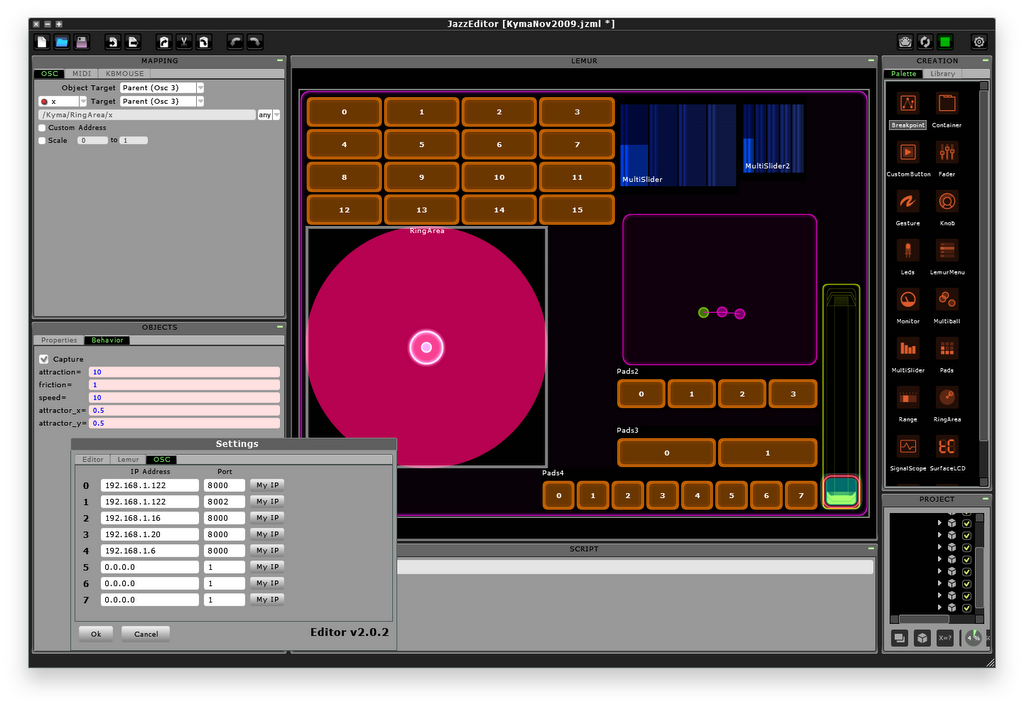
    Using Open Sound Control, users can interact with Kyma using a variety of real-time controllers and software that offer higher resolution and faster update rates than can be achieved using traditional, standard MIDI controllers, such as the newly announced Apple iPad (and compatible iPhone and iPod Touch), the award-winning JazzMutant Lemur multi-touch surface, among the others.
    OSC-enabled Kyma X.74 is a free software update for registered Kyma X owners.


    Wrapping Other Protocols Inside OSC: MIDI over OSC

    Symbolic Sound's protocol for sending bi-directional MIDI streams over OSC

    Users can make good use of one of the following applications for sending MIDI over OSC to Kyma (removing the need for a MIDI interface on the computer):

    Saturday, January 23, 2010

    Live Electronics: a conversation with Michele Tadini

    18th Festival Milano Musica
    Percorsi di Musica d'oggi
    @ Teatro Franco Parenti
    Milan, 22nd October 2009


    Michele Tadini live and work in Paris. He composes music for soloist, ensemble, orchestra, with or without electronics, for theater, dance and interactive installation, collaborates with video-makers, painters, directors and writers. He was the chief of production at AGON acustica informatica musica (Milan), co-directed Centro Tempo Reale (Florence) and, now, coordinates the activity of IRMus, Istituto di Ricerca Musicale (Milan). His music is performed all over Europe, USA, South America, Canada and Japan. He recently earned the Prix Italia with the radio-opera "La Musica Nascosta". He teaches composition and technologies in the Conservatoire National Supérieur de Musique et Danse of Lyon. He has an intense activity of conferences and master classes. Suvini Zerboni, Rai Trade and Edipan publish his music.


    [English subtitles are shown by default, you can turn them on/off by clicking the menu button located at the bottom right of the video player]

    The 'live electronics' is the real-time electronic processing of acoustic instruments and voices. This practice has infinitely expanded the horizon of compositions. Michele Tadini reflects with U.S.O. Project about the historical aspects of electroacoustic music of the last 50 years.
    The concert presents works of composers Tadini, Francesconi, Manzoni, Stroppa and Boulez. It will available for deferred broadcast Sunday, January 24, 8:30 p.m. (GMT+1) on RAI-Radio 3.


    Michele Tadini (1964)
    ...da viva Voce (2009)
    for Voice and electronics
    Premiére

    Luca Francesconi (1956)
    Animus II (2007)
    for Viola and electronics
    IRCAM Commission (Paris)

    Giacomo Manzoni (1932)
    Sei canti dal Kokin Shū (2007)
    for Soprano and live electronics
    MiTo SettembreMusica Commission

    Marco Stroppa (1959)
    I will not kiss your f.ing flag (2005)
    for augmented Trombone and chamber electronics
    Wittener Tage für Neue Kammermusik Commission

    Pierre Boulez (1925)
    Anthèmes 2 (1992/1997)
    for Violin and electronics

    Laura Catrani, Soprano
    Garth Knox, Viola
    Benny Sluchin, Trombone
    Jeanne-Marie Conquer, Violin

    Michele Tadini, sound director
    Luca Francesconi, sound director
    Alfonso Alberti, Keyboard
    Marco Stroppa, sound projection

    Special thanks:
    Cecilia Balestra - Associazione Milano Musica
    Michele Tadini
    [www.milanomusica.org]

    Saturday, February 28, 2009

    Computer Making Music on MAKE Magazine

    Meet CCRMA, a group of musical makers who stretch the sonic boundaries by turning personal computers into an electronic symphony. Based at Stanford University, CCRMA teams composers, artists and acoustical researchers together to meld music with new technology and explore the outer limits of audio from playground-activated sounds to laptop orchestras.


    [via makemagazine]

    Thursday, January 15, 2009

    Max for Live

    After two years of development, Cycling '74 and Ableton have finally revealed their integration project for extending Live using Max. Don't miss David Zicarelli's perspective on the Max for Live project, and read about the new Max tools for building Live devices. Here's the press release.

    [update: Create Digital Music - Make Max Patches that Integrate with Ableton]

    Ableton proudly presents...

    [ableton.com/extend]

    And, if you'll be in Los Angeles, please take note of the following:

    Touch Controlling Ableton Live Seminar presented by Lemur experts Gareth Williams (aka Raw Hedroom) and Bryant Place (aka CPU) focusing on the unique interfacing capabilities of the JazzMutant Multitouch Controller with Ableton Live.
    Topics include:
    • "Performing a powerful hybrid live/DJ set with the Lemur"
    • "Using the Lemur with Live as a powerful sound design tool"
    • "Natural and musical sequencing with Lemur and Live"
    Ableton Live User Group-Los Angeles
    January 22, 2009 - 8 p.m.
    SAE Institute | DFC Theater | 6565 Sunset Blvd., Suite 100
    Los Angeles, CA 90028

    [read more - pdf]

    Saturday, January 10, 2009

    The Klangdom (Sound dome) in the ZKM_Cube

    Hightech instrument for spatialization at the ZKM | Institute for Music und Acoustics.

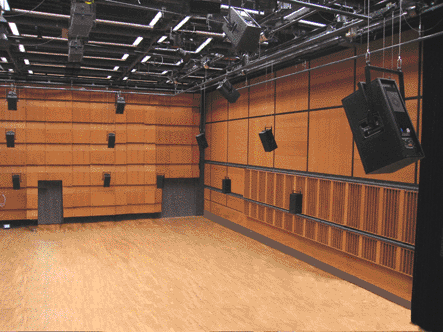
    ZKM "Cube" (photo by Marc Wathieu)

    The Klangdom was finished in 2006 after three years of conception, planning and installation. Forty-three Meyersound speakers are attached to an elliptical rig system three-dimensionally in the room, four additional ones are placed on the ground. With this unique speaker instrument, as the head of the institute Ludger Brümmer explains, "complex polyphonic space-sound-movements can be displayed realistically and perceived from every spot in the room".

    It can be controlled via Open Sound Control protocol or can also be used as Audio Unit plug-in. Thus, the user can incorporate Zirkonium's panning capabilities into his preferred environment (including Digital Performer, Logic).

    User interface of the control software Zirkonium, studio window

    [more via zkm.de/zirkonium]
    [Zirkonium Manual -PDF]
    [Zirkonium - Installer]
    [Zirkonium - Max/MSP and SuperCollider Examples]

    Tuesday, November 11, 2008

    De Musica 2008: the creativity factory

    DE MUSICA 2008, the week-long workshop by Nuova Consonanza will be conducted by Alvise Vidolin. He is one of the protagonists of experimentation in electronics and he collaborated with the most important composers of the 20th century. A pioneer of computer music, he is a sound director and interpreter of Live Electronics.

    The workshop is focused on the elaboration of sound in real time and the use of computer for contemporary music, through the analysis of electroacoustic works by composers Vidolin has worked with. He will also explore the most updated systems of elaboration in real time and their application in multimedia field.

    Lessons will be subdivided into three sections:
    theory
    listening and analysis
    experimental workshop and practice

    Theoretical lessons will develop the following subjects: process of live elaboration of voices and instruments; sound spatialization; techniques of live interaction and performance practice; system design for live electronics; performance environment design.
    Analysis of live-electronics works by Giorgio Battistelli, Adriano Guarnieri, Luigi Nono and Salvatore Sciarrino will be carried out for solo, ensemble or musical theatre.
    The workshop will take place in Max/MSP environment and will include the analysis and rehearsal of the pieces for the final concert.

    [read more - via nuovaconsonanza.it]