Showing posts with label Lemur. Show all posts

Friday, January 30, 2009

About 'Haptics'

What is Haptics?

"Haptics" comes from the Greek word Hapesthai, meaning "the science of touch."

The world of haptics is expansive by definition. It is the field of science and technology dedicated to tactile sensation, and it has applications for everything from handheld electronic devices to remotely operated robots. Yet outside of the research and engineering community, it is a virtually unknown concept. “People don’t even recognize the word ‘haptics’ yet,” says Ralph Hollis, director of the Microdynamic Systems Laboratory. “You have to spell it for them.”

In an age of digital devices that stimulate and amaze the eyes and ears with increasingly high fidelity, haptics has been employed mostly in relatively un­sophisticated applications—rumbling video-game controllers and buzzers that alert you to a cellphone call. But as our digital tools have become more complex and capable, our interfaces with these devices are beginning to run into the limitations of sight and sound. “It’s really only now that we’re seeing a migration from keyboards and mechanical switches to touchscreens and touch-sensitive surfaces,” said Immersion, a company that produces haptic interfaces. “We’re losing that tactile feel that we had before, and now we’re trying to bring it back.”


Touchable Technology

Moving haptics out of the lab can be challenging. Tactile feedback in consumer electronics must be both convincing to the user and appropriate for the device. Broadly speaking, touch can be divided into cutaneous sensing through the skin surface (feeling the pebbly surface of a basketball), and deeper kinesthetic sensing from muscles and tendons (experiencing the impact when hitting a ball with a bat). But much of the recent haptic development in consumer electronics has focused on fooling the fingertips into feeling onscreen buttons that aren’t physically there.

General consumers will first encounter haptics on these touchscreen gadgets and desktop controllers, but the most sophisticated touch technology outside of the lab is found in industrial, military and medical applications.

[read more - via popularmechanics.com]

Thursday, January 15, 2009

Max for Live

After two years of development, Cycling '74 and Ableton have finally revealed their integration project for extending Live using Max. Don't miss David Zicarelli's perspective on the Max for Live project, and read about the new Max tools for building Live devices. Here's the press release.

[update: Create Digital Music - Make Max Patches that Integrate with Ableton]

Ableton proudly presents...

[ableton.com/extend]

And, if you'll be in Los Angeles, please take note of the following:

Touch Controlling Ableton Live Seminar presented by Lemur experts Gareth Williams (aka Raw Hedroom) and Bryant Place (aka CPU) focusing on the unique interfacing capabilities of the JazzMutant Multitouch Controller with Ableton Live.
Topics include:
  • "Performing a powerful hybrid live/DJ set with the Lemur"
  • "Using the Lemur with Live as a powerful sound design tool"
  • "Natural and musical sequencing with Lemur and Live"
Ableton Live User Group-Los Angeles
January 22, 2009 - 8 p.m.
SAE Institute | DFC Theater | 6565 Sunset Blvd., Suite 100
Los Angeles, CA 90028

[read more - pdf]

Saturday, January 10, 2009

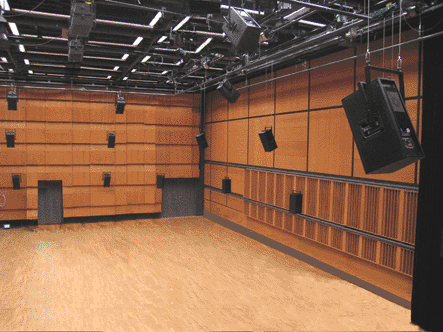
The Klangdom (Sound dome) in the ZKM_Cube

Hightech instrument for spatialization at the ZKM | Institute for Music und Acoustics.

ZKM "Cube" (photo by Marc Wathieu)

The Klangdom was finished in 2006 after three years of conception, planning and installation. Forty-three Meyersound speakers are attached to an elliptical rig system three-dimensionally in the room, four additional ones are placed on the ground. With this unique speaker instrument, as the head of the institute Ludger Brümmer explains, "complex polyphonic space-sound-movements can be displayed realistically and perceived from every spot in the room".

It can be controlled via Open Sound Control protocol or can also be used as Audio Unit plug-in. Thus, the user can incorporate Zirkonium's panning capabilities into his preferred environment (including Digital Performer, Logic).

User interface of the control software Zirkonium, studio window

[more via zkm.de/zirkonium]
[Zirkonium Manual -PDF]
[Zirkonium - Installer]
[Zirkonium - Max/MSP and SuperCollider Examples]

Tuesday, September 30, 2008

Jazzmutant Lemur V2 on the blogosphere


The public beta of the v2 firmware update will launched by Jazzmutant at AES (October 3rd to 5th) with the full version released Q4 2008. The full update will be free.

Brand new features:

Breakpoint object: multi-segment envelope editor
Gesture object: trackpad emulation with advanced gesture recognition
Alias: memory and time saver
Tabbed Container
Mouse and keyboard control (!)
Improved and new-look Jazzeditor
New multi-line script pane

[Sonic State]
[Harmony Central]
[Mac Music]
[Gearjunkies]