Showing posts with label Musique concrète. Show all posts

Friday, November 06, 2015

GRM pt.3: What made Syter original

(Continued from pt.2)

an excerpt from the booklet about the Syter system at INA - GRM | Archives GRM (CD 4) - by Daniel Teruggi

Looking back on it now, it is not easy to describe just how original the tool was for the time. It was at this time that the first "black boxes" were beginning to appear in the shops, at very high prices, enabling users to do a limited amount of processing to sounds. It was impossible to programme these devices. They had a certain number of parameters which were determined in advance and could be controlled using buttons and potentiometers to simulate analogue devices. At the same time, the first samplers were appearing, enabling users to record a sound just a few seconds long into memory and then to replay it, by transposing it and modifying certain parameters.
Syter was all of that and much more besides: processing and synthesis tools, rapid memories, the possibility of reading and recording sounds in real time on a hard disk (500 Mb, which was considered to be absolutely fabulous at the time) and above all, the possibility of reprogramming the processing tools and building new ones to your heart's desire, using a modular programming approach. Syter was the potential book of magic on the basis of which all the existing processing and synthesis methods could be rethought and new processes imagined and designed. All of this had a cost, and the price of the system was such that only one institution was able to buy it (although it was only about 10 times the cost of a synthesiser or a digital processing box at the time), and it required maintenance engineers to keep it running.
The originality came from the fact that processing methods that had come from studio work, and which had been used from the outset for GRM concrete music, were made readily available, without the need to learn programming languages or to have an assistant constantly on hand. In other words, the real originality was to be found in the algorithms and the interfaces.
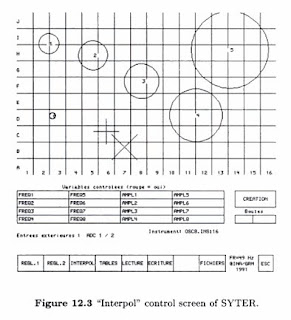
Concrete music and the use of electroacoustic studios had stabilised and modelled a certain number of sound-related operations on the basis of perception-based concepts. For example, an extremely powerful analogue studio process, "micro-editing", involved cutting minute fragments of sound from magnetic tape (using scissors!), which were then stuck end to end to create a new continuity. This principle was very successfully applied by the deferred time software and by Syter, making it possible to reorganise the material into new coherent sequences. This became known as "brewing". But brewing is not the end of the story, because the difficulty lies in controlling the way the brew comes together. Graphical interfaces, which these days are at the very heart of all computer technology, but which at the time were practically unheard of, were used to visualise the sound and the control parameters, and there was even an interpolation screen for exploring the intermediary terrain between two processing states.
Syter was a hit with musicians, both for studio work and instrumental work. In the studio, it could be easily built into the existing environment and breathed new life into the palette of processing possibilities. The system was essentially used for the processing of sound, meaning that the composer would record sounds and then modify them using the processing tools that were already built in, or by creating his own tools. In so doing, he would be faithful to the GRM tradition of processed sound, even though many hybrid processing techniques (between recorded sounds and synthesised sounds) provided entirely new kinds of sound. This material would then become (whether or not mixed with other sounds from other sources) the basis on which the composer would build his work.
Furthermore, at the time there was a unique relationship between composers and technical designers, who thanks to the modular programming techniques and their user-friendliness, could quickly build the tools necessary for creative work. A number of models that were later to become GRM Tools were a result ot this experimental relationship (in particular Doppler and Pitch Accum]. Once they had been built up, these algorithms were simple to implement, and integrated the whole palette of processing tools available in the system (around 40 different algorithms were designed and 15O variants of these basic algorithms).

An approach founded in pedagogy

The philosophy of the GRM has always been that the creator should work independently on his own process of composition, without the assistance of anybody else. Most composers had the training necessary to handle the techniques, to understand and work the analogue studio, and only in very rare cases were they assisted by the technician-musician. There was such a great interest in the deterred time software or the Syter system, and it was aimed at musicians of such varied backgrounds, that a training programme had to be set up in order to help them come to grips with the different systems. Man of these composers who came from an electroacoustic background, and many others were not familiar with studio techniques but who wished to become acquainted with them and develop projects bringing together instrumental and electroacoustic techniques. There were many other professionals from other fields: artists, radio and sound technicians, teachers or musicologists.
Week-long courses with small groups of trainees began to be organised 2 or 3 times a year, involving generally 6 to 8 participants (a total of 20 courses between 1985 and 1993]. During these courses, the system was explained and the participants had the chance to experiment and play with sounds. The objectives of these courses were manifold: the first was to provide composers with the training necessary for them to be autonomous in their work and to enable them to develop a project.
Another objective was to test the system with users. Because it was such an innovative system, using original approaches with regard to algorithms and interfaces, it had to demonstrate that it was up to the task and that the composers could use it easily and efficiently. Around 120 people followed these courses, and 80 works were composed, sometimes several of which were written by the same composer.

From pedagogy to production and concert presentation

Many of the composers were attracted by the possibilities offered in terms of the real time processing of acoustic sounds, and embarked on projects that brought together live instrumentalists, real time processing and recorded sounds. Others used the system in the studio, for acousmatic works, either to complement other existing studio technologies and tools, or sometimes as the sole production tool.
I was personally involved in this pedagogical and production aspect of the Syter system for some ten years. When it was first presented in-house in 1984, everybody underlined the technical prowess it had been to develop a system of that kind, but there was little enthusiasm on the part of the GRM composers, in light of the small number of existing algorithms and the fact that there were no instructions for use. I was fascinated by this approach and I proposed to Jean-François Allouis that I would help him in his project, in particular by explaining to composers how the system worked and by writing up a manual. We then organised the first training sessions in August 1985 and August 1986, and thereafter I took charge of the courses and production associated with the system and the development of variants of the instruments, in response to requests made by composers. I was therefore able to meet everybody who participated in the courses and I followed everything that was produced using Syter. I also played a great many works that involved Syter for the real time processing of instrumental sound Ia task that we became particularly involved in with Richard Bulski, the system technician, especially for moving it and setting it up for concerts).
I was able to gain an extensive and in-depth knowledge of how the system functioned, so much so that I was able to write my PhD dissertation on Syter (The Syter system, its history, development, musical production and implication in contemporary electroacoustic language, presented in December 1998 at the University of Paris VIII). I composed ten pieces on the system, some of which were with instruments, using the system only to produce electroacoustic sound, and others which were acousmatic, where a great deal of the sound creation work was done on Syter from start to finish. I began to move away from the system in around 1993, when it was beginning to become obsolete and when the first versions of GRM Tools were becoming available on Macintosh, designed and built by Hugues Vinet, who took much of his inspiration from the algorithms of Syter. I also realised, in 1993, that my life had been too wrapped up in the system, when a composer asked me seriously whether Syter was an acronym for System Teruggi!

inagrm.com/grmtools

[Prev | 1 | 2 ]

Monday, June 04, 2012

OnMedia - GRM Tools Workshop

Milan - Saturday, June 9th 10:00 to 12:00 and 13:00 to 17:00

Fifth round of the cycle, 'European centers of research on sound and new media'

Focus FRANCE: Ina-GRM_Groupe de Recherches Musicales, Paris
Guest speakers: Emmanuel Favreau (Chief Engineer for the Development of GRM Tools), Francois Bonnet (Research, Teaching and Curating activities)

[Pierre Schaeffer and Bernard Parmegiani, courtesy of Ina-GRM]

Ina-GRM (Institut National de l'Audiovisual - Groupe de Recherches Musicales) in Paris is a pioneering organization for musique concrete, acousmatic and electro-acoustic music, whose history dates back to the '50s, when it was founded by Pierre Schaeffer. Always engaged in the development of creative activity, research, preservation and dissemination in field of music and recorded sound, the GRM is an experimental laboratory unique in the world. In response to expectations and needs of musicians, composers and sound designers, it is highly specialized in the development of a range of innovative tools to treat and represent the sound: the GRM Tools and the Acousmographe. The activities of music creation and production are mainly grouped at Studio 116 in the Maison de la Radio in Paris.

Grm Tools Workshop
Up to 10 participants.
Bring your own laptop and headphones.
The workshop is free and is held in Italian by Emmanuel Favreau along with Francois Bonnet. During the seminar, after outlining a brief history, Emmanuel Favreau will explore the possibilities of digital sound processing with the latest Tools developed by GRM; he will also deal with issues related on how to interact with the musician.
These notions will be illustrated by demonstrations in real time and musical examples from the repertory of electroacoustic music. After the workshop Francois Bonnet will present the lecture 'Music and sound in space, an introduction to multichannel compositions'. The meeting is open to public, and will present the research activities of the Centre in Paris plays through spatialized listening sessions and projections.

For information and registration: on@on-o.org

OnMedia is focused - from September 2011 and throughout 2012 - in a wide range of events including a series of conferences dedicated to the most important European centers for research on multimedia sound, art and technology, a series of workshops on subversive listening, presentation of international visual artists and authors who use different media and languages, concerts and performances.

[More info: on-o.org]

Related Posts:

Friday, March 09, 2012

GRM pt.2: the birth of a concept

Daniel Teruggi wrote an interesting article about the Syter system at INA - GRM in the booklet for Archives GRM (CD 4). This whole CD is comprised of works created through Syter.

"To mark and celebrate the thirty years of the INA (Institut National de l'Audiovisuel), the GRM (Groupe des Recheches Musicales) has chosen to bring together an exceptional set of five compact discs, illustrating some of its most remarkable musical archives. These original works, which are often previously unpublished or have been dispersed throughout a host of other publications, are important because of the originality and audacity they testify to in the second half of the 20° century. Some listeners will be pleased to see that there are a number of illustrious composers here who, in the 1950s, frequented the studio of Pierre Schaeffer, and others will discover numerous musicians whose enthusiasm enabled this innovative musical genre to last throughout the following decades."
Emmanuel Hoog, président directeur générale de l'Ina

Daniel Teruggi - The time of real time

From the very beginning, music, whether vocal or instrumental, improvised or written, and up until the invention ol recording processes, was listened to at the precise moment it was produced. The twentieth century changed all that, First of all with the appearance of recording media, which made it possible to listen to sound in a place and at a time other than those at which it was originally produced; then by the widespread use of electricity, which made it possible to invent new instruments and new ways of imagining and making music. Concrete music, electronic music, electroacoustic music, acousmatic music or contemporary electronic musics are all testimony to the same ambition: using electrical, electronic and computer-based technologies to invent the sounds of music. The invention of sounds is the invention of new forms of music, of new ways of looking at music, and is the logical consequence of the new opportunities that technology continues to provide us with. Musicians began to use computer systems a long time ago (1958) in order to synthesise sounds and to develop computer programmes that would enable them to combine sounds into musical works. Progressively it became possible to record these sounds, to process them or to hybridise them with synthetic sounds.
Musical computer technology did not develop fast and was dependent on the way processors and data storage systems evolved; in 1958, a large computer in a research centre was necessary in order to produce a simple synthesised melody, which it was not even possible to record in the memory. These initial technical difficulties brought about the appearance of two concepts which could be described in a historical perspective, but which are often presented as if the were antagonistic: deferred time and real time. Deferred time described the way that the first computer systems were unable to produce an instantaneous result.
Between the moment at which the intention was expressed and the moment when its result become an audible phenomenon, there was always a certain lapse of time.
The user programmed a sound using software, defining its various parameters and timbre, and then the computer calculated the sound and, depending on the complexity of the calculation, produced the result ofter a given interval. The listening time was deferred with respect to intention time.
It was logical that the next technological objective was real time, a concept that describes the possibility of hearing a sound at precisely the some time as the intention to make it is expressed.
Moving over to real time required changes to the command tools. Deferred time was the result of a programming system whereby the user defined, using written language, the result he wished to obtain; moving over to real time made it possible to define the intentions instantaneously and to modify the result as it was being listened to.
Now, most sound production and generation systems work in real time, enabling the user, thanks to various interaction tools (keyboards, mice, screens) to control and modify the sounds created and heard. Nevertheless, in the field of musical creation, and for a relatively long time, this technological evolution was opposed on methodological grounds. Real time obliges the operator to act and react, depending on the result, in a way that is similar to that of the instrumentalist. For many composers, deferred time, because it separated the moment of conception from the moment of listening, created a distance that was necessary for reflection, a situation that is similar to instrumental composition, between the writing of a piece on paper, and its being played.

[Daniel Teruggi @ Sonic Acts 2010 - courtesy Rosa Menkman]

  
Deferred time and real time in the GRM

At the beginning of the 1970s, the Groupe de Recherches Musicales began to experiment using computer technologies. At the time, the Group already had 20 years of experience, a major repertoire of musical works, a tradition for profound reflection on music and perception as well as innovative technological research. Little by little, therefore, work was undertaken to look at the possibilities that this new domain, which was already strong in the United States, could offer in France, where it was comparatively little known. Two projects were to follow one another, and then coexist, between 1975 and 1993: the first, from 1975 to 1987, concerned the development of deferred time sound processing tools, the "Studio 123 software programmes", developments that are dealt with in CD 3 of the GRM Archives set. The second project, the Syter system was a major technological development for musical computer programming, so original that its impact can still be felt in the development of processing tools today.
These two projects were vitally important in opening electroacoustic music up to composers from the instrumental world. The main successes of these two projects were to bring electroacoustic music out of the studio, making computer technology accessible, without needing programming skills, and making processing reliable and reproducible. The range of things it was possible to do to sound was considerably widened, using original and unheard of sound processing techniques. These two projects were a unique period for the GRM, the studios opened up to welcome composers with other ideas, concepts and points of view, the dialogue was rich and fruitful, and the understanding and analysis of the music being written there were enhanced.

The Syter project 

With the advent of computer technology, the first idea was to imagine a parametric control of machines using digital tools. For example, synthesisers, while remaining analogue in the way that the sound is generated, could be controlled by digital systems that would provide o greater precision in terms of frequency that traditional rotary buttons. It was thus that the first Syter was born, an acronym for: Synthése en temps réel (real time synthesis), and the objective of which was to build up a digital synthesis system based on a set of oscillators, controlled in real time by specialised gesture-based access or by external signals.
The first prototype that was built was relatively simple, since its only function was to control, in real time, the movements of a sound source between a number of loudspeakers. This prototype, with its delicate control system and laborious programming, was used in concert on 16 March 1977 for the creation of Cristal by Francois Bayle.
The designer of this tool and of its following versions was Jean-François Allouis, an engineer who arrived at the GRM in 1974, and who was fascinated by the potential of computer technology as applied to sound and music, and who had an uncanny inventiveness when it came to finding solutions to new problems and designing original systems. For this first concert, the acronym Syter become: Systéme temps réel (real time system), and was the starting point for a whole 5-year period of development during which Jean-François Allouis contributed to the setting up of the first GRM computer, oversaw the implementation of the deferred time processing system, built the Syter real-time sound processor and the input and output converters, developed programming software for the processor, built one of the first interactive real-time parameter control systems and programmed the first processing tools. In conjunction with computer scientist Jean-Yves Bernier and computer technician Richard Bulski, he needed to build and rebuild the system several times before the first full system was complete, in 1984. The system underwent very few modifications and additions, subsequent to that. Eight systems were built and sold, up until 1988. The software continued to evolve up until 1989, in particular thanks to the impetus of Hugues Vinet, who designed a digital mixing tool, providing the system with all the functions of a Studio. Two systems were in operation at the GRM until 1995, and around 100 works were composed in part or in whole using the system.

Related Posts: 

Tuesday, May 17, 2011

GRM Tools - pt.1: an interview with Emmanuel Favreau

by Matteo Milani - U.S.O. Project, May 2011 

GRM Tools is the result of more than 50 years of cutting-edge research and experimentation at the Groupe de Recherches Musicales de l'Institut National de l'Audiovisuel in Paris.
These plug-ins were realized by a succession of hardware and software engineers, who formulated the algorithms for the original GRM Tools in the 1990s. Over the years the GRM has focused on developing a range of innovative tools to treat and represent the sound.
The new GRM Tools Evolution is the latest powerful and imaginative  bundle of new algorithms for  sound processing. Three new instruments are available: Evolution, Fusion and Grinder. All works in the  frequency-domain and provide powerful ways to manipulate audio in real time. I had the privilege of interviewing Emmanuel Favreau, software developer at INA - GRM. Here we go!


Matteo Milani: How many people are part of the GRM development team at INA?

Emmanuel Favreau: We are two people, working full-time. Adrien Lefevre handles the Acousmographe. I’m on GRM Tools. We welcome regular students.


MM: Can you tell us a brief history of the GRM Tools from the origin until now?

EF: The first version of the GRM Tools was created by Hugues Vinet, who is now scientific director of IRCAM in Paris. This stand-alone version offered a couple of algorithms, using the Digidesign SoundAccelerator/Audiomedia III card. The user interface was made ​​with HyperCard. When I arrived at the GRM in 1994, we took the decision to convert the processing available in the stand-alone version of GRM Tools plugins to TDM for Digidesign Pro Tools III. Treatments were rearranged, some modified, others abandoned. The original GRM Tools Classic bundle dates from this era. Later, the evolution of treatments has been closely following the technological evolution: when the processors became powerful enough for real-time processing, Steinberg introduced the VST architecture and the Digidesign RTAS Pro Tools format. And finally, we developed the ST version - Spectral Transform - when computer processing power allowed us to calculate several simultaneous FFT in real time.

 
[...] Jean-Francois Allouis and Denis Valette pioneered the hardware development of SYTER (SYsteme TEmps Reel / Realtime System) with a series of prototypes produced during the late 1970s, leading in due course to the construction of a complete preproduction version in 1984. Commercial manufacture of this digital synthesizer commenced in 1985, and by the end of the decade a number of these systems had been sold to academic institutions.
Benedict Mailliard developed the original software for SYTER. By the end of the decade, however, it was becoming clear that the processing power of personal computers was escalating at such a rate that many of the SYTER functions could now be run in real-time using a purely software-driven environment. As a result, a selection of these were modified by Hughes Vinet to create a suite of stand-alone signal processing programs. Finally, in 1993, the commercial version of this software, GRM Tools, was released for use with the Apple Macintosh.
The prototypes for SYTER accommodated both synthesis and signal processing facilities, and additive synthesis facilities were retained for the hardware production versions of the system. The aims and objectives of GRM, however, were geared very much toward the processing of naturally generated source material. As a consequence, particular attention was paid to the development of signal processing tools, not only in terms of conventional filtering and reverberation facilities but also more novel techniques such as pitch shifting and time stretching.

[via Electronic and Computer Music by Peter Manning]


MM: About GUI - 2DController. What is the origin of this pioneering, intuitive, but simple performer-instrument "link"?

EF: This type of interface has been widely used at the time of SYTER during the 80’s. It allowed us to regain "analog" access to a digital instrument. Indeed, even the manipulation of a slider with a mouse requires some attention (click in the right place, moving vertically or horizontally without mechanical guide, etc.). With the 2D interface, the entire surface of the screen becomes a controller. To obtain a result as soon as you click, the precision of movement is becoming necessary if you want to tune that.


MM: The mapping of parameters on multi-touch control surfaces free us from the use of a mouse and gives us an expressiveness never achieved before. What do you think of this new generation of controllers?

EF: Of course, these interfaces allow an overall and "analog" control which is not possible with the mouse (although the knob 2D mode or "elastic" are possible solutions to overcome the single pointer limitation). Since the engineering of the SYTER we proposed a system of "interpolator balls" to interpolate between different set of parameters arranged in a two-dimensional space. The multi-point control of such a device is natural: we need both hands to shape and transform the space.
 "Interpol" control screen of SYTER
[via DAFX: Digital Audio Effects - Udo Zölzer, Xavier Amatriain]


MM: Is the SYTER still in use today in Paris?

EF: No, SYTER no longer works. It was composed of several elements (a PDP-11, large hard drives, a vector graphics terminal) which can not be sustained today.


MM: Host-based tools vs. custom DSP engines: will there be a winner or they will continue to peacefully coexist in the business?

EF: For the type of tool that we develop, the winner is clearly the host-based. For very large sessions with dozens of tracks and hundreds of plug-ins, DSP is now the best choice, but they could disappear with the diffusion of multi-core processors.


MM: How long did the Classic Bundle take to get ported from TDM to RTAS?

EF: It's hard to say because it was not done directly. I first made ​​the VST version, and then adapted the RTAS version. The algorithmic part posed no particular problems, the difficulties being rather on the side of the interface between the various plugins and hosts.


MM: How much research was needed to create the Spectral Transform bundle?

EF: The prototypes of the Spectral Transform have been fast enough to achieve. The basic algorithm is the phase vocoder, which has been well known for a long time. What took time was the interface design, the choice of parameters and their mutual consistency, stability and the whole robustness (i.e. avoid audio clicks and saturation of the values ​​of some parameters).


MM: What's the technology behind the bundles?

EF: If we leave aside the TDM - the processing code is written in 56000 assembly language, all plugins are written in C++. The processing codes are fully compatible between Mac and PC. In addition, the portability of the user interface is guaranteed by Juce. All development is done on Mac; PC adaptation is virtually automatic and requires minimal work.


MM: A description of version 3 and its new features: what goals have you achieved during this long period of software development?

EF: Having redesigned the interface and rewritten all the code allowed us to add some new features: resizing the window, MIDI control with automatic learning, agitation mode.
Agitation is a generalization of the Randomize, it can be applied to all parameters of random variations in amplitude and frequency control. Now all the GRM Tools are also available as standalone applications. This easily handles individual sounds, to make quick tests and become familiar with the treatments without having to use host daw and sequencers.


MM: How do you manage feedback from musicians and sound designers to improve sound quality and the graphical interface?

EF: The user feedback comes from various forums and from discussions with users and composers here at the GRM. In response to suggestions, plug-ins will be changed, some features will be added (but always in small numbers to ensure compatibility) or it will create a new treatment that may ultimately prove quite different from the original application. This is what happened to Evolution that comes from improving the freeze that can be achieved with FreqWarp.

[GRM Tools Evolution @ Qwartz 7 - courtesy Alexandra Lebon]


MM: What are the most efficient methods of applications against piracy?

EF: There is none. Whatever the methods, they will be bypassed one day or another. We must find a solution that is not too heavy for the users, while allowing a minimum of protection. We chose the system of Pace iLok because it is very common in musical applications. The recently announced changes should make it more flexible to use.


Thanks for your time Emmanuel, keep up the good work!


[...] Any transformation, no matter how powerful, will never equal or surpass synthesis, if it fails to maintain a causal relationship between the sound resulting from the transformation and the source sound. The practice of sound transformation is not to create a new sound of some type by a fortunate or haphazard modification of a source, but to generate families of correlated sounds, revealing persistent strings of properties, and to compare them with the altered or disappeared properties.
In synthesis, the formalisation of the devices and resulting memorisable abstraction, offer a stable set of references which can be easily transposed from one environment to another. In sound transformation, no abstraction of the available results is possible and neither is generalisation. The result of an experiment is always the product of an operation and a particular sound to which this operation is applied. The composer must be able to add to the sum of knowledge by reproducing a previously proven experiment.
What makes the wealth and functionality of a system is the assembly and convergence of the whole, its ability at any moment to answer the questions imagined. Specific tools built for a single experiment, no matter how prestigious, are sterile if they cannot be applied to other purposes. - Yann Geslin


References:

[Digital Audio Workstation by Colby Leider]
[sounDesign, a blog dedicated to the world of Sound and Audio Design]
[On GRM Tools 3, Part 1 - via designingsound.org]
[GRM Tools 3 review: a classic reborn]
[The GRM: landmarks on a historic route
[GRM's current team]
[GRM Tools Store]

You can also read my interviews and reviews on Computer Music Studio (italian only), a monthly magazine by Tecniche Nuove Editore. - Matteo Milani

Tuesday, August 31, 2010

The RAI Studio of Musical Phonology: "XXth Century lute shop"

by Matteo Milani - U.S.O. Project, 2010


"The RAI Studio of Musical Phonology is the outcome of the matching between music and the possible new means of analyzing and processing that sound has" - Luciano Berio

After more than fifty years since the birth of analog magnetic recording, on the 17th of September 2008 at the Castello Sforzesco's Museum of Music Instruments in Milan, took place the inauguration of a new space dedicated to Rai Studio of Musical Phonology - "musical instrument of the 20th Century, extension of human thought". Such an event was made possible thanks to the International Music Festival MITO, in collaboration with the Civic Museum of Musical Instruments and RAI.

Maddalena Novati, RAI Radiophonic Production's musical consultant and responsible for the Phonology archive - thanks to the decisive contribution from Doctor Massimo Ferrario, Director of RAI TV Production Centre (Milan) - was able to transfer all the Studio equipment from Rai Turin to Milan headquarters. This is the very first plan of recovery, storing and refurbishing electrophonic musical instruments.

Maddalena Novati does in fact describe this niche of the Museum as the "20th Century lute shop". The idea of conceiving this space as a sole instrument in its whole, is moving: there are so many experiences enclosed in those devices that it is actually still possible to perceive the residual energy that characterized the entire handcraft process of sound-writing. The Milan Institute of Musical Phonology, designed by physicist Alfredo Lietti, was created in June 1955 at the RAI headquarter in Corso Sempione 27, by Luciano Berio and Bruno Maderna. During that year, Milan was on the verge of becoming a pivotal point in the international electroacoustic music post-war scene, through a new expressive language, which was a synthesis of the concrete and electronic experiences happening in Europe at the Studio für Elektronische Musik (WDR) in Cologne and at the Groupe de Recherches Musicales (GRM) in Paris. Among the electronic music experimental productions at the Studio of Phonology, we must mention works such as Visage by Luciano Berio, Notturno by Bruno Maderna, Fontana Mix by John Cage and Omaggio ad Emilio Vedova, the only entirely electronic work created by Luigi Nono.


"...in the opaque Milan of the '50s, Berio and Maderna found a hostile, apathetic environment, while opening the Phonology Studio. In a completely different situation from the newborn Studio in Cologne, the two masters, built their ideas on the strong basis of their French experiences, through a different technical method which was free and imaginative. Creatively, it has been the most relevant experience in the whole Old continent…" - Giacomo Manzoni


I always close my eyes and try to jump backwards in time, inside that Studio, imagining the noises, dialogues and sounds coming out the loudspeakers: living and breathing the miracles happening in that far age. We now have the possibility to touch by hand what I always used to see only in photographs and videos, how many protagonists of that time have lived (eminent musicians like Luigi Nono, Giacomo Manzoni, Aldo Clementi, Henri Pousseur, John Cage). In fact, in room XXXVI of the Museum of Music instruments, thanks to a glass structure designed by the architect Michele De Lucchi, the back of the eight famous frames containing the circuits are open for everyone to enjoy, allowing spectators to get the heart of the analog technologies with a 360° vision. Based on original pictures and videos from the time, the atmosphere of those years has been recreated.

Further information about the sounds that characterized the second half of last century, are available to the public of devotees and researchers, thanks to four computer stations with multimedia applications, and a digital library with photographs, footage, sound examples and scores (cured by the LIM Laboratory of the Università Statale di Milano).

The Studio, a patrimony fundamental to understand electroacoustic music writing, in the beginning has been experienced by composers as a mean to emancipate themselves from traditional instruments, with its 9 oscillators, the noise generators, different modulators, filters and the Tempophon (a device with rotating heads that allowed to vary the duration of the playback of a previously recorded sound, while maintaining the original pitch).

Those were the times of technicians in white lab coats, yet one particular person changed this professional's profile: Marino Zuccheri. Born on the 28th of February 1923, he was hired by EIAR in 1942; in the following year he left his job because of the war, but was re-hired a few years later by the new-founded RAI.

"... I like remembering Marino in his Phonology Studio, master among masters, master of sound among masters of music, because sound for him did not have any secrets, since he was trained in auditoriums while working for the Radio together with the most famous directors of the time. He would always recall how he begun working in Phonology by chance, but it is certain that it wasn't because of chance that he continued during the years, considering he's been the only holder of the Studio from when it was created (1955) until it closed down (1983)." - Giovanni Belletti, "Marino Zuccheri in Fonologia", 2008

He did not have any obligation to give advice, contributions or suggestions, yet musicians would follow his instructions on how to realize musical compositions: without him, much of last century's music would have never been born.

[Marino Zuccheri and Luigi Nono - courtesy of Fondazione Archivio LN]

"... All the protagonists of Neue Musik passed through the Studio, and it is fair to say this: many of them were in Milan through scholarships, and had to present a final composition at the end of their term, and sometimes the stay had not been long enough to master the nine oscillators' secrets, so the great Marino Zuccheri would put together an acceptable composition with a few touches, thus many of electronic music "incunabula" are his works, and not of those who signed them." - Umberto Eco, La Repubblica, 29 ottobre 2008

That has been an amazing adventure for many years, until 1983 to be precise, year of his retirement (Zuccheri then passed away in Milan, 10th of March 2005).

"Marino Zuccheri's demise was a great loss, not only for what he meant for Contemporary Music, but moreover for what he still could have done: he was to be involved in an important project by RAI, in order to catalog tapes (as himself defined the work) that would have given us a fundamental technical, artistic, musical and cultural insight on the history of the Phonology adventure (another of his own definitions), but not to restore the sound itself (which could be done by others when needed), rather to revive the ideas and technical intuitions that made possible the creation of that sound: Marino (along with the composers) was the only one that could help us!" - Giovanni Belletti, "Marino Zuccheri in Fonologia", 2008


"[..] Two of the first electronic works in my record collection - Berio's Visage from 1961, and John Cage's Fontana Mix from 1958 - were created there with Zuccheri. Even today, both of these pieces sound impressively vivid and dynamic, and what we should now recognise is that such qualities should be attributed to the technician as much as to the composer. 
[..] Zuccheri appears to fit the profile: Parete 1967, composed for painter Emilio Vedova for the Italian Pavilion at Montreal Expo, 1967, was his only known work. [..] Luigi Nono was his first choice as composer, but Nono's schedule prevented that, so Zuccheri stepped in to assemble a 30 minute continuous work using previously recorded sounds built up from long intersecting tape loops. Zuccheri's modest opinion of himself was that he was no composer. Certainly there's very little sense of form in Parete 1967, but the dramatic contrasts of harsh noise, perhaps sourced from piano strings and struck metal, and shifting, modulating drones suggestive of vocal choruses, have something in common with the ritualistic side of Iannis Xenakis, or the best horror movie soundtracks. To the regret of his label Die Schachtel, who have produced another of their sumptuous limited edition vinyl releases here, Zuccheri died before seeing the publication of his only record." - David Toop, The Wire, 2008


After the Studio closed down, the equipments were disassembled and exhibited in Venice for a short period, on the occasion of the temporary exhibition called Nuova Atlantide, organized in 1986 by the Biennale (with the collaboration of Roberto Doati and Alvise Vidolin) and in Milan for I piaceri della città - Iconografia delle sensazioni urbane in 2001, where Il risveglio di una città was displayed through music thanks to the futurist composition of the same name by Luigi Russolo, and to Ritratto di città, the first electroacoustic composition of the Fifties (voice and tapes by Luciano Berio and Bruno Maderna, lyrics by Roberto Leydi) created in order to convince the direction of RAI to create the Studio.

At the end of the Eighties, there still was no awareness of what the Phonology Studio had meant historically, at the point that all the documentations had been deposited (packed and cataloged) in a storage room at the RAI Museo della Radio in Turin, together with all sorts of disused equipments such as video-cameras, tape recorders, record players, microphones, with no plans to be restored or rebuilt.

Thanks to Maddalena Novati's interest, in 1996 the Studio devices were displayed in Turin's Music Salon and in 2003 they were brought back to RAI in Milan and located in a room on the fifth floor which is adjacent to the one where the Phonology Studio originally was. On June 20, 2008 they were officially transferred to the Castello Sforzesco.


It was a great pleasure for me to interview Maddalena Novati to talk about what the unique experience of the Milan Institute of Musical Phonology was and meant, and to understand what consequences and developments this process of recovery could lead to.


Matteo Milani: Maddalena Novati, why in your opinion the Studio became a myth?

Maddalena Novati: In 1955, to own 9 oscillators tuned on different frequencies, as opposed to the single one that was in Cologne, was like having a "whole orchestra" at your disposal, that could generate many sounds simultaneously like in a chord. This way, you already had a handful, a palette of sounds that killed production times. Human ear was the only judge which decided whether a sound was good or not, and after several attempts and mistakes, interesting tapes would be recorded and stored and this process would continue until a result was achieved. Berio would broadcast on radio each new composition from other Studios around Europe in order to spread the repertoire. The 11 TV episodes of C'è Musica e Musica (1972) on the history and ways of making music, sound fascinating with explanations by Luciano (Berio, n.d.a.). He was a great teacher on top of being a great composer, a person that could communicate and bring music to large audiences.
Berio developed an intense activity as a teacher in the United States and Europe, offering courses of composition in Tanglewood (1960 and '62), in Dartington Summer School (1961 and '62) in Mills College in California (1962 and '63), in Darmstadt, Cologne, Harvard University and, from 1965 to '72, in Juilliard School of Music in New York. From 1974 to '79 he collaborated with IRCAM in Paris. Berio's "Un ricordo al futuro - Lezioni americane" published by Einaudi is a beautiful book, which collects the lectures on aesthetics he gave in the US.


MM: When and how did Phonology's decadence period began?

MN: After the Sixties, at the beginning of the Seventies, radio is not anymore the core of research (not being an experimental mean anymore). Computers came up, and research centers moved elsewhere: large calculators are owned by universities and musicians depend on the physics and science departments. The computing machines had to function day and night, and only when physicists would leave their workplaces, musicians could take their place at night in order to perform calculations for their compositions. The radio was not involved anymore, as the broadcasting media did not yet use computers and their respective courses were different. Due to the lack of updates to its equipments and technology, the Phonology Studio was less and less attended by composers. Moreover the defection of some big names (Berio moved to the IRCAM of Paris, Luigi Nono to Fribourg, Maderna passed away prematurely in 1973) had an influence on an inevitable decline.


Active Conservation

It’s again Maddalena Novati who tells us that today the archives (original master copies) of the Phonology Studio, hold 391 ¼ inch-audio tapes with one or two tracks, as well as one inch tapes with four tracks, plus 232 digital copies from acquisitions (copies of works coming from other studios, centers for electronic music, recordings or concerts or plays of the main authors and interpreters who frequented the Studio during its active years). Since 1995 the custody of tapes continues to be her primary objective as well as their cataloging and digitalization in cooperation with Casa Ricordi (the oldest and most important Italian editor), together with the central Nastroteca of RAI and Mirage Laboratory of the Gorizia University.
No real decay of the tapes has occurred, thanks to the good quality of the tapes from BASF, that were selected instead of other brands like Scotch or Agfa. Survival of the audio documents is possible only by separating them from their physical support, and periodically transferring them to new supports. The second digital transfer at 96 khz/24 bit is currently ongoing at the Centro di Produzione TV and Produzione Radiofonia of Rai Milano, in cooperation with Mirage laboratory.


Restoration of recorded music
by Alvise Vidolin 

As for the restoration, the most common task is the elimination of noise of the analog tapes and, according to the tape conditions and the specific nature of the music, there are other interventions to be decided on a case by case basis. As a start, one has to perform an initial search, in order to detect the possible existence of other copies of the same music, as it would then be possible to exploit the best parts from each copy, and with suitable techniques, improve the effectiveness of the cleaning work.
In many works of electronic music, the original tape contains scratches and joints glued with adhesive tape whose glue loses its adhesive properties after a few years. Therefore it often happens that one has to paste various pieces of tape before copying it on a new support. On some tapes, it happens that there are some detached magnetic fragments, while on others, parts of material or protective film might have melted, and therefore deposited on the sound head thus blocking the progress of the tape. On top of these mechanical problems, there might occur electromagnetic problems or problems due to the type of equalization used during recording, and the fact that the oldest tapes could only support a proportionally lesser quantity of magnetization.


Reconstructing the laboratories

As I already had the chance to point out, very often the production of electronic music is not linked to a specific instrument like it happens with traditional music, but rather to a whole of equipments commonly called a system. Hence the conservation of a single element of a system does not give a full testimony of the modus operandi of a musician in a given period. Without doubt, the most effective solution is reconstructing a lab where one can reproduce all the phases of the production process of a musical work. In Cologne for instance, they reconstructed and brought back into function a lab for electronic music with the same configuration it had in the Fifties. In a similar way, this is what is happening at the Aja museum for the study of Sonology Institute of Utrecht University in the Sixties. In Paris at the Parc de la Villette, they are setting up a large section dedicated to the musical electrophonic instruments, until the experiences of computer music in real time of the Eighties.

[Vidolin A., "Conservazione e restauro dei beni musicali elettronici", in Le fonti musicali in Italia - Studi e Ricerche, CIDIM, year 6, pp. 151-168, 1992]

[the italian version of the article is also available @Digimag 55]
[listen: Ricordo di Marino Zuccheri | ITA - via Radio3 Suite]

Wednesday, October 07, 2009

An interview with Christian Zanesi, pt. 2

by Matteo Milani and Federico Placidi, U.S.O. Project
English translation: Valeria Grillo
(Continued from Page 1)


USO: Did mass-culture and consumerism create a lack of “listening attention”?

CZ: I think the ear is intact, it is the demand that has to be discovered and awaken. Even if there is a mass culture, to establish there is a dominant thought in hearing. But the border is very narrow, between the dominant thought and the adventure, we can cross this border very quickly, we only have to open ourselves and to create bridges. Also here there are very serious issues, for example the dominant idea of rock - let's take this example - has built a peculiar "ear" and we can recuperate this ear by using experimental musics. So the world is not made of cases separated by inviolable borders, on the contrary, there is no interruption of continuity between sounds; I am very attentive about popular music, because I know that there are cases of recycling, of experimentation, and also a genre which can be experimented. We have to be attentive, we have above all to avoid being dogmatic, fundamentalist or categorical. On the contrary, we have to observe what happens, try to detect in every practice, in every thing something different from the variable design of music, the variable design of humans and see how this can be transcended.


USO: What has been the role of physical space in the sound projection practice in GRM history?

CZ: In the 1950s, when Schaeffer invents this music, musique concrète with his collaborators, they suddenly asked themselves how to let everybody listen to this music in a public space, in a concert hall. Schaeffer said, if we have to go to the Carnegie Hall, how do we do, we cannot use a single loudspeaker on the scene, this was a little ridiculous, and finally the dimension of the concert, the dimension of how to present this music to the public was created, little by little; there is also the cinema industry which plays an extremely important role, since in the 1960s the Dolby firm had already imagined the surround, due to the invention of the Cinemascope, and were forced to position many loudspeakers to occupy the screen, and many more surround loudspeakers all around. So, we have at the same time the desire of people to experience sound in a bigger dimension, and the technology which built that ear. Today, we follow this process, and people is happy to come to a concert, because we think that a concert is going to be a particular and privileged moment, maybe a show, and that there is a difference between experiencing music in a concert hall and at home, that there is something really spectacular in that moment which justifies the concert. So there are many ways to face the problem, we chose one, but there are others.


USO: Can you describe your compositional process? How do you go from the idea to the sound, to the elaboration, to the structure, to the shape?

CZ: This is a personal question, if you ask this same question to another composer, the answers are different. Me, I don't go from idea to sound, but the opposite, I go from sound to idea; that is I need to find the sound that touches me for different reasons - if I had the time I would explain these reasons and give examples, but I don't - and inside this sound there is a potential, and the idea born from the sound is not a sound subjected to an idea, it is the opposite. We can consider the sound like some kind of fugue, which means that there is potential for development, and to work I need to find a sound which will be at the base because there is an emotive shock, there is really something imposing, which will be the source of my work, and at that moment we can listen to the sound in depth, not for what it is, but for what it can become; we hear the sound as a promising element of a musical structure. But this is a personal answer.


USO: Do you work with stereophonic material and perform live spazialization or do you prefer to design spatial trajectories/position in the studio?

CZ: 

I mainly work in stereo, because my studio is not multiphonic, but I have a lot of experience with sound projection in the auditoriums, with a stereo source you can give the illusion of a multiphonic work; I both do live concerts and acousmatic works. Finally you don't know what system we have, where it is, the space, and also the kind of concert we have been requested, but what we experience nowadays is that live practices and acousmatic practices are coexisting pacifically, and they enhance each other depending on the place, time, and project. The concrete music was born in 1950s, and it is about, after all these years, to create a new branch which will be the performance version, and the live version of this music. This evolution started in the year 2000, since today's systems (computers) are much faster than 20 years ago, and the tools for sound processing allow it. But these have developed because there was a strong desire to develop them. There are no technologies which arrive spontaneously, we look back into history, we observe, and what happens sometimes with dreams, there are dreams and conjunctions which make things possible. That's what it is going to happen in about 10 years.


USO: What are your working tools for non-linear editing and sound signal processing?

CZ: At the GRM there are more or less all programs - Pro Tools, Digital Performer - but there is a kind of consent on the tools to use, very quickly we can comment that today's programs are actually a direct-line consequence of the techniques from the 1950s, because with a tape or a disk we could go from a sound to another, create discontinuity, being able to superpose sounds, and create a verticality, and harmony; we have the mastery of time, thus on counterpoint and polyphonie, we could increase or decrease the volume; we need to check that there are the minimal conditions for the program to be exploitable, and finally, checking on today's programs; we have continuity. With the program, whatever that is, we can do anything - montage, superposition, regulate the volume, regulate the space and finally you do the same as it were a tape recorder. These are fundamental operations for the music's world.


[Prev | 1 | 2 ]

Special Thanks:
Laure de Lestrange
Christian Zanesi
www.ina.fr/grm

[Listen to Magnetic Landscapes - Christian Zanesi | via deezer.com]

Related Posts: Daniel Teruggi (GRM, Paris): The novelty of concrete music.

An interview with Christian Zanési, pt. 1

by Matteo Milani and Federico Placidi, U.S.O. Project
English translation: Valeria Grillo


Christian Zanési is a French composer and the head of the musical programming at the Groupe de Recherches Musicales. Zanési studied music at Université de Pau, then in Paris at the CNSMDP under Pierre Schaeffer and Guy Reibel. Since 1977, he is a member of GRM especially in charge of the production of radio programmes for France Musique and France Culture. He has been recently awarded the Special Qwartz at the Qwartz Electronic Music Awards (Edition 5).
We met Christian Zanési at 104 for the fifth Présences Électronique Festival, organized in co-production with Radio France, which explores the link between the concrete music of Schaeffer and new experiments in electronic music.
Since its founding in 1958, GRM has been a unique place for creation, research and conservation in the fields of electroacoustic music and recorded sound. The systematic analysis of the sound material Schaeffer proposed to his collaborators resulted in the publication of a seven hundred pages reference book, the "Treaty of Musical Objects" published in 1966.
Michel Chion’s Guide To Sound Objects (PDF, English translation) is a very useful introduction to this voluminous work (via ears.dmu.ac.uk).
In this very complete essay, Pierre Schaeffer develops the main part of his new musical theory of the sound object. It is based on two principal ideas, making and listening, and explores the first two levels of this theory: typo-morphology and classification of sounds. He uses various disciplines such as acoustics, semiotics and cognitive science to demonstrate his explanation of sound and, in particular, the musical object within musique concrète.


U.S.O. Project: You often mention that sound is the prime matter. How can we “orient” and recognize sounds we’ve already heard, without the cause-effect relationship?

Christian Zanési: The sound has to be considered in a musical context, it is not about recognizing the sound, it is an expressive matter, and every composer, every musician has some kind of personal sound, a signature sound, so when he transcribes it into his work, into an artistic project, the idea is not to try and play a guessing game, this is this sound, or this is that sound, there is a higher level that belongs to it, and this level is that of the musical relations, expressive relations. When you listen to a concert, for example for cello and orchestra, you are not pointing out each instant "this is a cello sound", you listen to music. And it is the same with sound.
 So, there is a second level which is a little more complex, it is true that some sounds reveal an image, from time to time there could be ambiguity, and this is also part of a rethoric, or of an ancient model, and it is possible that this provokes a kind of curiosity, and at the same time gets mixed into the expression. Composers are very strange.


USO: In the first 50 years of electronic music, has the absence of visual elements during performances limited or enhanced the listening experience?

CZ: Well, naturally us, at our festival Presences Electroniques, prefer to bring attention on the sound, sometimes there are some audiovisual experiences, but the nature, the physiology of it, makes the image a priority on the sound. So we, since we developed a projection system very very sophisticated, prefer that kind of listening experience, it is more complete, we don't need anything else, it is an orientation, it is one of the strengths of our festival; that is, to offer artists the best possible sound projection system, the best definition, and we think that is complete. We are very music-oriented, and I've often been there and I've seen musicians doing an audio-video performance, and I've been rarely convinced, sometimes yes, but it becomes something else, we go down to another level, and we want to explore the purely musical universe, sound and its programming.


USO: Can you give us a more in-depth definition of the concept of “l’ecoute reduit” (reduced listening) by Pierre Shaeffer?

CZ: The first time that... well in a few words it is difficult... when we recorded on vinyls, there were no tape recorders in the 1950s, when we reached the end of a disk, the last groove was repeated indefinitely, and it was a full modulation. In all vinyls today, there is a closed groove with a silence, to avoid that the stylus exits the turntable. All the disks at that time - all that were recorded in the 1950 - the disc, equivalent of today's vinyls, ended on a closed groove, and Schaeffer listened to this phenomenon, everybody could hear it, there was not a silence. The fact that the sound repeats itself, made him understand that finally we were listening to the sound itself, we wouldn't say "this sound is close or not, it starts this way, it is more or less acute, it is more or less brilliant, it is more or less thick, and in that moment he imagined that we could listen inside the recorded sound, which means we could verify, validate, objectivize the phenomenon by hearing the peculiar characteristics of the sound, how it starts and how it ends, in which tessitura it is, if it is light or if it is dark, it is loud, it is close or far. This is to objectivize the listen, this is "L'ecoute reduit".


USO: Can you discuss your vision of the sound organization principles? Definition of the sound object, objective and subjective aspects, articulation, iteration, quality of the information, musical language.

CZ: In classical music, the constituent elements of an opera function organically, that is there are consequences; when you put a sound together with another, this creates an harmony, for example a chord, and if you add another sound the chord completely changes in timbre, this is an organic principle. We can do the same with the sound the composer chooses, so to imagine music sometimes as a vertical relation, or as an horizontal relation; this is an organic system, and the organic system is a biological system, in some way copied from the living, and since we function following the living principles, we are particularly able and specialized to recognize an organic system, and in that moment something starts in our brains and there is some kind of a communion; this is what happens, how to organize the sound, why put this with that, and why after this, add that, they are organic relations.


USO: What do you think of hidden causality (between what the audience sees and hears)?

CZ: The ability to listen is a very complex phenomenon, so when a composer works, it is difficult to be conscious about everything, an artist works very much in an intuitive manner, intuition is a super-computer which gives us the answer immediately. But if we talk about the genesis, about why we made some choices, it takes an eternity. So, the relations, the sound is not inside a single "ear", there is a very ancient ear, for example, that is the ear we use to cross the street, it is the hearing of danger. Hearing is a prolongation of the sense of touch, imagine to be in the forest, when a predator hunts, if it touches you it is too late, you are dead. So hearing is a prolongation of touch, it allows you to foresee the arrival of a predator. There are various hearings - one which detects aesthetic information, one that detects information on the behavior of others, so when you work with sound you alternatively activate many "ears". When you begin a piece of music by having a sound turn around you, you awaken the ancient, the primitive "ear", the danger hearing, since in nature, something that turns around you it is something that tries to catch you, and a composer in some way is conscious of this mechanism and plays with it. It is very difficult to answer this question because the ear is very complex, and the reality around us is very complex. But we are all naturally gifted at hearing, since without it we could not cross the street, we could not hear something behind us, we could not see around us through sound.


[ 1 | 2 | Next ]

Sunday, August 23, 2009

Lo Studio di Fonologia (1954 - 1983)

(Photo: Luigi Nono, courtesy Teche Rai)

>Milan - Tuesday, September 8th, 2009 - 12:00 pm
Castello Sforzesco
>Museo degli Strumenti Musicali - Sala Balla

Presentation of the volume 'Lo Studio di Fonologia: un diario musicale 1954 - 1983', edited by Maddalena Novati.

Attended by: Francesco Micheli, Maddalena Novati, Enzo Restagno, Claudio Salsi, Salvatore Sciarrino.

At the end of the conference there will be the possibility of a free visit to the Studio di Fonologia inside the Museo degli Strumenti Musicali.

Free Admission.

In collaboration with Universal Music MGB Publications, Civico Museo degli Strumenti Musicali di Milano.

[via mitotorinomilanosettembremusica.it]

Related posts: RAI Musical Phonology Studio

Saturday, April 11, 2009

Bernard Parmegiani, a sound master

Organized by Groupe de Recherches Musicales (G.R.M.) and jointly produced with Radio France, the Présences Électronique festival explores the link between the concrete music of Pierre Schaeffer and new experiments in electronic music. One of this event’s special features is that it offers the public and performers a unique “spatialized” broadcasting and listening system in the Acousmonium.
This year, for this fifth event, Présences Electronique has moved out of the Maison de Radio France and spent three days in the various rooms of 104, the new multi-disciplinary cultural centre in Paris’s 19th arrondissement.

We were there and listened in darkness to 'De Natura Sonorum' (1974-1975), one of the best of Parmegiani's works in terms of technics-sound-harmonic-tone.

Bernard Parmegiani (1927) met Pierre Schaeffer who encouraged him to attend a training course in electro-acoustic music in 1959. Then he joined the Groupe de Recherches Musicales the next year, becoming a full member right up until 1992. Pierre Schaeffer put Bernard Parmegiani in charge of the Music/Image unit of the ORTF's Research Departement, where he went on the compose the music for both full-length and short films. The proved to be a first class training ground for learning how to deal with the problems of musical form as these relate to time, and how to overcome the constraints imposed by the medium of the cinema. He also wrote the music for several jingles, as well as songs and music written for television, the ballet or the theater. There then followed 40 years of uninterrumpted research and musical creations built out of an ongoing fight that led him to regard bodies of sound as living bodies. He took a keen interest in those areas in which the improvisation techniques used by jazz musicians meet with electro-acoustic music. Parmegiani's own output, primarily made up of sounds recordes on tape, includes more than 70 pieces of concert. Except some mixed pièces, his work as a whole take the form of music for « fixed sound », coming within the scope of the large repertoire of electro-acoustic music.


Some excerpts from the interview by Évelyne Gayou, published in full in the book "Portrait Polychromes: Bernard Parmegiani":


Can the Parmegiani's sound be defined? Some people speak of "organic sounds"...

In the past, people used to talk about a "Parmegiani's sound", a little too much to my liking, and it bothered me a lot. People would say: "Oh! Parmé, what beautiful sounds you make!!!" It's good to make nice sounds, but really, we don't compose music to produce nice sounds, but rather to compose from an idea. I'm not trying to seduce anyone with my music; I'm trying to get people interested. That's why I'm obsessed with constantly renewing myself musically. I can only exist by continuosly exploring new territories; otherwise one gets bored with one's own music. The risk is to do 'Parmegiani in the style of Parmegiani' and so on. If I must define what the "Parmegiani sound" is, then it's a kind of movement, a kind of colour, a way of starting and a way of fading the sound, a way of bringing life into it. I do consider sounds as living things. So there's, indeed, something organic, skin deep, but it's always difficult for me to define my music; what we perceive from within isn't always understood by others in the same way. We recognize ourselves in the mirror others hold up for us, to a certain extent; it's a game between the inner and outer realms.
[...] When I start a piece, I create a sound bank; I include new sounds, never used before, that might fit my intention and reworked old sounds. I listen to them and create detailed inventories; it is essential and imposed by my working method. For example, for De Natura Sonorum, I made lists of sounds classified by shape, subject, colour, etc. according to the TOM (Treaty of Musical Objects)'s typology. I like to set the sound material in my ear first, so that I can then work with these sounds to express what I want to say [...]


When performing your music in concerts, how do you see the spatial aspects? Do you want to create a show or is it a mere experience?

I'm not very happy with the word show because of its demonstrative character. I prefer for it to be an "experience" because I never project the sounds in the same way twice. When I'm in a concert, standing at the sound projection desk, I intentionally send the sound to specific speakers, I either pan to the left, to the right, along the sides or behind and I associate pairs of sounds. The sound can follow a pre-defined trajectory; remain static in a speakers area or even in a pair of stereo speakers. Some composers, especially when they start out, turn all the potentiometers up and don't vary the levels of the speakers much, the result is imperceptible. Worse than that, the sound is hindered in all directions because it is everywhere at once. Depending on the acoustics of the concert hall, you might even get reverberation or interference phenomena, and then the audience can't hear any subtlety.


You've gone through the digital revolution, what do you think these new tools have brought to your music?

I was probably the first person at the GRM with a personal digital studio. So I had to learn how to use the digital equipment by myself. By switching from the scissors to the mouse, we've improved a few things, but we've lost out on others. [...] The time it takes to put an idea into practice has shortened and, consequently, we're closer to the compositional act.

[the review of Parmegiani 12-CD box set | by Caleb Deupree]

Wednesday, April 08, 2009

EMS 09 - Heritage and future

The EMS conference is organised yearly through the initiative of the Electroacoustic Music Studies Network, an international team which aims to encourage the better understanding of electroacoustic music in terms of its genesis, its evolution, its current manifestations and its impact.
Areas related to the study of electroacoustic music range from the musicological to more interdisciplinary approaches, from studies concerning the impact of technology on musical creativity to the investigation of the ubiquitous nature of electroacoustic sounds today.


Presenting EMS 09 and Main Theme

Heritage and future

During recent years the electroacoustic community has been celebrating different dates related to the birth of electroacoustic music. Such moments are often a time for analysis and reflection, which is very important for a better understanding of our past, and allows us to review our present and to think about our future.

It also make us wonder: how do we imagine the future of electroacoustic music? And at the same time, what do we wish for the future of electroacoustic music?

At this point, many other questions arise, all of them connected to the same root: what is the role of musical education in this path? To what extent is our heritage significant in terms of our seeking to extend our sound-music boundaries or, instead, to what extent does this heritage generate barriers which limit our imagination?

Are we looking to develop a self-sustained electroacoustic art or do we think that electroacoustic music would be best integrated with other disciplines in the future?

Will technical developments limit our future steps or have we reached a stage of maturity which allows us to seek in the technology that which we need?

Is it possible to think about new languages (or derived new ones), starting from what is already known today as electroacoustic music?

[more info via ems-network.org]

Wednesday, March 18, 2009

Sound Junction 2009 - Special Guest: François Bayle

University of Sheffield Drama Studio
Sheffield (UK - map)

François Bayle has been at the forefront of acousmatic music for over 40 years. In 1958-60, François Bayle joined Pierre Schaeffer’s Groupe de Recherches Musicales in Paris, and between 1959-62 worked with Olivier Messiaen and Karlheinz Stockhausen. In 1966, Pierre Schaeffer put him in charge of the GRM which, in 1975, became an integral department of the French National Audiovisual Institute (INA). He maintained this position until 1997.
In addition, it was François Bayle’s idea to create the Acousmonium (1974).
Upon leaving the Grm in 1997, he created his own studio and the record label Magison.

5th June
Concert II - François Bayle
  • Eros bleu - L'infini du bruit (Erosphère /2) - 14' - stereo (1980 / revision 2009)
  • Eros noir - Toupie dans le ciel (Erosphère /3) - 25' stereo (1980 / revision 2009)
  • Métaphore + Lignes et points, Journal (L'Expérience Acoustique 6/7) - 15' four channel + video (1966 / 71) with images by Piotr Kamler
  • Univers nerveux, in memoriam K. Stockhausen - octophonic - 22' (2005 / 07)

6th June
Concert III - 'International'

Sound Junction concludes with a 'classic' by Christian Zanesi (Profil-Désir, 1988), who worked alongside François Bayle for many years at the GRM.

[via shef.ac.uk]
[Press release - pdf]
[magison.org]