In this surreal moment where a hypnotic silence takes hold of our cities, where the Internet makes us feel closer than ever, I am extremely happy to announce the release of Wasted Planet, a disc composed together with my friend Giovanni Dettori and published by Miraloop Diamonds. The album is the result of a long experimentation and research of new timbres and atmospheres between classical and electronic. The fusion between the depth of acoustic instruments belonging to the orchestral world and the detail of abstract sound textures, has allowed us to create suggestions with a cinematographic flavor, an omen of an uncertain future.
An ideal alternative soundtrack to reflect during our long quarantine period? Maybe ... the answer is yours!
Thanks to Feyzi Brera (Violin, Viola), Engjellushe Bace (Violin), Stefano (French Horn) and Micol Pisanu (Soprano) for the masterful performances.
Save 30% on our sound effects libraries to celebrate NAMM 2020 using the exclusive promo code "namm2020" - let's meet up at the Anaheim Convention Center (January 16-19)!
Kyma Ambiences vol.2 contains 100 abstract and evolving ambiences created with our beloved Kyma sound design workstation.
Due to the increasing demand of spatialized content for game and VR/AR project, this inspiring collection has been entirely designed as a spherical representation of sound natively in 3rd Order Ambisonics by generating all the Sounds in Kyma and mastering them in Pro Tools through a custom analog setup.
Create a truly immersive and dystopian atmosphere with the 2nd volume of the classic Kyma Ambiences sound effects library.
A creative collection of carefully synthesised Impulse Responses.
I'm proud to present Imagined Spaces, a new REmatrix library, the result of an extensive research in collaboration with MoReVox and Overloud. Imagined Spaces blurs the line between filtering and reverberation. Sound designers, sound editors, mixing engineers, composers and anyone who paints with sound will enjoy the surprising stuff included in the library, from strange but realistic locations to alien and odd ones.
Lots of IRs have been developed in Kyma sound design environment with synthesis/processing algorithms in the frequency and time domain, like waveshaping, frequency and time scaling, iterative convolution (spectra recombination of different IRs), among the others.
To create reverbs rich in diffuse field, white and pink noise has been treated with radical equalisation curves. Subsequently, Pro Tools has been abused for pitch and time alteration, dynamic filtering or capturing the sonic characteristics of custom plug-in chains to obtain eccentric ambiences with extremely different durations.
Imagined Spaces is conceived as a key tool not only to “paint" your tracks with air, depth and new perspectives, but also to expand and transform the original material into new ones.
With this advanced sound design collection, you can add life to dry and poor sample or original recordings. If you’re looking for tactile effects, Imagined Spaces is the spark you need to boost your imagination: you’ll easily get a density never obtained before with classic convolution and algorithm reverbs.
Coming soon from Unidentified Sound Object is "Transmission Apparatus", a construction kit to create a wide palette of communication sounds, from real to “alien” broadcasting signals.
Stop for a second and listen. Close your eyes, use your ears, and just listen.
Whether you are in a quiet office environment or out on a busy
street, you'll be amazed by how many sounds there are around you. Most
of us do not pay attention to the ambient sounds that surround us. Our
brains filter them out and we don't listen. Yet the sounds we miss can
be very enjoyable.
Designed Sounds
Today, what we hear in our daily lives is often designed sound- music
and sound effects carefully crafted for games, devices, and products.
For example, mission-critical products, such as heart rate monitors used
during medical surgery or a plane’s flight deck controls, use
distinctive alarming sounds that are designed to be easy to perceive and
raise a sense of urgency or danger.
In interfaces for everyday tasks, sound is used to create engaging
and beautiful experiences. Sounds can generate a special feeling or
underline brand identity while simultaneously providing cues that a
command has been received by the system. Most smart phones today come
with subtle sounds that indicate the pressing of a touch screen’s
virtual buttons. Since there is no way to feel if a virtual button has
been pressed, the sounds reinforce the action for the user. Another
example can be found in industrial design, where the latest electric
cars are being designed with artificial motor sounds. The sounds alert
pedestrians to the car as well as reinforce the sense of driving a
powerful vehicle. These examples underline the overall trend of sound
being used to create an aesthetic experience rather than serving as
purely a functional aid to improve interaction.
Blurring the Border Between Listening and Composition
While systems and products are becoming more enjoyable and pleasant
to listen to, they are usually not intentionally designed for sound
interaction. The emergence of accessible music software on computers and
mobile devices is changing this. These programs allow for easy
modification of sound by the average user and blur the border between
listening and sound creation. The small form and limited complexity of
mobile interfaces has forced music software designers to reduce the
complexity of their products, resulting in music software that is widely
used by average mobile phone users.
Music apps are often top sellers. Popular applications allow people
to become mobile DJs, to transform sounds, and to design ringtones.
I was interested in exploring the blur between sound creation and
listening when my friend and colleague Matteo Penzo put me in contact
with Matteo Milani from the U.S.O. Project
sound art group. The ideas and compositions of the U.S.O. Project
revolve around the use of noise and ambient sound as a foundation for
sound installations and music composition. Together we wanted to create a
mobile experience that would support active listening to the everyday
sounds that surround us, making the listener a part of a personal sound
installation. Instead of creating a tool for recording and transforming
sound, we wanted to start from the sounds themselves. Our goal was to
reinforce the sounds of the listener’s environment while blending them
with more musical sounds. Together the sounds would form a unique
experience that could be enjoyed by anybody that has an interest in
sound and art.
Early Experiments
We started with a small prototype app for iOS using simple sound
algorithms to blend U.S.O. music with live recording from the iPhone
microphone. The prototype was tested with real use cases that included
listening to the app while taking a long walk as well as while sitting
at the computer in the office. We added many parameters for the user to
be able to tweak and play with the sound transformation.The parameters
were mapped to on-screen sliders and buttons and to sensors like the
accelerometer.
While doing the informal tests we found that the users were
struggling to understand the relationship between the parameters and the
sound output. Also, in most cases they would end up spending time
experimenting with the parameters to discover how they work. The visual
interface and controls were clearly distracting, taking attention away
from the app’s original goal of reinforcing ambient sounds for the
listener.
Following these early experiments, we decided to take a drastically
different approach. We limited the visual interface as much as possible
and provided a set of sound themes in the app for the listener to
select. This worked much better. All of a sudden the users would pick up
the app and, once started, would tuck it away in a pocket while
listening to the sounds. Each theme takes sounds from the microphone and
blends them with sounds composed by U.S.O. Project. The sounds are
blended using sound algorithms, unique to each theme. Each algorithm is
carefully calibrated to replicate the work and skill that goes into
producing a great listening experience.
Lis10er
The result is Lis10er
(pronounced Listener), an augmented sound installation app. Sounds are
blended from the listener’s surroundings, creating dynamic music that
changes while maintaining its identity. Lis10er provides users with a
creative way of listening to their environment and a unique experience
with every listen.
Tue Haste Andersen is Senior Software Architect based in frog’s Milan studio. Tue is a Human Computer Interaction and Computer Music
expert, with research ranging from DJ work practices to the use of sound
and music in common interaction tasks. He is also the founder and
original author of the popular open source DJ software, Mixxx.
Concept and software design by Federico Placidi Hardware design by Matteo Milani Woodworker: Fabio Testa Produced by U.S.O.Project, 2012
Where: [.BOX] Videoart project space, Via Federico Confalonieri 11, Milan When: Thursday, September 27, 2012 | 6:30 until 21:30 PM Free admission
The concept of multiverse was first introduced in the so-called “many-worlds interpretation” (MWI) of quantum mechanics by Hugh Everett III in his PHD thesis, "The Theory of the Universal Wavefunction". His model was thought as an alternative to the renowned theory called “Copenaghen interpretation”, developed by Niels Bohr and Werner Heisenberg.
The MWI interpretation postulates that every quantum measurement process (at Planck’s scale) creates, as a consequence, a division of the observed Universe into multiple parallel universes - as many as the possible outcomes of the measurements are.
In different formulations of this concept, all the universes - which form the Multiverse - are structurally identical, and they can coexist at different states even if they possess the same physical laws and fundamental constants.
We need to take into account that those universes are non-communicating (there cannot be any information exchange between them).
In an episode of the famous TV series “Doctor Who” - the episode was Doomsday, written by Russell T. Davies - the Doctor finds himself in the situation to make a difficult and dramatic choice: separating from the person who probably loved him the most, by “exiling” her in a parallel universe to guarantee her safety and survival.
It is worth mentioning some parts of the dialogue from the original script of the episode:
Rose comes to a halt in the middle of the beach and stands there, waiting. A short way to her left, the Doctor fades out of thin air. Rose turns to him. He's slightly translucent. ROSE Where are you? THE DOCTOR (his voice sounds distant) Inside the TARDIS. INT. TARDIS The Doctor is, in reality, standing by the TARDIS console facing straight ahead. THE DOCTOR (CONT'D) There's one tiny little gap in the universe left, just about to close. And it takes a lot of power to send this projection, I'm in orbit around a super nova. (laughs softly) I'm burning up a sun just to say goodbye. Sure enough, the TARDIS is spinning around a beautiful super nova. EXT. BAD WOLF BAY ROSE (shaking her head) You look like a ghost. THE DOCTOR Hold on... He takes his sonic screwdriver out of his pocket. INT. TARDIS He points the sonic screwdriver at the console and somehow this strengthens his projection. EXT. BAD WOLF BAY The Doctor now looks as solid as if he were really there. Rose walks over to him and raises a hand to touch his face. ROSE Can I t--? THE DOCTOR (regretfully) I'm still just an image. No touch. ROSE (voice trembling) Can't you come through properly? THE DOCTOR The whole thing would fracture. Two universes would collapse.
The scene partially violates the no-information-transit prohibition between the two universes, but the subterfuge used in the story (the two characters cannot touch, only see each other), somehow preserves the assumption presented by the MWI, only conceding a small but necessary poetic licence.
In the same episode, there is a very touching scene, where the two characters (Rose and the Doctor), right after their isolation in two different universes, are in front of one another separated only by a simple white wall.
This border, imaginary and symbolic, which divides not only two places in the same space-time continuum, rather two whole universes, gave us an idea.
We wanted to offer that experience as an installation. We wanted to allow the audience to listen to whatever is “on the other side”, beyond that wall, and we wanted all this to happen in real time.
That’s how Mirror_Mirror was born.
The installation is organized inside a space.
What does this mean?
The space in itself, when it isn’t filled with matter (empty), is in reality permeated by low energy levels continually fluctuating.
These fluctuations in the void, have a particular significance on a quantistic level (we refer to the Planck scale, so at infinitesimally small dimensions).
In quantum mechanics, these fluctuations represent temporary shifts in the energy state of the void space, according to the Heisenberg Uncertainty Principle.
This means that the Conservation of energy principle can be violated for very brief periods of time (the lower the energy, the longer the fluctuation can persist.)
This energy can decade and take the shape of pairs of particles and antiparticles (which then annihilate each other).
In substance, the amount of average energy on a larger scale remains constant. Nothing is created, nothing is destroyed.
“There is a fact, or if you wish, a law, governing all natural phenomena that are known to date. There is no known exception to this law—it is exact so far as we know. The law is called the conservation of energy. It states that there is a certain quantity, which we call energy, that does not change in the manifold changes which nature undergoes. That is a most abstract idea, because it is a mathematical principle; it says that there is a numerical quantity which does not change when something happens. It is not a description of a mechanism, or anything concrete; it is just a strange fact that we can calculate some number and when we finish watching nature go through her tricks and calculate the number again, it is the same.” - R.Feynman
It was in our interest to draw an analogy in the sound domain, allowing the audience to directly experience this phenomenon.
As a consequence, we created an application able to “sonify” ideal energetic fluctuations (generating pressure waves, structures and emerging behaviours), starting from the lower energy level available, which is the background noise.
Thanks to the Kyma software implementation, and the use of microphones, it was possible to “measure” background noise and , through a series of negative feedback operations, enable the instrument to create “something”, using all the information available in our space/universe to create temporary energetic fluctuations (statistic variations of the density of sonic quantums’ “packets”), without violating the Conservation of energy principle - in fact, the average energy quantity, altogether, remains the same.
We’ve thus arrived to the gravitational center (here we have no more fluctuations, only numerous certainties, due to the dimensions and mass of the object) of the opera, which is represented by a wooden artifact, symbolically revisiting the white wall we came across in Doctor Who, which divides our universe from another possible universe.
Which one it is, the visitor will have to find out for himself.
By placing a stethoscope on the wooden surface. the observer will be able to “measure”, with various levels of definition, the sounds coming from another probable universe out of phase with ours.
In fact, as identical as it will seem, it strangely does not share the same temporal parameter.
From quantum mechanic and its Multi-Worlds interpretation, we know that every measurement operation will produce a further division of the universe.
So, it is possible that in the end, there will be as many universes as the present observers.
And, paying a little attention, it will be possible once again to listen to the voices of Rose and the Doctor, as if they are suspended in a temporal loop, to remind us that maybe, the current physics laws, could not be the same in every place and every time.
It's night.
There are no precise coordinates, nor recognizable signs that can lead us back to a familiar place.
And yet those sounds remind us, almost pathetically, of a summer night scene, to which we listened countless times.
But that’s not what this is.
The slow and articulated flow of pulsating energy gradually takes a structure, enabling us to be part of something very different.
The flow surrounds us, passes through us.
We can’t see it, nor touch it, but every particle interferes with our body, with our biological substrate.
Far away, a storm is coming, perhaps.
It’s neither natural, nor inoffensive. It deceives us with the variety of its harmony of timbres.
The structure suddenly changes, reorganizing itself while turning us into something new.
A breach made of light. It’s oscillating.
Then, silence.
The air stagnates, suspended and motionless.
An electrical impulse.
One more.
Others follow, one after another, fainter and more distant.
(Sounds), like petals made of ash.
F'Shima was designed and built around a series of recordings of electromagnetic fields generated by various electronic devices (Hard Drives, iPad, iPhone, Portable Game Consoles ...), recordings made by using old analog phone-captors.
The source material, sometimes fully recognizable, sometimes radically altered, has been digitally processed using the Kyma Sound Design environment.
Gretel's New Clothes
"Nibble, nibble, gnaw,
Who is nibbling at my little house?"
The children answered:
"The wind, the wind,
The heaven-born wind."
Gretel's New Clothes is, in a way, an acousmatic reinvention of the famous fairytale by the Brothers Grimm.
It is in the form of a Rondò.
There is no attempt to literally retrace the story, rather to suggest it in a subtle way, through the use of strongly characterized sound materials (footsteps in the woods, the wind, the "sounds" of the night...) which are then dialogically processed during the final Violin and Cello improvisation.
“They walked the whole night and all the next day too from morning till evening, but they did not get out of the forest, and were very hungry, for they had nothing to eat... And as they were so weary that their legs would carry them no longer, they lay down beneath a tree and fell asleep.”
Psalm 21
“...Your hand will find out all your enemies;
your right hand will find out those who hate you.
You will make them as a blazing oven
when you appear.
The Lord will swallow them up in his wrath,
and fire will consume them.”
Psalm21 is not a religious work.
There is no implication of a celebratory or ritual nature.
The dominant and recurring element during the composition of the piece, is the relationship between creation (as a constantly evolving act), creator (of which we ignore existence and features) and creature (as a self-conscious subject that reflects on his nature).
These three elements are the driving force around which the work unfolds.
We would like to introduce you our brand new iPhone app called Lis10er (pronounced
Listener). It's a binaural audio augmented reality iPhone application that creates an
“augmented soundspace”, warping and mixing in realtime the device live
microphone with prerecorded imagined sounds and the elaborated version
of the real-time input, designed by U.S.O. Project (Matteo Milani,
Federico Placidi) and Tue Haste Andersen.
The app is a mobile installation that places the emphasis on the surfaces of the world in which we live. It contains 10
themes: each one is a carefully composed “virtual place”, where the
sonic environment is encapsulated and transformed to invent a new
reality, mixing "Live" sounds and their relative aural context with
designed ones.
How It Works
Step 1: To get started you only need the earphones
or any other external headset with microphone.
Step 2: With the wet/dry slider you can blend the amount of the input source with the processed output.
Step 3: Swipe left and right to switch among 10
themes.
Compatible with iPhone 3GS, iPhone 4, iPhone 4S. Requires iOS 5.0 or
later.
What’s in the next versions:
New Themes
Non linear selection and crossfading between Themes
U.S.O. Project is happy to announce the selected artists for the 2012 edition of Sonic Screens, which will take place in Milan on November 2012 @ O’.
Here they are:
Andrea Valle Dispacci dal fronte interno for Violin and Cello, spatialized electronics and printers
Agostino Di Scipio Two Sound Pieces with Repertoire String Music for any number of bowed string instruments and live electronics
Hologram Room is the first bundle of the abstract Sound Design Collection produced by sound designers and composers Matteo Milani and Federico Placidi (aka U.S.O. Project).
These two gigabytes of “ready to use” original sound elements are designed to help you sweetening and enhancing your sound production. The whole library is organized in eight main folders: Active Drones, Alarms, Blips, Buttons, Communications, Ignitions, Telemetries, Transitions. It provides a selection of out of this world drones and ambiences, futuristic sound effects and electronic tools.
We have been spending hours composing, editing, mixing these categories in Symbolic Sound Corporation Kyma and Avid Pro Tools. All of the audio files have been embedded with metadata for detailed and accurate searches in your asset management software.
A note about the mastering: the library has not been peak normalized, but loudness normalized, based on the recommendation by the European Broadcast Union. What does it mean? During the audition of your samples, they will have the same loudness level when played through monitors.
This work has been made possible by the aid of LevelOne, a program developed by Grimm Audio.
EBU TECHNICAL provides all kinds of information about the EBU R128 loudness recommendation. The official R128 documents and guidelines can be found online, as well as introduction papers and videos.
Observation’s Pod is a new section on Synesthesia Recordings where we post most of our researches’ output to the collective. This place works as a permanent Laboratory where the product of our creative and experimental activity with sound is freely opened to the public in its raw form.
These three small works are based on the improvisational exploration of a specific configuration of the modules of Serge Modular synthesizer.
The synthesis model which was implemented is that of the Complex Feedback Frequency Modulation as shown in the artwork image: two oscillators recursively modulating that build a dynamic non-linear system exhibiting a chaotic behaviour.
In order to obtain a high timbral complexity, the waveforms generated by each oscillator are dynamically varied through the use of waveshaping modules.
All the material was created using only the patch described above, without any filter or other editing/mixing procedure.
The three short works are created on order to intuitively explore a dynamic system, while combining its output using an analogy with three well-defined poetic abstractions.
Between 1967 and 1969 Gottfried Michael Koenig devoted himself to compose electronic music, producing a series of works entitled Funktionen.
The instrument that inspired and made possible these compositions was the Variable Function Generator, designed by Stan Tempelaars at the Institute of Sonology, Utrecht.
Koenig used the VFG not only to produce the basic sounds (waveforms), but employed it as a modulator and control instrument in order to dynamically manipulate the elaboration processes which were carried out on materials (ring modulation, volume curves, filtering and reverberation).
The idea behind the experiment was to entirely produce the sound material and its structural implementation using only the VFG (this led to the creation of Funktion Grün, Funktion Gelb, Funktion Orange, Funktion Rot).
For a detailed analysis of Gottfried Michael Koenig’s Funktionen, please see the document on his official website:
The works presented in U.S.O. Project’s Functions explicitly refer to a series of works that with an extraordinary vision Koenig realized in those years.
The main challenge was both philological and aesthetical. The idea was to create an automated composition by exploiting the computing power of modern computers and by a sufficiently widespread and flexible software in order to re-program the original algorithms.
The Patches used in the prototyping of the generative software environment were assembled using a specially written program that provided in text format - using serial procedures - how the various modules should be combined with each other - i.e.:
Once we had identified the blocks, they were displayed in the form of flow charts - i.e.:
The various Patches were then implemented as Abstraction in Max/MSP:
In order to manage all the modules in parallel, plus the sends to the reverberation units and so forth, we constructed a matrix, that automatically reconfigures itself according to strict procedures based on serial techniques:
The implemented automata procedures have in fact "created" the composition itself.
In the end, the multichannel final master was obtained with Kyma/Pacarana’s surround Objects.
As you can deduce from a listening comparing the work of Koenig and U.S.O. Project, there are many differences, both in the aesthetic and formal domain.
It was clear to us since the beginning that we didn’t want to repeat Koenig’s compositional experiment in every detail, but to build - and then understand - something new produced using the same modus operandi that convinced him to make those works. At the same time we wanted to preserve an historical legacy with those works (something that is easily recognizable especially in the first piece). It was also interesting to us to empirically verify the effectiveness and efficiency of the procedures in terms of timbre and formal development using the serial approach.
The actual distributed version is rendered using U.S.O. Project’s custom binaural techniques for headphone listening only.
Beyond any reference to Koenig’s original works, Functions is a spontaneous self-reflection about the different states of sound matter and the exploitation of its possible configurations, shaped and imagined through a dialogical process between the machine and its operator.
Matteo Milani and Federico Placidi (aka U.S.O. Project - Unidentified Sound Object) are out now on Synesthesia Recordings with the new album called "Nachtmusik aus 01" (SYN-004), available in digital download only (PayPal, iTunes coming soon).
The video Invisible Words (an excerpt from InharmoniCity) has been selected for the second edition of Crosstalk Video Art Festival, which will be held in Budapest on June 25 - 30, 2009.
We are very happy to announce that the dvd-video 'InharmoniCity' is out. It's a co-production by U.S.O. Project with visual artist Selfish. Limited edition hard copies (300) are available via Synesthesia Recordings or via Zerofeedback (PayPal - $16). The press release is available here (pdf).
Consequenzas is a free hallucinated and irrational experience based on the counterpoint between a male voice-over (reading a text from T.S.Eliot's "Four Quartets"), and an arabesque of sounds derived from different compositions for solo instruments by Luciano Berio, known as the Sequenze. The electroacoustic transformation of the materials and the strong alteration of the voice's prosody refer to a far intimate place (in space and time), split between myth and religion, a place where the men's eyes can barely bear the light of truth.
(Italian) Il tempo presente e il tempo passato Son forse presenti entrambi nel tempo futuro, E il tempo futuro è contenuto nel tempo passato Se tutto il tempo è eternamente presente Tutto il tempo è irredimibile. Ciò che poteva essere è un'astrazione Che resta una possibilità perpetua Solo nel mondo delle ipotesi. Ciò che poteva essere e ciò che è stato Tendono a un solo fine, che è sempre presente. Passi echeggiano nella memoria Lungo il corridoio che non prendemmo Verso la porta che non aprimmo mai Sul giardino delle rose. Le mie parole echeggiano Così, nella vostra mente. Ma a che scopo Esse smuovano la polvere su una coppa di foglie di rose Io non lo so. Altri echi Vivono nel giardino. Li seguiremo? Presto, disse l'uccello, trovateli, trovateli, Girato l'angolo. Attraverso il primo cancello Nel nostro primo mondo, seguiremo noi L'inganno del tordo? Nel nostro primo mondo. Là essi erano, dignitosi, invisibili, Si muovevano sulle foglie morte senza calcarle, Nel caldo autunnale, per l'aria che vibrava, E l'uccello chiamava, rispondendo a La musica non udita nascosta tra i cespugli, E c'era lo sguardo non visto, perché le rose Avevano l'aspetto di fiori che sono guardati. Là essi erano, come ospiti nostri, accettati e accettanti. Così ci muovemmo, noi e loro, cerimoniosamente, Lungo il vuoto viale, fino al rondò di bosso, A guardar giù nel laghetto prosciugato. Secco il laghetto, secco cemento, orlato di bruno, E il laghetto si riempì d'acqua alla luce del sole, E adagio adagio si alzarono i fiori del loto, Scintillò la superfice al cuore della luce, Ed eccoli dietro di noi, riflessi nel laghetto. Poi passò una nuvola, e il laghetto fu vuoto. Via, disse l'uccello, perché le foglie erano piene di bambini Che si nascondevano, tutti eccitati, sforzandosi di non ridere. Via, via, via, disse l'uccello: il genere umano Non può sopportare troppa realtà. Il tempo passato e il tempo futuro Ciò che poteva essere e ciò che è stato Tendono a un solo fine, che è sempre presente.
_______________________________ (English) Time present and time past Are both perhaps present in time future, And time future contained in time past. If all time is eternally present All time is unredeemable. What might have been is an abstraction Remaining a perpetual possibility Only in a world of speculation. What might have been and what has been Point to one end, which is always present. Footfalls echo in the memory Down the passage which we did not take Towards the door we never opened Into the rose-garden. My words echo Thus, in your mind. But to what purpose Disturbing the dust on a bowl of rose-leaves I do not know. Other echoes Inhabit the garden. Shall we follow? Quick, said the bird, find them, find them, Round the corner. Through the first gate, Into our first world, shall we follow The deception of the thrush? Into our first world. There they were, dignified, invisible, Moving without pressure, over the dead leaves, In the autumn heat, through the vibrant air, And the bird called, in response to The unheard music hidden in the shrubbery, And the unseen eyebeam crossed, for the roses Had the look of flowers that are looked at. There they were as our guests, accepted and accepting. So we moved, and they, in a formal pattern, Along the empty alley, into the box circle, To look down into the drained pool. Dry the pool, dry concrete, brown edged, And the pool was filled with water out of sunlight, And the lotos rose, quietly, quietly, The surface glittered out of heart of light, And they were behind us, reflected in the pool. Then a cloud passed, and the pool was empty. Go, said the bird, for the leaves were full of children, Hidden excitedly, containing laughter. Go, go, go, said the bird: human kind Cannot bear very much reality. Time past and time future What might have been and what has been Point to one end, which is always present.
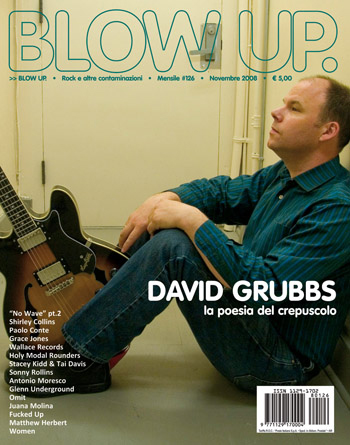
Blow Up is a monthly Italian magazine about “rock & other contaminations”: out rock, electronica, techno, house, experimental, industrial, improv/jazz, traditional.


 comparing the work of Koenig and U.S.O. Project, there are many differences, both in the aesthetic and formal domain.