Every time we open a session, the first thing we see is a waveform. It feels so natural that we rarely ask who drew it first.
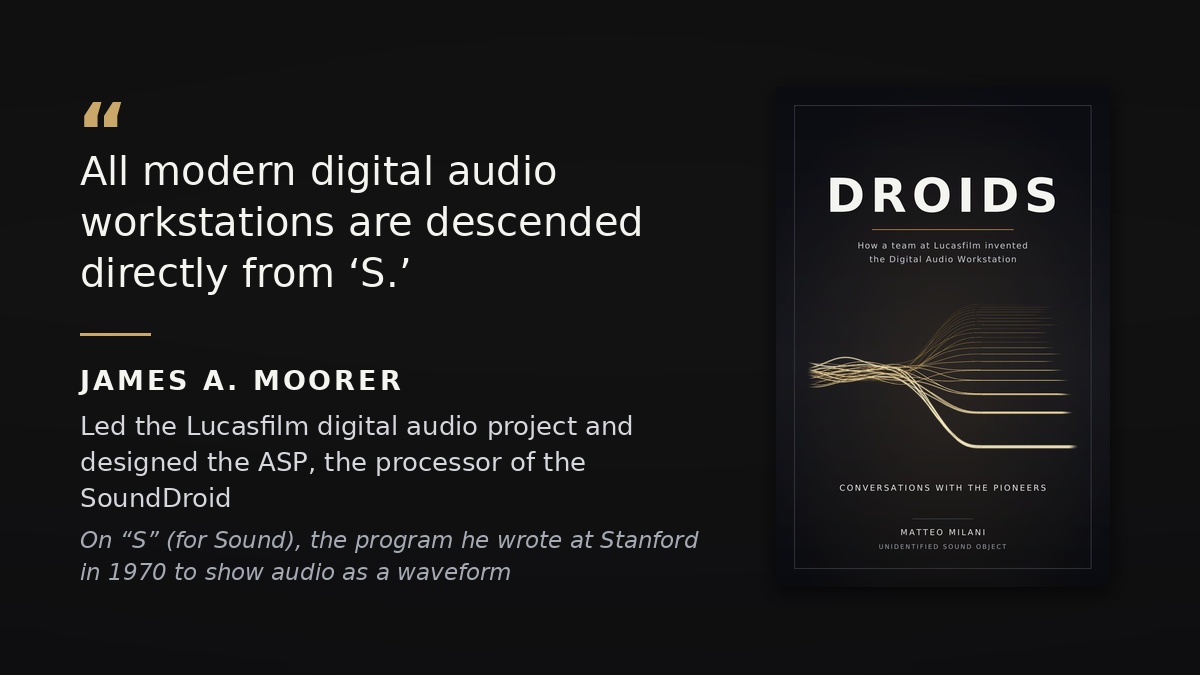
When I interviewed Andy Moorer, I asked him exactly that. In 1970, at Stanford, he had written a program called “S”, for Sound, that displayed audio as a waveform on a screen. He could not say where the idea came from: “It just seemed good at the time.” He was more certain about where it went: “All modern digital audio workstations are descended directly from ‘S’.”
Ten years later, at Lucasfilm, that display became the place where film sound was edited. Carla Scaletti points to an even older ancestor: the phonautograph of the 1850s, which traced sound as a line on paper but could not play anything back.
In his foreword to DROIDS, Gary Rydstrom describes Lucasfilm's C Building in San Rafael in the mid-1980s: on the top floor, the people who would become Pixar; below them, the people who would become The Droid Works, the mixing theatre where THX was born, Ben Burtt's room and the small "Sound Pit" where the SoundDroid lived. Two research groups, one building, and two very different afterlives.
Not far away, on Kerner Boulevard, was the home of ILM, later 32Ten Studios. Shortly before it closed for good, Ben Burtt took Adam Savage on a last tour of the former ILM facility in San Rafael, where an original EditDroid was still kept:
Last Look Inside the Former ILM Production Studio, with Ben Burtt and Adam Savage (Tested, 2024).
One division, three groups
George Lucas set up the Computer Division in July 1979 and hired Ed Catmull, then at the New York Institute of Technology, to run it. In Creativity, Inc. (2014) Catmull remembers that Lucas's interest in computers was entirely practical: digital optical printing, digital audio, non-linear editing, computer graphics. Catmull organised the division into graphics, video and audio groups, each with its own manager. Alvy Ray Smith led graphics. Ralph Guggenheim led the editing project that became the EditDroid. In September 1980 Andy Moorer joined as leader of the audio group, and built the Audio Signal Processor with John Snell, Curtis Abbott, Jim Lawson and the others listed in the book.
The groups faced the same resistance. Catmull writes that Lucasfilm's film editors refused at first to test the editing system: they were happy with razor blades and tape. The sound people had their own version of the problem, and the SoundDroid was designed to keep the feel of the tools editors already knew.
The Pixar Image Computer, and the name
The graphics group's first goal was not animation but special effects: a computer able to scan film, combine images and record them back to film. It took about four years. The machine was called the Pixar Image Computer, and Catmull tells where the name came from: Smith liked "Pixer", a fake Spanish verb for making pictures, and Loren Carpenter preferred "Radar". The two became Pixar. Smith tells the story himself on his website.
In 1983 a young Disney animator called John Lasseter visited the division, and soon joined to work on a short film, The Adventures of André and Wally B., finished in 1984.
1986
Then Lucasfilm decided to sell. Catmull describes a year of failed negotiations, about twenty prospective buyers and a deal with General Motors and Philips that collapsed a week before signing. In February 1986 Steve Jobs paid 5 million dollars to spin the graphics group off, and another 5 million to fund it. The new company kept the name of its computer. Smith has published the founding documents, including the check, on his Pixar history page.
The same year The Droid Works wound down and the SoundDroid, of which only one was ever built, went into storage. One half of the laboratory went on to make Toy Story; the other scattered its people and ideas into Sonic Solutions, Avid and the wider audio industry, and in the end into every digital audio workstation.
The connections did not stop there. Gary Rydstrom, who mixed in that building, did the sound for Pixar from Luxo Jr. onwards and later directed the Pixar short Lifted. Tom Holman, who said he was hired as a backup in case the Computer Division did not get everything done digitally in three years, designed the Technical Building at Skywalker Ranch, where Pixar's films were later mixed.
For the whole story of the Computer Division, the reference is still Michael Rubin's Droidmaker: droidmaker.com.
Today DROIDS is out, forty-one years after the SoundDroid was first shown in Los Angeles.
This blog is where it started. Between 2008 and 2011 I published here the conversations that became the core of the book: with Michael Rubin, Andy Moorer, Tom Holman, Richard Beggs and Gary Rydstrom. Reading them again this year, I found that many of the people who built the machine were still there, and willing to write their own chapters.
This blog has been quiet for a long time, and it seems right to wake it up with this news. Some of you may remember the interviews about the Lucasfilm SoundDroid that appeared here. That small project has grown into a book.
DROIDS: How a Team at Lucasfilm Invented the Digital Audio Workstation tells how a small team at Lucasfilm built the Audio Signal Processor (ASP) and the SoundDroid between 1980 and 1986. Only one SoundDroid was ever built and it was never sold, yet its ideas (sound as an editable waveform on screen, non-destructive editing on disk, a signal processor you could reprogram) arrived years before the tools we now take for granted.
The book lets the people who were there speak first: conversations with James A. Moorer, Tomlinson Holman and M.H. Rubin; a foreword by Gary Rydstrom; first-person accounts written for this edition by John Snell, Curtis Abbott, Bernard Mont-Reynaud, Marie-Dominique Baudot, Jeffrey Borish and John Strawn; and an epilogue by Carla Scaletti.
DROIDS will be released on Saturday 31 October 2026, the 41st anniversary of the SoundDroid's presentation at the SMPTE conference in Los Angeles. It is free, as PDF and ePub, under a Creative Commons licence (CC BY-NC-ND 4.0). It will be available on the book’s official page: unidentifiedsoundobject.com/droids.
My thanks go to everyone who shared their memories, documents and corrections over these years. This book exists because of them.