From organs (biological) to organs (musical), this year’s Kyma International Sound Symposium (#KISS2014), to be held in Lübeck Germany on 25-28 September 2014, will explore multiple meanings of the phrase “organic sound” through technical talks, live performances, and hands-on workshops.
Events will kick off with the unveiling of a major new release of the Kyma software and feature technical/philosophical sessions on topics ranging from voice processing, to sonification of organic chemicals and the Internet, to organic growth and decay, to how to build your own performance controller and use it to control Kyma via OSC, to presentations by individual composer/performers detailing how they utilize Kyma in their live performances and installations.
Milan - Saturday, June 9th 10:00 to 12:00 and 13:00 to 17:00
Fifth round of the cycle, 'European centers of research on sound and new media'
Focus FRANCE: Ina-GRM_Groupe de Recherches Musicales, Paris
Guest speakers: Emmanuel Favreau (Chief Engineer for the Development of GRM Tools), Francois Bonnet (Research, Teaching and Curating activities)
[Pierre Schaeffer and Bernard Parmegiani, courtesy of Ina-GRM]
Ina-GRM (Institut National de l'Audiovisual - Groupe de Recherches
Musicales) in Paris is a pioneering organization
for musique concrete, acousmatic and electro-acoustic music, whose
history dates back to the '50s, when it was founded by
Pierre Schaeffer. Always engaged in the development of creative
activity, research, preservation and dissemination in
field of music and recorded sound, the GRM is an experimental laboratory unique in the world. In response to
expectations and needs of musicians, composers and sound designers, it
is highly specialized in the development of a
range of innovative tools to treat and represent the sound: the GRM Tools and the Acousmographe. The activities of music creation and
production are mainly grouped at Studio 116 in the Maison de la Radio in Paris.
Grm Tools Workshop
Up to 10 participants.
Bring your own laptop and headphones.
The workshop is free and is held in Italian by Emmanuel
Favreau along with Francois Bonnet. During the seminar, after outlining a brief history, Emmanuel Favreau will explore the possibilities of digital sound processing with the latest
Tools developed by GRM; he will also deal with issues related on how to interact with the musician.
These notions
will be illustrated by demonstrations in real time and musical examples from the repertory of electroacoustic music.
After the workshop Francois Bonnet will present the lecture 'Music and sound in space, an introduction to multichannel compositions'. The meeting is open to
public, and will present the research activities of the Centre in Paris plays through spatialized listening sessions and projections.
OnMedia is focused - from September 2011 and throughout 2012 - in
a wide range of events including a series of conferences dedicated to the most important European centers for research on multimedia sound,
art and technology, a series of workshops on subversive listening, presentation of international visual artists and authors who use different media and languages, concerts and performances.
"Listening to the environment, contextualizing it objectively and creatively has always been a priority of the work of U.S.O. Project.
Free from any pseudo-environmental or socio-political implication, the continuous work on sampling, processing and transfiguration of found sound and carefully preserved in memory of a digital recorder, has always played a central role in our compositional practices.
U.S.O. defines Soundscape as the expressive and narrative richness that comes from the reciprocal and continuous interaction of multiple sound sources from the real world, and other phenomena which are perceptible and measurable only through proper and adequate transduction (electromagnetic signals, for example).
A Soundscape is also an opportunity for reflection and imagination that has little to share with the real world.
A Soundscape can be a place of the mind, a reminiscence of a future experienced in dreams, lands far away in space and time.
We try to deal with the possible infinites of the listening experience, both in their objective and manufactured dimensions.
We believe this represents our primary objective, to render the endless possibilities of life and its surroundings, sensible and experienceable in our conscious activity."
Objectives of the Workshop:
Students will be encouraged to actively listen to the rich sound world around them. Their imagination and creativity will be stimulated, and at the end of the course they will create a sound composition using the world around them as a musical instrument.
The workshop offers an introduction to theory and practice as follows:
An historical perspective on the Soundscape Composition.
Tools and methodologies for field recordings.
The listening practice to analyze the characteristics of ambient sound.
A practical approach to the transformation of sound.
Composition with three-dimensional space. The Ambisonics format.
Tools and Advanced spatialization Techniques.
Target
Anyone interested in the Soundscape Composition and sound field experimentation.
Structure of the course
1) Introduction
Brief history of soundscape composition, with examples drawn from the work of contemporary artists who incorporate the practice of Field Recording in their compositions.
Introduction to the concept of "soundscape".
2) Tools
Field Recordist's Tools: microphones and recorders.
Conventional microphones techniques and creative miking.
3) Sound Transformation
Manipulation and digital signal processing techniques (VST+AU).
Filtering.
Convolution.
Granular Timeshifting.
PhaseVocoder.
4) Composing in Space
Multichannel Surround Sound.
HOA (Higher-Order Ambisonics).
Tools for encoding and decoding.
At the end of the four-day workshop, participants will develop a short sound composition (about 6 min.) using the concepts and techniques acquired during the various modules.
Duration:
4 days / 17-18, 24-25 September 2011
10 a.m. to 7 p.m.
Costs and subscription
To participate in the workshop you must register no later than 10th September 2011. The fee is € 100.
Listening paths and outdoor recordings. The participants will take part in a "sound walk" to "collect" their
point of view of a soundscape with their digital portable recorders, as
defined by a preplanned route. Editing sessions of the collected material.
Requirements:
It is recommended that participants bring their own laptop, a portable recorder and headphones.
The number is limited to 14 participants.
Sonic Screens – environmental music listening sessions
Live mixing and spatialization by U.S.O. Project (Matteo Milani & Federico Placidi)
Call for multichannel works
U.S.O. Project is pleased to invite submissions of fixed media sound works for the second edition of “Sonic Screens”, a journey among different electroacoustic Soundscape compositions.
Sonic Screens is an annual event that will take place during two acousmatic evenings in Milan during Fall 2011.
Sonic Screens aims to render the endless possibilities of life and its surroundings experienceable in our conscious activity, trying to deal with the possible infinites of the listening experience, both in their objective and manufactured dimensions.
“Listening to the environment, contextualizing it objectively and creatively has always been a priority of the work of U.S.O. Project.
Free from any pseudo-environmental or socio-political implication, the continuous work on sampling, processing and transfiguration of found sound and carefully preserved in memory of a digital recorder, has always played a central role in our compositional practices.
U.S.O. defines Soundscape as the expressive and narrative richness that comes from the reciprocal and continuous interaction of multiple sound sources from the real world, and other phenomena which are perceptible and measurable only through proper and adequate transduction (electromagnetic signals, for example).
A Soundscape is also an opportunity for reflection and imagination that has little to share with the real world.
A Soundscape can be a place of the mind, a reminiscence of a future experienced in dreams, lands far away in space and time.” – Matteo Milani & Federico Placidi
Composers and sound artists are invited to submit multichannel works, up to 8 channels. The assignment of channels to speakers must be clearly indicated in the submission. Works of any duration will be considered although pieces of under 16 minutes will be given preference.
The performance will take advantage of Ambisonics sound diffusion practice, creating an immersive and uninterrupted sound flow between different works from selected international artists.
The recordings of the concerts will be available for streaming and released in binaural format for headphone use. The ownership of the tracks remains to the authors.
Submissions need to include:
a stereo version of the piece
individual mono files for each channel
channel configuration
sample rate
program notes
brief biography
While the composers of the selected works are encouraged to attend the event, attendance is not required for a work to be presented.
There is no registration fee.
The deadline for submission of works is October 31st, 2011.
Material Submissions
Please send download links to your work using one of the many file delivery services (yousendit.com, sendspace.com, gigasize.com, wetransfer.com, etc) in .zip or .rar format. Please do not email file attachments.
“The essential difference between an electroacoustic composition that uses pre-recorded environmental sound as its source material, and a work that can be called a soundscape composition, is that in the former, the sound loses all or most of its environmental context. In fact, even its original identity is frequently lost through the extensive manipulation it has undergone, and the listener may not recognise the source unless so informed by the composer. In the soundscape composition, on the other hand, it is precisely the environmental context that is preserved, enhanced and exploited by the composer.” – Barry Truax
Recorded 29th October, 2010 @ O' - no profit organization, during Live!iXem 2010 - Edition VII International festival of music, mixed media and experimental electronic art - Milan
Between 1967 and 1969 Gottfried Michael Koenig devoted himself to compose electronic music, producing a series of works entitled Funktionen.
The instrument that inspired and made possible these compositions was the Variable Function Generator, designed by Stan Tempelaars at the Institute of Sonology, Utrecht.
Koenig used the VFG not only to produce the basic sounds (waveforms), but employed it as a modulator and control instrument in order to dynamically manipulate the elaboration processes which were carried out on materials (ring modulation, volume curves, filtering and reverberation).
The idea behind the experiment was to entirely produce the sound material and its structural implementation using only the VFG (this led to the creation of Funktion Grün, Funktion Gelb, Funktion Orange, Funktion Rot).
For a detailed analysis of Gottfried Michael Koenig’s Funktionen, please see the document on his official website:
The works presented in U.S.O. Project’s Functions explicitly refer to a series of works that with an extraordinary vision Koenig realized in those years.
The main challenge was both philological and aesthetical. The idea was to create an automated composition by exploiting the computing power of modern computers and by a sufficiently widespread and flexible software in order to re-program the original algorithms.
The Patches used in the prototyping of the generative software environment were assembled using a specially written program that provided in text format - using serial procedures - how the various modules should be combined with each other - i.e.:
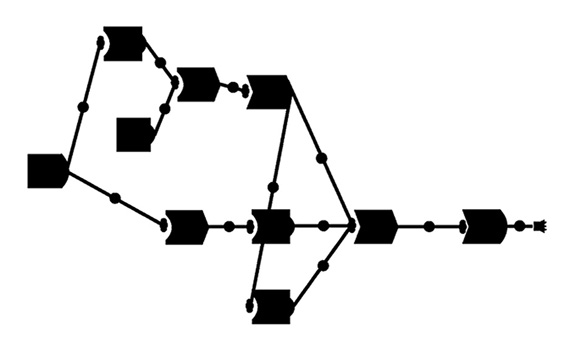
Once we had identified the blocks, they were displayed in the form of flow charts - i.e.:
The various Patches were then implemented as Abstraction in Max/MSP:
In order to manage all the modules in parallel, plus the sends to the reverberation units and so forth, we constructed a matrix, that automatically reconfigures itself according to strict procedures based on serial techniques:
The implemented automata procedures have in fact "created" the composition itself.
In the end, the multichannel final master was obtained with Kyma/Pacarana’s surround Objects.
As you can deduce from a listening comparing the work of Koenig and U.S.O. Project, there are many differences, both in the aesthetic and formal domain.
It was clear to us since the beginning that we didn’t want to repeat Koenig’s compositional experiment in every detail, but to build - and then understand - something new produced using the same modus operandi that convinced him to make those works. At the same time we wanted to preserve an historical legacy with those works (something that is easily recognizable especially in the first piece). It was also interesting to us to empirically verify the effectiveness and efficiency of the procedures in terms of timbre and formal development using the serial approach.
The actual distributed version is rendered using U.S.O. Project’s custom binaural techniques for headphone listening only.
Beyond any reference to Koenig’s original works, Functions is a spontaneous self-reflection about the different states of sound matter and the exploitation of its possible configurations, shaped and imagined through a dialogical process between the machine and its operator.
by Federico Placidi and Matteo Milani - U.S.O. Project, May 2011
Otto Laske is a composer internationally known for his work in computer-assisted score and sound composition. In the 1980’s, he co-founded and co-directed the New England Computer Arts Association, NEWCOMP, together with Curtis Roads (1981-1991). In 1999, his 25-year long work as a cognitive musicologist was introduced to, and explained to, a larger public in Jerry Tabor’s 1999 Otto Laske: Navigating New Musical Horizons (Contributions to the Study of Music and Dance). The book contains a comprehensive bibliography of Otto’s compositions, poems, and musicological writings.
Otto Laske has always been seen as an innovator, both in theory and composition. After a career in music, he became a knowledge engineer in the 1980s and a psychologist in the 1990s. Since 1999, in addition to his compositional work, he has practiced as a developmental coach and management consultant based on a methodology created by him, called the Constructive Developmental Framework (www.interdevelopmentals.org). This methodology for assessing individual’s developmental potential shares certain global structures with Laske’s cognitive musicology of the 1970s and 1980s, in that it is multi-dimensional, dialectic, and based on empirical research.
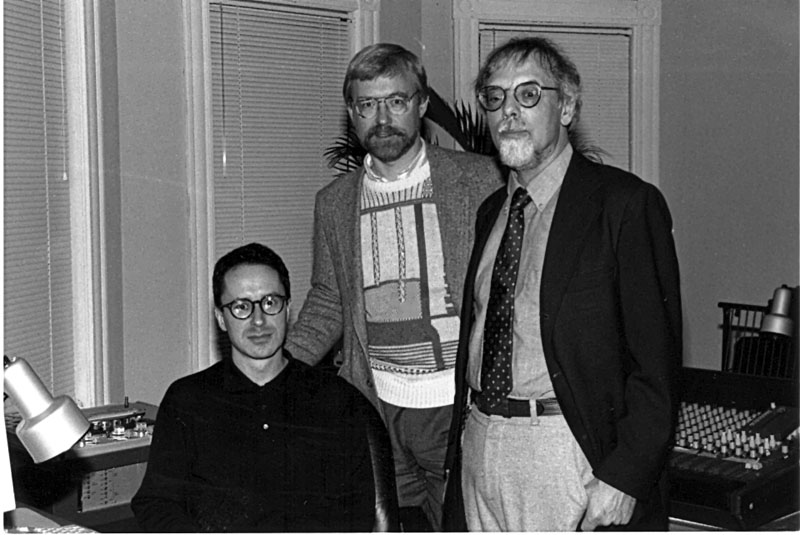
[Barry Truax with Curtis Roads and Otto Laske, Cambridge, MA, 1989 - courtesy Barry Truax]
" [...] a theory of music has to understand not musical results but rather the mental processes that lead to such results." - Otto Laske
"Looking back at 43 years of making electronic music, it's clear to me that ever since I began composing in 1964, the development of music technology strongly shaped my compositional ideas. The artistic task seemed to be to show that new technologies can indeed produce "art." At the same time, these technologies brought forth new compositional ideas not elaborated before. In short, a stark interdependency of compositional thinking and technological possibilities prevailed. When listening to my various compositional adventures today there is, for me, a certainty aesthetic unity that binds all of my pieces together. It will be up to historians (once they have become knowledgeable about the technology underlying these pieces) to judge them from a more balanced perspective than is perhaps possible today." - Otto Laske, January 2010
Computer Software Based Composition
My background is in both philosophy and music, not to speak of poetry. I studied with Adorno in Frankfurt: a philosopher and composer who shaped my thinking for a decade (1956-1966) and also helped me to emigrate to the U.S. in 1966 in order to study computer music. He also made me aware of the Darmstadt Music Festival, at which I met Stockhausen, Gottfried Michael Koenig, Ligeti and Boulez, among others. The first time I went to Darmstadt was the 1963: I was especially taken with Stockhausen as a teacher and with Pierre Boulez' notion of orchestration virtuelle, by which he meant that a professional composition contains elements that are not immediately obvious or even hidden, but have to be there to make a rich composition come to life. This notion of Boulez’s has accompanied me all my life, and not only in music, as much as P. Klee’s Das Bildernische Denken.
My main musical mentor, although not as a teacher of composition, is Gottfried Michael Koenig. I met Koenig in 1964 when he first presented Project 1 to colleagues. While his program was unfamiliar to me, I had previously studied with a German composition teacher (Konrad Lechner) who was very influenced by medieval music, as well as the works by Webern and Stravinsky. He had taught me something called micro-counterpoint by which he meant minutely working-out selected musical elements (such as, e.g., 10 rhythms, tones, or tone colors) and bringing them into the form of a cantus firmus on which to base a larger composition, under the intense influence of the ear.
When I listened to Koenig in his lecture at that time, I understood him to be talking about parametric counterpoint, counterpoint of parameters like pitch, duration, instrument color, register, volume and so forth, as Lechner had done. The difference was his use of computers for composition. What captivated my interest in computers was not the hardware, but the idea that compositions could be designed on the basis of contrapuntal ideas so that different parameter streams (lists) could be merged to create new sounds, either in ideal time (through notation), or in real time (electronically). In all of the computer programs of the sixties, such as those by Xenakis and Mathews, what interested me was expanding my contrapuntal, multi-dimensional way of working.
When I sit down to compose music using a program like Project 1 or Kyma, I find of central interest the feedback loop between the frozen and the living knowledge that is engaged: the frozen knowledge embodied by the computer software, whether it is knowledge of an instrument, waveforms, envelopes or knowledge about deforming and sequencing visual images, and the living knowledge in the composer’s mind. In my writings, including in Computer Music Journal, I always emphasized that a computer used in music (including its interface with the user) should have as much intelligence as possible, including the ability to learn from the user. I was always disappointed that this has been made possible to date by programmers only to a small extent. My notion regarding this was to permit the composer to build new “task environments”, a kind of artistic homesteads in which s(he) could re-use fruitful ideas and presets, or even understand his/her compositional process better.
I think that the new concepts engendered by computers are valid in many artistic fields. When I work with my painting program today, or make animations accompanied by music, I find much greater openness to the idea of having the computer program “know its user”. It seems to me that the visual programs I am using have a higher-level intelligence than present music programs, or so it seems to me. (I am not a live performer of music, where much of the available computer intelligence seems to be located these days.)
In music, I guess, I am an “old-fashioned” composer, in the sense that I typically work from numerical templates such as produced by Koenig’s Projekt 1. I refer to this way of working as “score synthesis” in contrast to “sound synthesis”, whether I am engaged in instrumental, vocal, or electronic composition. Algorithmic composition really never caught on in the US, except perhaps in Milton Babbitt’s work. As to Koenig’s Project 1, it seems I have remained the only composer who used it also in electronic composition, -- although composers like Barry Truax have, of course, been using “algorithmic composition” all their life, much influenced by Koenig’s work as holds for myself.
Score synthesis was a European idea stemming from Xenakis, Koenig and few others like L. Hiller in the US. My goal as composer over 45 years has been to bring score synthesis (the computation of score parameters) and sound synthesis (the computation of acoustic material based on “reading” score parameters) into balance with each other, giving equal attention to both. This meant that I had to always use at least two different programs (not originally made for working together), one for score synthesis and another for sound synthesis. And considering that the algorithmic paradigm of composition requires bringing together “score” and “sound” (whether in CSound or Kyma), the art of composition for me became that of marrying the right set of instruments to the right score by using my listening.
The Project 1 Experience: Interpretative Composition
In the 1960s and 1970s, there came into being very different compositional programs. Some made it easy to create numerical materials but required intensive interpretation by the composer, while others required elaborate inputs (such as Koenig’s Program 2) and their outputs could only either be accepted or rejected.
Koenig's Project 1, like Xenakis's ST/10, is of the former kind. It requires very little input and will give the composer a large amount of data to interpret, either for instruments or for electronic sound. I found that the Project 2 type of program didn't suit me as well as Project 1 because I love the freedom of interpreting data, often using the same score for an electronic as well as an instrumental composition (which probably nobody would hear or needs to know). However, I am still curious about the Project 2 type of program and may use it some time in the future after all.
Both programs show me that it is the composer’s mind that creates music, not the sound or the machine, because the composer can obviously use any kind of template, even – as Stockhausen used to say – a telephone book.
I called my work with Project 1 interpretative composition, because I was interpreting data generated by computer software according to guidelines programmed by a composer. I also refer to it as “rule” rather than “model” based composition, meaning that in each new composition I followed a different set of rules, some inherent in the program, others stipulated by me. It is the feedback loop between my own set of rules and the computer’s that interested me. As to the difference between following rules or models, I thought little of artists following others’ or their own compositions as models. I wanted to start from scratch each time, although I of course brought into being my own tradition over many years of composing.
As an abstract thinker, I was also of the persuasion that one should plan compositions “top down”, by stipulating rules for how a score or set of sounds ought to be created, and not bother about details other than in continued rehearsal of listening to the results, -- Berg’s “Durchhören”. It was a matter of what to control when, and not to control everything but to know what controls one could delegate to a computer slave.
Specifics of Koenig’s Project 1
To be specific, in Koenig’s Project 1 (created in 1967 and continuously refined til the 1990s), a composer works with 7 degrees of change for all parameters (such as pitch, entry delay, pitch, register, volume). Degree 1 represents constant change, while degree 7 stands for minimal change (redundancy), with degree 4 standing in for a compromise between the two.
Now imagine the fun to be able to plan, and carry out, a creative process in terms of the different parameters that need to come together to make a new composition! Should entry delay – the delay between subsequent sound entries – vary according to degree of change 1 or 4 or 7? If you chose 7, then what degree of change do other parameters such as pitch or volume need to follow? If you then in addition to using Project 1 stipulated your own interpretations of what “register 4” or “volume 6” is to stand for, you are in a creator’s paradise because you can model your rule stipulations to whatever strikes your fancy, keeping in mind the limits of the medium – instrumental, vocal, or electronic – you are writing in. Each movement of your composition will have it own unique “parametric signature” that is never repeated anywhere in your life’s output. And with regard to electronic music, you might arrive in a studio other than your own – e.g., at the GMEB in Bourges – and hear your score for the first time in your life -- with 2 weeks left to convert it to sound.
By using Project 1, I was able to plan the FORM of my compositions’ – the main esthetic concern of every composer – in the minutest detail by using a global top-down design based on parametric counterpoint. I was not composing with “tones” but at a meta-level, with“parameters” whose streams coalesced to create novel sound. And I could do so not only for sequencing scores (whose length I determined); I could also MERGE (mix) scores to my heart’s content. (This procedure is found in all of my electronic compositions after 1999).
Of course, the computer (luckily) could not help me sequence or merge different “sub-scores”, as I called them. I was challenged to do so by ear, “rehearsing” pieces like a conductor (without ever needing one). The computer couldn’t even guide me in designing instruments (e.g., in Kyma) that would be ideal for playing a particular score. I was free and obliged to do so myself (which shows that “algorithmic composition” is a very misleading term). And so, I often ended up “orchestrating” a particular score based on different sets of instruments (called “orchestras”), and then would mix different sonic renditions of the same score into a final complex result. It is here that I practiced what Boulez had called orchestration virtuelle because many fine details of a composition could easily be generated by superimposing different instruments (tone colors) slightly varied in their onset in time against each other.
Of course in instrumental composition I could only sequence, not mix, scores, although even here I could (theoretically) have decided to orchestrate the string section with one and the brass section with another score. Ultimately, electronic music won out in my production of music. I could easily produce a final score with 18, 24, or 36 voices per sound entry, by overlaying different scores played by different instruments, and I could vary the “parametrical depth” of the sound from second to second. The compositional freedom I enjoyed using Koenig’s Project 1 and Scaletti’s Kyma was limitless.
I am speaking here of the most recent phase of my work of computer music programs during the first decade of the 21st century. The beginnings of this labor in the 1970s and 1980s were far less idyllic. For one thing, not having access to a computer running Project 1, I would produce my numerical scores manually, by “cutting and pasting” parameter lists from older score printouts I had retained and copied. This allowed me to design new scores in which the 7 degrees of change in Project 1 were quite different from previous scores, whether for instruments, voices, or tape. Then also, there was initially no “translator” for Project 1 scores into the DMX1000 or CSound or Kyma format, so that all of this work had to be done by hand. So it was a breakthrough in the early 21st century when Koenig provided me with a formatting of Project 1 scores that could actually be read by CSound or Kyma, respectively. No longer did one have to wait for a week, as in the 1970s, to hear a short piece one had programmed, by which time one had already forgotten the compositional idea input to the computer a week earlier.
The New England Computer Arts Association (NEWCOMP)
The 1980s were a heady time for “scandaliser le bourgeois” listening to music at Boston Symphony Hall. Curtis Roads was a very good friend of mine at that time, and for nearly a decade we worked together trying to put the focus on the production, rather than the consumption, of music. (It was only at the end of the 1980s that I could finally built my own studio, so that I could experiment with musical ideas any time I pleased, rather than having to travel to Vancouver, Bourges, or Ötwil am See to make a composition.)
I met Curtis (then editor of Computer Music Journal) in 1980 when he came to live in Cambridge, MA. After some talks we decided to form an association of composers, initially for presenting computer music concerts, later expanded to other computer arts, like computer poetry, computer dance and what we then call “visuals”. At that time I was married to a choreographer and I taught her to use Koenig's Project 1 in designing choreographies, which she did using parameter lists for determining “gestural events” for her dancers who collaborated to make a composition.
Curtis and I founded the New England Computer Arts Association in 1981 (which was renamed in 1984 into Computer Arts Association). During the time we worked together, Curtis and I gave about 65 concerts, planning every detail of them. Artists came from around the US to be presented by us. Curtis left NEWCOMP in 1985 and I carried on until 1991 when, not finding a worthy successor, NEWCOMP ceased to exist. We presented concerts not only in Cambridge (Massachusetts), but in also Europe (Warsaw, Stuttgart, Tbilisi). In addition, we sponsored an international computer music competition which became internally known as the NEWCOMP Music Competition.
At that time, both he and I were very sick and tired of the concert music scene in Boston, which was all about consuming music. We felt that what matters was producing, not consuming, music, and so we also presented composition courses for computer music beginners, and symposia for showcasing creative work. Our concert venue was a church in Cambridge, near Harvard University (where during 1992-1995 I would study developmental psychology).
NEWCOMP was a group of about 15 artists and composers which held regular meetings in my house, complete with a President, Vice-President, 2 Artistic Directors, and a Treasurer, -- all volunteers. We invited composer colleagues in the US and Europe – Koenig, Lansky, Ruzicka, and GMEB, and others – to be judges of the works submitted to the competition. NEWCOMP members came together to make the final selection of 3 winners. For ten years, NEWCOMP was the only association in the US that presented regular computer music and mixed computer arts concerts outside of academia. We “schlepped” loudspeakers, advertised, sold tickets, and in this way performed a lot of new music. It was a great pleasure.
Laske's work in Cognitive Musicology
I was always interested in what is knowledge, that is, epistemology. What does it mean to know, how does knowledge develop and work in the world?. As a result, the essential question I posed in my cognitive musicology between 1970 and 1995 (to be published in part in three volumes by Mellen Press by 2013) is "what is musical knowledge"?
As you know, musicologists have formulated hypotheses as to how Beethoven may have composed his string quartets, but they don't have enough data to really establish any sound theories about that. So that was the project that history handed to me. I was tired of the old musicology that I had studied in Frankfurt am Main. In my research after 1970, I was suggesting that, given the existence of computers, the time had come to branch out and study not only musical products – “compositions” – but the mental processes by which living computers brought their works into being. I was especially eager to understand the linkage between the mental process that led to a particular composition – carried out by using computer programs – and the work that resulted: how was musical form actually created? I was convinced that one could never derive the process from an existing work of a dead composer. Even old music was brought to life only through mental processes in the present, and so, in a way, there was no pre-existing music; it all occurred NOW. I also thought that conventional musicologists made too many illicit assumptions, called “interpretations”, that couldn’t be empirically proven and were largely arbitrary; and still think so.
Therefore, when upon Koenig’s (Godsend) invitation I worked in Utrecht between 1970 and 1975, inspired by what he called “composition theory”, I decided to use computer programs to work out empirical theories about how music is thought or “made”, whether in music analysis, conducting, composing, and listening. I rejected notation as a worthwhile medium and started working directly with electronic sound produced by the Institute of Sonology’s PDP-10 computer. Influenced by J. Piaget, the geneticist of knowledge, as well as N. Chomsky’s Transformational Grammar and P. Schaeffer’s Traité des Objets Musicaux, my goal was to understand the musical thinking of children.
" [...] At the Institute of Sonology, Gottfried Michael Koenig and Otto Laske and a host of really excellent teachers were formulating the digital future. That may sound overly dramatic, but they had this wonderful set of analog studios, with a lot of custom made equipment and two and four channel machines for recording it and banks of voltage control equipment that defied description. It was very, very complex. A long way from the Buchla and Moog synthesizers I’d been weened on at UBC. Stan Tempelaars was teaching modern psychoacoustics that he had gotten from Reiner Plomp, which I now realize was pretty cutting edge at the time. Koenig was teaching composition theory but also programming and macro assembly language for the PDP-15, almost as fast as he was learning it himself. And suddenly, for the first time, I found myself with the mini-computer; that’s what they were called, even though they took up one huge wall of a room. But they were single user, not mainframe computers like Max Mathews had. Although the only means of interaction was the teletype terminal, you could have real-time synthesis and interact with it as a composer rather than writing programmes. And I developed this thing called the POD System for interactive composition with synthesis, which was a top down type of approach." - Barry Truax
While in society computers were used to make profit, I looked at the computer as a machine that could strengthen (not replace!) the creative mind, thus working against the grain of technology. I felt artists could finally become independent of the many conventions than bind them in their work and in their performances, and simply satisfy their own criteria for what was “good art” (never mind the conductors who wouldn’t play their work). That was the political background.
Theoretically speaking, I was waking up to Artificial Intelligence as a means to “simulate” creative mental processes. For this reason, when I returned to the US in 1975, I applied for a grant to study with one of the luminaries of A.I., Nobel Prize winner Herbert Simon, at Carnegie-Mellon University, Pittsburgh (himself an excellent cello player). Together with A. Newell, another founder of A.I., Simon had created the first chess computer program that could beat a human player. He had also invented “protocol analysis”, a way of analyzing the intellectual moves of a human computer user engaging with a particular task such as chess and understanding spoken language.
So it was natural to wonder whether a computer program could not also “protocol”, or document, what children did with electronic sound compositionally (as I had been trying to understand in the Utrecht OBSERVER programs built together with B. Truax in FORTRAN), and whether they could not simulate, or at least intellectually support, musical composition, and not only for children. It was an idea that was in the air, so to speak.
As this shows, thinking about composition as a theorist and making music was very closely linked in my work. Not that composition was becoming a “science”, but rather that composers would do well to get out of their studio and sniff the air of science, as many composers began to do (e.g., James Tenney, not to speak of Xenakis and Koenig). I felt the composer needed to know as much as he/she could about computers and composition theory in order to understand his/her own creative process, and become more dynamic and flexible in using new processes rather than following old “models”, even their own.
From documenting children’s work in composition at the Instituut voor Sonologie, Utrecht (1970-75), I proceeded to simulating compositional processes by writing A. I. programs (1975-77) at Carnegie-Mellon. However, to do this was a very large undertaking, and I never managed to obtain the financial funds for working with others on this project which, finally, I had to give up to fully return to composition (1995). EMF is bringing out a 2 CD set “Otto Laske: The Utrecht Years”, which features 9 music pieces I had composed in at the Institute of Sonology over 5 years.
Visual Music
[Lanesville seen by camera - Otto Laske]
My artistic life is far from over. I have often been told that my music is very visual and contains many visual cues. Therefore, in 2009 I began to think: composition is composition, why don’t I extend my compositional work into the visual domain. (I also have written a substantial body of poetry, both in German (1955-1968) and in English (1967-1995)), still unpublished.
In 2008, after having begun work in watercolour and oil, I discovered what today is called visual music through Dennis Miller, a fellow composer living near me, and one of the pioneers of the new medium. (I always meet the right people at the right time, it seems.) Visual Music is a discipline still in its infancy, but has its roots in the 1920's and 1930's, when artists like Oskar Fischinger, Germany, began to experiment with abstract films that were called “absolute film” since they were without narrative and storyline, and rather simply focused on (often geometrical) shapes and colors. The pioneers of visual music had the vision that it was possible, or should be possible, to bring abstract painting in the sense of Kandinsky and Klee to film or video, and link it to music (instrumental music at first, and later electronic music).
In my present work with Studio Artist and Cinema 4D -- the first a program for digital painting and the second for animation -- I have again taken up the practice of using two different programs not initially meant to work with one another. But at least they can “talk” to each other now, which was not the case with early music programs. And so I am gradually learning to go back and forth between these 2 programs, not to mention that I also need to use a sound processor such as Sound Forge, a movie making program such as Vegas Movie Studio, and bring them all together to produce a visual music video.
For the time being, I have produced a gallery of images that will be accessible on www.ottolaske.com in the near future. Even for an experienced composer like myself, learning and using visual programs presents a steep learning curve. I am therefore putting my poetry and music on hold in order to became a digital painter and animator. I have given myself two or three years to learn these programs before I can turn out anything that would satisfy my artistic standards.
Again, the computer is the "leading voice" that challenges me as an artist to bring together music and image after a lifetime of composition. I feel very fortunate to be able to do this at my age (75), additional years permitting.
It is possible to think of the two extremes of the world of sound as the inner domain of microsound (less than 50 ms) where frequency and time are interdependent, and the external world of sonic complexity, namely the soundscape. In terms of sonic design, the computer is increasingly providing tools for dealing with each of these domains, such as granular synthesis and multi-channel soundscape composition. The models of interaction involved with the complexity of each of these domains are instructive, and will be presented with sound examples.
Barry Truax is a Professor at Simon Fraser University where he teaches courses in acoustic communication and electroacoustic music. He has worked with the World Soundscape Project, editing its Handbook for Acoustic Ecology, and has published a book Acoustic Communication dealing with all aspects of sound and technology. As a composer, Truax is best known for his work with the PODX computer music system which he has used for tape solo works and those which combine tape with live performers or computer graphics. In 1991 his work, Riverrun, was awarded the Magisterium at the International Competition of Electroacoustic Music in Bourges, France, a category open only to electroacoustic composers of 20 or more years experience.
International festival of music, mixed media and experimental electronic art
[a project by AntiTesi (Domenico Sciajno) and U.S.O. Project in collaboration with O' and Die Schachtel]
Live!iXem is a well established event that explores the relationship among sound, music, electronic arts and new technologies. iXem is a project conceived and produced since 2003 by AntiTesi, an organization founded and directed by Domenico Sciajno based in Palermo. Center for self-documentation, research and interdisciplinary development for new forms of Arts, Antitesi focuses on contemporary arts in its diverse expressions, coordinates and organizes cultural events, festivals and exhibitions in music and art.
Festival Live!iXem in October 2010 is divided into two events, a 'preview' in Turin on October 8th, organized with Hiroshima Mon Amour, and the main festival in Milan including live performances, installations and a workshop, organized in conjunction with O' and Die Schachtel.
The field is transverse. The common denominator is not the genre but the experimentation and research to innovation, helping to explore the variety of approaches to aesthetic guidelines, tools and technological solutions adopted by selected international artists and involved in the contemporary music scene.
After the introductory event in Turin, October 8th - with Live! IXem Preview - the festival appointment in Milan will take place in the Isola area, between the spaces of O', Medionauta and VisualContainer on Friday 29th and Saturday 30th October, from morning until late at night, offering a busy schedule of events.
Among these, the workshop 'Movement of acoustic images' - whose theme is the field recording, its transformations and its reproduction in acousmatic space - will consist of three different phases: the first by a technical approach, the second one by listening to environmental sound sources chosen as points of a hypothetical ideal sound map and the third one with 'on-site' recording of sound events.
Sound Researchers and Practitioners Convene to Discuss 'symbolic sounds' at #KISS10
Can music and sound-effects be symbolic?
Sound designers, composers, sound artists, film makers, researchers and others sharing an intense interest in sound will be convening in Vienna (Austria) from the 24th through 26th of September to discuss this and other, similarly controversial, issues at the annual Kyma International Sound Symposium (#KISS10).
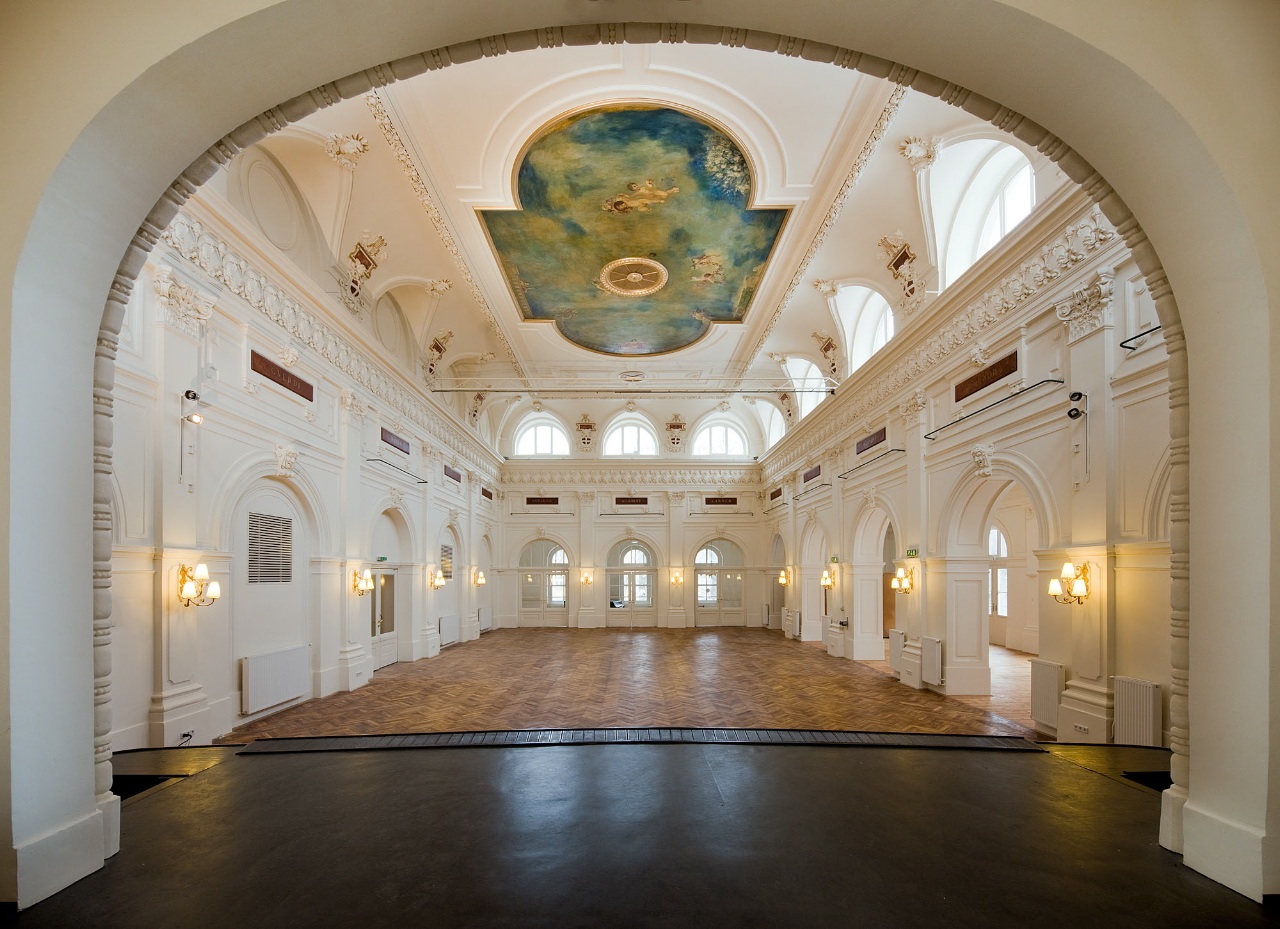
Lively discussions, electronic/computer music performances, interactive installations, demos, workshops, and paper sessions will be held in the newly renovated Casino Baumgarten, a spectacular ballroom built in 1890, and the Rhiz Bar Modern, a showcase for experimental media in Vienna.
[view from the Stage at Casino Baumgarten]
Join in the free on-line discussion
Anyone having an intense interest in sound is invited to join in the free on-line discussion at pphilosophyofsound.ning.com. Sign in and introduce yourself by sharing your earliest sonic memory. Discussions on sound, symbol, and meaning have already begun and will continue during and after the symposium. You can participate on line whether or not you are able to attend the symposium in Vienna.
To register for #KISS10:
The registration deadline for participating in #KISS10 is 13 September 2010. The participation fee of € 90 (€ 40 for students) includes the 3-day symposium, morning/afternoon refreshments, and 2 evening concerts.
Background
The Kyma International Sound Symposium (KISS) is an annual conclave of current and potential Kyma practitioners who come together to learn, to share, to meet, to discuss, and to enjoy a lively exchange of ideas, sounds, and music! Kyma is a sound design environment created by Symbolic Sound Corporation. This year, the KISS symposium is being organized by Wiener Klangwerkstatt in cooperation with Symbolic Sound and with the support of Analog Audio Association Austria, Preiser Records, and the Austrian Federal Ministry of Science and Research.
by Federico Placidi - U.S.O. Project, June 2010 / Eng: Valeria Grillo
The works of Agostino Di Scipio include compositions for instrumentalists and electronics and sound installations. Some of these explore non-conventional approaches on the generation and trasmission of sound, including a special focus on phenomena of noise, turbulence and emergence. Other works implement dynamical networks of live sonic interactions between performers, machines, and environments (e.g. his Audible Ecosystemics project).
FP: Let's talk about your early works, before the 'ecosystemic' paradigm. How different was it from your more recent work?
AdS: Well, I had a very early phase when I gathered as much knowledge as possible about computer music techniques and digital signal processing. That included a special for algorithmic composition, too, the question being how I could formalize musical gestures of use in writing for either usual music instruments or electronics. In retrospect, I view that time as one of broad explorations in sonic materials, which eventually took me, later on, to focus on granular, textural and noisy materials, of a kind I later described as "sound dusts". It took me, in short, to micro-composition, i.e. to focus on the finest temporal scales in sound - with various degrees of densities and consistencies among sonic grains or particles. The idea was that micro-composition would let macro-level, gestural properties emerge at larger time scales. I tried to determine a process in sound in a way that lower-level processes would bring forth larger sonic gestures.
Along this path, I even developed new synthesis techniques based on the mathematics of nonlinear dynamic systems, as found in the so-called 'chaos theory' - that was end of the 1980s and early 1990s, and chaos (or better: the mathematics of nonlinear dynamical systems) was not as popular as it later became. I came across it and studied it quite in depth for some time.
Now, all those efforts usually provided me with sound materials for studio works. But at some point I felt a need to find my own way into live electronics performance. I had stayed far removed from that, because I was completely dissatisfied with how live electronics, including real-time interactive computer music, was approached at the time. Or, at least, I didn't want to follow those paths...
FP: What made you unhappy with extant approaches?
AdS: It was mainly because of the obvious linearity in the unfolding of time. And the fact that peculiar electroacoustic possibilities and artifacts - for example Larsen tones (feedback sounds) - were exclusively understood as a problem in audio engineering, stranger to the wanted sounding results. I felt they could rather be taken as the very resources, to be controlled and exploited in a truly live electroacoustic situation. I was dissatisfied with the usual notion that the technology was there to 'neutrally' represent and convey musical signals, as if the tools and their hydiosincracies were not part of the experience; instead of pretending to set them aside, I felt they could be studied and turned into sonic resources, the medium itself of experience. Then, and maybe more importantly, I realized that the processes I was dealing with in a formalized manner, were abstract models rid of any surrounding space, separate from any source of noise and risk in their own unfolding. They were models, as it was, not the thing itself. That confined me to performance as representation, as the (imperfect) replication of an ideal. I realized I could use the electroacoustic equipment and computers to implement dynamical processes, to make real nonlinear systems, exposed to ambience noise and the hydiosincracies of the electroaoustics, exposed to these sources of uncertainty and change. No more software modelling of abstract dynamical systems, but the implementation of a self-regulating sounding system in contact with the surrounding environment. In a way, this was a move from models of existing, and usually extra-musical, systems or processes, to the design of a kind of living sound organism in contact with the surrounding space, one that grasp in that space the energy necessary to stabilize itself, grow and change.
So, that was how I moved on towards my more recent work. Some compositions are a significant testimony of this journey. For example, take the first string quartet (5 difference-sensitive circular interactions, 1997-98): it already had a strong relationship with the surrounding space, although clearly the instrumental material still had a predominant role. Another work, Texture-Multiple (started 1993), for small ensemble and electronics, represented for me a kind of a long-lasting workshop (it didn't know a final version until recently); born of a sketch for a smaller scale work (Kairos, with saxophone and electronics, 1992), it soon 'conquered' the 'collective', the ensemble dimension (3-6 instruments), and then, with the mediation of real time computer processing, it took contact with the surrounding space (since 1994). At each new performance of that work, I would try ideas concerning the interactions between human performance, machinery, and space, that would later become central to the 'ecosystemic' pieces.
FP: The two works you mentioned, call for a kind of multiple-level interaction: on the one hand, we have a written score which remains quite flexible in terms of how one plays the notated materials; on the other hand, there is a programmable DSP unit transforming all instrumental sounds; and furthermore, we have the room, whose resonances to the music somehow drive the computer processing that in turn affects the interactions among instrumentalists. So all components, one way or another, are constantly transforming each-other, in a rather flexible or elastic temporal and spatial dimension.
AdS: Yes. Let's pick Texture-Multiple as an example. The instrumental material is notated in separate, independent instrumental parts. These are similar among themselves (not identical, each is tied to the specifics of the particular instrument), so actually all instrumentalists involved play the 'same' thing, in slightly different and flexible manners, seldomly in synch. When the performance starts, the instrumentalists are not really an 'ensemble', they are separate individuals, no sense of community. The role of electronics consists in bringing to their attention, as they play, the higher or lower degree of communion of their independent intents. The computer alters their sound, to different degrees, depending on features of the instrumental gestures. In turn, depending on the sonorities the computer gives them back, the instrumentalists may get to know better whether they are acting together or not, and accordingly change their playing, following simple interaction rules. So gradually a sense of 'ensemble' takes shape throughout the piece. The unity of the members is not given for granted, is not pre-determined, it comes forth as they actually play, with the mediation of the electronics. I must add that, to some extent, the computer processing is also driven by specific features in the total sound in the room space; 'space', here, is an ineliminable liaise of the relations among the involved players. For some people, the compositional process in Texture-Mulitple is reminiscent of Christian Wolff's music. However, different from Wolff, the electronics intervenes to alter the instrumental sound, making a larger sound texture dynamically depending on the peculiar resonance of the surrounding space, thus emphasizing the active, or pro-active role of the room acoustics in the gathering of the ensemble community. An important implication, that is not found in Wolff music, is that, for the good or the bad, here human relationships are profoundly mediated by the technology. (Which is what happens in our daily life, nowadays).
FP: If I remember correctly, there is a 'attraction point', a high F-sharp, and the closer the instrumentalist get to that pitch, the less their sound is subject to electronic transformations.
AdS: Yes, that's a fair approximation. The F-sharp is quite frequent in the six instrumental parts, so it fills the resonant space. If it grows too much, and the room acoustics reinforce it, the comptuer will 'avoid' getting more of it. That way, a bit of information that is relevant to the piece, doesn't saturate (intended symbolically and musically, not signal-wise) the surrounding space.
FP: I remember well, it regulates the level of the signal sent to the recording buffer.
AdS: Indeed, a more general idea I work with in that piece is: the louder the instrumental material resonating in the room - or, the denser and quicker the instrumentalists' gesture - the more heavily processed, 'granulated' ('spliced-up' in tiny bits) and finally 'evaporated' and thus attenuated, the sound flow from the computer; until the moment where grain density is so small that there is sound no more. The score binds the overall process to an overriding direction, so I know that sooner or later there will be the sense of 'communion' or 'common intent' that we were mentioning. And I know that sooner or later the ensemble members will play loud enough to inhibit any further electronic processing and reduce the computer sound to silence. To some extent, in that work the score notation predetermines an overall narrative: when a sense of ensemble is finally achieved, the total ensemble sound may be strong enough as to silence the computer, but that very event negates the mediation they were leaning on. However, one can't really say how the network of interactions will eventually develop during the performance, but one can be sure it will come to achieve the goal. Like in other works of mine, a rather open interaction network operates under the spell of a higher-level force or guide (in this case, stipulated by the composer himself in his notation).
FP: And how is the musical writing conceived of, in such a case? Is it linear? Does it develops in time? Do you read it from left to right?
AdS: In Texture-Multiple you do, yes. Except for local loops, repeats whose variable duration depends on local intentions on the part of each of performer. In large sections of the string quartet score, you read from left to right, as you say; at a certain point, though, the four guys settle on material that has to be reiterated (again a loop-based notation, but on much larger spans). At that point, their playing techniques vary depending on what they hear from the electronics - and what they hear is an articulated texture arising from the computer processing of their own sound. The four members have special rules of behavior: if they, on subjective basis, hear the computer processed sound as a rather dense and continuous texture, then they have to gradually slow their tempo down and decrease the sound level, until they come to silence, making the playing gesture but touching none the strings. Viceversa, if they hear a sparser texture, they keep playing, adding more material, eventually decreasing in level, but speeding up the tempo (that will provide the computer with more materials to work with, reinforcing the rather foggy or dusty texture). The idea is, local behaviors compensate for the activity of the system, 'system' being understood in its whole entirety, including human beings, space, electroacoustic apparatus. Simple local mechanisms may become a quite intricate net at a global level. It gets really difficult to hear out the specific agency driving the performance - who affects whom, who has the lead and who is led. You could speak of an 'emerging agency'. In cybernetics and complexity theory, one speaks of distributed causality. The performance system is no more decomposable into independent parts, it becomes a holon - using an awful term put forth by some scientists.
FP: Going back to sound, we could say that, with these works, we move from the usual situation where sound is raw material transformed or projected in space and time, to a peculiar situation where sound takes on an informational, communicative value, maybe more essential, and yet often subtle and feeble, as it eventually gets to thin noise events that verge on background noise, while at the same time affecting further gestures and developments in both the human and the machine components.
AdS: I agree with that. Sound sets the conditions of its own existence and development. Which actually brings us to the works in the Audible Ecosystemics project (2002-2005), where probably the approach is more fully crafted. The project includes a variety of concert piececs and sound installations. More recent works are like further extensions of that project (e.g. a series of works named Modes of Interference). Sometimes I think that the words Audible Ecosystemics refer more to a way or attitude of making sound art, and less to a set of pieces. Anyway, we are talking of live electronic solo works, i.e. performed with specific live electronics set-ups, no music instrument involved. They explore sound materials existing in the given room, such as background noise, in different ways. Or Larsen tones (i.e. the accumulation of ambience noise mediated by the room acoustics and the electroacoustics utilized) deliberately caused by the 'electronic performer', i.e. the person or people in charge of preparing the equipment and tweaking the overall audio infrastructure. In the Background Noise Study (Audible Ecosystemics n.3a) you start from this 'nothing musical' (background noise) and make something out of it. If this 'something' is interesting and keeps your attention, then it can be defined as music. However, that chance is never granted beforehand: the performer does his/her best, particularly in the rehearsals, in order to establish a sufficiently varied system dynamics, the crucial rerequisite for something of interest to happen; yet, the variables are so numerous - the audience walks in after reheasals, so the room acoustics change; there might be some accidental sound events in the room, or from outside, that were not there before… you know, all such marginal circumstances can modify how the performance turns out in the end. Now, strictly speaking that is not a problem. My directions as a composer, and the performer's own skills, cope with such circumstances and strive to ensure that some music eventually emerges thanks to such accidents. In fact all that is there prompted to make that happen is purely potential, the performance itself has to turn it into actuality, and that is only possible by feeding the process with some little energy, however musically insignificant.
I do have some works of a rather different kind. Take the Book of Flute Dynamics (also known in Italian as Per la meccanica dei flauti). It is not based on the kind of sonic inter-connections we have mentioned between the electroacoustics, the musical instruments and the room acoustics. And still, it is another an example of how you can work with the usually unwanted, in the particular case, with several small noises a flutist makes never blowing into the flute, simply holding the instrument in her hands and lowering the keys, etc. Again, attention is turned to residual, with hardly-noticeable noise, understood as artifact traces left by human interaction with a piece of (mechanical) technology, the instrument, and work with that. A bit like in the Background Noise Study in the Vocal Tract (Audible Ecosystemics n.3b), the method may be different, yet the purpose is obviously of a similar kind: in the flute work the ‘space’ is a small tube of varying length, manipulated with a finite set of keys and fingers; in the Audible Ecosystemics works, on the other hand, the physical space, itself mechanically and culturally connotated, consists in the room environment where we set to present the work. In the just mentioned Background Noise Study in the Vocal Tract, the idea is to experience the resonances and unwanted noises of a smaller but changing room (a mouth) and the resonances and unwanted noise in a larger room (concert hall).
FP: How do you experiment and gradually finalize an 'audible ecosystem'?
AdS: Things often are born out of trial and errors. It can last quite a long time. Say, I start with an idea about how sound should originate and develop, setting the minimum requirements for some sound to be there instead of silence.
Based on that, I slowly shape up a process that, beside bringing forth some sound, articulates the thus generated sound in time. This requires extensive experimentation. I assemble a small-scale set-up in my own studio, smaller than the one eventually to be set in a concert hall or performance space, and live with it for months, trying it, listening, refining, testing it under different conditions, technical and environmental: during the day and the night, with open or closed windows, more or less cars or else in the distance, voices or birds in the street, the plane passing by, the telephone ringing, the neighbors cheers, etc. And then different microphones and microphone placements, maybe soldering some speaker or piezo, and certainly refining the software, etc. Up to a point where I can see that the process works (sustains itself) and changes (generates significantly varied sound textures and patterns). Being satisfied with it, doesn’t mean that the whole thing works in a musically, aesthetically rewarding way: it simply means that it shows the ability to self-regulate for some time in an autonomous way, such that, by feeding it a little noise, it can behave in a non-destructive way.
Now, that’s empirical evidence of what I mean saying that music is never there before you make it, or that music doesn’t exist until it emerges to existence. It may sound as a philosophical statement about music, a statement from a nonobjectivisit and constructivistic perspective, yet it's very practical, too. As a general criterion, I’m happy with the process that I set-up when, as a result of the inherent system dynamics, it unfolds through as many as possible system states: perceptually that means that you have a variety of textures of changing density, with several degrees of tactility to them, with internal timbre variations, changing across frequency regions, variations in micro-rhythmical (granular, random or patterned) activity. Things are probably at the most clear when listening to a performance of Feedback Study (Audible Ecosystemics n.2a). Let me explain. I don’t usually pay too much attention to musical pitch and pitch structures. But in Feedback Study I can hardly avoid a sense that pitch is important, because the only sound generating device is there a, is a feedback loop causing Larsen tones, often coming with a clear pitch quality. Their frequency (or frequencies, as sometimes they come in clusters) depend on roon acoustics and the mic-to-speaker distance (as well as on the mic and speaker characteristics in electro-acoustic transduction). Therefore, one of the things in this work is how the system dynamics allows for developing different harmonic fields based on the Larsen tones: the variety and the redundancy in frequency regions and pitch relationships project the system dynamics in the dimension of pitch, making it audible to the ear.
At a different level of discourse, the general idea behind such works is that the identity of a work is captured in the array of determinate relationships and composed interactions, including the connection between microphones and loudspeakers, their placement in the room, how the software itself works and what role the performers take on as they handle the gear, etc. At the same time, the potential to express this identity lies in the variety of random stimuli coming during the performance from the hall, and other, often random, particulars of the available electroacoustic equipment. My understanding and appreciation of the results is less grounded in aesthetic evaluation, and more in the sense of a convergence or coming together of room, people involved, and the whole equipment (hardware and software).
I don't mean that the aesthetics of the sounding results is of little significance to me. Yet, the focus of experience is about this vergeance, this coming together of all too often reputed independent components. The network of interactions I devise is usually enough open to the surronding environment as to change in time, wander and develop; at the same time, it is closed-onto-itself enough to preserve its identity, retaining its structure notwithstanding the random events in the ambience. It gives something to the ambience, and it gets something from the ambience, in a truly structural coupling. Action and perception: two faces of the same coin, tossed in a determinate environment, where some random events happen. This mutual exchange is what we seek, it’s what we hopefully obtain during the performance, the richness. The goal is to provide an experience where everything is connected to every other thing, in sound. Nothing, in a given space, is foreing to sound and hearing. The ear knows that nothing is disconnected, that nothing is neutral to what it hears.
FP: Turning to technology, how relevant is for you the computer programming environment, its flexibility, its peculiarity? And what role does it play?
AdS: Well, first it is important to stress that "technology" here is more than the computer and the software involved. As should be clear, critical is the array of transducers, be them loudspeakers, membrane microphones, piezos, or other sensors (I am fond of the accelerometers I was allowed to work with, two years ago in Berlin, for Untitled 2008 - Soundinstallation in two or more dismantled or abandoned rooms). Not to forget the mixer console, which I tend to consider as a performing device. Essentially, all analog gear included is really crucial, so possibly one has to consider it part of one's own designs. And I am not necessarily referring to the quality of high-end professional equipment: even lousy speakers and cheap microphones can do a good job, if used in sensible and informed ways. What is important is your awareness of the role and function you assign to them as components in a larger infrastructure.
Now, as far as software is concerned, I use real-time DSP programming environments that allow me to develop a variety of automated functions. "Automated" is not the same as "predetermined", it means "able to extract information from the signal and to turn this data into variable control signals". I make a distinction between what is usually named "audio signal processing" and what I often refer to as "control signal processing". Sometimes my computer patches are more voluminous and complicated in their control signal processing subpatches than in the audio signal processing ones. Sound processing and trasformations can be kept rather simple and can still yield quite interesting results, if driven and articulated by properly shaped, "adaptive" control signals generated in real time.
In this regard, I find that Kyma is a truly remarkable computer workstation, that I have been using for 15 years now (fifteen!). It is extremely powerful, and the programming environment is efficient for both rapid prototyping, and for deeper programming technicalities. I also work with PD. In my "scores" (instruction booklets?), I usually document all necessary signal processing in a machine-independent notation, partly graphic, partly verbal, eventually referring the reader to well-known digital signal processing technicalities. That allows other people to re-create the algorithms using programming languages and computer systems they prefer. Baed on such documentation, works of mine have been performed by colleagues who work with software I tend to avoid (like Max/MSP). From what I can hear, the results are rather consistent with my own performances.
FP: It seems that you have a modular approach on preparing your codes, avoiding redundancy, and creating meaningful connections among extracted signal features, or their psychoacoustic equivalents.
AdS: I spend quite some time with designing feature-extraction algorithms. I have an ‘arsenal’ of them. Also important is the array of mapping functions from extracted data to control signals to apply in ways consistent with their perceptual reality. I change or refine these software modules, tuning them depending on context. I mean not only compositional or musical context, but also physical context. Suppose we have the computer track, during a performance, the most resonant frequency in the total room sound (via microphones). Suppose we use this data to attenuate that very frequency in the computer output signal routed to the speakers, thus compensating between input magnitude and output. One aim for that could be to avoid or limit strong feedback peaks. Now, if you go like that in a 10mt x 10mt room, the code you come up with may not be working in much smaller rooms. In the installation Stanze Private (ecosystemic sound construction), the rooms I work with are glass bottles and vessels, with volume ranging in the few squared centimeters. In which case, the trackers necessary to establish the inverse amplitude relationship I was describing, have to be tuned to work in a very peculiar way, their reaction time must be much shorter just because of mere physical dimensions and reflective properties of the room surfaces. The general criterion is the same (inverse i/o relationship), but it doesn't work regardless of dimension. The timing of the ‘followers’ or 'trackers' must be properly studied. Therefore, in general, at each new project I may re-cycle tools I have already developed, but depending on many factors, specific extensions, implementations or refinements are also necessary.
FP: Let’s go back to the performance paradigm: it is clear that your music - or your work more generally – lives on symbiotic relationships between the performance space, the sound events produced in it and the people that establish a connection with that space. That implies a social dimension, taht is essential to make the experience ‘sensible and REAL’. Nowadays, we live in a historical timeframe where the experience of the real is often replaced by a paradigm of the simulacrum, an extreme, sometimes violent virtualization of life, where the real space, the physical space, is depicted almost as a social problem. People prefer to interact through virtual social networks, more often than in the ‘real world’. This being so, I wonder: in a society where experience is becoming more and more virtual (literally reduced to purely binary information), what will happen of your works, which need a real venue and environment in order to exist?
AdS: I am myself interested in research dealing with how we perceive space and all that is around us in space. As I see it, that is done in two ways: either in observing what happens in the very moment of lived experiences, here-and-now; or via simulation tasks and technologies, pinning on as many aspects of perception as possible among those having a role (biological, biocybernetic, ecological aspects). The latter approach, pursued among the tidy walls of research labs, leads to virtual reality. Thanks to it, it is possible to expand our knowledge of what is and what isn’t relevant to the process of human perception. Now, in my view, it is important not to misunderstand the data we gather from the scientific approach for unique and unambiguous representations of reality. They only add a bit of rationalistic analysis of what it means to be living beings. It may be great to be able to synthesize virtual spaces and use this technology to ‘travel’ to inexistent spaces, or anyway to spaces other than the space where the living body is. But, again, that's only good in order to gain a bit of knowledge on the organism’s behavior. Once we have that knowledge, we must turn to real life, and see how it can be a relevant part of lived experience. A ‘fake’ life, a virtual dimension may be ok for entertainment purposes - with entertainment mass-media, we always shift from perceiving the content of human communications, to perceiving the medium presumed to communicate that content. That is only interesting if you strive to appropriate the medium, or even to design the medium. Otherwise it is of little interest and even verges on the totalitaristic, when sold as the predonominant or exclusive manner of human communication.
My opinion on these matters is highly conflictual and critical: while rational knowledge is acceptable and desirable, it must not prevent people from ‘feeling’ and experiencing reality. That's all the more true when speaking of artistic endeavours. The risk of setting-up for ourselves an utterly synthetic world in the name of a kind of body-less notion of aesthetics leads in fact to the opposite: the body is ‘anaesthetized’, not empowered (as some people claim, instead). The triumph of re-presentation kills all presence. Let me say it, ‘too much aesthetics anaesthetizes’.
FP: What would happen to your works if one day there were no more possibility to perform it in a socially shared space? Where could it migrate, and how could it reconfigure itself?
AdS: If one day there were no more transducers (I mean microphones, loudspeakers, the tympanic membrane of human ear, even the skin maybe…) acting as interfaces between air pressure waves and nervous-electrical measures, my work and the work of a lot of other people would stop existing, it would cease. Fine so! It happened so many times in history. The music of the British virginalists, a few centuries ago, disappeared because of the extinction of their very instrument (the virginale, existing in several fashions across Europe). Then, just like it happens today with Renaissance music, at some point so-called 'philologically informed' interpretative approaches would be proposed, and these older technologies would be revived and again built.
FP: A last question. What is the Utopia of your work?
AdS: …mmmhh… hard to say. Well, actually there is one thing! For quite some time I have beein living with this fixed idea in my mind, just a concept for the moment, as I don’t possess enough competence to make it real. I envision a sound-generating device capable of producing, beside sound, the electricity that is needed to sustain itself as a sound-generating device. A kind of ‘aural living being’ which, through a closed circle, would use its own vibrations, or the air vibrations it causes, to allow for the power supply necessary for its own function. This ‘aural being’ wouldn’t probably be musically very interesting, it would be a kind of ecologically self-sufficient or self-sustaining device. I sketched a little drawning of this concept a few years ago, in Berlin, as my signature on a friend's guestbook, as a gift. Your question makes me think that that's a kind of Utopia underlying my work. Yes, the draft lays in a Folkmar's guestbook, somewhere in Berlin! And it's not a draft of musical Utopia…


 comparing the work of Koenig and U.S.O. Project, there are many differences, both in the aesthetic and formal domain.