Showing posts with label Sound Libraries. Show all posts

Friday, November 27, 2020

"Back and Forth", a new Scratch and Turntable Sound Effects Kit


Back and Forth was born of an idea with my pal Lorenzo di Tria (aka Dj Mate), thinking on how to build an intuitive and great sounding music tool for contemporary producers and sound designers.
Based on Lorenzo’s experience on the art of turntablism, this library is now an easy way to add real scratch and turntable performances to your musical and audiovisual projects, and finally make them sounds better then ever before.

Back and Forth differs from any other scratch library on the galaxy for its 400 samples recorded entirely in the studio only with real vinyls, plus a unique Ableton Live Instrument (.amxd): the Scratch Machine. It’s a magical sample-based scratch improvisator that combines many different scratch combos with criteria. With the ability to choose six different classic samples (THA, FRESH, TWAI, AYE, YE, YO), the Scratch Machine adds a timeless and authentic turntablist to any type of production, from the most old school Breakbeat, to the freshest Trap Vibe.
But wait, there’s more: THE QnA LOOPER – VOL.1 is included in the package and it’s free! It’s a new way of thinking the scratch looper. Now you can easily improve your dj skills using just this Max/MSP standalone application (for Mac and PC) and practice on 18 different beats with an automated scratch engine! With 900 sample-based answers, the QnA Looper makes easier and smarter your training sessions.
 
Use coupon code "bf2020" to get 25% off on all our libraries until November 30th [Find out more]

Saturday, January 04, 2020

Unidentified Sound Object @ the 2020 NAMM Show

Save 30% on our sound effects libraries to celebrate NAMM 2020 using the exclusive promo code "namm2020" - let's meet up at the Anaheim Convention Center (January 16-19)!


Friday, September 27, 2019

OUT NOW: Kyma Ambiences vol.2


Kyma Ambiences vol.2 contains 100 abstract and evolving ambiences created with our beloved Kyma sound design workstation.
Due to the increasing demand of spatialized content for game and VR/AR project, this inspiring collection has been entirely designed as a spherical representation of sound natively in 3rd Order Ambisonics by generating all the Sounds in Kyma and mastering them in Pro Tools through a custom analog setup.


Create a truly immersive and dystopian atmosphere with the 2nd volume of the classic Kyma Ambiences sound effects library.

FIND OUT MORE

Tuesday, August 23, 2016

OUT NOW: Imagined Spaces – IR Library

A creative collection of carefully synthesised Impulse Responses.

I'm proud to present Imagined Spaces, a new REmatrix library, the result of an extensive research in collaboration with MoReVox and Overloud. Imagined Spaces blurs the line between filtering and reverberation. Sound designers, sound editors, mixing engineers, composers and anyone who paints with sound will enjoy the surprising stuff included in the library, from strange but realistic locations to alien and odd ones.
Lots of IRs have been developed in Kyma sound design environment with synthesis/processing algorithms in the frequency and time domain, like waveshaping, frequency and time scaling, iterative convolution (spectra recombination of different IRs), among the others.
To create reverbs rich in diffuse field, white and pink noise has been treated with radical equalisation curves. Subsequently, Pro Tools has been abused for pitch and time alteration, dynamic filtering or capturing the sonic characteristics of custom plug-in chains to obtain eccentric ambiences with extremely different durations.
Imagined Spaces is conceived as a key tool not only to “paint" your tracks with air, depth and new perspectives, but also to expand and transform the original material into new ones.
With this advanced sound design collection, you can add life to dry and poor sample or original recordings. If you’re looking for tactile effects, Imagined Spaces is the spark you need to boost your imagination: you’ll easily get a density never obtained before with classic convolution and algorithm reverbs.

Thursday, October 16, 2014

"Transmission Apparatus" Sound Effects Library Preview

Coming soon from Unidentified Sound Object is "Transmission Apparatus", a construction kit to create a wide palette of communication sounds, from real to “alien” broadcasting signals.


Available November 2014 on www.unidentifiedsoundobject.com

Sunday, May 26, 2013

Out now: Kyma Ambiences - vol.1 [USO003]

 
Kyma Ambiences [USO003] is the third sound effects bundle created by Matteo Milani (U.S.O. Project). The generation of these "Artificial Reality Ambiences" starts entirely in Symbolic Sound Kyma - during the development of projectgenesismovie.com - from the processing of white and pink noise by filtering - in the time/spectral domains - and convolving these sources with custom FM, additive, formant and granular synthesis.

The composition’s resource of sound material is drawn solely from these processed stochastic sound elements: coloured noise is a raw material already full of life and can be sculpted into a variety of temporal forms, movements and textures. The interaction with Kyma was typical of a composer who explored a device’s potential for sound transformation like a musical instrument. The goal was to obtain an organic and acoustic quality using only a restricted sound source, in order to evoke real spatial characteristics attached to each invented sound.

The sound effects collection is published @ 96kHz (native), plus a budget version @ 48kHz (resampled). “Kyma Ambiences vol.1” is not only available in these two packages, but also as dual-layer separated “Elements”, suitable for recombinant stratification, varispeed and spatial positioning in the surround field (for a total of 112 files @ 96kHz).

Here is what you get in “Kyma Ambiences vol.1”:
  • Stereo Interleaved Files (56 items, duration 120s each)
  • Comma-separated values file (.csv)
  • Excel spreadsheet (.xls)
  • License Agreement (.pdf)
  • Artwork (.png)

Three flavours:     

48 kHz (small): $ 49 - via PayPal  

Audio Format: Broadcast Wave Files (.wav)
Bit Depth: 24-bit  Size: 1.97 GB
Download size is 1.50 GB (compressed .rar archive)

96 kHz (medium): $ 79 - via PayPal 

Audio Format: Broadcast Wave Files (.wav)
Bit Depth: 24-bit  Size: 3.93 GB
Download size is 2.78 GB (compressed .rar archive)

Elements (large): $ 99 - via PayPal    

Audio Format: Broadcast Wave Files (.wav)
Sample Rate: 96 kHz
Bit Depth: 24-bit  Size: 7.86 GB
Download size is 4.99 GB (compressed .rar archive)

Available on www.unidentifiedsoundobject.com

Thursday, April 19, 2012

Unseen Noises [USO002]

24-bit/48kHz Royalty-free Sound Design Collection


Unseen Noises is the second sound effects bundle created by sound designers and electronic composers Matteo Milani and Federico Placidi (aka Unidentified Sound Object - U.S.O. Project).

Electromagnetic informations are invisible and omnipresent. In every city, especially the big ones, an infinite number of electromagnetic waves is hidden: we can't hear them, but they're everywhere! We explored this invisible noise pollution transducing electromagnetic fields into audio signals with a telephone pickup: it acts like a radio antenna for hum and weird electromagnetic noises.

We plugged it into a SONOSAX SX-R4 recorder, moving it close to electrical devices - like a stethoscope - to locate interesting and curious sounds, just like LCD television, internet antennas, lighting systems, transformers, game consoles, tablet, electronic security systems, scanners, computer monitors and hard-drives, printers, navigation systems, fax machines...

All of the audio files have been embedded with metadata for detailed and accurate searches in your asset management software.

As the previous library, this collection has not been peak normalized, but loudness normalized. Through loudness normalization, the gain of a signal is modified so that the signal’s loudness level equals -23 LUFS. Loudness normalization helps us solve the problem where we wish to balance the loudness level of multiple sound files.

Here is what you get in "Unseen Noises":
  • Stereo Files (40 items)
  • Tab-delimited file (.txt)
  • Excel spreadsheet (.xls)
  • License Agreement (.pdf)
  • Artwork (.jpg)

Audio Format: Broadcast Wave Files (.wav)
Sample Rate: 48 kHz
Bit Depth: 24-bit
Size: 2.43 GB
Download size is 1.9 GB (compressed .rar archive)

Available on www.unidentifiedsoundobject.com

Thursday, July 28, 2011

Hologram Room - vol.1 [USO001]

24-bit/48kHz Royalty-free Sound Design Collection


Hologram Room - vol.1 by usoproject

Hologram Room is the first bundle of the abstract Sound Design Collection produced by sound designers and composers Matteo Milani and Federico Placidi (aka U.S.O. Project).

These two gigabytes of “ready to use” original sound elements are designed to help you sweetening and enhancing your sound production. The whole library is organized in eight main folders: Active Drones, Alarms, Blips, Buttons, Communications, Ignitions, Telemetries, Transitions. It provides a selection of out of this world drones and ambiences, futuristic sound effects and electronic tools.

We have been spending hours composing, editing, mixing these categories in Symbolic Sound Corporation Kyma and Avid Pro Tools. All of the audio files have been embedded with metadata for detailed and accurate searches in your asset management software.

A note about the mastering: the library has not been peak normalized, but loudness normalized, based on the recommendation by the European Broadcast Union. What does it mean? During the audition of your samples, they will have the same loudness level when played through monitors.

This work has been made possible by the aid of LevelOne, a program developed by Grimm Audio.
EBU TECHNICAL provides all kinds of information about the EBU R128 loudness recommendation. The official R128 documents and guidelines can be found online, as well as introduction papers and videos.


Here is what you get in "Hologram Room - vol.1":
  • Folders:
    • Active Drones (81 items)
    • Alarms (26 items)
    • Blips (52 items)
    • Buttons (62 items)
    • Communications (18 items)
    • Ignitions (34 items)
    • Telemetries (35 items)
    • Transitions (123 items)
  • Tab-delimited file (.txt)
  • Excel spreadsheet (.xls)
  • License Agreement (.pdf)
  • Artwork (.jpg)

Audio Format: Broadcast Wave Files (.wav)
Sample Rate: 48 kHz
Bit Depth: 24-bit
Size: 1.87 GB
Download size is 1.23 GB (compressed .rar archive)

Available on www.unidentifiedsoundobject.com

Wednesday, January 05, 2011

An interview with Frank Serafine (via Tron Wiki)

Tron Wiki founder Max Petrosky discussed with Frank Serafine - who was the sound designer on the original Tron film - about how some of the movie's most memorable sounds were created and how they were put together using technology no one have ever used before for sound editing.


Max Petrosky: I want to discuss about how you created some of the sound effects. I remember you were telling me earlier that the Lightcycle was created by using a Prophet-5 synthesizer. What it just a Prophet-5 or was it motorcycle sounds mixed in with the Prophet-5?

Frank Serafine: Yeah, it was a combination of Sequential Prophet-5, Minimoog, and then motorcycles that I recorded out in the field with Mike Fremer. We went out to this place called, The Rock Store, it's like the only place in Southern California where you can come and race in motorcycle racing, because it's so far out there in the middle of nowhere, and hard to get to that the only way they can catch people is by helicopter. So, they leave everybody alone out there and these guys go out there by the hundreds and race. We got these guys to come and do some incredible stuff for us. You know, all of their "crotch rockets" and racing through the hills and then we were able to mount the microphones onto the motorcycles and have them drive around and Michael Fremer had this interesting Saab Sonett 4-cylinder sports car and we put microphones inside the engine and went, you know, that same day, went riding around with his car and we ended up using a lot of that as well.


MP: How did you make the sound of the Recognizers?

FS: That was a program I created on the Prophet-5. It was kinda derived from a helicopter preset that was one of the original presets in the Prophet-5 and then I modified it and came up with the Recognizer sound.
I performed it by pitch wheel and modulation wheel right down to 24-track, so all of the Doppler effects and everything I did electronically.

[Recognizers]

MP: How did you make the sound effects for the disk flying through the air?

FS: That was a combination of a monkey scream backwards processed through a flanger and it was also another one of those weird synthesizer effects that I was able to create through the modulator and also I took a big wire cable spin and that was the whooshing element. The monkey was kinda like the element that was suppose to come around your head because we were doing a lot of surround effects with that disk throw stuff and we wanted it to be kinda like something that flew around your head and really scare you, you know, monkeys are kinda freaky sounding. So, I turned it backwards and you couldn't recognize that it was a monkey scream really. I affect the pitch the little bit, you know, what I like to do was back then I was using 1/4" tape recorders so I able to create really interesting elements by just turning the speed up and down on the tape recorder. That's the thing, a lot of the new digital work stations don't get you the sort of controllers and things we had back then to create special sound effects. They don't exist in the digital world right now. I'm creating a plug-in called the Serafine FX Tron from Sonic Reality and it's going to be a plug-in that you can play either through Pro Tools, Logic or Soundtrack Pro and you'll have all the fun stuff that we had back then: turning the sound backwards, affecting the pitch, manipulating all the elements and having a really strong search database engine to find all the effects in the library quickly and then you'll be able to perform on a keyboard, the same way I did it in Tron. We're developing that right now because it doesn't exist and it's very hard for people, they just basically take sounds out of a library and stick it into Pro Tools and that's it.


MP: How was the voice of the MCP created?

FS: It was processed through an Eventide Harmonizer and I able to lower his voice down like almost an octave, to make him sound like God, you know? And then, we had the Lexicon 224 Reverbs and that's how we created the massive "canyon-effect" that he was in. It was real heavy processing on the stage and they had him going through all 6 channels and it was a custom patch that I did, in order to get that big deep sound. And I was the one that had the Harmonizer. Now, every body's got one, but back then they were so expensive that the mixing stage didn't have one, so anytime they wanted to do special effects on the dub stage they called me in and I did all the processing on the stage. Like for instance, all the footsteps, you know like how it sounded when they walked, like a flanging kinda delay. It was a sneaker on cement with processing and that's what we basically came up with and that was used on the dub stage when we did our pre-dubs. We went and we processed all of the footsteps in a way that we all decided that was the best sound for the world and then I did all that processing on those foley effects.

[Master Control Program]

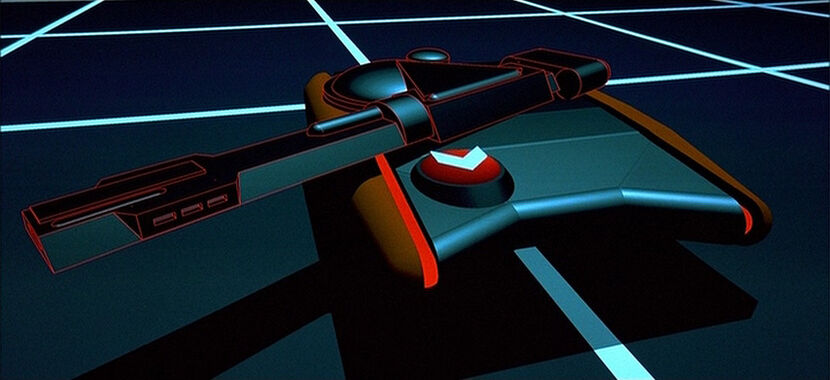
MP: How was the sound for the Tank was created?

FS: The Tank, again, was my Prophet-5 and I just basically performed them like I did the Lightcycles. I came up with a really cool, buzzy electronicy, "tanky" effect and then I created a bunch of them because every tank had to have a different sound. I had to go through and create different sounding tanks every time they started up so it didn't sound like a clone. It was a lot of design work on a lot of those tanks. As they lit up and everything, that was a special effect that I created using Minimoog stuff, you know, like a flash element like a pink noise flash through a flanger. 

[Tank]
[read more: tron.wikia.com]

Saturday, February 06, 2010

Ann Kroeber | Sound Mountain

If you don’t know Ann Kroeber’s name, you certainly have heard her work. In 1999 she formed a company called Sound Mountain and has recorded and or provided sound effects for such films as The Star Wars Trilogy, The Lord of the Rings: The Return of The King, Pirates of the Caribbean, The Lion, The Witch and The Wardrobe, Gladiator, The English Patient, The Horse Whisperer, A Bug’s Life, K-19, Polar Express, The Village, Hidalgo etc. and many games.
Although she is often called upon to supply sounds from her huge collection of animal noises/vocalizations, she is also renowned for her unusual recordings of sounds from everyday life, many recorded with a FRAP (Frequency Response Audio Pickup) contact microphone custom-made many years ago by an English audio guru named Arnie Lazarus. In fact the Hollywood Edge FX library (@Hollywood_Edge) even put out a disc of her FRAP recordings--Common Sounds Heard in Uncommon Ways--as part of a three-CD set called Sounds of a Different Realm. The other two of the discs are dominated by the work of her late husband, Oscar-winning FX designer/editor Alan Splet, who did groundbreaking work with Carroll Ballard, David Lynch, and other directors before his untimely passing in 1995.
His incredible archive of effects recordings was passed down to Ann, who had been an integral part of his recording life since they met while working on The Black Stallion (which won an Academy Award for Sound Fx Editing), where she was an effects recordist. Kroeber quickly established herself as a masterful sound editor, as well, on such films as The Elephant Man, Dune, Never Cry Wolf, The Unbearable Lightness of Being, The Mosquito Coast, and Dead Poets Society. She was also the production mixer on Blue Velvet and sound designer on Carroll Ballard’s Duma at the Saul Zaentz Film Center in Berkeley.
The Saul Zaentz Film Center, along with American Zoetrope and Lucasfilm, it was one of only three major film production facilities in Northern California. By 2005, it has largely shut down its post-production facilities, except for the foley recording studio, which is part of the still-active Fantasy Recording Studios. The film center was sold in 2007 and, after renovations, became the Zaentz Media Center.
[colemanfilm.com]
[en.wikipedia.org]

[Ann Kroeber @ Linkedin]

"Discovery of Sound Mountain is like finding a new star cluster within the Star Wars Universe. Ann offered unique original audio from which I designed many new and fascinating Star Wars aliens and machines."
[Ben Burtt]


Sound Mountain - Reel from Michael Coleman on Vimeo.

"Ann Kroeber has a unique ability to provide one-of-a-kind sound effects. Both as a recordist, and as the knowledgeable gatekeeper of a vast, reknowed library. Ann has given me great sounds that lead to great ideas. When we are searching for something nobody's heard before, Ann can help us find it."
[Gary Rydstrom]

Dont'miss:
[Directors on working with Alan Splet - via musicofsound.co.nz]

Saturday, July 11, 2009

Richard Devine+Josh Kay

Must-watch: exclusive videos included in the sample kit "Richard Devine - The Electronic Music Manuscript" by Sony Creative Software (it won Best Sample Library for the "Seventh Annual Remix Technology Awards" 2009).

In the two segments Richard Devine demonstrates some very interesting techniques on how he and Josh Kay (aka JESWA) captured the sounds for the collection as well as showing off his vast array of equipment.


Part 1:

Part 2:


[read "The Making of the Electronic Manuscript" on Trash Audio]
[sonycreativesoftware.com]
[richard-devine.com]
[@RichardDevine on Twitter]
[devinesound.net]
[devsnd.blogspot.com]

Saturday, February 28, 2009

SONOPEDIA Sound Design Competition Results

Blastwave FX has announced the winning composition of the SONOPEDIA Sound Design Competition (in collaboration with Post Magazine). It was designed by Weston Fonger.
What Academy Award winner Richard King had to say about Weston’s piece:

“[this piece]… gave me the strongest emotional reaction … It’s clear the sound designer was striving to tell a story – certainly an abstract one which the listener can interpret in any number of ways, but there’s a purposeful development to the sounds. The subtle moments are well done and pleasingly organic, with a very effective use of total silence in one transition, and the louder, denser sections retain their clarity. The sounds chosen stand out for their uniqueness and clarity and the mix is focused. Very good work!”


But this piece by Erik Reimers is what I like the most.
Academy Award winner Randy Thom had this to say about it:


“Designing voices for creatures and robots is probably the most difficult kind of sound design there is. [Bot vs Bee] had a nice narrative arc, it was funny, and I’m guessing the designer had to twist the raw sounds quite a bit to achieve the final result.”


[more here - via blastwavefx.com]
[postmagazine.com]
[Judges]

Thursday, October 23, 2008

Rob Nokes - Sound Seminar Q & A - Part 1&2

Rob Nokes, Owner of Sounddogs.com, Sound Effect Field Recordist, Supervising Sound Editor answers:

What is the job of a sound editor?
In your job what audio is expected of you to deliver?
What happens if you steal sounds?
How do you prove copyright?
In your job what audio is expected of you to deliver?
What bit depth do you record at?
Detail the sound equipment you actually use.
How did you make monster sounds sound real?
What makes a good sound?
Why is it best to record clean?
Is it better to have actors do adr?
Is there another way to avoid adr?
What is 'smoothing' or EQ?
Do you process while you record?


Is it better to have actors do adr?
Is there another way to avoid adr?
What is 'smoothing' or EQ?
Do you process while you record?
What is a series?
How best to record gunshots?
How do you make a sound bigger?
How close to the sound or actor do you record?
Do you change your levels while recording?
How best do you cut background sounds in?
What mic technique would you use to record a room?
How can you control loud sounds?
What is your underwater technique?
How did you create your favourite sound?
Do you record everything?


[via sounddogs]

Tuesday, April 08, 2008

Frank Serafine @ Surround Broadcast Conference

The Fifth Annual Surround Broadcast Conference will be held April 16 from 9:30 a.m. to 5:30 p.m. at the Las Vegas Convention Center.

At the conference, Frank Serafine will present 5.1 On Your Shoulder: Single System EFP Camera Miking For Surround. A sound designer and remote recordist specializing in audio-for-video and post production, Serafine will explore his use of the Holophone H4 SuperMINI mic for a variety of projects. Serafine will demonstrate his setup, play examples of his work, and discuss ongoing projects.

Serafine is owner of Serafine Inc, located in the countryside of Simi Valley, California, just northwest of Los Angeles, from where he and his staff provide comprehensive post-production solutions including original music, sound design, sound editorial and supervision, dialogue editing, ADR, Foley and sound mixing.

[Surround Broadcast Conference 2008]

Tuesday, March 27, 2007

Non Linear Food Vol. 1


Matteo Milani, Lorenzo Brusci and Fonògeno, sound designers and electronic composers, in collaboration with PowerFx, are proud to announce the release of a sound library called NONLINEAR FOOD, elements for new composers.

Three distinct personalities that bring life to an elaborated sound spectrum that is elegant and primed to move beyond the clichés of cinema and television. Sound elements that walk the border between music, ambient sound and abstract acoustical synthesis, where the sound source is in constant mutation and has the ability to carry images to points outside the television and film screen where it seeks a psycho-emotional connection, a new physical world capable of forging new frontiers within multimedia interaction.

In other words, audio and video create an environment of constant interaction and perceptive antagonism in which one works to steal expressiveness from the other, moment to moment, scene by scene. A struggle that molds the spectator, an active participant in this dimension where content and medium are constantly renewed.

You can listen to [this] one minute-demo, it's a short sample of the aestethic and quality of the optimized materials included in the library.

Four gigabytes of custom, absolutely never heard samples and sound effects, are organized in five main directories as follow:

· RHYTHMIC_TOOLS (electronic loops, e-percussions, vivid grooves))

· ELECTRO_SCENARIES (active drones, beat oriented textures)

· HYPER_DRUM_SET (one-shot heavy-processed claps, crashes, fills, kicks, snares)

· SURROUNDSCAPES (5.0 ready-to-go textures)

· DIGI_EVENTS (alarms, buttons, communications, telemetries, transitions)

They have been spending hours composing, editing, mixing and mastering these categories with main platforms like Symbolic Sound Corporation Kyma and Digidesign Pro Tools. The team mastered a thousand of broadcast wave files (.WAV, acidized WAV), 44.1khz/24bit, compatible with all the Digital Audio Workstations and loop applications running on multi-platform operating systems.

This cd is now available for download at PowerFx:
[\Downloadable CDs\Acid/Wav].

nonlinearfood_at_gmail.com