Showing posts with label Lectures. Show all posts

Tuesday, July 01, 2014

From Organs to Organs — KISS2014: Organic Sound

From organs (biological) to organs (musical), this year’s Kyma International Sound Symposium (#KISS2014), to be held in Lübeck Germany on 25-28 September 2014, will explore multiple meanings of the phrase “organic sound” through technical talks, live performances, and hands-on workshops. 


Events will kick off with the unveiling of a major new release of the Kyma software and feature technical/philosophical sessions on topics ranging from voice processing, to sonification of organic chemicals and the Internet, to organic growth and decay, to how to build your own performance controller and use it to control Kyma via OSC, to presentations by individual composer/performers detailing how they utilize Kyma in their live performances and installations. 


Check out the lineup of presenters, composers, performers and Kyma experts here: http://kiss2014.symbolicsound.com/presenters-and-performers 

Discounts are available for students and for anyone registering before 1 August 2014. 

For travel and lodging information, please visit: http://kiss2014.symbolicsound.com/travel-and-lodging 

More information 

Tuesday, November 19, 2013

Gary Rydstrom - Unexpected Sounds

Here's my guest post "Gary Rydstrom’s Talk from VIEW", originally published on Designing Sound


Last year, Skywalker Sound’s Gary Rydstrom, joined for the first time the roster at View Conference – Italy’s leading computer graphics symposium – following Randy Thom in 2011. His feature presentation was called UNEXPECTED SOUNDS. The 19th October 2012, inside the Cavour Hall, at the conference center “Torino Incontra”, professionals and sound lovers coming from different countries, gathered to be part of this unique moment.

Now, we have the opportunity to present here at Designing Sound, the polished session of Gary at VIEW. The recording I made directly from the console to my Zoom H4 has been possible thanks to Maria Elena Gutierrez, director of the Festival. In this one-hour podcast, Gary talks about the art of sound design and illustrates how sound is being used and how it can be better used to tell stories. You’ll listen to many examples of raw sound effects recordings, designed sounds, and mixes from Pixar films, and live-action films such as “T2,” “Jurassic Park” and “War Horse”.

Enjoy… and thanks Gary for your invaluable experience!

Matteo


A special thanks to Shaun Farley and Peter Albrechtsen

Saturday, October 13, 2012

Randy Thom @ VIEW Conference 2011


On Friday, Oct. 28, 2011 VIEW Conference hosted a Master Class with Randy Thom, Director of Sound Design at Skywalker Sound. He is a firm believer that the sooner the sound designer is involved in the pre-production, the better the story can be told. Randy illustrated how sound can shape a film, talking about how doors can be opened to sound. He also shared clips from movies where this kind of early collaboration has happened. Here's an excerpt of his talk during the workshop.

Sound as a full collaborator to make better films 

Alan Splet, Walter Murch and Ben Burtt where the three people who lived within about 20 miles each other near San Francisco who really brought a new revolution into American film sound during 70s. I was lucky enough to work with all three of them and “steal” some of their best ideas. One of the first things that you learn as a sound designer is not think to literally about sound, so one aspect of training your ear is to interpret sound in emotional terms. Subjectivity in filmmaking is a playground for sound: when the audience understand that they don’t figure out consciously, but what they seeing and hearing is being filtered through a character’s or filmmaker’s point of view in a subjective way. Very often working on a sequence for a film what you want to do is think of how you want the sound to make people feel and you analyze what it is about that sound makes you feel certain way and you go looking for sounds or raw material that have those qualities. 


Apocalypse Now

If there was ever a film where sound and image were treated more or less equally and allow to affect each other certainly is Apocalypse now. The first sound that you hear in the film - before any music or any dialogue - is a very odd, electronically synthesized helicopter sound - the Ghost Helicopter. Captain Willard is hearing the memory of the helicopter that he has. What you’re listening to is this guy’s brain. He’s remembering things, he’s hallucinating, he’s dreaming, he’s drunk and under the influence of drugs, he’s listening to his brain operate. The opening sequence is the launching point for all story, immediately the audience is put in a frame of mind that anything can happen, this is going to be a very strange ride. As he stands at the window looking outside he might heard a little fly buzzing: it took me a week to record that fly (laugh). At first he hears - and we hear - the sound of Saigon outside (car horns, Vespas, police whistles). Those sounds morph into the sound of the jungle: each one of those individual city sounds turns into specific jungle sound. Physically for the all sequence he’s still in his hotel room, but in his mind he moves back into the jungle.


Once upon a time in the West 

Sergio Leone decided early on that they will record all the music for this movie before they started shooting the film and they used the music during the shooting to help the actors and essentially to inform how the film is going to be shot. They were struggling how to make music and sound working together before shooting the sequence. Ennio Morricone, the composer, happened to go to a musique concrete concert - a genre involved using real world sounds, rather than traditional musical instruments - by a guy who played a latter, banging and scraping on it. Then he called Leone and said: “There’s should be no conventional music at all in the beginning of the film: instead you perhaps should shoot around the sound effects.” Leone went shooting the sequence thinking about how the sound of this little train station were going to work in the storytelling.

I think that’s a tragedy that very few studios these days will have the guts to allow a filmmaker to do a sequence like that. They say: “People are going to be bored, we have to fill up with uptempo music through the all thing”. Some budget filmmaking these days is “fear based”, it’s not an attempt to do something new, interesting and unusual, to open people imagination. It’s an attempt to avoid boring people, which is never a good motivation in art.

One of the things that these two scenes have in common is a very strong sense of point of view. Camera angle are very important to sound, believe it or not. The kind of shot, where an actor looking at nothing in particular, is another open door for creative, subjective sound, because the audience knows intuitively that they’re going inside the character’s head. It’s an open door for sound designers to put almost any kind of sound that we want. Having some ambiguity or mystery about the visual image makes it easier for me to do something useful with the sound. Extreme close-ups get across the idea of subjectivity. Long duration shot opens the door for sound, too. The character’s closing eyes is also an opportunity for sound to do something interesting (imaging, remembering...). The most difficult kind of shot is a brightly-lit medium shot, because you’re not focusing on anything in particular and there’s no mystery there, there’s nothing that invites the ear to help figure out what’s going on.

Another element they’ve in common is sparse dialogue. I’m certainly not against dialogue in film - dialogue will always has a role. Dialogue and sound design generally don’t go well together, because there’s something about the human voice that the human ear want to attempt to.
If someone is talking - no matter how hard a director ask me to try to push sound effects during that sequence - it will distract you from the dialogue, which the audience is trying to hear. The way to solve that problem is to design the sequence in a way that there are moments for the dialogue and moments for sound effects. A compromised has to be made, you can’t as a filmmaker try to fire all your bullets at the same time, it’s not going to work. One category of sound tends to dominate at a time - it’s dialogue, it’s music or it’s sound effects. Another bad tendency in contemporary filmmaking is to try to set it up so that all three dominates simultaneously, it will never works. Lazy filmmakers will just call the composer: “make some very strange music telling the audience that this is a very strange place”. As a sound designer you try to do things and variations in the same way a music composer, to use sound in pure musical way: tempo, harmony and rhythm to evoke emotion. Think about what elements in a set could generate the sound useful for the storytelling: this will be more powerful at the end, it’s not a decoration, that’s a very organic way of telling the audience “this is a very strange place”.


Sound-friendly scripts

Most writers are obsessed with words, and they tend to think words should dominate every sequence, with wall-to-wall dialogue.
Filmmakers simply don’t think about how to use sound in that way before start shooting the sequence. Think about what the characters hear. Think about how the things they hear affects them and how character changes over time. I often found people who come from visual/light background - which David Lynch did - have very interesting sound ideas. He demands you to be creative all the time.

Another thing I told to directors is: during rehearsal in a live action scene, play with your actors in terms to find things in the space that can make sound that will be useful to the story.
As a sound designer, try to imagine ways that sound could playing in an interesting but organic, truthful way to help the storytelling in the sequence. Try to think to other powerful sounds that the audience doesn’t expect. Part of your job as a sound person - I think - is to help the director make the best film possible. If you have interesting ideas - and you should have them - about the way of film shooting that allow you to do something you couldn’t do otherwise, of course you should talk about it.


Sound for Animation 

Thanks to big aesthetic jumps in animation, more contemporary animation directors want movies should sound like a live-action movie. For “How to Train Your Dragon” I come up very early on with some speculative vocalizations for the dragons that will help the animators to animate to those elements. I tried to use real-world animal sounds - tiger growls, elephant, whales, goats, camel, dogs - to cover a wide range of emotions, allowing sound to influence the animation. The challenge is how to make the transition from one to another, which needs a lot of work and experimentation with pitch-changing techniques.


Sound Mixing 

Mix is about to choose right or most powerful sound in any given moment. In a moment when you need to hear the dialogue you try to artfully lower or eliminate sets of other sounds that are competing with the dialogue at that moment. Space can make sounds useful to the story: there are a lot of others tricks like moving the sound effects and the music into the side loudspeakers and have the voices mostly come out from the center speaker, which make a little bit easier to understand the lines of dialogue. Sound is more powerful if comes from a place we doesn't expect. You need to think of sound in terms of spectrum and frequencies and tailor those for a given moment.


Related Post:

Monday, October 03, 2011

Richard Beggs @ P.A.I.F.F.

From Apocalypse Now to Twixt: Sound Design with Richard Beggs

I have a masters in painting and it remains the motif of my work. I am an audio painter. #

I work thematically I like sounds that are motific. #

I have a very idiosyncratic work style... I like to be involved w/ every aspect of the track as the picture moves forward. #

Very important to be on the set, to absorb the feelings of the whole crew & to be in tune w/ the sensibility of the Director. #

The film exists on 2 levels: the sound that you see and sound that you don't see. #

I am in the biz of manipulating people. Sound can do that. #

Sound can convey emotional complexity without music, just with pure sound. #

When someone wants to work with me, I always asks "Why?" Because it informs what they know about me + what they like. #

On a smaller pictures you're given a lot of latitude, on the other hand limited resources make things challenging. #


courtesy of
paiff.net
twitter.com/PaloAltoIFF
twitter.com/Dolby
facebook.com/PaloAltoInternationalFilmFestival

Related Posts:

Friday, August 26, 2011

Rome Calling – The Audio and Loudness Seminar of 2011

In June 2011, some of the most respected audio authorities – including George Massenburg, Bob Katz, Florian Camerer and Thomas Lund – gathered in Rome, Italy, to share their thoughts and experiences on loudness measurement in connection with recording, mixing, mastering and broadcasting. The speakers at the seminar in Rome included such capacities as Simone Corelli, Alessandro Travaglini, Richard van Everdingen, among the others.
The first day of the seminar focused on post-production, while the second day concentrated on professional broadcasting and particularly the radical changes happening in production and distribution of broadcast, film and music as a consequence of new ITU and EBU standards.
The groundbreaking and comprehensive EBU R128 loudness recommendation was investigated from a multitude of angles, as was the just updated ITU-R BS.1770-2 broadcast standard.
Tc Electronic documented the event and on this page they have gathered some of the footage form the seminar. First up are Florian Camerer and Richard van Everdingen from EBU’s PLOUD Group.
Florian provides a general overview of EBU’s R128 broadcast standard presented with great enthusiasm and a twist of humor. New videos will be available soon!


Friday, September 17, 2010

Field Recording Workshop: "Movement of acoustic images"

October 29th, 30th | Milan @ Live!iXem 2010 - Edition VII
International festival of music, mixed media and experimental electronic art


Aims of laboratory
  • Explore through the knowledge of digital recording techniques the universe sound belonging to the "places";
  • Discuss some aspects of the use of specific material in electronic and instrumental composition.
Localization of sound in the environment focuses on the theme "sound mapping" as a social and cultural identity and, at the same time, an expression of conscience and personal feelings, whereas its use in music opens important interdisciplinary horizons.

The workshop's aim is to provide an introduction to theory and practice of the main mobile sound recording techniques and the use of sound sources in different fields, from sound design to cinema, from digital editing to the use of digital sources in instrumental composition, electronic music and live electronics. Music compositions and musical excerpts from field recordings will also be introduced, listened and discussed. All members are invited to participate in the soundwalk along the neighborhood "Isola" in Milan and thus contribute during the workshop to the creation of a small sound map of the place. The pieces obtained at the end of the workshop will be diffused through a multi-channel audio speakers setup and then available to the public in the form of soundscape composition.


Speakers: Alessandro Massobrio (ITA), Fabio Orsi (ITA), Natasha Barrett (ENG)
Curated by Matteo Milani, Federico Placidi (U.S.O. Project) and Domenico Sciajno


Documents available online

[Live_iXem_2010_Workshop_ITA.pdf]
[Live_iXem_2010_Workshop_ENG.pdf]


Costs and subscription

To participate in the workshop you must register (spaces are limited) no later than 23/10/2010 and pay the fee (€ 60.00).
For more information about the workshop and registration, please write to workshop [at] antitesi [dot] org or visit the Facebook and Twitter page.


Payment methods
  • PayPal
  • Money transfer

Level

All subjects and activities of the workshop/laboratory are addressed at the introductory and preliminary level, combining theory and practice with some helpful audiovisual material. Members are encouraged to get involved actively, having discussion and bringing in their experience. Participants will be guided, if weather conditions permit, in a short sound-geo path through the "Isola" neighborhood in Milan and invited to contribute to the creation of a work of the soundwalk. It does not require any special technical knowledge and/or music. However, the knowledge of digital audio recording/editing basics can be an advantage.


Recipients

The workshop is devoted for those sound designers, musicians, composers, sound engineers and experts who would consolidate and compare their experience in an environment of exchange and sharing, to all the "listening lovers" and those who have interest and curiosity about soundscape and electronic compositions.


Entry requirements

There are no special requirements. The workshop is open to all without any age limit. Entries remain open until all available seats have been booked.


Devices
  • Mac/PC laptop (useful but not essential during the editing and sound processing sessions)
  • owners of a portable recorder are asked to take it for the soundwalk in the neighborhood "Isola"
  • Roland Italy will provide participants two digital recorders - R-09HR and R-05

Location

The workshop will be held at:

O' | residences | photography | sound | performance
non-profit association | via Pastrengo 12, 20159 Milan (Italy)
tel +39 02 6682 3357
website: www.o-artoteca.org

O 'is a non profit organization for the promotion of artistic research, founded in May 2001 by Sara Serighelli and Angelo Colombo as O'artoteca (O' since 2008). Its activity is divided into a large exhibition space, an area of consultation and archive, and an outside lab, L.A.B.-LaboratorioArtibovisa for the production related to photography and printing. It developes exhibition projects and discussions, performances, concerts, lectures, publications; it's a place where artists can experiment, test and compete with their work.

Thursday, June 24, 2010

Does Sound Have Meaning?

Sound Researchers and Practitioners Convene to Discuss 'symbolic sounds' at #KISS10


Can music and sound-effects be symbolic?
Sound designers, composers, sound artists, film makers, researchers and others sharing an intense interest in sound will be convening in Vienna (Austria) from the 24th through 26th of September to discuss this and other, similarly controversial, issues at the annual Kyma International Sound Symposium (#KISS10).
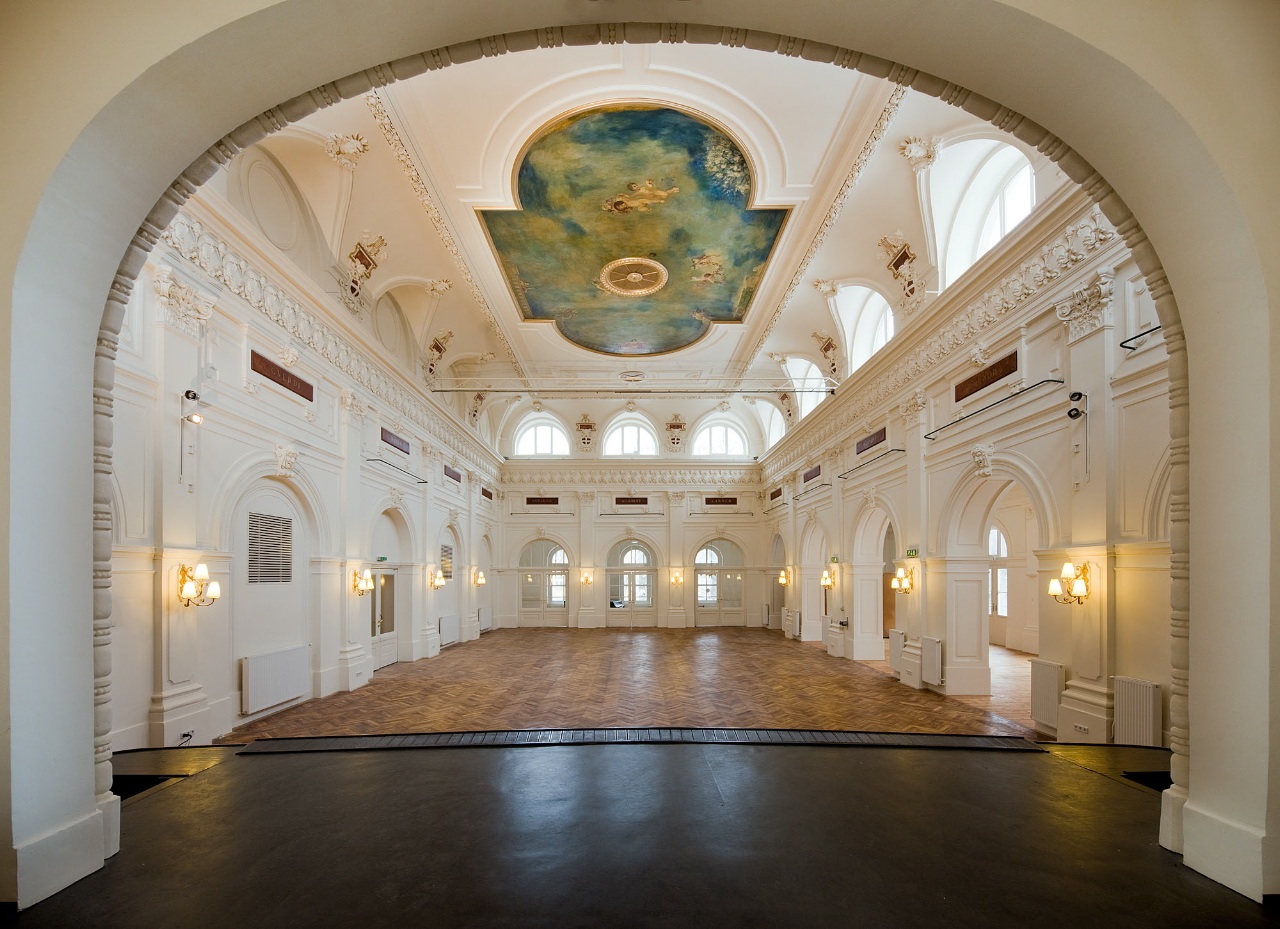
Lively discussions, electronic/computer music performances, interactive installations, demos, workshops, and paper sessions will be held in the newly renovated Casino Baumgarten, a spectacular ballroom built in 1890, and the Rhiz Bar Modern, a showcase for experimental media in Vienna.

[view from the Stage at Casino Baumgarten]

Join in the free on-line discussion
Anyone having an intense interest in sound is invited to join in the free on-line discussion at pphilosophyofsound.ning.com. Sign in and introduce yourself by sharing your earliest sonic memory. Discussions on sound, symbol, and meaning have already begun and will continue during and after the symposium. You can participate on line whether or not you are able to attend the symposium in Vienna.

To register for #KISS10:
The registration deadline for participating in #KISS10 is 13 September 2010. The participation fee of € 90 (€ 40 for students) includes the 3-day symposium, morning/afternoon refreshments, and 2 evening concerts.

Background
The Kyma International Sound Symposium (KISS) is an annual conclave of current and potential Kyma practitioners who come together to learn, to share, to meet, to discuss, and to enjoy a lively exchange of ideas, sounds, and music! Kyma is a sound design environment created by Symbolic Sound Corporation. This year, the KISS symposium is being organized by Wiener Klangwerkstatt in cooperation with Symbolic Sound and with the support of Analog Audio Association Austria, Preiser Records, and the Austrian Federal Ministry of Science and Research.


Conference Contact Information:
Barbara Kopf
KISS 2010 Conference office
Email: office.KISS2010@tonsalon.at
Telephone: +43 (0)650 212 1646
[tonsalon.at/KISS2010]

Monday, May 03, 2010

Lee Unkrich on editing animated film

by Matteo Milani - U.S.O. Project, March 2010

[click the image to visit the TS3 page - via iTunes Movie Trailer]

Lee Unkrich is a longtime member of the creative team at Pixar, where he started in 1994 as a film editor. Unkrich graduated from the University of Southern California School of Cinematic Arts in 1990. Before joining Pixar, Unkrich worked for several years in television as an editor and director.  He came to Pixar on a temporary assignment during the development of Toy Story and he later moved into directing, as co-director of Toy Story 2, Monsters, Inc., and Finding Nemo.  His upcoming work Toy Story 3 will be released on June 18, 2010.

On Monday, Sept. 7, 2009 the 66th Venice Festival hosted a Pixar Animation Master Class on storytelling. Here's an excerpt of the speech by Unkrich during the special panel on animation.

[George Lucas presents the Golden Lion to John Lasseter]

"What is the difference between editing live action and editing animation? During live action you shoot first and then edit together after you shoot. But in animation, we edit first, then create the footage. Or more accurately we edit, before, during and after the film is shot. The best analogy I could come up is that editing an animated film is like building a sand castle. one grain at a time. Thousands of bits to be assembled. We have to focus on innumerable details, frame by frame, moment by moment, as well as keeping an eye on the big picture and how the movie is playing as a whole.
At the end the editor’s responsibility is the same in live action and animation. He manages the narrative structure and flow of the film as well as orchestrates the sound and visuals to create an engaging experience for the audience.
Editing animated film begins with a first tiny piece and that piece is a drawing, a storyboard, that first drawing is followed by a second, a third… one hundred thousands storyboards. The storyboards are edited together in a story reel. It’s a working document, an extension of the writing process, it’s a way how to judge how the film is flowing. A story reel done well provides the audience with a nearly completed experience that its only going to get better when the film is animated.
The editors first task is to sequel all those hundreds of thousands of storyboard together. To give the appropriate timing in the different moments of the film." - Lee Unkrich

[Lee Unkrich editing Toy Story 3 on Avid Media Composer]

[Photo credit: Lee Unkrich - via Twitpic]

"Eventually the real roles of the film will be cast with real actors. The temporary dialogue  (performed by people we work with at Pixar) is then replaced by the performances of real actors. In addition to editing vocal performances we will also edit sound effects and we do this around the scene in a sonic environment and give it more texture and believability. It takes a lot of time to do all the sound work, but I think it is very very important to help to keep the audience wrapped up in a spell like the feel to watch a real film. We also take music from existing movie soundtracks and we’ll edit that music against the scene.
So even if the music in the finished film will be different than what we have put in, the tap music should support the desired pace and emotional tone of what we are going for. The wrong piece of tap music can ruin hundreds of hours of meticulous editing, but the writing of music can elevate even the simplest crudest story reel to poetry. When all combined together with dialogue and sound effects hopefully we'll have a good sense of how the scene is playing. If all goes well the scene will end up in a finished film." - Lee Unkrich
 
[Lee Unkrich @ Abbey Road Studios]

[Scoring with Randy Newman and the Toy Story 3 Orchestra]

"Animation is actually combination. Is the voice actor plus the animator. They create the character. In early exploration in animation we sometimes take lines of dialogue from movies with actors we are interested in. The choice of the actor really does affect the personality of the character. So in the voice casting is so important to get an actor who can be, first of all we always get actors that are themselves. Not care how big the star they are , the important thing is how good an actor they are to get the action.
The other thing we look for is improvisation, we want the actor to make the part their own. There is no better improvisation actor than Tom Hanks. In animation a very little detail is worked out and thought trough in advance so the thing you don’t often get is spontaneity. So the place where we can get spontaneity is the recording session." - John Lasseter

"I’d like to drill in a little more detail into one aspect of cutting which is particularly close to me and that’s dialogue editing. It is a vital part of editing especially in animated film, but in the end it is usually completely transparent to the audience. The vocal performances are reported for over several years and the actors are very rarely in recording studios together. That’s why the editor has got to all these different performances and edit them together to create the illusion of spontaneity and real action." - Lee Unkrich

[Lee Unkrich and Tom Hanks at Woody sessions on TS3]

"Many of the lines are the price of many little pieces of several different takes. Some of them recorder at multiple recording sessions. One of the luxuries in editing for animation is that we have a degree of control over how to shape the actor’s performances that is really nearly impossible in live action. So for a single performance can comply with different multiple takes from months apart.
It is like I am cooking, I am trading the finest and freshest ingredients from all the performances of the actors and reducing them to a richest demi-glace. How does an editor know which pieces are the best pieces? Well, in the end the most important tool in the editor’s arsenal is his or her intuition. There is no better game than if the film feels right. It is not as easy to explain your intuition or defend it to anyone but a great editor a film maker in general needs to listen to their intuition and learn to trust their intuition. Editing is not about deciding when to cut but often when not to cut. Sometimes the most powerful moments come from the editor just sitting back and allowing to see it to play." - Lee Unkrich

[Tom Myers on mixing TS3 at Skywalker Sound]

At ShoWest 2010, Dolby announced it is working with Walt Disney Pictures and Pixar Animation Studios to deliver a new audio format, Dolby Surround 7.1. Disney and Pixar have stated that Dolby Surround 7.1 will be launched in select theatres with the release of Toy Story 3 in 3D this June.

Dolby Surround 7.1 provides content creators four surround zones to better orchestrate audio channels in a movie theatre environment. The four surround zones incorporate the traditional Left Surround and Right Surround with new Back Surround Left and Back Surround Right zones. The addition of the two Back Surround zones enhances directionality in panning 360 degrees around the theatre.  Dolby Surround 7.1 format comprises 8 channels of audio and has the following channel layout: Left, Center, Right, Low-Frequency Effects (LFE), Left Surround, Right Surround, Back Surround Left (new), and Back Surround Right (new).


[Visiting Pixar: Inside the Studio - via The Pixar Blog]
[follow @upcomingpixar, @pixartalk, @DisneyPixar on Twitter]

All material used on these pages is copyrighted by its respective copyright holder. Disney/Pixar images are ©Disney/Pixar.

Saturday, January 30, 2010

2nd Kyma International Sound Symposium: Vienna, Austria

@Symbolic Sound and Wiener Klangwerkstatt invite you to share your ideas, experiences and results with fellow practitioners at the Kyma International Sound Symposium (KISS), an annual conclave of current and potential Kyma practitioners who come together to learn, to share, to meet, to discuss, and to enjoy a lively exchange of ideas, sounds, and music.

[This year's theme]
[How to submit]

#KISS10 is scheduled for 24-26 September 2010 in the newly renovated Casino Baumgarten, a spectacular ballroom from 1890, which - due to its excellent acoustics became one of the main recording studios in Vienna in the 1960s and 70s.

[Casino Baumgarten]

Cost: € 90, students € 40
Deadline for submission of proposals: April 11th, 2010
Organizers: Wiener Klangwerkstatt in cooperation with Symbolic Sound, supported by Analog Audio Association Austria (AAAA), Preiser Records and Stadt Wien

[Full details - via tonsalon.at]

Sunday, October 11, 2009

Focus on Kyma International Sound Symposium - KISS09

These have been busy days here at NIU, especially for the speakers who showed to all the symposiast each method of working with Kyma.
A lot of participants came from different sides of the world, it was great to be immersed in this colourful community! Carla Scaletti and Kurt Hebel (the creators of Kyma) introduced their new hardware Paca(rana) - you can find a lot of information here @ SSC - and the latest features implemented in Kyma X.70 (where 'X' stands for the last letter in 'six' - 6.70).


Carla and Kurt did a wonderful job to develop a state-of-the-art "recombinant" workstation, which gives any user the freedom to explore unknown sonic territories without hitting the DSPs (there's plenty of headroom in processing power).
During the morning of the first day, Carla showed us how to control Kyma with external devices like the Wacom Tablet and the Continuum Fingerboard, then with Nintendo Wiimote+Nunchuck and SpaceNavigator (via OSCulator by Camille Troillard).
The AC Toolbox presentation by Hector Bravo-Benard, revealed to us an algorithmic approach to sound composition with Kyma. By using the LISP language, it is possible to structure an entire composition and have Kyma play it. It is possible to make use of strict algorithmic procedures like probability distributions, Markov chains, tendency masks, and many other techniques used by composers of the likes of Paul Berg, Gottfried Michael Koenig.
A special mention should be made for Bruno Liberda's lecture, where he explores subtle connections between his wonderful graphical scores and different kinds of ancient neumatic notation, making symbolic notation and symbolic sound computation converge.
Cristian Vogel explained his latest creation called Black Swan for swiss choreographer Gilles Jobin. The 50 minutes original Kyma score was composed in Geneva and at the electroacoustic studio of the Musique Inventives d'Annecy. Here's a Swiss TV documentary about the creation of Black Swan.

What is Kyma?

Kyma is a sound design language that permits to manipulate, transform and warp any kind of sound source in realtime, but we already know all of this.
During these days in Barcelona - at the first Kyma International Sound Symposium - we have learnt something more specific and, maybe, unexpected.
As Carla Scaletti said during the opening lecture of KISS09, "Recombinance Makes Us Human". So, what does this mean? Actually each of the participants brought their own experience, point of view, modus operandi and creative talent to the symposium. This multiform epiphany allowed everyone involved to share the same time and space for 2 days, exchanging their ideas like sharing bits of code in a recombinant manner.
The symposiasts all came from different fields where Kyma plays a fundamental role in each of their activities (sound designers, composers, DJs, etc.). Each of them knows and likes different specific aspects of Kyma.

The lectures performed during these 2 days taught us something: regardless of their own personal skills, and of their own degree of Kyma knowledge, observing things from other users' point of view reveals unexpected surprises and creates new connections, on a mental and operational level, which were never considered before.
Even sounds commonly used in our everyday activity, if put in a different context (artistically or technologically), appear to us as new and unexpected, bringing back to our memory John Cage's famous concept: "(You have) to look at a Coca-Cola bottle without the feeling that you've ever seen one before, as though you were looking at it for the very first time. That's what I'd like to find with sounds -- to play them and hear them as if you've never heard them before."

The musical performances have contributed themselves to recombine new pieces of code, bearing different morphologies, sintax and structures.
With her liveset "SlipStick for Continuum and Kyma", Carla Scaletti explores the sound phase-space, in order to find new timber paths moving from materic aggregation to resonant chimes and back, without forgoing a "virtuoso gestuality" given by the nature of the instrument itself.
We have experienced the possibility of creating vibrating soundtracks for silent movies in real time, thanks to the contribution of Franz Danksagmüller's work, with the help of Berit Barfred Jensen's voice.
Concrete sounds produced by the friction of a Cello bow on different-shaped polystyrene objects, saturate the listening space thanks to the work of Hector Bravo-Benard, reminding us of some textures of Xenakis' work "La legende d'Eer".
Marin Vrbica's "Tiger in the Jungle" immerses us into an exotic and rich spatial dimension made of revolving sound-surfaces and sliding glissando-like multiple trajectories.

In the end, we are surprised that the paradigma presented in the beginning by Carla Scaletti (Recombinance Makes Us Human), has actually acted as an invisible force guiding, transforming, rearranging our thoughts, knowledge and purposes.
So, after the symposium we observe ourselves in a different way. We have changed into new intellectual human beings, and this gave everyone of us a fresh new start, in order to discover new possible configurations and interactions between ourselves and the others, between what we are and what we will be until #KISS10.

We really enjoyed our first attempt to follow a live event via Twitter, we hope you appreciated our efforts to make you feel like you were in Barcellona with us, as part of the symposium.
You can track all of our tweets via search.twitter.com.

Here's a selection of related tweets of interests:
  • Now live #KISS09: Carla Scaletti - "Recombinance Makes Us Human" - Philosophy of Kyma #
  • a Question: Infinity makes us HUMANS? #
  • Infinity+ self-awareness of finitude #
  • Open-ended possibilities= open-ended amount of time, but the learning is fun! #
  • Kyma sounds are recombinant...like us..! #
  • Pen Morph Gandalf to Saruman "You are tracking the footsteps of two young Hobbits" #
  • Writing in time and space..... #
  • I became operational ath the C.E.R.L. lab in Urbana, Illinois on the 12th of November, 1986. -- Kyma #
  • Kyma was inspired by three ideas: cutting & splicing audio tape, voltage control, symbolic logic & computer programming #
  • An interview with Carla Scaletti @symbolicsound usoproject.com/C... #
  • and now...linear interpolation of presets - smooth transition in the phase space... #
  • music is something like a side effect of explorating timbre and sound configurations... #
  • Presets as aural Keyframes #
  • ...the problem of finding graphic symbols for the transposition of the composer's thought into sound." Edgard Varèse #
  • ...without friction [...] there would be no music!"- Carla Scaletti #
For anyone interested in the Kyma sound design language, the book "Kyma X Revealed" is available here @ SSC. This document gives you an overview of the environment, gives you a strategy for approaching this deep system one layer at a time and then walks you step-by-step through each level of Kyma like your own personal tour guide. At the back of this guide, you’ll find several summaries and quick references that you can keep handy for refreshing your memory while working. This book covers the mechanics of how to use Kyma — not the art and science of sound design. However, if you love sound and are hungry for more knowledge on the subject, achieving fluency with Kyma is an excellent first step!


A great thanks to Cristian Vogel (Station 55 Productions) and Symbolic Sound Corporation for their greeting and organization.

UPDATE: Slides from Recombinance Makes Us Human (.pdf), the welcoming address for the First International Kyma Symposium in Barcelona, October 2009.

Tuesday, August 04, 2009

Randy Thom, keynote speaker at Siggraph

Randy Thom, the brilliant sound effects designer from Skywalker Sound, offered the first keynote of the conference. A protégé of Walter Murch, who “went to school” on Apocalypse Now and earned Oscars for The Right Stuff and The Incredibles, Thom offered an enlightening discussion on “Designing a Movie for Sound.” In fact, he used the openings of both Apocalypse Now and WALL•E to illustrate two innovative approaches. Early collaboration is essential in achieving a cinematic result and so is experimenting with how the visual and the sonic can work together. On Apocalypse Now, when director Francis Ford Coppola made Willard (Martin Sheen) a passive observer, he opened up the possibility for experimentation with sound. Thom even crucially suggested that animation is currently utilizing the best strategy for successful integration of sound design more than live-action. Early collaboration with the director is offering inspiration to animators for finding the right balance between visuals and sound, and the most appropriate combination of dialogue, music and sound effects. The latter, he said, was key.

[via events.animationblogspot.com]


Thom delivers sound ideas at Siggraph

"One emerging difference that's very important ... is the directors of animation more and more often are asking me and other sound designers to get involved very, very early in the process, and do speculative sounds to help animators get inspired."

"This idea that sound is something you do at the end of the process -- that it's sort of a decoration you apply at the end of the movie -- is false. I think it's bound to make a better movie if you start thinking about sound and start experimenting with sound as soon as you start the project."

He urged the assembled graphics designers and animators to remember, "When you're writing the story, think about what your characters might hear that could tell the audience something about who the characters are. Create moments to feature those sounds."

He also warned that if the characters are always talking, "neither they nor the audience will get a chance to hear the objects, places and events that will make your film more cinematic."

[read the full article - via variety.com]
[Twitter realtime results for Randy Thom during #siggraph]

UPDATE:
The following video podcast is up now on ACMSIGGRAPH's Channel:


A message from Randy via Sound Article List:

"My SIGGRAPH presentation went very well. There were more than 3000 people in the audience. Gulp! My long time co-supervisor and in-his-spare-time theater sound design and calibration specialist Dennis Leonard worked with the team in New Orleans to create an amazing sounding 5.1 system for a room that large."

"The audience was mostly computer graphics and animation professionals, but included lots of students interested in those areas too. They were very receptive to the ideas I presented about treating sound as a full collaborator, getting sound experiments started as early on a project as possible, and integrating visual and sonic experiments from the very beginning of the project. I had done video interviews with Francis Coppola and Walter Murch talking about the sound on Apocalypse Now; and Andrew Stanton and Ben Burtt talking about Wall-E, and I used excerpts from those interviews in the presentation."

"I made the point that one emerging difference between sound for animation and sound for live action is that animation directors are increasingly interested in getting sound involved early, whereas nearly all live action filmmakers are stuck in this dumb old notion that sound is a decoration you apply to a film just before it's released."

"Basically the presentation was about integrating visual experimentation and sonic experimentation as soon as either of them starts. That's literally what happened on Wall-E. Ben Burtt started doing sound experiments at the same time the animators started imagining what the robots in the movie would look like. Walter didn't start playing with sound quite that early on Apocalypse Now, but he did start while they were still in principal photography."

"I also talked about the sound design opportunities on Apocalypse increasing exponentially when Coppola re-wrote John Milius' original script. Milius wrote the Willard character as more active, aggressive. Coppola decided he should be more passive, like a lens through which we experience the war... basically an observer. That turned the movie into a playground for sound design, because an observer is also a listener. So, even though Coppola may not have anticipated that outcome exactly in terms of sound, he opened the door nonetheless."

[Randy Thom - Scene Unseen Interview]

Monday, March 02, 2009

Brian Eno: a painter in sound

Brian Eno as composer and visual artist. Brian Eno as arts experimenter with his "all-round" vision, the interdisciplinarity, the meeting and integration between different arts. Brian Eno as a thinker of the future. The example being his involvement in the Foundation of the Long Present, an cultural institution born to promote and spread long-term thinking "slower/better", while facing today's mentality of "faster/cheaper".
An artist who has always observed the world with his installations, and represent it with his meticoulous orchestration of lights and sound layers intertwined to create an unique experience, to become integral part of a place, a space. "Mind places that you can immerse yourself in".

The following talk was given by Brian Eno at the inauguration of the 258° Academic Year of the Accademia di Belle Arti (Venice).


Brian Eno on education and politics


Many years ago, during the time of Margaret Thatcher - who is our version of Silvio Berlusconi - the government kept reducing the money for the art schools, because they thought: "Artists aren't important, science, technology and defense, those are important." What they were really doing is saying: "We stop thinking about the future." And they kept cutting money for the art schools. What that story really means is that the governments don't take us seriously, they don't understand what the use of art is, what the purpose, what the function is.
It's true, but I think however that the real justification is of a different nature and has to do with imagination. There's one thing that distinguishes humans from all of the other creatures on the planet and as far as we know is unique to human beings in the all universe. That is our ability to imagine. What makes humans different from everything else that we know is that we can imagine a future that doesn't yet exist. So we can constantly make new realities in our minds. And then we can live in those realities, we can experience them. We call that a "gift of imagination". When a society loses its respect for this gift, that society has stopped developing, stop progressing. Whenever you see a government doing this, you see the beginning of the end of society. The active imagination is the thing that makes us human and makes us capable of thinking of a better future, thinking of the world in a new different way.

So I helped to make the study of the value of art schools. Of course people who come out of art schools don't only become painters or sculptors, they became graphic designers, textile designers, product designers, industrial designers. They became teachers, musicians - very often the case in England. There are all sort of people that come out of art schools. And I calculated that, as system of education, the art school is probably more efficient then any other in terms of creating income in a country. In economic terms, you can justify the existence of institutions like the Accademia di Belle Arti di Venezia.
What it requires is for you to stop trying to convince the population and the government in particular of why this is important. You can't just say: "Well, Venice has always been a wonderful place where the arts were developed. You have to do it in term of the future. You have to say: "For the future of our imagination to be secured, we need to support places like this. This is not only a 258 years tradition, it's actually a hope for how we can think in the future. You have to present that argument, a government isn't going to present it, nobody else would do it.


Brian Eno on his hybrid areas


I started my life as a painter. Like most english people who studied painting, fine arts and art history, I joined a band (Roxy Music). This is what english art schools really exist for, to create pop musicians (laugh), but that's a secret, most people who work in the art schools don't know(!). I didn't leave the experience of painting, which was probably always my biggest inspiration, I was more interested in painting, I suppose, than music. Gradually, I started making a kind of music that was more and more like painting. I made a very still kind of music, which I imagined being experienced in a way you experience painting. Then, in the late seventies, I started experimenting with video and light and I used that technology to make a very still kind of video, a kind of video more like music than like pictures. I have a chance to say thank you to Gabriella Cardazzo, who gave me my first serious exhibition of that work here in Venice. So I have a long history with Venice, I had several shows of that work here. What I ended up doing was working in a some kind of new medium which is halfway between music and picture making.
I continue to do that to this day. I teach sometimes in London at the Royal College of Art. There was one little department called the department of 'Illustration'. When computers appeared, they went into this department. Suddenly it started getting bigger and bigger. And then was called the department of 'Communication' and actually now has hundreds and hundreds of students, it's by far the biggest dept. in Royal College. The reason it is so big is because anyone who's doing anything that doesn't fall into the category of painting, sculpture, art history or industrial design, ends up in this department. It keeps growing. Communications is really just a word to cover everything else. And everything else is what I teach now. Everything else is what I do, really. One of the things you have to be careful about when you are trying to set up a course, is not to make boundaries that are too strict, because if you do, somebody else will just set up another course and will call it something like the department of Communication and you'll lose your best students.


Brian Eno on art and technology


I work, in one of my lives, as a record producer. That means I work with some of the best musicians alive, who are people like oil painters, people who know how to use quite traditional instruments: guitars, drums, bass guitars, violins and so on. I work in the same room with some of the most sophisticated computers in existence. I'm very aware of the possibilities of each of them.
The musicians can't replace the computers, the computers can't replace the musicians. They do different jobs. The two things will coexist quite happily. One of the things that's very interesting, over the last 35 years I've been working in recording studios, is the expansion of possibilities with computers and recording technology. I would say they double every year. So every year there's twice as many things that you can do with technology. There's an interesting effect of this, which is having many possibilities available to you. Imagine if you have a guitar with not just one switch that gives you three positions - which is what most electric guitars do, but a thousand switches, each of which gave you a thousand positions. You will spend most of your time on that guitar not playing the guitar, but exploring the switches. This is what often happens with technology, people spend very long time just trying to learn what is available to them and not very much time learning what they can do with it. So people have traditional instruments with a very limited set of physical possibilities, which means that they spend a lot more of their time exploring emotional possibilities.
Given billions of options, where do I start with computers? There's too much to do. One of the things I found I'm doing when I work with bands, is that I'm a lot of the time trying to cut away possibilities to say: "We won't do any of this, we won't do any of that." Now, what's left? I'm trying to make small enough space for people to be able to makes proper decisions in.
Options mean the number of choices you have available to you. It's very difficult to have a relationship with an absolutely unlimited set of possibilities. It would be like having a friend who behaves like an entirely different person each time you meet him. With limited instruments you can understand their restrictions and develop your relationship with them. The reason we still listen to people who play those instruments is that we respect their relationship and we gain something from it. This is the same with traditional visual art tools.


Brian Eno on 20th century

I was thinking about recording. Music had a huge breakthrough in the 20th century, the invention of the recording studio, which was as big as the 18th century breakthrough: the invention of the orchestra. It made an entirely new art form, just as the invention of film made a new art form. Before, there was theatre and the people started taking pictures of the theatre. But very quickly people realized that you can do original things with film: to change time quickly, to change scale, to have different points of view, all the things that we now accept as part of movies. Now movies are an art form and theatre is another art form. Of course they crossover with one another. Some of the skills that an actor needs are common to both of those jobs.
In music we still pretend to have the same name for people sitting in a hall playing instruments. It is the same as what happened in the recording studios, isn't it? We've got an entirely new art form called recording. There's always new art forms being involved, they continue with the old ones and very often they start as a little modification of the old form. With music we haven't made the jump yet, we shouldn't call this music anymore, we should give it another name, we should accept that is requires different skills, different people, different ways of listening, different understandings. So I don't think anything ever gets lost, good ideas never go away, new ones just keep getting added. New things just come along. In the 'digital' world, we are in a kind of tropical situation in terms of ideas. In the tropics new lifeforms constantly come into being: some of them are successful and take a huge expansion on the Earth, others exist for a short time and turn in something else. With art, new possibilities always come up, some of them will turn into a very big important future, some always remain as little niches (I think video-art may be one of those, to be provocative).

Related Post: Brian Eno at the opening of the 258° academic year of the Accademia di Belle Arti

[italian adaptation - via Digicult]

Sunday, February 15, 2009

Brian Eno at the opening of the 258° academic year of the Accademia di Belle Arti (Venice)

Accademia di Belle Arti - Venezia: Year 258

On Monday 16th February at 11 am, the inauguration of the Academic Year of the oldest institution of high culture operating in the city will take place. It was born in 1750 from the will of the Serenissima Republic, while the University was rooted in Padua.
The ceremony will take place in the auditorium of San Servolo where the Academy has transferred, for lack of space in the headquarters of the (Former Hospital of) Incurabili, part of its teachings, in particular the subjects of the New Technologies in Art.
It is precisely for this reason that to hold the opening "lectio magistralis", was invited Brian Eno, self defined musician-not-musician, with a degree in Fine Arts in England taken in 1969. Devoting himself to music, Eno invented in the mid-70s, the "ambient music", this way theorizing a new way to make and enjoy music, while collaborating with, among others, U2, David Bowie, Talking Heads, John Cale, Laurie Anderson.
Poli-instrumentalist, sculptor, painter but especially a video experimenter combining images and sound, Eno creates alternative environments in which the audience can immerse themselves completely.
By visiting the laboratories of the multimedia laboratories of the Academy of Fine Arts of San Servolo, the audience will have access to a "sound environment" that evokes the process of demolition of reality theorized and applied by Eno.
A preview of "Imaginary Landscapes, a film on Brian Eno", the work that Duncand Ward and Gabriella Cardazzo have dedicated to him in 1989, has been presented in its entirety on Thursday February 12th, with the introduction by Gabriella Cardazzo in the headquarters of the Incurabili, along with Eno's video "Mistaken memories of mediaeval Manhattan" (1980-81).


[Brian Eno on his exhibition, Constellations | 77 Million Paintings]

[coming next: "77 Million Paintings" manifests itself as "PRESENTISM: Time And Space In The Long Now" at Palazzo Ruspoli in Rome | 20th February to 10th March]

UPDATE:

Brian Eno said the sort of Future proposed by Marinetti has had its day. "The kind of modernism the Futurists endorsed was sort of: smash the past, build the future and it's going to be rough."

"It very much fitted with ideas that were going around at that time in the century, and of course it had this very progressivist idea which then infected and was infected by what was going on in the rest of culture: the idea that we had to rebuild the world from scratch."

Eno's installation, in an ancient palace on Via del Corso, is at the polar extreme from the noisy, hyper-active, self-assertive art of the Futurists. "People enter a darkish room which has music coming from many different sources," he said.

"There are several large plasma screens on the wall and those form a continually changing, slowly moving painting; basically, a very complicated, extremely rich, coloured abstract picture. The important part about the motion on the screens is that it's very, very slow. It flies in the face of the Hollywood idea that people need more and more stimulation, that they have increasingly short attention spans.

"I'm absolutely convinced that that's the diametrical opposite of what's true... People who come to the shows say, 'I wish there was one of these in the city all the time.' And it makes me realise that there are things that people traditionally do – like go to church or sit in parks or daydream – which have become harder to do...

"So when people find a place where they can do that, they are pretty excited."

[via independent.co.uk]

Information:
[accademiavenezia.it]
[artspace.it]
[fondazionememmo.com]

Sunday, January 04, 2009

Curtis Roads: Microsound (Lecture)

Curtis Roads teaches and pursues research in the interdisciplinary territory spanning music and technology. He is currently Professor of Media Arts and Technology + Music, University of California Santa Barbara.

This lecture presents an overview of several projects pursued over the past five years in laboratories at UC, Santa Barbara. All this research is based on a scientific model of sound initially proposed by Dennis Gabor (1946), and soon afterward extended to music by Iannis Xenakis (1960). Granular analysis (also called atomic decomposition) and granular synthesis has evolved over more than five decades from a paper theory into a broad range of applied techniques. Specific to the granular model is its focus on the microsonic time scale (typically 1 to 100 ms). Granular methods treat sound as a stream of acoustic particles in both the time domain and the time- frequency (TF) domain.

SCI-Arc
960 East 3rd Street
Los Angeles, CA, 90013 USA
7 PM - February 11th, 2009

[via architectureweek.com]

Tuesday, November 11, 2008

De Musica 2008: the creativity factory

DE MUSICA 2008, the week-long workshop by Nuova Consonanza will be conducted by Alvise Vidolin. He is one of the protagonists of experimentation in electronics and he collaborated with the most important composers of the 20th century. A pioneer of computer music, he is a sound director and interpreter of Live Electronics.

The workshop is focused on the elaboration of sound in real time and the use of computer for contemporary music, through the analysis of electroacoustic works by composers Vidolin has worked with. He will also explore the most updated systems of elaboration in real time and their application in multimedia field.

Lessons will be subdivided into three sections:
theory
listening and analysis
experimental workshop and practice

Theoretical lessons will develop the following subjects: process of live elaboration of voices and instruments; sound spatialization; techniques of live interaction and performance practice; system design for live electronics; performance environment design.
Analysis of live-electronics works by Giorgio Battistelli, Adriano Guarnieri, Luigi Nono and Salvatore Sciarrino will be carried out for solo, ensemble or musical theatre.
The workshop will take place in Max/MSP environment and will include the analysis and rehearsal of the pieces for the final concert.

[read more - via nuovaconsonanza.it]

Monday, October 20, 2008

Sound Design, new forms of creative communications.

Master Multimedia Workshop: Sound Design, nuove forme di comunicazione creativa.
26 ottobre 2008, ore 14.00-16.00, Festival della Creatività, Fortezza da Basso, Firenze
.

Master Multimedia Workshop: Sound Design, new forms of creative communications.
26th October 2008, 2-4 pm, Festival of Creativity, Fortezza da Basso, Florence 
.


Ospiti/Guests

Enrico Ascoli, Torino, [www.enricoascoli.com]

Valerio Murat, Roma, [www.myspace.com/maisondesplaisirs]

Matteo Milani - Federico Placidi, U.S.O. Project, Milano, [www.usoproject.com]

Davide Rocchesso, Università IUAV, Venezia, [www.iuav.it/Ricerca1/Dipartimen/dADI/Docenti/Rocchesso-/]

Nicola Torpei, Media Integration and Communication Centre, Firenze, [www.micc.unifi.it]

Moderato da/Moderated by: Sara Lenzi e Gianpaolo D'Amico, sounDesign.

Organizzato da/Organized by: Master in Multimedia Content Design, Università degli Studi di Firenze [www.mastermultimedia.unifi.it] - sounDesign [www.soundesign.info].

Saturday, May 03, 2008

The Logic of Listening: Pierre Schaeffer and the Acousmatic Reduction

Date & Time:

Fri May 9th 2008, 3:15 pm - 5:15 pm

World-making and World Art May 9-10, 10am-5pm, Berkeley Art Museum Theater, free admission Sponsored by the Arts Research Center. http://www.bampfa.berkeley.edu/bca/events.html#9

This conference explores practices of visual and aural culture in painting, photography, film, architecture, performance, music, and new media as world-making—how they create human worlds of sensation, knowledge, and action. The traditions addressed range from 19th-century Europe and 20th-century America to the medieval Islamic world, the transnational Caribbean, and contemporary India. Speakers aim to confront theories of world-making with the diversity of world art traditions. It seems obvious that art makes many different worlds. How do they interrelate and change? Are interpre- tations limited to individual cultures, or do they offer resources for comparisons among traditions? What world is involved in “world art”?