Showing posts with label Live Electronics. Show all posts

Tuesday, July 01, 2014

From Organs to Organs — KISS2014: Organic Sound

From organs (biological) to organs (musical), this year’s Kyma International Sound Symposium (#KISS2014), to be held in Lübeck Germany on 25-28 September 2014, will explore multiple meanings of the phrase “organic sound” through technical talks, live performances, and hands-on workshops. 


Events will kick off with the unveiling of a major new release of the Kyma software and feature technical/philosophical sessions on topics ranging from voice processing, to sonification of organic chemicals and the Internet, to organic growth and decay, to how to build your own performance controller and use it to control Kyma via OSC, to presentations by individual composer/performers detailing how they utilize Kyma in their live performances and installations. 


Check out the lineup of presenters, composers, performers and Kyma experts here: http://kiss2014.symbolicsound.com/presenters-and-performers 

Discounts are available for students and for anyone registering before 1 August 2014. 

For travel and lodging information, please visit: http://kiss2014.symbolicsound.com/travel-and-lodging 

More information 

Thursday, November 01, 2012

Sonic Screens 2012 - full lineup


Electroacoustic music concert 
an event by U.S.O. Project (Matteo Milani, Federico Placidi) in collaboration with O’ and Die Schachtel 

Premieres: 
Agostino Di Scipio
"Two Sound Pieces with Repertoire String Music"
for any number of bowed string instruments and live electronics


Andrea Valle
"Dispacci dal fronte interno"
for Violin, Cello, spatialized electronics and printers


Federico Placidi
"TimeCapsule"
for Violin, Cello and live electronics


Performed by: 
Èdua Amarilla Zádory - Violin
Ana Topalovic - Violoncello

Sound Direction: 
Matteo Milani

Live Sets: 
Thoranna Bjornsdottir aka Trouble
Massimiliano Viel

O’ | via pastrengo 12 Milan | Italy
Saturday, December 1st - from 8:00 to 22:30 p.m. 

Door 5 euro

Monday, September 17, 2012

Mirror_Mirror | Sound Installation


Concept and software design by Federico Placidi
Hardware design by Matteo Milani
Woodworker: Fabio Testa
Produced by U.S.O.Project, 2012


Where: [.BOX] Videoart project space, Via Federico Confalonieri 11, Milan
When: Thursday, September 27, 2012 | 6:30 until 21:30 PM
Free admission

The concept of multiverse was first introduced in the so-called “many-worlds interpretation” (MWI) of quantum mechanics by Hugh Everett III in his PHD thesis, "The Theory of the Universal Wavefunction". His model was thought as an alternative to the renowned theory called “Copenaghen interpretation”, developed by Niels Bohr and Werner Heisenberg.

The MWI interpretation postulates that every quantum measurement process (at Planck’s scale) creates, as a consequence, a division of the observed Universe into multiple parallel universes - as many as the possible outcomes of the measurements are.

In different formulations of this concept, all the universes - which form the Multiverse - are structurally identical, and they can coexist at different states even if they possess the same physical laws and fundamental constants.

We need to take into account that those universes are non-communicating (there cannot be any information exchange between them).

In an episode of the famous TV series “Doctor Who” - the episode was Doomsday, written by Russell T. Davies - the Doctor finds himself in the situation to make a difficult and dramatic choice: separating from the person who probably loved him the most, by “exiling” her in a parallel universe to guarantee her safety and survival.

It is worth mentioning some parts of the dialogue from the original script of the episode:


Rose comes to a halt in the middle of the beach and stands there, waiting. A short way to her left, the Doctor fades out of thin air. Rose turns to him. He's slightly translucent.

ROSE

Where are you?

THE DOCTOR


(his voice sounds distant)

Inside the TARDIS.

INT. TARDIS

The Doctor is, in reality, standing by the TARDIS console facing straight ahead.

THE DOCTOR (CONT'D)


There's one tiny little gap in the universe left, just about to close. And it takes a lot of power to send this projection, I'm in orbit around a super nova.

(laughs softly)

I'm burning up a sun just to say goodbye.

Sure enough, the TARDIS is spinning around a beautiful super nova.

EXT. BAD WOLF BAY


ROSE


(shaking her head)

You look like a ghost.

THE DOCTOR

Hold on...

He takes his sonic screwdriver out of his pocket.

INT. TARDIS

He points the sonic screwdriver at the console and somehow this strengthens his projection.

EXT. BAD WOLF BAY


The Doctor now looks as solid as if he were really there. Rose walks over to him and raises a hand to touch his face.

ROSE

Can I t--?

THE DOCTOR


(regretfully)

I'm still just an image. No touch.

ROSE

(voice trembling)

Can't you come through properly?

THE DOCTOR

The whole thing would fracture. Two universes would collapse.

The scene partially violates the no-information-transit prohibition between the two universes, but the subterfuge used in the story (the two characters cannot touch, only see each other), somehow preserves the assumption presented by the MWI, only conceding a small but necessary poetic licence.

In the same episode, there is a very touching scene, where the two characters (Rose and the Doctor), right after their isolation in two different universes, are in front of one another separated only by a simple white wall.

This border, imaginary and symbolic, which divides not only two places in the same space-time continuum, rather two whole universes, gave us an idea.

We wanted to offer that experience as an installation. We wanted to allow the audience to listen to whatever is “on the other side”, beyond that wall, and we wanted all this to happen in real time.

That’s how Mirror_Mirror was born.

The installation is organized inside a space.

What does this mean?

The space in itself, when it isn’t filled with matter (empty), is in reality permeated by low energy levels continually fluctuating.

These fluctuations in the void, have a particular significance on a quantistic level (we refer to the Planck scale, so at infinitesimally small dimensions).

In quantum mechanics, these fluctuations represent temporary shifts in the energy state of the void space, according to the Heisenberg Uncertainty Principle.

This means that the Conservation of energy principle can be violated for very brief periods of time (the lower the energy, the longer the fluctuation can persist.)

This energy can decade and take the shape of pairs of particles and antiparticles (which then annihilate each other).

In substance, the amount of average energy on a larger scale remains constant. Nothing is created, nothing is destroyed.

“There is a fact, or if you wish, a law, governing all natural phenomena that are known to date. There is no known exception to this law—it is exact so far as we know. The law is called the conservation of energy. It states that there is a certain quantity, which we call energy, that does not change in the manifold changes which nature undergoes. That is a most abstract idea, because it is a mathematical principle; it says that there is a numerical quantity which does not change when something happens. It is not a description of a mechanism, or anything concrete; it is just a strange fact that we can calculate some number and when we finish watching nature go through her tricks and calculate the number again, it is the same.” - R.Feynman

It was in our interest to draw an analogy in the sound domain, allowing the audience to directly experience this phenomenon.

As a consequence, we created an application able to “sonify” ideal energetic fluctuations (generating pressure waves, structures and emerging behaviours), starting from the lower energy level available, which is the background noise.

Thanks to the Kyma software implementation, and the use of microphones, it was possible to “measure” background noise and , through a series of negative feedback operations, enable the instrument to create “something”, using all the information available in our space/universe to create temporary energetic fluctuations (statistic variations of the density of sonic quantums’ “packets”), without violating the Conservation of energy principle - in fact, the average energy quantity, altogether, remains the same.

We’ve thus arrived to the gravitational center (here we have no more fluctuations, only numerous certainties, due to the dimensions and mass of the object) of the opera, which is represented by a wooden artifact, symbolically revisiting the white wall we came across in Doctor Who, which divides our universe from another possible universe.

Which one it is, the visitor will have to find out for himself.

By placing a stethoscope on the wooden surface. the observer will be able to “measure”, with various levels of definition, the sounds coming from another probable universe out of phase with ours.

In fact, as identical as it will seem, it strangely does not share the same temporal parameter.

From quantum mechanic and its Multi-Worlds interpretation, we know that every measurement operation will produce a further division of the universe.

So, it is possible that in the end, there will be as many universes as the present observers.

And, paying a little attention, it will be possible once again to listen to the voices of Rose and the Doctor, as if they are suspended in a temporal loop, to remind us that maybe, the current physics laws, could not be the same in every place and every time.

Federico Placidi, Matteo Milani
>>U.S.O.Project

Wednesday, July 25, 2012

Lis10er is now available in the App Store

We would like to introduce you our brand new iPhone app called Lis10er (pronounced Listener). It's a binaural audio augmented reality iPhone application that creates an “augmented soundspace”, warping and mixing in realtime the device live microphone with prerecorded imagined sounds and the elaborated version of the real-time input, designed by U.S.O. Project (Matteo Milani, Federico Placidi) and Tue Haste Andersen.

The app is a mobile installation that places the emphasis on the surfaces of the world in which we live. It contains 10 themes: each one is a carefully composed “virtual place”, where the sonic environment is encapsulated and transformed to invent a new reality, mixing "Live" sounds and their relative aural context with designed ones. 


How It Works

Step 1: To get started you only need the earphones or any other external headset with microphone.

Step 2: With the wet/dry slider you can blend the amount of the input source with the processed output.

Step 3: Swipe left and right to switch among 10 themes.


Compatible with iPhone 3GS, iPhone 4, iPhone 4S. Requires iOS 5.0 or later.


What’s in the next versions:
  • New Themes
  • Non linear selection and crossfading between Themes
  • Background recording
  • iTunes file transfer
  • Soundcloud integration
  • Support for iPhone’s built-in microphone

Friday, June 29, 2012

News: Sonic Screens 2012

U.S.O. Project is happy to announce the selected artists for the 2012 edition of Sonic Screens, which will take place in Milan on November 2012 @ O’.
Here they are:

Andrea Valle
Dispacci dal fronte interno
for Violin and Cello, spatialized electronics and printers 

Agostino Di Scipio
Two Sound Pieces with Repertoire String Music
for any number of bowed string instruments and live electronics


 [photo courtesy of Franz Rosati]

The two works will be performed live by Ana Topalovic & Èdua Amarilla Zádory and will later be released (in the first months of 2013) as a digital download by Synesthesia Recordings.

Sunday, February 05, 2012

Introducing: Ana Topalovic & Èdua Amarilla Zádory

U.S.O. Project is pleased to announce its collaboration for Sonic Screens 2012 with Ana Topalovic & Èdua Amarilla Zádory. 
They will be also involved by playing the two selected scores during the evening Concert that will take place in Milan later this November. 


Ana Topalovic 


As an all-around cellist, Ana is an active member of the musical scene, performing as a soloist, chamber and crossover musician. Besides standard cello repertoire Ana’s concert programs also include less known works which she is very fond of promoting as well as her own arrangements and transcriptions for solo cello and other formations. A very important part of her artistic work is the engagement with the modern music. Ana performed throughout Europe, Americas and Asia as a soloist and with various ensembles (Oltenia Filharmonic Orchestra, Vienna String Duo, Trio Incognito, Ensemble Hombroich, Pierrot Lunaire Ensemble Wien, Burst Trio, Vienna Celloduo, Palestra Trio a. o.). She recorded and broadcasted solo works, chamber music and musicals for RBB, ORF, RTS, TVR and TV Metropolis. Ana Topalovic plays on cello made by R. and A. Gagliano in 1815. She lives and teaches in Vienna, Austria.


Èdua Amarilla Zádory


“Édua Amarilla” Zádory, which means „glistening moonrise“ in Hungarian, was born in 1974, in the southern Hungarian town of Kecskemét. Her professional life in Vienna has been marked by numerous concert engagements. Whether performing solos in the Golden Hall of the Wiener Musikverein, serving as lead chair of the Vienna Chamber Orchestra, or playing alongside the other members of her „young“ Hungaria Piano Trio, Édua’s expressive and beautiful music expertly fuses Hungarian soul with the traditional Viennese sound. As of September 2012, Edua holds the status of Guest professor at the All-Quds University college of Music in Jerusalem. Édua Amarilla Zádory plays a masterpiece of a violin dating from 1801 and crafted by Joseph and Antonio Gagliano.

[www.anatopalovic.com]
[www.eduazadory.net]

Tuesday, December 27, 2011

Call for Works: Sonic Screens 2012


U.S.O. Project is pleased to announce that the 2012 edition of Sonic Screens will be focused entirely to the electro-acoustic music praxis.

Specifically, candidates should produce a composition for instruments and real-time signal processing (live electronics).

Two works will be selected to be played during the concert.

The requirements are as follows:
  1. The piece must be composed for Violin and Cello as a duo. Scores for solo violin or cello will not be taken into account. 
  2.  The Score (in .pdf format) must be graphical and not in traditional notation. 
  3. The interpretational and playing instructions should be made ​​clear, in order for the players to follow them even without the presence of the composer. 
  4. The electronic processing must be developed and implemented using Max/MSP or Kyma (*). The multichannel format for the spatial diffusion must be up to 6.0 (2.0 and 4.0 works are still eligible). 
  5. The type of interaction should follow the "ecosystemic" paradigm and should be as autonomous as possible (no pedals or sensors are allowed). 
  6. The work should not exceed a total duration of 12 minutes
The evaluation criteria will focus on originality and effectiveness of the interplay between the electronic and instrumental parts.

The deadline for all submissions is set for 30th June, 2012.

Interested composers and sound artists should send the material (Score + Patch) within this date.

The two selected works will be presented during the evening of Sonic Screens in Milan.

The event will be recorded for digital distribution (on Synesthesia Recordings netlabel).

The names of the musicians who will perform the selected scores will be announced in March.

U.S.O. Project, composer Daniele Corsi and the musicians chosen to perform during the concert will form the reading panel which will evaluate the submitted works.

The selected works will be announced in September 2012.

For more information or clarifications, please contact us at our e-mail:

submissions at synesthesiarecordings dot com


(*) Clarification:
We can only accepts patches made with Kyma or Max/MSP due to the fact that we are not able to provide financial support for the two selected composers. To avoid any technical issues, we had chosen the platforms we already use in our daily work, with which we are very familiar. If the selected composers can confirm their presence for the evening concert at their own expenses, then any piece of software/hardware can be used to perform live electronics. Thank you for your comprehension. 

Saturday, April 02, 2011

Out now: "hiSS vol.1" on Synesthesia Recordings


The works included in 'hiSS [Synesthesia Sampler] vol.1' have been produced using only analogue devices and processing tools - such as no input mixers, analogue synthesizers and custom-built or hacked/reconfigured instruments.
Without the use of computers or digital devices, the 4 pieces recall an era from the 1950s-70s, when most of the electronic music makers around the world had limited resources and quite primitive equipment.

The compositional techniques are available in the following document:

[hiSS_vol-1_Press_Release.pdf]

Produced by Matteo Milani, Federico Placidi
Artwork by Kirjava [kirjava.deviantart.com]
SYN-005 | 2011 Synesthesia Recordings
Artists retain copyright to their respective works


RELEASE INFO:

Title: 'hiSS vol.1'
Cat.No: SYN-005
File under: Experimental/Electronic
Format: Digital/Compact Cassette
Release date: 4.2011

Limited edition compact cassettes coming soon! Contact us for more info:

write [at] synesthesiarecordings [dot] com

Digital album available ($ 5, mp3 @ 320 kbps) [here]
Pick other formats (FLAC, AAC, Ogg Vorbis) on BandCamp [here]

ALBUM ARTISTS:

Volker Hennes (GER)
Title of the piece: eromenoi erastai
Duration: 12' 16''

Volker Hennes (b. 1976) is a sound artist and composer. He studied at the Academy Of Media Arts Cologne from 2000 till 2005 – mainly at the Sound Laboratory, at which he was employed as assistant for two years. Focuses on live-electronics, acousmatic and electroacoustic music, computer music, field recordings, multichannel and interactives works, and installations. Works have been performed and presented internationally; e.g. Metamorphoses / Belgium, ICMC / Copenhagen, Concordia University/ Montreal, Música Viva / Portugal, MANTIS Festival / Manchester, Festival Internacional de Música Electroacústica Ai-Maako / Chile, A & A Elektrokonzert / Argentina, Digital Art Weeks / Zürich, SMC, Inventionen / Berlin. In 2003 he founded All Of Orlov with Robert Vater, since then performing duets and duels. Member of the audiovisual performance and improvisation group Frequenzwechsel.

[www.earesistible.de]


Chris Mercer (USA)
Title of the piece: Deification | for 2‐channel tape
Duration: 13' 14''

Chris Mercer received a B.M. in Composition at the North Carolina School of the Arts in 1995, and a Ph.D. in Composition at the University of California, San Diego in 2003. His principal teachers were Chaya Czernowin and Chinary Ung - instrumental music; and Peter Otto and Roger Reynolds - electronic music. He has held artist residencies at Experimentalstudio SWR, Künstlerhaus Schloss Wiepersdorf, and Sound Traffic Control in San Francisco. His music has been performed by The Nonsense Company, Ensemble Ascolta, Ensemble SurPlus, SONOR Ensemble, and Schlagquartett Köln. His most recent electroacoustic music and research have focused on animal communication, especially non-human primate vocalization, with research residencies at the Duke University Lemur Center, the Wisconsin National Primate Research Center, and the Brookfield Zoo.
His instrumental music involves modified conventional instruments, found objects, and instruments of the composer's own design, in combination with amplification, live electronics, and spatialization. He has taught electronic music at UC San Diego, UC Irvine, and CalArts, and is currently coordinator of the Music Technology program at Northwestern University.

[musictechnology.northwestern.edu/Mercer]


Ian Helliwell (UK)
Title of the piece: Convergence
Duration: 14' 02''

Since the start of the 1990s Ian Helliwell has been making films and building and modifying 9v circuitry, developing his unique series of Hellitron tone generators, which are used for live performance and for the soundtracks to over 50 of his experimental super 8 shorts. In 2007 he designed and built an analogue synth, the Hellisizer 2000, and since 2008 he has been producing The Tone Generation, his ongoing radio series which explores the early development of electronic music. In 2010 several of his abstract super 8 films have been included in a major retrospective of direct animation - Celluloid: The Cameraless Film at the Schirn Kunsthalle in Frankfurt.

[ianhelliwell.co.uk]


Jeroen Visser (CH)
Title of the piece: The Spanning
Duration: 13' 41''

Jeroen Visser (1961) is a musician and a composer living in Zürich, Switzerland. His primary instrument is classical piano, and he is also a self-taught woodwinds player. After his study of Sonology in Utrecht, being taught by a.o. G.M. Koenig, J. Vink, and S. Tempelaars, he worked as musician and sound engineer. From 1988-1992 he worked as music technologist at the Sweelinck Electronic Studio in Amsterdam, NL.
After his relocation to Zürich in 1993, he has been composing music for groups and theatre, where he was also responsible, as musical director, for productions, and making musical or sound installations. Recent musical activities, apart from electro-acoustic compositions, include studying ethiopian music, and playing music which investigates the combination of improvisation and musique concrete.

[121234.net]

Product pages:
[synesthesiarecordings.com]
[synesthesiarecordings.bandcamp.com]

Sunday, November 14, 2010

"Empty Rooms", audio-visual self-organized performance space


(Mixed Media Installation)

Premiered on 29th - 30th October 2010 @ [BOX] Videoart Project Space in Milan, during the Live!iXem Festival 2010 (thanks to VisualContainer)


A Movie made of algorithmically generated "inactive spaces” is projected on a screen.

An overlapped stream of pre-recorded “sound activities” is then diffused from a record player and from 4 different iPods running in shuffle mode, creating recombinant “invisible actions” to fit into the Movie.

A self organizing link between sound and visuals is established via cybernetic procedures defined as interconnected spin networks, produced by a video camera “observing” the movie and by one microphone “listening” to the space placed inside the performance Locus.

The Kyma sound design environment (accelerated by the Pacarana sound computation engine) is then engaged in order to compute the data and perform real-time evaluations between the different types of numerical information (audio-video), producing a “sonorous response” to the asynchronous stream of audio-visual contents.

The synthesized information is then diffused in the performance space again through 4 loudspeakers.

Various types of feedback will take place during this highly dynamic process implying a self regulating behavior that will establish new connections between the pacing of the movie locations and the “sonorous” content produced by the processing of the iPod sound streams.

The Observer will then experience the following layers of information:

- a Real-Time recombinant Movie made of “inactive” locations.

- an Overlapped Stream of “possible actions” diffused by the iPods that fits into the Movie.

- a Sonorous link between the above domains of activities via 4 full range loudspeakers.

The Observer can take into account one or more layers of information (even all of them) in order to create himself a cinematic experience via a correlation process.

More info here:
[Empty_Rooms_eng_booklet.pdf]
[Empty_Rooms_Technical_Rider.pdf]

artists contact: unidentified.sound.object (at) gmail (dot) com
booking: booking (at) usoproject (dot) com
promotion: press (at) usoproject (dot) com

Friday, September 17, 2010

Field Recording Workshop: "Movement of acoustic images"

October 29th, 30th | Milan @ Live!iXem 2010 - Edition VII
International festival of music, mixed media and experimental electronic art


Aims of laboratory
  • Explore through the knowledge of digital recording techniques the universe sound belonging to the "places";
  • Discuss some aspects of the use of specific material in electronic and instrumental composition.
Localization of sound in the environment focuses on the theme "sound mapping" as a social and cultural identity and, at the same time, an expression of conscience and personal feelings, whereas its use in music opens important interdisciplinary horizons.

The workshop's aim is to provide an introduction to theory and practice of the main mobile sound recording techniques and the use of sound sources in different fields, from sound design to cinema, from digital editing to the use of digital sources in instrumental composition, electronic music and live electronics. Music compositions and musical excerpts from field recordings will also be introduced, listened and discussed. All members are invited to participate in the soundwalk along the neighborhood "Isola" in Milan and thus contribute during the workshop to the creation of a small sound map of the place. The pieces obtained at the end of the workshop will be diffused through a multi-channel audio speakers setup and then available to the public in the form of soundscape composition.


Speakers: Alessandro Massobrio (ITA), Fabio Orsi (ITA), Natasha Barrett (ENG)
Curated by Matteo Milani, Federico Placidi (U.S.O. Project) and Domenico Sciajno


Documents available online

[Live_iXem_2010_Workshop_ITA.pdf]
[Live_iXem_2010_Workshop_ENG.pdf]


Costs and subscription

To participate in the workshop you must register (spaces are limited) no later than 23/10/2010 and pay the fee (€ 60.00).
For more information about the workshop and registration, please write to workshop [at] antitesi [dot] org or visit the Facebook and Twitter page.


Payment methods
  • PayPal
  • Money transfer

Level

All subjects and activities of the workshop/laboratory are addressed at the introductory and preliminary level, combining theory and practice with some helpful audiovisual material. Members are encouraged to get involved actively, having discussion and bringing in their experience. Participants will be guided, if weather conditions permit, in a short sound-geo path through the "Isola" neighborhood in Milan and invited to contribute to the creation of a work of the soundwalk. It does not require any special technical knowledge and/or music. However, the knowledge of digital audio recording/editing basics can be an advantage.


Recipients

The workshop is devoted for those sound designers, musicians, composers, sound engineers and experts who would consolidate and compare their experience in an environment of exchange and sharing, to all the "listening lovers" and those who have interest and curiosity about soundscape and electronic compositions.


Entry requirements

There are no special requirements. The workshop is open to all without any age limit. Entries remain open until all available seats have been booked.


Devices
  • Mac/PC laptop (useful but not essential during the editing and sound processing sessions)
  • owners of a portable recorder are asked to take it for the soundwalk in the neighborhood "Isola"
  • Roland Italy will provide participants two digital recorders - R-09HR and R-05

Location

The workshop will be held at:

O' | residences | photography | sound | performance
non-profit association | via Pastrengo 12, 20159 Milan (Italy)
tel +39 02 6682 3357
website: www.o-artoteca.org

O 'is a non profit organization for the promotion of artistic research, founded in May 2001 by Sara Serighelli and Angelo Colombo as O'artoteca (O' since 2008). Its activity is divided into a large exhibition space, an area of consultation and archive, and an outside lab, L.A.B.-LaboratorioArtibovisa for the production related to photography and printing. It developes exhibition projects and discussions, performances, concerts, lectures, publications; it's a place where artists can experiment, test and compete with their work.

Thursday, June 24, 2010

Does Sound Have Meaning?

Sound Researchers and Practitioners Convene to Discuss 'symbolic sounds' at #KISS10


Can music and sound-effects be symbolic?
Sound designers, composers, sound artists, film makers, researchers and others sharing an intense interest in sound will be convening in Vienna (Austria) from the 24th through 26th of September to discuss this and other, similarly controversial, issues at the annual Kyma International Sound Symposium (#KISS10).
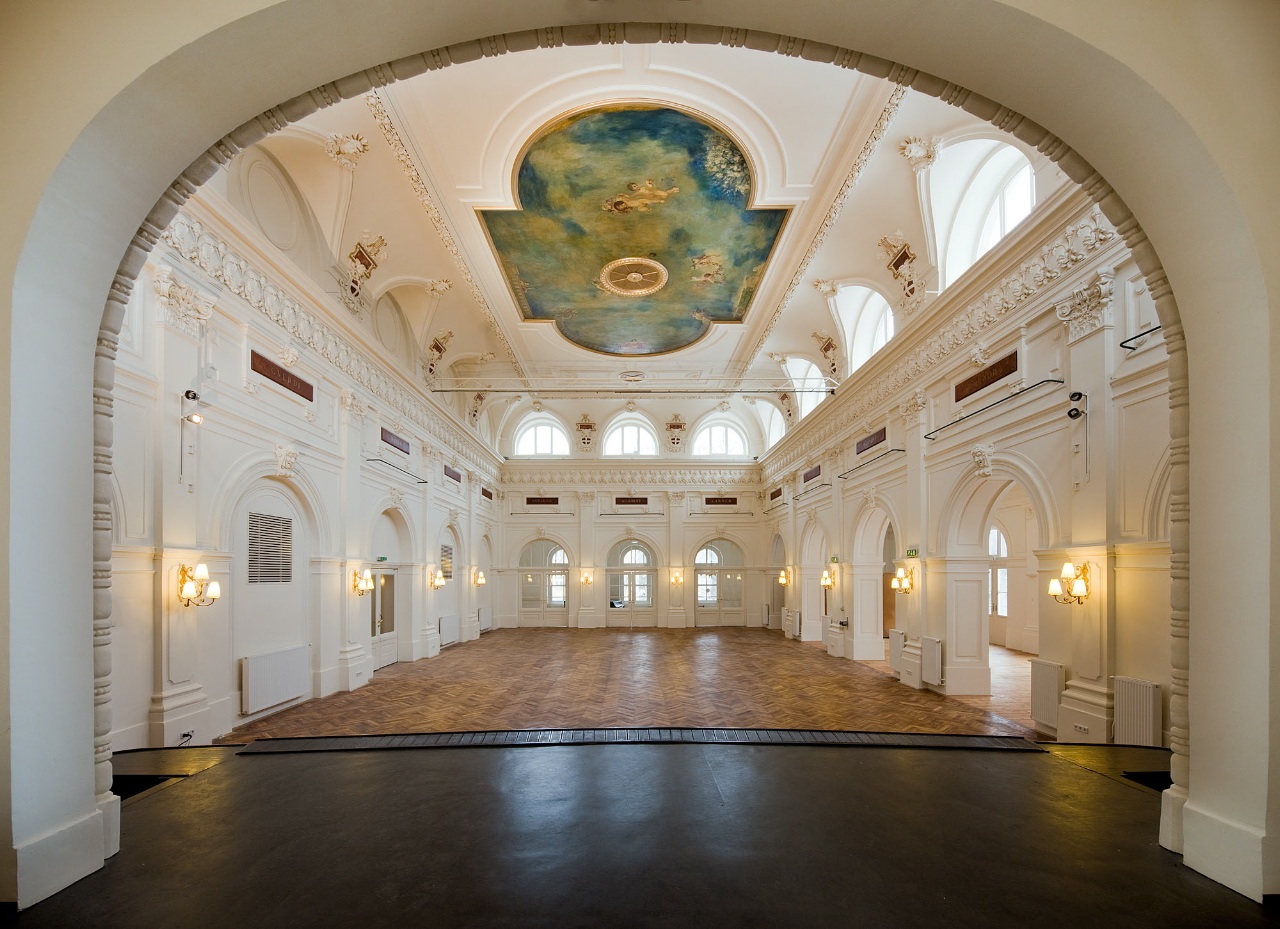
Lively discussions, electronic/computer music performances, interactive installations, demos, workshops, and paper sessions will be held in the newly renovated Casino Baumgarten, a spectacular ballroom built in 1890, and the Rhiz Bar Modern, a showcase for experimental media in Vienna.

[view from the Stage at Casino Baumgarten]

Join in the free on-line discussion
Anyone having an intense interest in sound is invited to join in the free on-line discussion at pphilosophyofsound.ning.com. Sign in and introduce yourself by sharing your earliest sonic memory. Discussions on sound, symbol, and meaning have already begun and will continue during and after the symposium. You can participate on line whether or not you are able to attend the symposium in Vienna.

To register for #KISS10:
The registration deadline for participating in #KISS10 is 13 September 2010. The participation fee of € 90 (€ 40 for students) includes the 3-day symposium, morning/afternoon refreshments, and 2 evening concerts.

Background
The Kyma International Sound Symposium (KISS) is an annual conclave of current and potential Kyma practitioners who come together to learn, to share, to meet, to discuss, and to enjoy a lively exchange of ideas, sounds, and music! Kyma is a sound design environment created by Symbolic Sound Corporation. This year, the KISS symposium is being organized by Wiener Klangwerkstatt in cooperation with Symbolic Sound and with the support of Analog Audio Association Austria, Preiser Records, and the Austrian Federal Ministry of Science and Research.


Conference Contact Information:
Barbara Kopf
KISS 2010 Conference office
Email: office.KISS2010@tonsalon.at
Telephone: +43 (0)650 212 1646
[tonsalon.at/KISS2010]

Friday, April 30, 2010

Audioscan: the alchemy of noise transmuted into music

audioscan is an artistic project conceived by Giorgio Sancristoforo, produced by AGON in collaboration with basemental. The project consists of a multimedia interactive installation and of a live performance combining music and video. Both are based on the sound mapping of Milan.
At the basis of audioscan there are 1.580 recordings and phonometric surveys gathered within the perimeter contained in the main ring road of Milan.
A process of meeting and exchange between contemporary art, music and environmental themes, a meditation on soundscape and the auditive dimension of human experience, both on an aesthetic and a social perspective.
An ambitious cataloguing work and an environmental awakening project through the transformation of a waste product of technological society – noise – into an artwork.


" [...] Essentially, noise is an ambiguous entity, setting up in a fluctuating reality, whose definition changes according to the coordinate system used to measure it.
Sounds can be sculpted. We can use noise as raw material to start with. Noise is at the same time “no sound” and all the possible sounds. Just as white light contains all the colours, noise contains countless sounds.
Therefore, instead of using musical instruments we have ground and crumbled noise in very fine components, building from these elements orchestras made up of roads and airplanes, people and cars. We have created music from a scrap of our society.
Everything is transformed. Nothing resembles anymore its former essence. Airplanes become microscopic percussions, cars are turned into metallic pianos and rubbery basses, hollow murmurs and waterish illusions.
Braking and tailpipes screeches become tides of the thinnest strings.
We have animated a deep transformation, resembling closely the alchemic processes: actually, we have performed the alchemy of noise transmuted into music.
The city, unaware of the transformations undergone, perpetuates its rhythms and mood intact. This is why those sounds, even if unrecognizable, still describe Milan, with its chaotic passages and deep breaths, with its syncopated rhythms and the feeling, peculiar to an ocean, of being constantly wound by countless mutations."

Audioscan (#1) MILANO - FULL by Giorgio Sancristoforo

"I listen to the music of Audioscan again, and I realize how much it’s melancholic.
Milan is melancholic. Not sad. A gloom which could belong to Calvino works, a blues pervading the streets, in the morning, creeping like a cat between porches and boulevards, between old mansions and post-war eyesores. The same melancholy that smoothes the cold when I stroll around, ravished by the decadence of Civic Aquarium or sitting on the lawns of San Lorenzo Basilica, while besides me the city keeps darting in sound tidal waves." - Giorgio Sancristoforo

[audioscan.it]

Saturday, January 23, 2010

Live Electronics: a conversation with Michele Tadini

18th Festival Milano Musica
Percorsi di Musica d'oggi
@ Teatro Franco Parenti
Milan, 22nd October 2009


Michele Tadini live and work in Paris. He composes music for soloist, ensemble, orchestra, with or without electronics, for theater, dance and interactive installation, collaborates with video-makers, painters, directors and writers. He was the chief of production at AGON acustica informatica musica (Milan), co-directed Centro Tempo Reale (Florence) and, now, coordinates the activity of IRMus, Istituto di Ricerca Musicale (Milan). His music is performed all over Europe, USA, South America, Canada and Japan. He recently earned the Prix Italia with the radio-opera "La Musica Nascosta". He teaches composition and technologies in the Conservatoire National Supérieur de Musique et Danse of Lyon. He has an intense activity of conferences and master classes. Suvini Zerboni, Rai Trade and Edipan publish his music.


[English subtitles are shown by default, you can turn them on/off by clicking the menu button located at the bottom right of the video player]

The 'live electronics' is the real-time electronic processing of acoustic instruments and voices. This practice has infinitely expanded the horizon of compositions. Michele Tadini reflects with U.S.O. Project about the historical aspects of electroacoustic music of the last 50 years.
The concert presents works of composers Tadini, Francesconi, Manzoni, Stroppa and Boulez. It will available for deferred broadcast Sunday, January 24, 8:30 p.m. (GMT+1) on RAI-Radio 3.


Michele Tadini (1964)
...da viva Voce (2009)
for Voice and electronics
Premiére

Luca Francesconi (1956)
Animus II (2007)
for Viola and electronics
IRCAM Commission (Paris)

Giacomo Manzoni (1932)
Sei canti dal Kokin Shū (2007)
for Soprano and live electronics
MiTo SettembreMusica Commission

Marco Stroppa (1959)
I will not kiss your f.ing flag (2005)
for augmented Trombone and chamber electronics
Wittener Tage für Neue Kammermusik Commission

Pierre Boulez (1925)
Anthèmes 2 (1992/1997)
for Violin and electronics

Laura Catrani, Soprano
Garth Knox, Viola
Benny Sluchin, Trombone
Jeanne-Marie Conquer, Violin

Michele Tadini, sound director
Luca Francesconi, sound director
Alfonso Alberti, Keyboard
Marco Stroppa, sound projection

Special thanks:
Cecilia Balestra - Associazione Milano Musica
Michele Tadini
[www.milanomusica.org]

Sunday, October 11, 2009

Focus on Kyma International Sound Symposium - KISS09

These have been busy days here at NIU, especially for the speakers who showed to all the symposiast each method of working with Kyma.
A lot of participants came from different sides of the world, it was great to be immersed in this colourful community! Carla Scaletti and Kurt Hebel (the creators of Kyma) introduced their new hardware Paca(rana) - you can find a lot of information here @ SSC - and the latest features implemented in Kyma X.70 (where 'X' stands for the last letter in 'six' - 6.70).


Carla and Kurt did a wonderful job to develop a state-of-the-art "recombinant" workstation, which gives any user the freedom to explore unknown sonic territories without hitting the DSPs (there's plenty of headroom in processing power).
During the morning of the first day, Carla showed us how to control Kyma with external devices like the Wacom Tablet and the Continuum Fingerboard, then with Nintendo Wiimote+Nunchuck and SpaceNavigator (via OSCulator by Camille Troillard).
The AC Toolbox presentation by Hector Bravo-Benard, revealed to us an algorithmic approach to sound composition with Kyma. By using the LISP language, it is possible to structure an entire composition and have Kyma play it. It is possible to make use of strict algorithmic procedures like probability distributions, Markov chains, tendency masks, and many other techniques used by composers of the likes of Paul Berg, Gottfried Michael Koenig.
A special mention should be made for Bruno Liberda's lecture, where he explores subtle connections between his wonderful graphical scores and different kinds of ancient neumatic notation, making symbolic notation and symbolic sound computation converge.
Cristian Vogel explained his latest creation called Black Swan for swiss choreographer Gilles Jobin. The 50 minutes original Kyma score was composed in Geneva and at the electroacoustic studio of the Musique Inventives d'Annecy. Here's a Swiss TV documentary about the creation of Black Swan.

What is Kyma?

Kyma is a sound design language that permits to manipulate, transform and warp any kind of sound source in realtime, but we already know all of this.
During these days in Barcelona - at the first Kyma International Sound Symposium - we have learnt something more specific and, maybe, unexpected.
As Carla Scaletti said during the opening lecture of KISS09, "Recombinance Makes Us Human". So, what does this mean? Actually each of the participants brought their own experience, point of view, modus operandi and creative talent to the symposium. This multiform epiphany allowed everyone involved to share the same time and space for 2 days, exchanging their ideas like sharing bits of code in a recombinant manner.
The symposiasts all came from different fields where Kyma plays a fundamental role in each of their activities (sound designers, composers, DJs, etc.). Each of them knows and likes different specific aspects of Kyma.

The lectures performed during these 2 days taught us something: regardless of their own personal skills, and of their own degree of Kyma knowledge, observing things from other users' point of view reveals unexpected surprises and creates new connections, on a mental and operational level, which were never considered before.
Even sounds commonly used in our everyday activity, if put in a different context (artistically or technologically), appear to us as new and unexpected, bringing back to our memory John Cage's famous concept: "(You have) to look at a Coca-Cola bottle without the feeling that you've ever seen one before, as though you were looking at it for the very first time. That's what I'd like to find with sounds -- to play them and hear them as if you've never heard them before."

The musical performances have contributed themselves to recombine new pieces of code, bearing different morphologies, sintax and structures.
With her liveset "SlipStick for Continuum and Kyma", Carla Scaletti explores the sound phase-space, in order to find new timber paths moving from materic aggregation to resonant chimes and back, without forgoing a "virtuoso gestuality" given by the nature of the instrument itself.
We have experienced the possibility of creating vibrating soundtracks for silent movies in real time, thanks to the contribution of Franz Danksagmüller's work, with the help of Berit Barfred Jensen's voice.
Concrete sounds produced by the friction of a Cello bow on different-shaped polystyrene objects, saturate the listening space thanks to the work of Hector Bravo-Benard, reminding us of some textures of Xenakis' work "La legende d'Eer".
Marin Vrbica's "Tiger in the Jungle" immerses us into an exotic and rich spatial dimension made of revolving sound-surfaces and sliding glissando-like multiple trajectories.

In the end, we are surprised that the paradigma presented in the beginning by Carla Scaletti (Recombinance Makes Us Human), has actually acted as an invisible force guiding, transforming, rearranging our thoughts, knowledge and purposes.
So, after the symposium we observe ourselves in a different way. We have changed into new intellectual human beings, and this gave everyone of us a fresh new start, in order to discover new possible configurations and interactions between ourselves and the others, between what we are and what we will be until #KISS10.

We really enjoyed our first attempt to follow a live event via Twitter, we hope you appreciated our efforts to make you feel like you were in Barcellona with us, as part of the symposium.
You can track all of our tweets via search.twitter.com.

Here's a selection of related tweets of interests:
  • Now live #KISS09: Carla Scaletti - "Recombinance Makes Us Human" - Philosophy of Kyma #
  • a Question: Infinity makes us HUMANS? #
  • Infinity+ self-awareness of finitude #
  • Open-ended possibilities= open-ended amount of time, but the learning is fun! #
  • Kyma sounds are recombinant...like us..! #
  • Pen Morph Gandalf to Saruman "You are tracking the footsteps of two young Hobbits" #
  • Writing in time and space..... #
  • I became operational ath the C.E.R.L. lab in Urbana, Illinois on the 12th of November, 1986. -- Kyma #
  • Kyma was inspired by three ideas: cutting & splicing audio tape, voltage control, symbolic logic & computer programming #
  • An interview with Carla Scaletti @symbolicsound usoproject.com/C... #
  • and now...linear interpolation of presets - smooth transition in the phase space... #
  • music is something like a side effect of explorating timbre and sound configurations... #
  • Presets as aural Keyframes #
  • ...the problem of finding graphic symbols for the transposition of the composer's thought into sound." Edgard Varèse #
  • ...without friction [...] there would be no music!"- Carla Scaletti #
For anyone interested in the Kyma sound design language, the book "Kyma X Revealed" is available here @ SSC. This document gives you an overview of the environment, gives you a strategy for approaching this deep system one layer at a time and then walks you step-by-step through each level of Kyma like your own personal tour guide. At the back of this guide, you’ll find several summaries and quick references that you can keep handy for refreshing your memory while working. This book covers the mechanics of how to use Kyma — not the art and science of sound design. However, if you love sound and are hungry for more knowledge on the subject, achieving fluency with Kyma is an excellent first step!


A great thanks to Cristian Vogel (Station 55 Productions) and Symbolic Sound Corporation for their greeting and organization.

UPDATE: Slides from Recombinance Makes Us Human (.pdf), the welcoming address for the First International Kyma Symposium in Barcelona, October 2009.

Saturday, September 05, 2009

Kyma Symposium 2009 Preliminary Program

The First International Kyma Symposium is scheduled for 8-10 October 2009 in the vibrant Poble Nou neighborhood of Barcelona during the annual LEM festival. The preliminary program includes master classes presented by the creators of Kyma, papers and demos presented by Kyma practitioners, and a program of concerts, live improvised silent film scores.

Symbolic Sound and Station 55 invite you to share your ideas, experiences and art with fellow practitioners at the First Kyma Symposium by attending the symposium and interacting with your fellow Kyma practitioners!

We'll be live microblogging from Barcelona (via Twitter) and we'll write a daily report here on Unidentified Sound Object so that even those who cannot attend can still benefit from the symposium. Photos of the event will be available via Flickr.

If you cannot attend...

Not everyone can make it to Barcelona, but your Kyma Sounds can! Cristian Vogel invites you to submit AIFF or WAV files created exclusively with Kyma for an automated "DJ Pacarana" set which will be providing background ambience for the 'Meet and Greet' reception on Thursday evening. Textures, sound design sketches, loops, and ambiences ranging in duration from 1 second to 5 minutes can be submitted in 16 bit, 44.1K WAV or AIFF and will be combined, spatialized, and layered according to a random number generator seeded with "0.8102009". In the spirit of 'Meet and Greet', please include your name and your city as part of the sound (spoken, sung, or otherwise encrypted) so we can meet and greet you virtually! Please send your files to his drop box.

---------------------------------------------
Kyma Symposium in Barcelona 8-10 October 2009
Preliminary Program (as of 31 August 2009)
---------------------------------------------

THURS (8 October 2009)
18:00 meet & greet
w/ DJ Pacarana: installation created by Cristian Vogel with participation of the international Kyma user community
21:00 Dinner at nearby restaurant (no host)


FRI TALKS
11:00 Welcome
11:30 Carla Scaletti & Kurt Hebel: "Recombinance Makes Us Human": Philosophy of Kyma
Demo of Recently Added Features
14:00 ---Lunch at Bharma
16:00 Camille Troillard: New Developments in OSCulator (1 hour)
17:00 Hector Bravo-Benard: Using the AC Toolbox with Kyma (30' lecture + 10' piece)
17:45----Coffee Break----
18:00 Cristian Vogel: The Black Swan: Composing with Kyma for Dance (1 hour)
19:00 Eckard Vossas: Improvising with Kyma: Miniaturen X, Cecil Variations B, Lehnade 2: (30')
19:45---Break for concert setup--

FRI CONCERT at Niu
20:00 Franz Danksagmüller: Kökarlen: Silent film + voice +live Kyma & voice (~2 hrs)
22:00 tear down, Dinner together nearby (no host)

SAT TALKS
11:00 Carla Scaletti & Kurt Hebel: Composing with Kyma: Vector spaces, Timeless nonlinear timelines, sequencing
CapyTalk, Smalltalk, Tools

14:00 ---Lunch at Bharma
16:00 Bruno Liberda: siebenmal gefärbt: Addicted to Kyma (1 hour)
17:00 Cristian Vogel: Kyma in the Club: The Never Engine (1 hour)
18:00 ---break--- (set up and sound checks for concert)

19:00 SAT CONCERT at Niu
* Carla Scaletti: SlipStick for Continuum and Kyma (~10')
* Marin Vrbica: Tiger in the Jungle: Video + Live Performer (~10')
* Hector Bravo-Benard: Styrotron: Live Kyma performance (~10')

---INTERMISSION---

* Franz Danksagmüller: Frtiz Lang's Metropolis: Silent film + Live Kyma accompaniment (~30')
21:00 Tear down
22:00 Celebratory Dinner together
---------
1:30 AM * Cristian Vogel: Never Engine (Live Kyma!)
The Moog

SUN
Informal breakfast and lunch, consulting, meetings, demos, sightseeing, travel day

For up-to-the-minute information on schedules, maps, accommodations, travel, and discussions, please join the erutufon forum (there is no cost to join the forum).

Venue: Niu Espai Artistic Contemporani
Cost: € 80 (includes workshops, concerts and 2 lunches)

Related Post: The First International Kyma User Symposium - Barcelona 2009

Sunday, August 16, 2009

The First International Kyma User Symposium - Barcelona 2009

Symbolic Sound Corporation's Kyma X is a powerful visual programming language for music and sound, originally created in 1987 and still going strong today. The Kyma sound design environment is used by composers, researchers and sound designers for realtime sound generation and manipulation.

The First International Kyma Symposium will be held from the 8-11 October 2009 at the Niu Espai Artistic Contemporani in Poble Nou, Barcelona.

Current and potential Kyma practitioners are invited to attend an in-depth 3 day interactive conclave devoted to the technical and artistic aspects of the Kyma sound design language.

The preliminary program includes master classes presented by Carla Scaletti and Kurt Hebel, the creators of Kyma, papers and demos presented by Kyma practitioners and professional users , plus a program of concerts, installations and performances in the Niu art space of Poble Nou.

Cost: €80 for the workshops and concerts.

Organisers: Station 55 Productions in co-operation with Niu, Symbolic Sound, TC Electronic Spain and the LEM Festival.

Links:
[symbolicsound.com]
[niubcn.com]
[no-future.com]
[gracia-territori.com]
[tcelectronic.com]


UPDATE (23rd August 2009):

[Register your attendance @ Erutufon forum]

An excerpt of a KYMA demo with Carla Scaletti at EMF studios in NYC (4/20/2009):

Tuesday, December 30, 2008

U.S.O. Project @ Spark Festival 2009

Girl Running, an excerpt from the new forthcoming dvd "InharmoniCity" (Zerofeedback/Synesthesia Recordings © 2009) has been accepted for performance at Spark Festival of Electronic Music and Arts, Minneapolis.

Spark Festival of Electronic Music and Arts / February 18th, 2009 / Cedar Cultural Center, University of Minnesota, Minneapolis, MN.


Matteo Milani and Federico Placidi (aka U.S.O Project - Unidentified Sound Object) + Giovanni Antignano (aka Selfish) / Moving Visual Art


View Larger Map

Tuesday, November 11, 2008

De Musica 2008: the creativity factory

DE MUSICA 2008, the week-long workshop by Nuova Consonanza will be conducted by Alvise Vidolin. He is one of the protagonists of experimentation in electronics and he collaborated with the most important composers of the 20th century. A pioneer of computer music, he is a sound director and interpreter of Live Electronics.

The workshop is focused on the elaboration of sound in real time and the use of computer for contemporary music, through the analysis of electroacoustic works by composers Vidolin has worked with. He will also explore the most updated systems of elaboration in real time and their application in multimedia field.

Lessons will be subdivided into three sections:
theory
listening and analysis
experimental workshop and practice

Theoretical lessons will develop the following subjects: process of live elaboration of voices and instruments; sound spatialization; techniques of live interaction and performance practice; system design for live electronics; performance environment design.
Analysis of live-electronics works by Giorgio Battistelli, Adriano Guarnieri, Luigi Nono and Salvatore Sciarrino will be carried out for solo, ensemble or musical theatre.
The workshop will take place in Max/MSP environment and will include the analysis and rehearsal of the pieces for the final concert.

[read more - via nuovaconsonanza.it]

Thursday, November 06, 2008

Live!iXem 2008

Festival of experimental electronic music and arts

18>22 November 2008 - Palermo, Italy

V Edition


18 nov. 21.30 – Goethe Institut – Via Paolo Gili 4
Antony Pateras (pianoforte preparato), Sean Baxter (percussioni) e David Brown (chitarra elettrica preparata).

19 nov. 21.30 – Malausséne – Piazzetta Resuttano 4
AMP2 + SECRET GUESTS Live performances

20 nov. 19.30 > 24.00 – Left – Via degli Schioppettieri 8
AV screenings by Torregrossa

21 nov. 21.30 – ASK 191 – Viale Strasburgo 191
SonoRoom Live sets: Marco Pianges, Dario Sanfilippo, Samuele Calabrò, Gandolfo Pagano.
DanceFlor DJ sets: Ajno [minimal <+/-> techno | dubstep] and More!

22 nov. 21.30 – ASK 191 – Viale Strasburgo 191
SonoRoom Live sets: Nino Secchia e Dario Sanfilippo, Talachtis, Mathias Manceck+Raffaella Piccolo, Il cielo di Baghdad.
DanceFloor DJ sets: D.M.D. Death Modern Dance, Claudio Bonanno e Gianluca Scuderi, Ajno.

[ixem.it]