Showing posts with label Technology. Show all posts

Tuesday, May 29, 2012

"Digital Re-Working / Re-Appropriation of Electro-Acoustic Music"


What is DREAM

DREAM is a EU funded project, aimed at preserving, reconstructing, and exhibiting the devices and the music of the Studio di Fonologia Musicale della Rai di Milano. During the 1950s and 1960s, this was one of the leading places in Europe for the production of electroacustic music, together with Paris and Cologne.
During the project, part of the equipment of the Studio (oscillators and non-linear filters) has been virtually reconstructed and will become part of the permanent exhibit at the Museum of Musical Instruments in Milan.

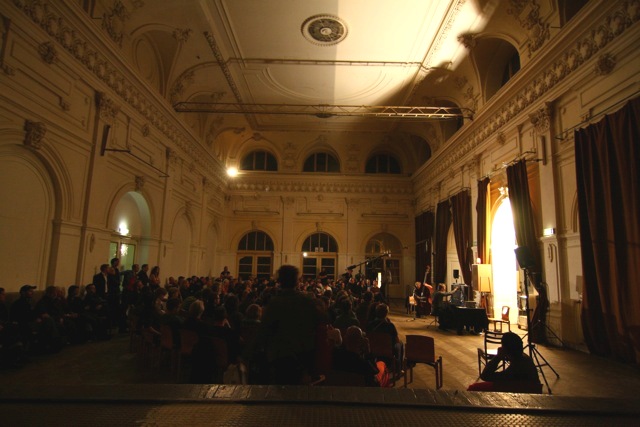
The aim of this one-day symposium is to present to the public the main results of the DREAM project, including the installation that recreates part of the original devices of the Studio di Fonologia di Milano della Rai, as well as the book “The Studio di Fonologia – A musical journey”, edited by Maria Maddalena Novati and John Dack, and published by Ricordi.

The event is comprised of two parts.
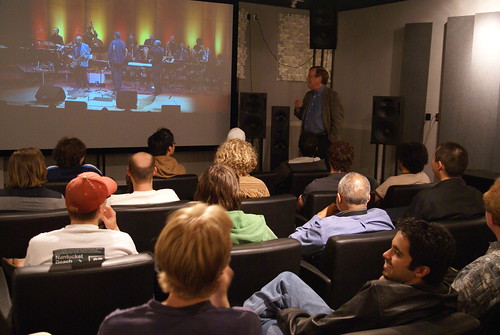
The morning will be devoted to the workshop Conservare, mostrare, interagire: per un museo da toccare [Preserve, exhibit, interact: for a tangible museum]. During the workshop, DREAM researchers and invited speakers will discuss applications of novel interactive technologies to museum exhibits, with particular reference to music and musical instruments museums.
The afternoon session will present to the large public the results of the DREAM project, through the movie Avevamo 9 oscillatori [We used to have 9 oscillators], additional talks by DREAM researchers, and two musical performances that make use of sonic materials produced at the Studio di Fonologia.

Program
[http://dream.dei.unipd.it/?page_id=645]

Friday, June 15, 2012
Castello Sforzesco, Museo degli Strumenti Musicali, Sala della Balla Milano 
Free of charge, limited places available

Friday, August 26, 2011

Rome Calling – The Audio and Loudness Seminar of 2011

In June 2011, some of the most respected audio authorities – including George Massenburg, Bob Katz, Florian Camerer and Thomas Lund – gathered in Rome, Italy, to share their thoughts and experiences on loudness measurement in connection with recording, mixing, mastering and broadcasting. The speakers at the seminar in Rome included such capacities as Simone Corelli, Alessandro Travaglini, Richard van Everdingen, among the others.
The first day of the seminar focused on post-production, while the second day concentrated on professional broadcasting and particularly the radical changes happening in production and distribution of broadcast, film and music as a consequence of new ITU and EBU standards.
The groundbreaking and comprehensive EBU R128 loudness recommendation was investigated from a multitude of angles, as was the just updated ITU-R BS.1770-2 broadcast standard.
Tc Electronic documented the event and on this page they have gathered some of the footage form the seminar. First up are Florian Camerer and Richard van Everdingen from EBU’s PLOUD Group.
Florian provides a general overview of EBU’s R128 broadcast standard presented with great enthusiasm and a twist of humor. New videos will be available soon!


Saturday, January 30, 2010

2nd Kyma International Sound Symposium: Vienna, Austria

@Symbolic Sound and Wiener Klangwerkstatt invite you to share your ideas, experiences and results with fellow practitioners at the Kyma International Sound Symposium (KISS), an annual conclave of current and potential Kyma practitioners who come together to learn, to share, to meet, to discuss, and to enjoy a lively exchange of ideas, sounds, and music.

[This year's theme]
[How to submit]

#KISS10 is scheduled for 24-26 September 2010 in the newly renovated Casino Baumgarten, a spectacular ballroom from 1890, which - due to its excellent acoustics became one of the main recording studios in Vienna in the 1960s and 70s.

[Casino Baumgarten]

Cost: € 90, students € 40
Deadline for submission of proposals: April 11th, 2010
Organizers: Wiener Klangwerkstatt in cooperation with Symbolic Sound, supported by Analog Audio Association Austria (AAAA), Preiser Records and Stadt Wien

[Full details - via tonsalon.at]

Friday, May 08, 2009

JoAnn Kuchera-Morin: Tour the AlloSphere

JoAnn Kuchera-Morin demos the AlloSphere, a new way to see, hear and interpret scientific data. Dive into the brain, feel electron spin, hear the music of the elements ... and detect previously unseen patterns that could lead to new discoveries.

Composer JoAnn Kuchera-Morin works on the Allosphere, one of the largest scientific and artistic instruments in the world. Based at UCSB, the Allosphere and its 3D immersive theater maps complex data in time and space. Kuchera-Morin founded the Center for Research in Electronic Art Technology (CREATE) and has been the director since its birth in 1986. In 2000 she began work on a Digital Media Center within the California NanoSystems Institute at Santa Barbara. Her fascinations include gestural interfaces for performance and the expression of complex data in nontraditional forms.

[Mapping terrain in space and time: Exclusive interview with JoAnn Kuchera-Morin of the AlloSphere]

[allosphere.ucsb.edu]

Wednesday, April 22, 2009

An interview with Tomlinson Holman, pt. 3

by Matteo Milani, U.S.O. Project, April 2009
(Continued from Page 2)


MM: Where did come the idea to write your book Sound for Film and Television? When you started teaching at school?

TH: Yes. It really was taken from the first seven years of teaching and followed the outline of my course. I am currently at work on the 3rd ed. [now out]. Having now fully made the digital transition there is much new information but I'm hoping this is the magnum opus and I won't have to revisit it again for a very long time.

THX continued to grow inside Lucasfilm. A division with excellent revenues and low overhead, the THX Sound System became the 'de facto' standard of superior theatrical presentation, and it had a profound impact on the theater industry. [...] THX remained part of Lucasfilm until 2002, when it was spun off as an independent company, owned partly by LFL, with other corporate and private investors. [...] Tom Holman began working with Audyssey Labs in 2002, a start-up company whose first product was a device that could tune professional and home theater sound.
[excerpt from Droidmaker]


MM: Ten years of '5.1 Surround Sound - Up and Running'. Where are we today?

TH: Well that book is in its 2nd ed. now called only Surround Sound -- Up and Running. We dropped the 5.1 because when it first came out the idea was new to music people, and now the idea is well understood. 5.1 remains the principal film-making format, with up-mixing in home receivers to 7.1 routinely, and newly introduced 9.1 and 11.1 channel systems.


MM: Your thoughts about Cinema Digital distribution. Toward linear PCM (no bit-rate coders) sound on a server with picture?

TH: Yes, they are 24-bit, 48 kHz, multichannel systems, so are transparent in a theatrical environment. Even those who argue for wider bandwidths have to be content with 48k sampling in large spaces because air absorption over 10m and more just does in very hf frequencies.

About Absorption
Sound may be absorbed by its interaction with boundaries of spaces, by absorptive devices such as curtains, or even by propagation through air. Absorption is caused by sound interacting with materials through which it passes in such a way that the sound energy is turned into heat.

[excerpt from Sound for Film and Television]


MM: Meaning and your progress of 10.2 channel sound at 'TMH Corporation'.

TH: I've been working on 10.2 for many years now, a system with a full path (not an upmix) from input to output because among the three competitors for bit rate, sample rate, bit depth or word length, and spatial capability it is the spatial one that is the most interesting since everyone we've exposed to the system can hear the differences across 1 to 2 to 5.1 to 10.2. There's simply no debate except "well how practical is it?" Well how "practical" is 192 kHz sampling? Who can get to 24 bits of precision, one part in about 17,000,000 in just over 5 microseconds? Nobody, that's who. Those extra bits are "marketing bits" if the truth were to be told.


MM: Marketing bits. As you wrote, is sampling at 60 kHz still enough?

TH: Yes I covered this extensively in Surround Professional magazine, taking on every single theory that has been proposed that I could find, and 60 kHz is adequate for all. 48 is pushing things a little bit. You know the 20 kHz limit of hearing is a "soft" limit, an average of thousands. As a young person I could hear an undistorted sine wave out to about 24 kHz, and we've had students who could do this in our lab confirm it in the last few years. But above about 24k there's just no response. So that leaves little wiggle room for 48k sampling, but probably enough for almost all practical purposes, certainly for cinema due to its air propagation effects.


MM: Beyond 5.1 - Height sensation, missing from all stereo and multichannel system. Is it for you unnecessary nowadays to implement in the movie industry?

TH: IMAX has had its Center Top channel for many years. I made that stereo since a width and height sensation is required I believe. In fact, Fantasound in some of its eight renditions in 1939 had some overhead channels, so it's not new, just "new" in the marketplace.

[Prev | 1 | 2 | 3 ]

Related Posts:

Bibliography

Books
Holman, T. (2007) Surround Sound: Up and Running, Focal Press
Rubin, M. (2006) Droidmaker: George Lucas and the Digital Revolution, Triad Publishing Company
Blesser B. | Salter L.(2006) Spaces Speak, are You Listening?: Experiencing Aural Architecture, MIT Press
Holman, T. (2001) Sound for Film and Television, Focal Press

Websites
tmhlabs.com
wikipedia.org
cinema.usc.edu
imdb.com
digitalcontentproducer.com
focalpress.com
britannica.com

An interview with Tomlinson Holman, pt. 2

by Matteo Milani, U.S.O. Project, April 2009

(Continued from Page 1)

MM: You've invented a system that is a signal processing chain of different products, blending knowledge, math, material, and so forth. How did you manage this huge work of taking care of each small step during its development?

TH: With a lot of help, which I credited in the THX Manual. The ideas did come from many sources, some dating to the 1930's whereas some were brand new in 1980. It was my skill to: go to the MIT library and read the whole field within a week of getting the job (I was in Boston at my company 'Apt Corporation' at the time), selecting from amongst those developments the ones that made sense; working with John Eargle at JBL to find real products that would meet the standard sought; to assemble and figure out how to measure them; to exchange measurements with, and have experiments conducted, at Waterloo University (Stan Lipshitz, now retired, and John Vanderkooy); to select the LR4 crossover and get help in implementing it; to figure out how to make delay lines and fit poles and zeros with which I had help from Gordon Jacobs; then to build the crossover networks, find a manufacturer, etc. So there was lots of help but I performed an integration and leadership function.

The invention came about after it was nearly finished. Standing one day at the base of a wall that contained the system, with my head stuck between the wall and screen, I heard lots and lots of high-frequency energy, and figured out that this was from multiple bounces between the wall and screen. The wall was needed to support low frequencies but was a problem at high frequencies, so covering the wall in high-frequency absorbing material made it disappear acoustically at high frequencies. That's the patent: more a "discovery" than an "invention" that I set out to do.

[Holman Talking About 10.2 Possibilities - via sklathill]


MM: How was the relationship with Dolby Laboratories? What's the output of your collaboration at that time?

TH: Dolby set the stage by improving film sound to the point where THX was worth doing. While they concentrated on the pipeline to get program material from studio to cinema and home, I concentrated on what happened to it once it was delivered. So they were compatible completely, although some ignorant parts of the marketplace thought one was supplanting the other and vice versa. Never was true.

By the mid-'80s, Lucasfilm and Dolby labs were ping-pongin developments - "technological leapfrog" Tom Holman called it. Dolby was pushing improvements for recording sound on film and playing it back with expanded frequency and dynamic ranges; Lucasfilm focused on the auditorium.
In 1987, a committee of audio engineers debated the number of channels for digital sound on film. It was lively debate about a range between two and eight channels; Holman proposed 5.1 - five main channels and a dedicated sub-woofer channel. (Technically speaking, the sub-woofer represented 0.005 of a channel in bandwidth. "I call that marketing rounding!" said Holman.) 5.1 Surround Sound became the industry standard.
[excerpt from Droidmaker]


MM: What was exactly the Lucasfilm's Theater Alignment Program? It was an early version of THX?

TH: No, it was a companion program to see that all theaters were tuned up to the best of their ability and consisted of lab viewing of 70 mm prints, installation tune-up by certified technicians, and viewing by trained people separate from the technicians with feedback to Lucasfilm, and end-to-end quality control for films in theaters. It ran a number of years on a lot of films but didn't make any money.


MM: Few words on the development of Home THX.

TH: I went to CES (Consumer Electronics Show) in the mid-80's and found misrepresentations of the work of Ben Burtt and others, some of it deliberate, and some of it from a lack of knowledge. So I set our to better represent movies over home systems, and Home THX with its patented technology is the result. It also had a "better housekeeping seal of approval" component, especially in areas where people routinely stretched the truth, such as power amplifier output capacity. We used loudspeakers to test, not resistors, and some high-end products simply failed to pass the standard based on real program material into real loads.


MM: When (and why) did you move away from Lucasfilm?

TH: I started teaching at USC in 1987 and working at Lucasfilm mainly in THX by that point from 1987 to 1994, but it was a hard road to hoe to have two jobs, one in northern and one in southern California, so the dye was cast with the completion of the Technical Building in 1987, the design and building of which occupied three years of 60 hour plus weeks for me.

Tom Holman had succeeded beyond everyone's expectations in his execution of C Building; he produced some of the most remarkable filmmaking workspaces ever, and, in the process, launched the TAP/THX projects. After testing out numerous ideas on Kerner, Holman transitioned into working full time on the engineering specifications for the 750,000 square foot Technical Building.
[excerpt from Droidmaker]

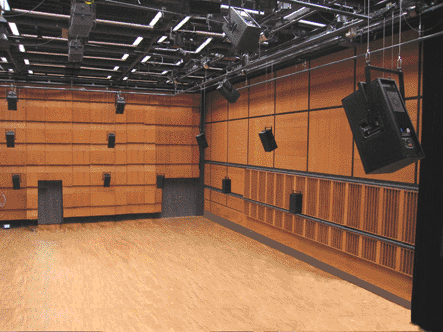
In the 'Stag Theater' at Skywalker Ranch it's twenty-two speakers all-around which are positioned for uniformity of coverage. The multiple arrival times screw up your ability to localize any one sound. A lot of things in the Tech Building are all hidden from view on purpose, because if you don't see one, you don't locate one.
[excerpt from Sound-On-Film]

[Prev | 1 | 2 | 3 | Next]

An interview with Tomlinson Holman, pt. 1

by Matteo Milani, U.S.O. Project, April 2009

This is the last chapter dedicated to the new era of film sound, started in the early 80's, thanks to George Lucas and his talented crew. His efforts to develop new technologies had taken the cinema experience radically into the future. We take for granted technologies like THX, now been absorbed in the popular culture. I had the pleasure of interviewing Tomlinson Holman, the developer of the THX Sound System and its companions Theater Alignment Program, Home THX, and the THX Digital Mastering program. He was at Lucasfilm for 15 years, winding up as the company's Corporate Technical Director.

Mr. Holman is Professor of Film Sound at the University of Southern California School of Cinema-Television and a Principal Investigator in the Integrated Media Systems Center at the university. IMSC is the Engineering Research Center for multi-media of the National Science Foundation. He is founding editor of Surround Professional magazine, and author of the books Sound for Film and Television and Surround Sound Up and Running, both published by Focal Press. He is an honorary member of the Cinema Audio Society and the Motion Picture Sound Editors. He is a fellow of the Audio Engineering Society, the British Kinematograph Sound and Television Society, and the Society of Motion Picture and Television Engineers. He is a member of the Acoustical Society of America and the IEEE. He has lifetime or career achievement awards from the CAS and the Custom Electronics Design and Installation Association. Tom holds 7 U.S. and corresponding foreign patents totalling 23, and they have been licensed to over 45 companies.


MM: Could you describe the movie sound at the beginning of the 80's, a period of study and development about a new way of experience movies that eventually became THX. But what was there before it (untrained professionals, unprepared audience)?

TH: Just after WWII cinema sound systems had gotten standardized. Drawing on the developments of the '30's, but adding to them the outgrowth of technology developed for the war, the 'Altec Voice of the Theater' became "standard," with 80%+ market share in theaters, and thus in dubbing stages. This chicken-and-egg served decently for decades, but even its own inventor tried to improve upon it, but couldn't crack the chicken begets egg paradigm. An example of the WWII technology employed is the permanent magnets used in the loudspeakers. They were originally developed for bombadier crew earphones! The loudspeakers of the 1930's needed dc current to form their magnetic fields. So the 'Voice of the Theater' was a great step forward, but also froze technology at the 1947 level until 1980.

What I did was to consolidate many of the developments made between 1947 and 1980, add a few of my own (which got patented), and make one comprehensive system out of it, and then install it only in rooms that met required acoustical standards. It was the first time ever that anyone tried to standardize on room acoustics from place to place, eventually around the world, within certain parameters--the very opposite of, say, concert hall design, but in many ways far simpler.

[..] With the introduction of surround sound, audio mixing engineers were forced to adapt the old rules and paradigms to that had been used for mixing a stereo production. Answers were needed for new questions. Tomlinson Holman, the father of THX cinema surround, pointed out that the most important decision in creating surround sound was the choice between two primary listener perspectives: the 'in-audience perspective', where the listener sits in the best seat in the house, sonic activity is located at the front, and surround creates reverberant ambience; and the 'onstage perspective', where the listener sits in the midst of the musicians, encircled by active sound sources.
[excerpt from Spaces Speak, are You Listening?: Experiencing Aural Architecture]


MM: You're in the film history, as you invented the "de-facto" standard of theater industry. How could you describe your early days at "Lucasfilm"?

TH: Heady. We were on a mission to improve the whole experience of going to the movies. THX was only one of the resulting developments, but it had the most public face eventually.

People have been asking the question for years: what does THX stand for? And this is was exactly Jim Kessler's marketing intent: keep 'em asking question after question, and they're taking about you!" [...] "It's gotta sound cool, high-tech, and I wanted a way to credit Tom Holman, the inventor," said Kessler. Doodling around, "I just wrote the initials for Tom Holman Crossover on my desk one day." "Crossover" was a reference to the way the speakers divide the treble and bass for ideal acoustics. Traditionally, the crossover is done passively, in a loudspeaker. Holman had designed an electronic crossover. Kessler wrote "crossover" with an X, as in "X-over." He smiled as he recognized the letters THX from George's film THX 1138. "George always seemed to like them, and had used them as a private joke on a license plate on Harrison Ford's roadster in American Graffiti." Kessler liked that the name was both very "Lucas" and still not immediately identifiable as Lucas. "THX, that's perfect!" So Kessler rushed down the stairs and into the cool dark mixing theater beneath him, where Lucas was sleeping on the couch during another marathon Jedi mixing session. Lucas woke up and watched in silence as Kessler waved the paper around and ranted about how perfect the name would be. "Great" was all he said, and that was the end of it.
[excerpt from Droidmaker]


MM: Could you technically describe the C building in San Rafael, the site of the original THX speaker installation?

TH: Within the first weeks of joining Lucasfilm I had a conversation on the phone lasting past midnight with the architect/acoustician of the C building dub stage. He wanted a text book approach as he was an MIT grad and trained members of the team headed by Leo Beranek, who had written the great classic book 'Acoustics'. Beranek's "recommendation" for cinemas was an average of cinemas he found pre-1952, and in the stereo era, I thought the reverberation time should be shorter than what were in fact old vaudeville theaters revamped for cinema. He wanted 1.2 s RT60 and I wanted something like 0.6 s. We compromised on 0.9 s but he forgot some absorption so it came in at 0.8 s. When we finished and listened to movies in the room, I was convinced of the utility of lower RT than the average 1930's theaters for improvement in speech intelligibility and localization.

The first phase of Holman's work would be the new sound mixing environment for the dubbing stage. "Bring a new level of quality to film post-production," said George Lucas to Tom. C Building was his canvas. [...] The Sprockets theater was a marvel. Visitors to C Building from Hollywood and from theater exhibitor companies were stunned by the audio. "They wanted that sound in their new facilities," said Tom Holman, "because it was clearly better."
[excerpt from Droidmaker]

The reverberant process smears together the syllables of speech and the sound effects so that a loud sound will cover up a soft one that comes after it. [...] If you want reverberation, you record it on the sound track and if you don't want it, you turn it off. That's really a rather different way of doing things. That makes it pretty independent of the number of people in the auditorium. [...] There's a fundamental difference between a concert hall, which is a space for production, where the orchestra plays and interacts with the hall, and a movie theater, which is a space for reproduction.
[excerpt from Sound-On-Film]


MM: How Ben Burtt helped you to develop the system at Lucasfilm? Did you shaped with him the sound post-production workflow and method in an innovative way?

TH: I was hired as a back up in case the computer division didn't get it all done digitally within three years. It didn't, but their work eventually became Pixar and some went to Avid, etc. So the work flow was pretty much standard, but highly cleaned up: three generations of magnetic heads made the response flatter and flatter, 3000 man-hours of modifications to a music industry console for features and sound improvements beat film consoles, and many more. Ben was vital in being the main customer, and at recognizing the value and quality of what was being done. He also taught me a great deal about workflow, history of Hollywood sound, etc. I remember one time we were in the first small room before the C building in a store front. We were working on Raiders. He told me that the sound source for opening the lid of the ark in the last reel was within 20'. I couldn't figure it out. It turned out to be lifting the back off the toilet above the water chamber, and slowing it down. I was astonished at his methods and remain in awe of them as heard recently in Wall-E. I liked later to define the difference in roles as "I make it sound good; he makes it sound interesting."

Film sound consoles weren't very good because they were custom built to the needs of film sound in small quantity without much competition. We bought a music industry console built in much higher volumes and with a lot of more competition and changed its functions to make it into a film sound console.
[excerpt from Sound-On-Film]

[ 1 | 2 | 3| Next ]

Tuesday, February 17, 2009

An interview with James A. Moorer, pt.3

by Matteo Milani, February 2009

(Continued from Page 2)

MM: Can you talk about the synthesized arrows in Indiana Jones and the Temple of the Doom?

JM: This was done by linear prediction. Ben had recorded the sounds of arrows going by, but they were too fast. I took 100 ms from the middle of one of those sounds and created a filter of order 150 from it. When driven by white noise, it made the same noise as the arrow, but continuing forever. He then put that sound in the doppler program to produce the sounds of the arrows flying by.

In addition to being a numbers prodigy, ASP is quite garrulous. It can synthesize speech, the sounds of musical instruments, and even special effects by the same mathematical techniques. In Indiana Jones, for example, there is a hang-onto-your-seat scene in which Jones and his pals, while dangling precariously from a rope bridge slung across a deep chasm, come under attack by a band of archers. Lucasfilm technicians had recorded the sound of a flying arrow in a studio, but they discovered that the whistling noise did not last long enough to match the flight of the arrow on the film.
ASP came to the rescue. Moorer copied 25 milliseconds from the middle of the one-and-a-half-second recording and spliced the duplicate sounds to both ends, all electronically. Then he manipulated the arrow's noise so that it faded as the missile moved from left to right across the screen. To ensure total accuracy, Moorer even used ASP to include a Doppler shift - the change in pitch from high to low heard when an object sweeps rapidly past. Thus, as the arrow flies by actor Harrison Ford's head the audience hears a subtle change of frequency in its noise. In this way the sound track dramatically increases the audience's sense of the hero's peril.
[excerpt from Discover Magazine, August 1984
]


MM: How did Ben Burtt use the machine at its fullest on his projects?

JM: There were a number of sounds in "Temple of Doom" that were done using the ASP. The main ones were the arrow sounds and the sound of the airplane crashing near the beginning of the movie, although there were many, many other sounds throughout the film that were processed on the ASP.


MM: Do you recall the 'SoundDroid Spotter' genesis? Could you describe the early “spotting” system for searching sound effects libraries inside SoundDroid?

JM: People said they wanted a less expensive system. I designed and built a 1-board processor with a TI DSP chip on it for doing sound effects spotting. TI (Texas Instruments) made a DSP (digital signal processor) chip called the 320. It was a bit like the Motorola 56000 that we used later at Sonic Solutions, except that it could only use 16-bit samples.


MM: The first digital devices have landed in recording studios as outboard gear. Does it make sense nowadays to have custom DSP to spread calculation outside the computer?

JM: No. It didn't then, and it doesn't now. First digital devices were outboard devices. This never made any sense. For instance, they could not be automated. You can have this nice, big mixing desk with all this fancy automation, but none of your outboard equipment could be turned on or off using the mixer automation. Similarly, the tape recorder and the mixing desk and the outboard equipment were all separate things. There is no way to make sure that your automation program for the mixing desk is the correct one for the audio tape you put on the tape recorder. If you have to pick up a project a year later, it is impossible to get all the same settings, since you never remember what outboard equipment was used or what special patching might have been present between the tape recorder and the mixing desk. If you want to make the "disco mix" a year later, there is no way to do it. It is like starting all over. It creates more problems than it solves. Now, you do everything through one program, and all the effects are perfectly automated, and all the automation is combined with the editing into one integrated project. The mixing desk with external tape recorded and "uncontrolled" outboard devices never made any sense to me.


MM: You're the real composer of the original THX logo. Michael Rubin wrote in his book "Droidmaker" that it was the startup sound of ASP first, correct? Who came up with this idea like the Apple Mac's startup sound? Did you name it Deep Note (or The Chord)?

JM: It was not the startup sound of the ASP. It was a program that you would load into the ASP which, when started, synthesized the sound in real time. I had named it Deep Note. I have no idea who came up with the Apple Mac's startup sound. The THX logo was started because the THX sound system was to come out in time for the release of "Return of the Jedi". They were doing a 35-second animation that would go before feature was presented in the theater. The director of that animation came to me and said that he wanted a sound that "comes out of nowhere and gets really, really big". I told him that I knew how to do that, and 2 weeks later, we had the THX logo theme.

Jim Kessler found Andy Moorer in the second floor kitchen when he pitched him on his vision for a THX logo. He [...] wondered if the ASP could generate a cool sound. "It's gotta swirl around and it should be like this really big one dynamic thing," Kessler explained, "and make sure we all get the stereo high range and low range." Being a musician and composer himself, Moorer was excited to have a musical project. [...] Moorer retreated to the prototype ASP he had built. It was the only device of its kind in the world. [...] He envisioned a power chord that would emerge from a cluster of sounds. He built a single note from thirty-two voices of synthesized sounds. Moorer called the sound "Deep Note" (possibly one of the most recognizable sound logos ever, and certainly the most recognizable piece of completely digitally synthesized music. It plays more than 4,000 times every day).

Thirty-two simultaneous voices of sound from a synthesizer in real time would be a computational challenge, even by modern standards. Moorer programmed the computer to generate a cluster of sounds between 200 and 400 Hertz that sort of "wandered up and down," but soon resolved into a big carefully planned chord based on a note of 150 Hertz, a little below D. The exact trajectories of the "wandering" sounds were created randomly by the ASP, so every time Moorer ran the program, the score was slightly different.
[excerpt from Droidmaker]


MM: The task of re-creating the THX sound is a standard homework assignment at Stanford's CCRMA (Center for Computer Research in Music and Acoustics) in an introductory course entitled "Fundamentals of Computer-Generated Sound." Every year, twenty or so students attempt to re-create the sound using LISP and Common Lisp Music. How much influence has your musical preparation had in the "composition" of "The Deep Note"?

JM: I knew exactly what it was going to sound like before I made a sound.

The THX logo theme consists of 30 voices over seven measures, starting in a narrow range, 200 to 400 Hz, and slowly diverting to preselected itches encompassing three octaves. The 30 voices begin at pitches between 200 Hz and 400 Hz and arrive at pre-selected pitches spanning three octaves by the fourth measure. The highest pitch is slightly detuned while there are double the number of voices of the lowest two pitches.
[via tarr.uspto.gov]


I set up some synthesis programs for the ASP that made it behave like a huge digital music synthesizer. I used the waveform from a digitized cello tone as the basis waveform for the oscillators. I recall that it had 12 harmonics. I could get about 30 oscillators running in real-time on the device. Then I wrote the "score" for the piece.

The score consists of a C program of about 20,000 lines of code. The output of this program is not the sound itself, but is the sequence of parameters that drives the oscillators on the ASP. That 20,000 lines of code produce about 250,000 lines of statements of the form "set frequency of oscillator X to Y Hertz". [...] It took about 4 days to program and debug the thing. The sound was produced entirely in real-time on the ASP. [...] There are many, many random numbers involved in the score for the piece. Every time I ran the C-program, it produced a new "performance" of the piece. The one we chose had that conspicuous descending tone that everybody liked. It just happened to end up real loud in that version.
[via musicthing.blogspot.com
]


MM: Would you like to make some comments about the evolution of the digital audio industry, and some of the expectations for the future of this technology?

JM: It was very difficult to convince people that we could perform all the operations on audio using the computer. Nowadays, nobody could imagine doing audio in any other way. The big challenge for the future is the amount of audio we will have. By 2040, we will all carry devices the size of an iPod Nano that will hold ALL THE AUDIO THAT HAS EVER BEEN RECORDED IN THE WORLD! You will not download audio any more - it will ALL be on your player all the time. The problem will be in indexing that material so you can find it. You will not press buttons - you will talk to your devices to tell them what to do. You will be able to get your email by asking your telephone to read you your new messages without ever touching it. You will start to forget that they are machines. You will give them names, like we do our pets.

"Sometime in the near future, the technology will make it possible to store all of the information in the world in a cube that's 12 inches square....but the index to access that knowledge would take up an space 1/2 the size of the planet." - James A. Moorer
[via blogs.adobe.com]


[Prev | 1 | 2 | 3 ]


Related Posts:

References

Signal Processing Aspects of Computer Music - A Survey. Invited Paper, Proceedings of the IEEE, Volume 65, Number 8, August 1977, pp. 1108-1137

The Audio Signal Processor: The Next Step in Digital Audio. in "Digital Audio", Collected Papers from the AES Premiere Conference, Rye, New York 1982, June 3-6, pp. 205-214

"Digital Audio Processing Station: A New Concept In Audio Post-Production" by James A. Moorer, et al., Journal of The Audio Engineering Society, 34:6, June 1986, pp. 454-463


Bibliography
Books
Rubin, M. (2006) Droidmaker: George Lucas and the Digital Revolution- Triad Publishing Company

Websites
jamminpower.com
mixonline.com
en.wikipedia.org
cnmat.berkeley.edu

An interview with James A. Moorer, pt.2

by Matteo Milani, February 2009

(Continued from Page 1)

MM: Did Lucas himself choose the name SoundDroid?

JM: No. It came from the name of the group, which was "The Droid Works". Peter Langston came up with the name "Droid Works".


MM: Is it true that SoundDroid was the second generation digital audio workstation after the ASP? Or the ASP was called later SoundDroid?

JM: The ASP was later renamed SoundDroid. We were working on a second generation when the work was stopped.

The Droid Works closed before the production-ready version of the device was completed, before any products were delivered. Still, the audio research that went into it lived on. In the last months of 1986, Lucasfilm tried to find an industry leader to purchase the technologies had been created there, with no success.
[excerpt from Droidmaker
]


MM: What kind of sound processing did you implement? Filtering, eq, dynamics?

JM: All the kinds that were known at that time - filtering, dynamics, spatialization, reverberation, pitch shifting, denoising, and many more.


MM: Did your pioneering work on the Phase Vocoder lead to NoNoise for removing hiss, noise, clicks and pops from recordings?

JM: The Phase Vocoder work did lead directly to the algorithms for removing clicks and pops. The broadband noise reduction came out of some work I did with John Strawn on the "Karen Silkwood Tapes" back at Stanford. These were the techniques used for the Amadeus restoration projects.

Milos Forman was [...] mixing “Amadeus” at Fantasy Films (Saul Zaentz). [...] There was a scene in the movie (the asylum scene) where the performances of Salieri and Mozart were excellent but the audio recording was not. Forman's sound engineers, Mark Berger and Tom Scott, knew that Lucas's teams were pioneering new technology for exactly this kind of problem. They brought the tapes over to Andy Moorer and asked if his ASP could help.[...] Andy immediately digitized the tapes into the ASP. Then he excised small samples of pure noise and had the computer analyze them - getting, in essence, a fingerprint of the background noise. Then the pure noise was subtracted from the dialog tracks, leaving the human voices intact.
"About half of the tapes they brought me we were able to clean up," said Moorer. Amadeus was the first feature film to utilize their new noise reduction technology.
[excerpt from
Droidmaker]


MM: The visual waveform had been demonstrated originally in your program called "S" (for Sound) at Stanford in 1970. How was your contribution to the user interface design? Where did you find your inspiration of waveforms, from optical recordings?

JM: ALL modern digital audio workstations use the SAME waveform display that I created in the program "S". All modern digital audio workstations are descended directly from "S". I have no idea where the idea for the display on "S" came from. It just seemed good at the time.


MM: What was the audio recording format for the SoundDroid?

JM: We used 16 or 24-bit samples at 48 kHz.


MM: How big was the storage of the SoundDroid?

JM: We used 300 MByte "Storage Module Drives" on the original ASP. One drive would hold about 50 minutes of monaural sound at 48K and 16-bit samples. You could attach up to 4 drives to one ASP. With SoundDroid, we got some newer drives that could hold 850 MBytes, or about 2 hours of mono. Four of those drives adds up to about 1 hour of eight-track audio.


MM: How was your connection with Tomlinson Holman? Did you collaborate at that time?

JM: I enjoyed working with Tom Holman, although we had different responsibilities. He was all analog and didn't really work much with digital audio.


MM: How was your relationship with Ben Burtt? Was he the only figure who helped you sweetening the software?

JM: Ben helped me understand what sound designers did and how they do it.

"Ben Burtt said the biggest bottleneck was the spatializing of sounds; it was his biggest time sink," recalled Andy [Moorer]. Ben needed fine control over the room size around a sound, a magic knob that would adjust the spatial environment so he could immediately hear how a sound could be varied.
His traditional method was slow and tedious, with tape decks and amplifiers. And creating flybys! All those objects - space ships, motorcycles, airplanes - that had to be made to sound like they were moving fast by an imaginary microphone. He needed a Doppler shift that could be added to a sound.
Andy provided a solution. "We put a box in his little mixing room in the basement of C building, connected through the wall to the sound pit, where the ASP resided." He wrote Ben a basic set of programs that would allow the box to input a sound, fly it around at a desired speed, and output it.
[excerpt from
Droidmaker]

MM: The Doppler machine you invented for Ben was stand-alone or was it a remote controller doing a specific task?

JM: It was a remote terminal on the ASP. We would load a specific program into the machine for him to use.


[Prev | 1 | 2 | 3 | Next]

An interview with James A. Moorer, pt.1

by Matteo Milani, February 2009


I had the pleasure of interviewing James A. Moorer, an internationally-known figure in digital audio and computer music, with over 40 technical publications and four patents to his credit. He personally designed and wrote much of the advanced DSP algorithms for the Sonic Solutions "NoNOISE" process which is used to restore vintage recordings for CD remastering.
Between 1980 and 1987, while Vice-President of Research and Development at Lucasfilm's The Droid Works, he designed the Audio Signal Processor (ASP) which was used in the production of sound tracks for Return of the Jedi, Indiana Jones and the Temple of Doom, and others.
Between 1977 and 1979, he was a researcher and the Scientific Advisor to IRCAM in Paris.
In the mid-seventies he was Co-Director and Co-Founder of the Stanford Center for Computer Research in Music and Acoustics. He received his PhD in Computer Science from Stanford University in 1975.
In 1991, he won the Audio Engineering Society Silver award for lifetime achievement. In 1996, he won an Emmy Award for Technical Achievement with his partners, Robert J. Doris and Mary C. Sauer for Sonic Solutions "NoNOISE" for Noise Reduction on Television Broadcast Sound Tracks. In 1999, he won an Academy of Motion Picture Arts and Sciences Scientific and Engineering Award for his pioneering work in the design of digital signal processing and its application to audio editing for film. He is currently working at Adobe Systems as Senior Computer Scientist in the DVD team.


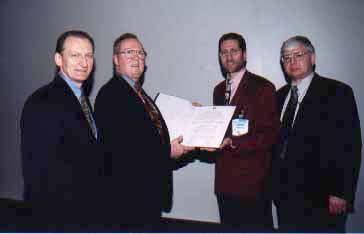
[James Moorer (second from left), who gave the 2000 Richard C. Heyser Memorial Lecture at the 108th AES Convention in Paris, Audio in the New Millennium, receives Technical Council recognition - via aes.org]


The SoundDroid is an early digital audio workstation designed by a team of engineers led by Moorer at Lucasfilm. It was a hard-disk–based, nonlinear audio editor developed on the Audio Signal Processor. Only one prototype was ever built and it was never commercialized. Lucasfilm  started putting together a computer division right after Star Wars as an in-house project to build a range of digital tools for filmmaking. The audio project that became SoundDroid was done in close collaboration with the post-production division, Sprocket Systems, and later spun out as part of a joint venture called The Droid Works. Complete with a trackball, touch-sensitive displays, moving faders, and a jog-shuttle wheel, the SoundDroid included programs for sound synthesis, digital reverberation, recording, editing and mixing. EditDroid and SoundDroid were the beginnings of the desktop tools digital revolution.


MM: Mr. Moorer, who developed the concept of a "digital audio workstation", during those early days? How did you collect the ideas for the ASP?

JM: It was my idea from back in my days at Stanford University. My 1977 paper describes a "digital recording studio". The digital audio processing station and digital audio workstation came out of that work. I first coined the term "digital audio workstation" in a talk I gave at the AES. A paper from that talk came out in 1982, but I don't think the term "digital audio workstation" made it into the paper.

Andy Moorer, the director of Audio Research, was moving ahead with the design of the digital audio processor, the ASP. [...] The sound work centered on the invention of a brand new set of chips that could perform the special kinds of calculations required for digital audio. [...] Designing new hardware chips was a long and complex process. Once the engineer determined precisely what needed to be done, and perhaps executed the various algorithms in sofware, he needed to translate the software into fundamental logical steps that could be built with wire and chips. [...] This process of chip design, finding the best position of the chips on a board and the most efficient way to wire them together, was expedited by using specialized CAD software.
By summer of 1982, after most two years of work, Andy Moorer and his cohorts finally completed the first working prototype of the audio computer, the ASP. The massive ASP consisted of eight oversized boards assembled entirely by hand, requiring more than 3.000 IC chips. It represented a number of significant engineering breakthroughs.
[excerpt from Droidmaker
]


MM: Who's missing from this list of your crew at that time: John Max Snell, Curtis Abbott, Jim Lawson, Bernard Mont-Reynaud, John M. Strawn?

JM: That about it. John Snell worked on user interfaces (touch-sensitive screens, assignable knobs, moving faders and shuttle wheel). The other folks worked on software.

John Snell had met repeatedly with Ben Burtt and the rest of the Sprockets sound team. They all felt that the audio computer had to look and work pretty much like the traditional tools they knew. [...] Though Ben wanted the flexibility that digital processing and random access might provide, it couldn't be at the cost of changing the interface.
"We felt that you could use one knob or slider and have the sofware change its function," said Snell, "and a console could be built with perhaps eight sliders, or twelve, but not a hundred. [ The old console design ] simply wasn't practical."
Before Peter Nye arrived to the audio project, the ASP was controlled by a command-line interface, much like MS-DOS, and a small box of knobs that John Snell had built for Ben Burtt. Peter Nye, a computer-music student of Moorer's, implemented the paradigm on the SoundDroid for a film-oriented system, which traditionally viewed tracks running vertically, from top to bottom. The new SoundDroid interface featured Snell's touchscreen and a novel by-product of the digital audio: a waveform of the sound. [...] The Droid Works trademarked the feature as "See the Sound."
[excerpt from Droidmaker
]


MM: Are you the co-founder of CCRMA at Stanford University? Later, how was your experience in Paris @ IRCAM?

JM: Yes, with John Chowning, John Grey and Loren Rush. It was an interesting experience at IRCAM. I enjoyed my time there. I did not enjoy the internal politics.


MM: Did you help John Chowning during his research of FM synthesis? What kind of sound synthesis run in the ASP?

JM: Yes, of course. I designed the original hardware FM synthesizer that was the basis of the FM patent. Yamaha later built that particular device. We could run all kinds of sound synthesis on the ASP - FM, additive (Fourier), subtractive, whatever.


MM: Thanks to George Lucas who subsidized pure research, for the first time in the movie history scientists and filmmakers were together under the same roof (The Droid Works). What were the big hurdles from the machine-side and from the human-side during the development years?

JM: Technically, the problem was just that we didn't have a lot of the modern technology, like computers with 1 GHz processors and 1 GByte of memory. We had to build all the technology we used. From the human side, people were having trouble understanding the workflow in the digital audio world. I had a very, very difficult time selling people on the idea that you could do "scrub" or "reel-rock" on a computer, rather than by sliding a tape over a head. Someone even suggested that I use the top of a tape recorder as a computer interface, even with no tape on it, so it would "feel" the same. Today, nobody even knows that audio was edited using razor blades and scotch tape.


ASP does for sound tracks - the band of squiggly lines at the edge of a film that encode the film's sounds - what EditDroid does for images: it uses its silicon circuitry to mix, edit, and even synthesize the music, speech, and sound effects so important to film makers, especially somebody like Lucas for whom sound is as important as sight in stirring the emotions of an audience. ASP has already been used to heighten the drama - by changing the pitch of a scream, for example, to make it more chilling - in the current hit Indiana Jones and the Temple of Doom, co-produced by Lucas and Steven Spielberg. Lucasfilm's sound mixer is even more ambitious technologically. Today's films have as many as six sound tracks to drive the multiple speakers in many theaters. But even these are usually the distillation of many more tracks. Project chief Andy Moorer points out that in a film like Return of the Jedi the sounds in a typical scene may represent a mix of 70 separate tracks of dialogue, music, and audio effects. A single change in one of the original tracks - say, the boom of a rocket or the pitch of a siren - would require remixing all of them. Jedi needed only five film editors but 17 sound editors. "What we set out to do," says Moorer, "Was to put a computer in the middle of all of this." That was not easy: just as the visual images must first be converted to electronic signals for EditDroid, so the sounds must be turned into digital form for ASP. This means every flutter of noise has to be translated into the "on-off" binary language of the computer. In other words, the sounds become numbers.
[excerpt from Discover Magazine, August 1984
]


[ 1 | 2 | 3| Next ]

Friday, January 30, 2009

About 'Haptics'

What is Haptics?

"Haptics" comes from the Greek word Hapesthai, meaning "the science of touch."

The world of haptics is expansive by definition. It is the field of science and technology dedicated to tactile sensation, and it has applications for everything from handheld electronic devices to remotely operated robots. Yet outside of the research and engineering community, it is a virtually unknown concept. “People don’t even recognize the word ‘haptics’ yet,” says Ralph Hollis, director of the Microdynamic Systems Laboratory. “You have to spell it for them.”

In an age of digital devices that stimulate and amaze the eyes and ears with increasingly high fidelity, haptics has been employed mostly in relatively un­sophisticated applications—rumbling video-game controllers and buzzers that alert you to a cellphone call. But as our digital tools have become more complex and capable, our interfaces with these devices are beginning to run into the limitations of sight and sound. “It’s really only now that we’re seeing a migration from keyboards and mechanical switches to touchscreens and touch-sensitive surfaces,” said Immersion, a company that produces haptic interfaces. “We’re losing that tactile feel that we had before, and now we’re trying to bring it back.”


Touchable Technology

Moving haptics out of the lab can be challenging. Tactile feedback in consumer electronics must be both convincing to the user and appropriate for the device. Broadly speaking, touch can be divided into cutaneous sensing through the skin surface (feeling the pebbly surface of a basketball), and deeper kinesthetic sensing from muscles and tendons (experiencing the impact when hitting a ball with a bat). But much of the recent haptic development in consumer electronics has focused on fooling the fingertips into feeling onscreen buttons that aren’t physically there.

General consumers will first encounter haptics on these touchscreen gadgets and desktop controllers, but the most sophisticated touch technology outside of the lab is found in industrial, military and medical applications.

[read more - via popularmechanics.com]

Saturday, January 10, 2009

The Klangdom (Sound dome) in the ZKM_Cube

Hightech instrument for spatialization at the ZKM | Institute for Music und Acoustics.

ZKM "Cube" (photo by Marc Wathieu)

The Klangdom was finished in 2006 after three years of conception, planning and installation. Forty-three Meyersound speakers are attached to an elliptical rig system three-dimensionally in the room, four additional ones are placed on the ground. With this unique speaker instrument, as the head of the institute Ludger Brümmer explains, "complex polyphonic space-sound-movements can be displayed realistically and perceived from every spot in the room".

It can be controlled via Open Sound Control protocol or can also be used as Audio Unit plug-in. Thus, the user can incorporate Zirkonium's panning capabilities into his preferred environment (including Digital Performer, Logic).

User interface of the control software Zirkonium, studio window

[more via zkm.de/zirkonium]
[Zirkonium Manual -PDF]
[Zirkonium - Installer]
[Zirkonium - Max/MSP and SuperCollider Examples]

Tuesday, September 30, 2008

Jazzmutant Lemur V2 on the blogosphere


The public beta of the v2 firmware update will launched by Jazzmutant at AES (October 3rd to 5th) with the full version released Q4 2008. The full update will be free.

Brand new features:

Breakpoint object: multi-segment envelope editor
Gesture object: trackpad emulation with advanced gesture recognition
Alias: memory and time saver
Tabbed Container
Mouse and keyboard control (!)
Improved and new-look Jazzeditor
New multi-line script pane

[Sonic State]
[Harmony Central]
[Mac Music]
[Gearjunkies]

Monday, September 22, 2008

Music On microSD: pros and cons

What is slotMusic [slotmusic.org]

Official Press Release [sandisk.com]

What's in the Cards for SanDisk? Music [bits.blogs.nytimes.com]

SanDisk SlotMusic Cards Are Destined to Fail [gigaom.com]

Music On microSD: I Can’t Believe The Labels Fell For This [techcrunch.com]

Tuesday, September 16, 2008

Sneak Preview: RAI Phonology Studio

In 1955, the Radio Italiana (Rai) established the Studio di Fonologia Musicale at RAI Center in Corso Sempione 27, Milan (Italy). Physicist Dr. Alfredo Lietti builded the famous “nine oscillators”, the white noise generator, the amplitude selector, the dynamic modulator, the ring modulators, the frequency shifter, the pulse modulator, the electronic fader, the “toc” generator, the cathodic comparer, the octave filters and the third octave filters.
Almost half a century later, the museum of Musical Instruments in the Castello Sforzesco now houses the equipment on which Luciano Berio and Bruno Maderna conducted the first experiments in electronic music.
An innovative digital library service allows the public to obtain informations and to listen to short excerpts from the rich archive of compositions carried out in such machines.

Maddalena Novati found about 400 tapes for 200 hours of listening, which she has been cataloguing, restoring and converting with the help of Laboratorio MIRAGE (Università di Udine) and Laboratorio Audio Rai (Milan).

I suggest you the following reading: "Technology and Technics: Alfredo Lietti and Marino Zuccheri", written by Giovanni Belletti [pdf].
Some excerpts from original footage:

[RAI Studio of Musical Phonology: historical footage #1]
[RAI Studio of Musical Phonology: historical footage #2]
[2007/04/rai-electronic-music-studio]
[2007/05/rai-studio-of-musical-phonology-pt-2]
[2007/05/rai-studio-of-musical-phonology-pt-3]

MM

more soon!

AES San Francisco 2008: ILM Technical Tour

Saturday, October 4, 8:15 am — 11:15 am TT10, TT11, TT13, TT15 - Industrial Light & Magic/Letterman Media Complex, SF.

Don't miss the opportunity to tour George Lucas’s storied Industrial Light & Magic complex at its new home on the Letterman Digital Arts campus on the Presidio.


Technical Tours are made available on a first come, first served basis. Tickets can be purchased during normal registration hours at the convention center (maximum of 20 participants per tour).

Wednesday, May 28, 2008

Interview with Surround Sound Specialist Rik Ede

Rik Ede is the founder and managing director of GAMESOUND Ltd. Rik has been making music for games for over 18 years, 10 of which have been spent creating music in 5.1 (and more recently 7.1) surround sound.
Rik is considered to be the world’s leading authority on surround sound in games having spent 5 years working for Dolby as 5.1 evangelist, 2 years as a consultant to DTS and more recently Rik has just finished a 2 year stint as the PLAYSTATION® 3 surround consultant to Sony's R&D group.

[read the interview - via music4games.net]

Wednesday, December 05, 2007

Jazzmutant: Dual Mode Capability

JazzMutant introduces the Dual Mode capability for the Lemur and Dexter controllers.

The Lemur is dedicated to anyone who's looking for maximum modularity and customization of their controlling experience. The Lemur can adapt to all kinds of applications, from live Djing software to light control and interactive media arts.

Dexter is a dedicated solution for studio professionals looking for a complete and easy way to get access to all features of their Digital Audio Workstations. Dexter provides in a minimal form factor functionalities only expected from large bulky desks, and introduce novel ways to get in touch with your DAW.

You can now get both on one single device: the Dual Mode capability lets any Lemur or Dexter run the two feature-sets on the same machine. Since Lemurs and Dexters are based on the exact same hardware, installing the Dual Mode capability allows you to select Lemur or Dexter functionality when booting up your controller, effectively doubling the potential for your JazzMutant hardware.

The upgrade will be free to all Dexter users.
Lemur users will be able to upgrade to dual-boot for 390 euros.

Sunday, November 25, 2007

The target consumers are (not ) audiophiles (?)

"...over the last decade the ranks of true audiophiles have been thinning, in large part because of the growing popularity of MP3 players and iPods. These nifty devices enable you to store thousands of hours of your favorite music and take it with you as you bop through your day. You can listen while shopping, while jogging or even, depending on your job, while at work. No one, not even devoted users of MP3s or iPods, claims that the sound reproduction on these technological marvels is equal to that of the best home CD systems. After all, they work by eliminating some of the digitized sound bits to open up storage space for multiple compressed files of music, rendering the sound a little thinner. Still, for consumers, easy access has trumped high fidelity".

[via nytimes.com]