Showing posts with label Pixar. Show all posts

Tuesday, November 19, 2013

Gary Rydstrom - Unexpected Sounds

Here's my guest post "Gary Rydstrom’s Talk from VIEW", originally published on Designing Sound


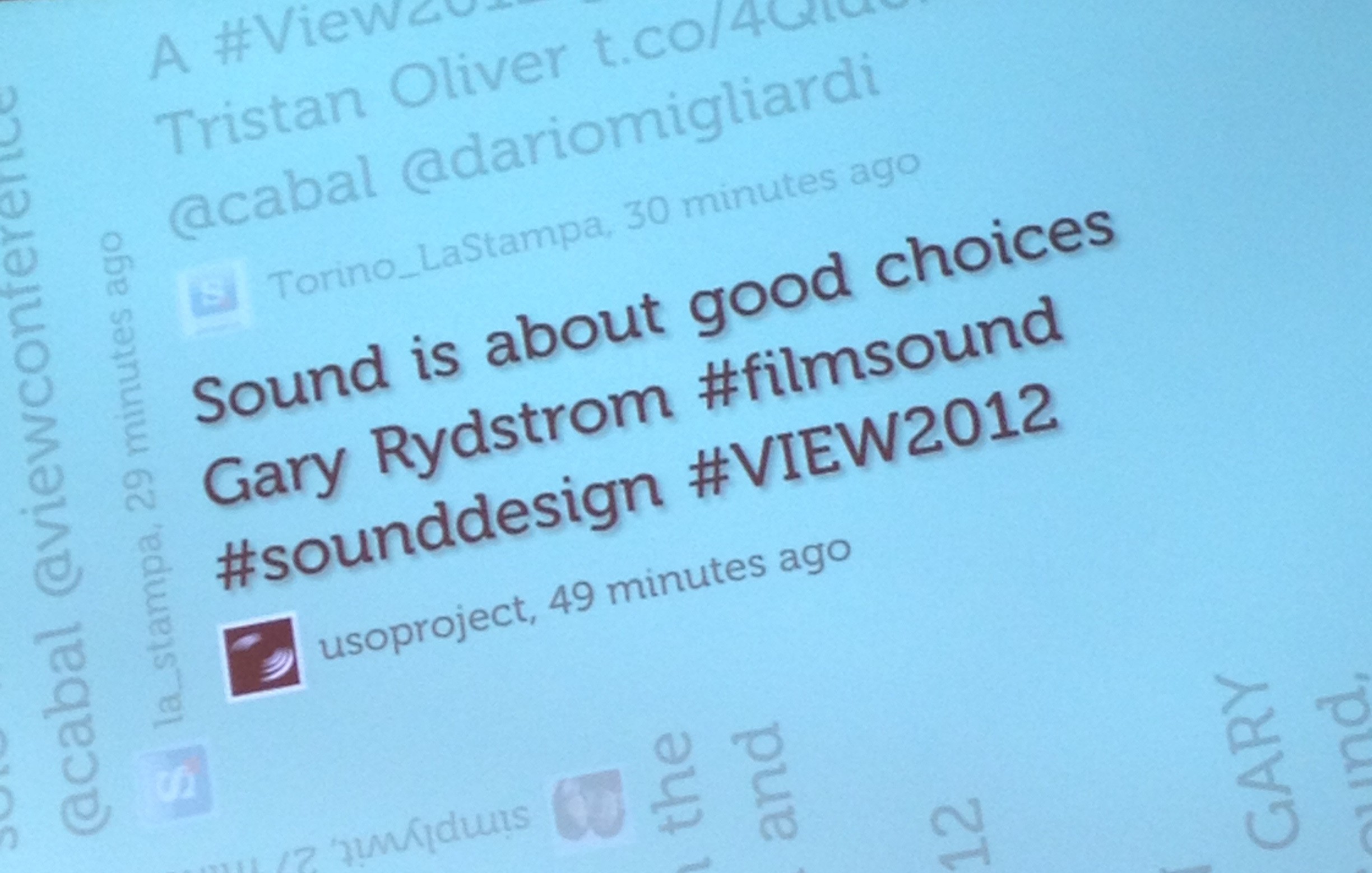
Last year, Skywalker Sound’s Gary Rydstrom, joined for the first time the roster at View Conference – Italy’s leading computer graphics symposium – following Randy Thom in 2011. His feature presentation was called UNEXPECTED SOUNDS. The 19th October 2012, inside the Cavour Hall, at the conference center “Torino Incontra”, professionals and sound lovers coming from different countries, gathered to be part of this unique moment.

Now, we have the opportunity to present here at Designing Sound, the polished session of Gary at VIEW. The recording I made directly from the console to my Zoom H4 has been possible thanks to Maria Elena Gutierrez, director of the Festival. In this one-hour podcast, Gary talks about the art of sound design and illustrates how sound is being used and how it can be better used to tell stories. You’ll listen to many examples of raw sound effects recordings, designed sounds, and mixes from Pixar films, and live-action films such as “T2,” “Jurassic Park” and “War Horse”.

Enjoy… and thanks Gary for your invaluable experience!

Matteo


A special thanks to Shaun Farley and Peter Albrechtsen

Saturday, October 13, 2012

Randy Thom @ VIEW Conference 2011


On Friday, Oct. 28, 2011 VIEW Conference hosted a Master Class with Randy Thom, Director of Sound Design at Skywalker Sound. He is a firm believer that the sooner the sound designer is involved in the pre-production, the better the story can be told. Randy illustrated how sound can shape a film, talking about how doors can be opened to sound. He also shared clips from movies where this kind of early collaboration has happened. Here's an excerpt of his talk during the workshop.

Sound as a full collaborator to make better films 

Alan Splet, Walter Murch and Ben Burtt where the three people who lived within about 20 miles each other near San Francisco who really brought a new revolution into American film sound during 70s. I was lucky enough to work with all three of them and “steal” some of their best ideas. One of the first things that you learn as a sound designer is not think to literally about sound, so one aspect of training your ear is to interpret sound in emotional terms. Subjectivity in filmmaking is a playground for sound: when the audience understand that they don’t figure out consciously, but what they seeing and hearing is being filtered through a character’s or filmmaker’s point of view in a subjective way. Very often working on a sequence for a film what you want to do is think of how you want the sound to make people feel and you analyze what it is about that sound makes you feel certain way and you go looking for sounds or raw material that have those qualities. 


Apocalypse Now

If there was ever a film where sound and image were treated more or less equally and allow to affect each other certainly is Apocalypse now. The first sound that you hear in the film - before any music or any dialogue - is a very odd, electronically synthesized helicopter sound - the Ghost Helicopter. Captain Willard is hearing the memory of the helicopter that he has. What you’re listening to is this guy’s brain. He’s remembering things, he’s hallucinating, he’s dreaming, he’s drunk and under the influence of drugs, he’s listening to his brain operate. The opening sequence is the launching point for all story, immediately the audience is put in a frame of mind that anything can happen, this is going to be a very strange ride. As he stands at the window looking outside he might heard a little fly buzzing: it took me a week to record that fly (laugh). At first he hears - and we hear - the sound of Saigon outside (car horns, Vespas, police whistles). Those sounds morph into the sound of the jungle: each one of those individual city sounds turns into specific jungle sound. Physically for the all sequence he’s still in his hotel room, but in his mind he moves back into the jungle.


Once upon a time in the West 

Sergio Leone decided early on that they will record all the music for this movie before they started shooting the film and they used the music during the shooting to help the actors and essentially to inform how the film is going to be shot. They were struggling how to make music and sound working together before shooting the sequence. Ennio Morricone, the composer, happened to go to a musique concrete concert - a genre involved using real world sounds, rather than traditional musical instruments - by a guy who played a latter, banging and scraping on it. Then he called Leone and said: “There’s should be no conventional music at all in the beginning of the film: instead you perhaps should shoot around the sound effects.” Leone went shooting the sequence thinking about how the sound of this little train station were going to work in the storytelling.

I think that’s a tragedy that very few studios these days will have the guts to allow a filmmaker to do a sequence like that. They say: “People are going to be bored, we have to fill up with uptempo music through the all thing”. Some budget filmmaking these days is “fear based”, it’s not an attempt to do something new, interesting and unusual, to open people imagination. It’s an attempt to avoid boring people, which is never a good motivation in art.

One of the things that these two scenes have in common is a very strong sense of point of view. Camera angle are very important to sound, believe it or not. The kind of shot, where an actor looking at nothing in particular, is another open door for creative, subjective sound, because the audience knows intuitively that they’re going inside the character’s head. It’s an open door for sound designers to put almost any kind of sound that we want. Having some ambiguity or mystery about the visual image makes it easier for me to do something useful with the sound. Extreme close-ups get across the idea of subjectivity. Long duration shot opens the door for sound, too. The character’s closing eyes is also an opportunity for sound to do something interesting (imaging, remembering...). The most difficult kind of shot is a brightly-lit medium shot, because you’re not focusing on anything in particular and there’s no mystery there, there’s nothing that invites the ear to help figure out what’s going on.

Another element they’ve in common is sparse dialogue. I’m certainly not against dialogue in film - dialogue will always has a role. Dialogue and sound design generally don’t go well together, because there’s something about the human voice that the human ear want to attempt to.
If someone is talking - no matter how hard a director ask me to try to push sound effects during that sequence - it will distract you from the dialogue, which the audience is trying to hear. The way to solve that problem is to design the sequence in a way that there are moments for the dialogue and moments for sound effects. A compromised has to be made, you can’t as a filmmaker try to fire all your bullets at the same time, it’s not going to work. One category of sound tends to dominate at a time - it’s dialogue, it’s music or it’s sound effects. Another bad tendency in contemporary filmmaking is to try to set it up so that all three dominates simultaneously, it will never works. Lazy filmmakers will just call the composer: “make some very strange music telling the audience that this is a very strange place”. As a sound designer you try to do things and variations in the same way a music composer, to use sound in pure musical way: tempo, harmony and rhythm to evoke emotion. Think about what elements in a set could generate the sound useful for the storytelling: this will be more powerful at the end, it’s not a decoration, that’s a very organic way of telling the audience “this is a very strange place”.


Sound-friendly scripts

Most writers are obsessed with words, and they tend to think words should dominate every sequence, with wall-to-wall dialogue.
Filmmakers simply don’t think about how to use sound in that way before start shooting the sequence. Think about what the characters hear. Think about how the things they hear affects them and how character changes over time. I often found people who come from visual/light background - which David Lynch did - have very interesting sound ideas. He demands you to be creative all the time.

Another thing I told to directors is: during rehearsal in a live action scene, play with your actors in terms to find things in the space that can make sound that will be useful to the story.
As a sound designer, try to imagine ways that sound could playing in an interesting but organic, truthful way to help the storytelling in the sequence. Try to think to other powerful sounds that the audience doesn’t expect. Part of your job as a sound person - I think - is to help the director make the best film possible. If you have interesting ideas - and you should have them - about the way of film shooting that allow you to do something you couldn’t do otherwise, of course you should talk about it.


Sound for Animation 

Thanks to big aesthetic jumps in animation, more contemporary animation directors want movies should sound like a live-action movie. For “How to Train Your Dragon” I come up very early on with some speculative vocalizations for the dragons that will help the animators to animate to those elements. I tried to use real-world animal sounds - tiger growls, elephant, whales, goats, camel, dogs - to cover a wide range of emotions, allowing sound to influence the animation. The challenge is how to make the transition from one to another, which needs a lot of work and experimentation with pitch-changing techniques.


Sound Mixing 

Mix is about to choose right or most powerful sound in any given moment. In a moment when you need to hear the dialogue you try to artfully lower or eliminate sets of other sounds that are competing with the dialogue at that moment. Space can make sounds useful to the story: there are a lot of others tricks like moving the sound effects and the music into the side loudspeakers and have the voices mostly come out from the center speaker, which make a little bit easier to understand the lines of dialogue. Sound is more powerful if comes from a place we doesn't expect. You need to think of sound in terms of spectrum and frequencies and tailor those for a given moment.


Related Post:

Sunday, December 04, 2011

Pixar Animation Master Class at 66th Venice Festival

On Sunday, Sept. 6, 2009 George Lucas presented John Lasseter, Andrew Stanton, Brad Bird, Pete Docter and Lee Unkrich with the Golden Lion for Lifetime Achievement at Venice Film Festival. This is the first time in the Festival’s history that the Lifetime Achievement award has gone not to an individual filmmaker, but to a team of filmmakers. The next day, the Festival hosted a Pixar Animation Master Class on storytelling: during this rare and exciting panel dedicated to the Pixar filmmaking process, the directors discussed the various aspects of bringing their stories to life.

 
[Photo credit: graphicalSound]  

John Lasseter 

Animation is the most collaborative among art forms; one of the things that is very special about Pixar is the collaboration, never has a studio been so collaborative.
At Pixar we make films to entertain our audiences, all across the world, both children and adults. We make movies for ourselves, the kind of movies we would like to watch. We all have kids, we all love movies and we all love animation and this is what we wanted to do from the beginning as filmmakers. We (the creative Brain Trust) get together to help each director to make the movie the best it can be, and the director knows that. And so he takes the notes that make the movie better.
One of the things I remember more clearly of when I was a very new animator at Walt Disney, is a great professional called Ollie Johnston, a fabulous animator. I was not a great drawing person, my students were a lot better than me. At that time, when I was struggling drawing in a scene, he took my stack of papers and started flipping it. And I thought he was going to start talking about the drawing. But he turned to me and he simply asked: “What is the character thinking”? That simple statement from this guy hit me so strongly, that it became kind of a foundation of everything I have done after that point.
When you look for “animation” into the dictionary, one of the definitions is “to give life to”. The thing that I have always loved about animation is creating life. In our films the animator and the animation are the act. An animator must animate a character so that every single movement appears driven by that character thought process. That is when it becomes a thinking character.
You are moved by these characters, you believe in these characters. All the meticulous and hard work should be completely invisible. We wanted the audience to be involved in the scene and not to think that Nemo is a bunch of computer layouts. We do not want you to think about the many hours that took to create that scene. You are just carried away by the scene and every focus in every step of the production that we do at Pixar is about the story. It is about entertaining the audience.
We are constantly changing and growing, trying to make things differently. One of the things I stress in animation, is that you have to show your stuff really early: every single morning each animator shows his stuff so we can be sure they are on the right track. I also get inspired by what the animators do without telling them to. In Pixar we have a room with a video camera and mirrors so they can actually try out the acting of the character.
Walt Disney once said: “for every laugh there should be a tear.” This is the foundation of every Pixar film. This is not about animation, it’s about making films. I say something to my sons: “I want you to choose a profession that you love, because if you do you’ll never lose a day in your life.” And this is true for everybody, we work so hard, many long hours, but we so dearly love what we do.
Now we are going step by step through the entire process on how we make a movie, on how we develop stories and on how we can tell a story visually. 


Andrew Stanton 

In Pixar there is no politics, we are all employees, we do not have agents, no creative executives, no deal-making. We are very similar to the old studio systems where the artists work under one group on multiple projects: I’d like to call it a film school without the teacher. It’s a filmmaker driven studio, we invest in people. As John has previously described, we have a creative Brain Trust where the directors get together sort or like doctors conferring on another doctor’s operation. And we also have in-house original ideas, based either on ideas that the directors had, or stories the directors like or want to invest in. We pick one idea and we hammer on it. Again and again, until it finally is good enough to show other people.
First of all it is not just for kids: basically we make the movies we would like to see, we are film-goers first and filmmakers second.
We work hard on making movies as original as we can, in other words we think more like our own audience, what I’d like to see if I were the audience who wants to enjoy themselves as much as they did on the last film, but every time in a new way.
Being stupid is only possible if you are in a creative estate environment. So the truth is that we are not good at getting it right at Pixar, but we are really good at getting it together when we are getting it wrong in fixing our mistakes. And I think that’s really where our specialty lies. And the variable is that we have discovered something fresh from having made those mistakes. So we don’t try to avoid it, we embrace the idea to make mistakes.
The script is not the end of developing a story, it is the beginning of it: to me screenwriting is not writing, it is an intermediary form, it’s a way of passing all the ideas in your head to the screen. It’s also what I’d like to call cinematic dictation. You’re just basically notating what you have seen in your head, when you are trying to catch the visual aspect of something.
We just wanna tell 2 + 2 and let the audience decide on what 4 is. And that’s really the way to construct anything. The way dialogue is done, the way actors act. The way scenes are put together. I think you can apply it to any aspect of film-making. It is all about audience participation. Movie-making is all about manipulation, but it is only truly successful if your audience has no idea that they-re being manipulated. In most cases 2 + 2 gives you a greater sum than 4.
How you tell the story becomes as much important as the story itself. Even a great joke can be murdered by a bad joke teller. So the joke and the joke telling are equally important.
Personally I think you have to develop both characters and plot simultaneously. Plotting to me is your means of discovering the character. Then once you have found what that character is, you have to link them together, one begets the other.


Brad Bird 

If we are going to talk about breaking the rules, we have to know what the rules are. And this is what storyboarding was traditionally used for, it was used to work out business for the characters, what the characters were doing.
I got my first opportunity to do my first feature film, it was Iron Giant. I had a third of the money and a third of the time I had for the other animated films of our competitors. So I dealt with something unfamiliar with animation, this was Warner Brothers, not Disney. They had limited power with visual imagination, so we had to find a quick and relatively cheap way of getting closer to what we were envisioning. We spent a larger percentage of our budget on storyboarding, because it was the cheapest place to make the stage. We couldn’t afford to do anything else, we got to look and know exactly what we were doing before we did it.
When I came on to Pixar to do The Incredibles, we had a different sort of problem. It was to enlarge the scope without enlarging the resources. I had way more resources than I had for Iron Giant, but the scope of the film was so huge.
The Incredibles was a fast cutting film, large location to a large shot camera, the only way to wrap our heads around it was to figure it out early. The downside of that is that you’re kind of locked in. The upside of it is that you know much more about the rhythm of the film and the specific needs of each shot.
Film is alive, it is a medium, it is a dream medium and dreams are unpredictable. There is a difference between sleeping and dreaming. One is active and one is throwing yourself off balance. Don’t take anything for granted: it’s a way to keep your company, your movies and yourself alive.


Pete Docter 

Everything you see on the screen has an emotional charge. Characters, locations and the props in there exist for very specific story reasons. This is the primary job of the set designer. The first question a production designer should ask himself is: “what is the story about emotionally”? Designing for computer animation has no accidents, everything you see has to be intentionally designed, built, shaded and lighted.
Film-making is discovery. We do not just start drawing, we do a lot of research. The sense of authenticity really helped us capture an emotion. We wanted to look authentic.
The primary job of the lighting is to direct the eye. There is a whole lot of tricks to make sure people are looking where we want. The second job of lighting is emotion. And John (Lasseter) says that light is much like music and can really emotionally affect the eye. We are all trying to get inside the head of the character. Use light to represent how that character is feeling.
Lighting really works the same way it does in live action, so you have lights everywhere to get the final shot. Lighting is not left to chance, everything is planned for an impact. The quality of work is due to the fact that we are working with some of the best professionals in the world. The ultimate goal of lighting is to make the audience feel something.

Related Post:

Pixar: 25 Years of Animation Exhibition


The Pixar exhibit that was originally displayed in 2005-2006 at the Museum of Modern Art in New York City has been touring the world. Now, it's running from November 23rd 2011 to February 14th, 2012 at PAC (Padiglione d'Arte Contemporanea), Milan (Italy).

 [www.mostrapixarmilano.it]

[follow @leeunkrich, @andrewstanton, @Pixar_Mi on Twitter]

Friday, June 24, 2011

An interview with Gary Rydstrom

by Matteo Milani and Federico Placidi - U.S.O. Project, 2011 


Gary Rydstrom was born in 1959 in Chicago, IL. He graduated from the University of Southern California - School of Cinematic Arts in 1981. He began his career at Sprocket Systems, formerly Skywalker Sound, in 1983. Offered the job by a college professor, Gary received the opportunity to work with his mentor, Star Wars sound designer Ben Burtt. He created sound for numerous successful films including Backdraft, Terminator 2: Judgment Day, Jurassic Park, Titanic, Saving Private Ryan, Minority Report and Finding Nemo. Through this work he has won 7 Academy Awards.
Rydstrom did his first work for Pixar on the short film Luxo Jr.. John Lasseter has said it was Rydstrom's work on Luxo Jr., such as creating the lamp's voice from the squeak of a lightbulb being screwed in, that taught him how sound can be a partner in the storytelling of a film. In 2006 he has made his directorial debut with the Pixar animated short Lifted. He recently jumped again into the director's chair to create his second animated short Hawaiian Vacation, set to play in front of Cars 2


[Rydstrom talks about the first of Pixar's new brand of Toy Story shorts @ AWN] 

For every director and for all of us the goal is at any one moment in a movie to have the audience on the edge of their feet and can't wait to see what happens next. You are moved by these characters, you believe in these characters. All the meticulous and hard work should be completely invisible. We wanted to be involved in the scene and we don’t you to think that Nemo is a bunch of computer layout. We do not want you to think the many hours that took to create that scene. You are just carried away by the scene and every focus in every step of the production that we do at Pixar is about the story. It is about entertaining the audience. - John Lasseter, 66th Venice Film Festival 


USO: Gary, you’re the third person – of our personal “respect-list” – who came from a sound career and crossed over to a director’s chair: Walter Murch did it first, Ben Burtt came after him. They still design their own sound for their works, just as you did for your first short movie Lifted (with a tribute like the Wilhelm Scream at the very end). How did you manage the transition from sound designer/re-recording mixer to director? How about your feelings?

Gary Rydstrom: Working in film sound is a great way to immerse yourself in the rhythms of a movie. Having done sound for so many movies, and so many different kinds of movies, I’m hoping I’ve developed some mysterious “film instinct.” I think the best directors – and best sound designers – work more from their gut than their brain. In other words, to make movies, your gut has to be bigger than your brain… or maybe I should rephrase that?


GR: "It was a little scary but I always wanted to make films and wanted to have opportunities to write and tell stories. So Pixar being old friends, they gave me this opportunity to come over there and do that. So it was a little scary because there were a lot of things I had to learn. But doing sound for so many years, what I found was that the big similarity is that sound is all about rhythm. It’s about using sound, rhythm helps delineate sound effects, sound tracks, and telling a story with these kind of rhythms is really key. Animation is really about rhythms and timing so I think working in sound gave me a great sense of timing. In fact, on Lifted I used, before animation had been started, used a temp soundtrack to express the timing that I wanted to the animators so they had some reference of what I was after. It was a way for me to even communicate to the animators." - CanMag


[Lifted producer Katherine Sarafian and director Gary Rydstrom © AWN Inc]


USO: Did you develop and learn your new craft in sound room working movie by movie?


GR: Central to sound design is finding what feels right for a movie, what matches its look and heart. So every movie I worked on taught me different lessons. I kept thinking I was close to end of my lessons, but they never ended. Turns out that’s what makes working in film fun. It’s never the same twice. 


USO: Being close to first-class directors during all your sound career has thought you well?

GR: I felt like a spy, watching a lot of directors. I’ve been very lucky to have worked with many of the best – Spielberg, Cameron, Lasseter, Redford – and you probably don’t need me to tell you (their movies do) how different in approach they were. One thing the best have in common: they inspire their crews.


GR: "... I've had this long, great relationship with John Lasseter and Pixar. I've felt involved throughout the whole filmmaking process on their films. They offered me an opportunity to develop and direct films, maybe because I bring an outsider's perspective while still being a Pixar guy through and through.
My friends there know that I've had a long-standing love of comedy. When I first told Steven Spielberg and George Lucas that I was doing this, they were touchingly supportive and generous with advice. I'm grateful for my sound career. It gave me the equivalent of 50-yard-line seats, second row, during a fascinating era in film history." - Mix Magazine


USO: Can you describe what you were feeling when you left the Technical Building (where you spent almost 20 years), and all your friends at Lucas Skywalker Sound, to your new life/experience in Emeryville?

GR: Luckily I get back to Skywalker Sound quite often, otherwise I’d REALLY miss my old friends and career. Pixar’s no slouch, but there isn’t a more beautiful place to work than Skywalker Ranch. 


I've known Gary for over 20 years and he's really been a mentor and a role model for me, as to how to do this work. His standard for quality, inventiveness and humor is really always in the back of my mind when I work. No one is a quicker study when you break down a scene or a film in terms of what, soundwise, is the best direction to go to serve the story. - Tom Myers, Skywalker Sound 


USO: What does it mean for you to associate a particular sound to a visual event (identifying it in a vast catalogue as big as the sound library of SkySound)? What are the mental or purely instinctive paths competing in making the choice?

GR: Something magical happens when a sound effect is added to picture – and it’s not predictable. After all my years of doing it, I still depend on experimenting, putting sounds against image and seeing what happens. First time I did this, as a film student, it amazed me how sound could “open up” a movie, how the combination of sound and visual could create something greater than the sum parts. Having a great sound library is essential, but the real secret is how one uses it. 


GR: "I wanted to give the lamps in Luxo Jr. character through sound. I told John (Lasseter) that I'd come up with these voices. He'd never imagined they'd have voices and was wary of the idea. But I experimented with taking real sounds — a lot of it as simple as unscrewing a light bulb or scraping metal. Every once in a while, a sound would be produced that would remind you of sadness or glee. I always think of sound design being like prospecting for gold. Start by, say, goofing around, making lots of sounds, then find the one percent that has something interesting about it. Put this against the film, and there's a magical moment when the sound, if it's right, merges into the image, brings it to life. They were not cartoon-y. They were fun, reality-based sounds. It felt like the birth of something new, even then." - Mix Magazine


USO: Many sound artists working in other domains like electroacoustic music, musique concrete, environmental sounds has been strongly influenced by the contemporary cinema, and by its ability to create stories with the help of sound effects, soundscapes and even to define the personality of some "objects" with unmistakable sounds. How it is possible to interrelate these multiplicity of experience? 

GR: What all sound artists share is a desire to convey emotions, so I certainly was inspired by non-movie sound work. Sound is emotion. Not just music, but all sound. Humans (who can hear) seem to take sound in general for granted, which is frustrating, but liberating. How manipulative can we be when no one’s paying attention! 


USO: While Europe was experiencing electronics and sound design like natural language consequence of the avant-garde of 50's, in the U.S. this journey took place independently in the field of the film industry with other purposes and objectives. You were aware of what was happening in the old continent and its experiments?

GR: I’m certainly aware of the European traditional of producing “soundscapes” (for lack of a better word) for radio. In some ways, I was jealous of sound work that didn’t depend on the visual – how free it seemed! Best I could do was build an “off-screen” world in film. But I always had a movie to be influenced by – how scary to have sound work stand on its own. 


USO: You've been one of the most assiduous "regulars" of the Synclavier, an instrument widely used in various musical fields. Can you describe the creative approach with this tool? What were your procedures? What made it such as a instrument so unique? To create the sound of the engines of the Titanic you and Chris Boyes worked long on the Synclavier to reproduce the effect in question. Do you remember how you did it?

GR: I fell in love with the Synclavier early in my career because it was such a powerful instrument for shaping natural sounds. I never used the FM synthesis – even making electronic sound effects I would try to use natural sounds, just because I find real sounds are more interesting. Sampling sounds and putting them on a keyboard allowed me to quickly experiment with pitch and layering, which are my primary tools for bending real sounds to my will. The Titanic engine sounds took advantage of how the Synclavier could speed up and slow down a sound pattern. For me, nothing beats using a “musical” instrument for creating sound effects.


GR: "The idea of using a sampler for sound effects work had astonishing potential. With sampled sounds in RAM, you can instantly pitch-bend it and layer it and play it and shape it, without using any processing time. You can layer on the same key and very finely manipulate the pitch and delay and merge them together in ways that were harder to do in the tape-to-tape days. It allowed me to create the dinosaurs in Jurassic Park, in which I took several layers and blended different animal sounds into what sounds like one animal.
With the Synclavier, I have a library of sound “parts,” little snippets that are like phonemes in language. Interesting bits of sound that can be rearranged in multitudes of ways. It's a library of raw material, and it's valuable still." - Mix Magazine


USO: How about your relationship with Ben Burtt along your sound career and especially now in Pixar? I mean crosstalk and dialogue, to share ideas. Could you describe him as a mentor, a friend, a colleague, a druid?


GR: All of my approaches and philosophies about sound come from Ben Burtt. At the time he was revolutionizing sound design, I was lucky enough to get a job at Sprocket Systems and see how he did it, how much he knew about film sound history, and most importantly how much he cared about using sound to tell a story. When I started working on Jurassic Park, I remember Ben was away on vacation. I stumbled along until he came back – for all sorts of reasons, psychological and practical, I couldn’t get started until he was in the building.


[Gary Rydstrom Talks About Cinema Sound - via DolbyInsider]


USO: Nowadays many sound designers are working in nonlinear environments like Pro Tools, Nuendo with tons of plug-ins to make everything. One thing we always admired in your work is the exquisite and unfailing "organic" sound and his innate musicality. It seems that sounds "exist" in nature and are not a product of a skilled craftsman. Would you like to talk about that?

GR: There’s a danger in processing sound too much. I believe the best sound effects come from the best raw recordings, and are tweaked as little as possible. The world is so full of amazing sounds – sounds no synthesizer can match – so why not find them and use them?


GR: [...] I remember a scene in the first Mission Impossible in which Tom Cruise breaks into a computer room at the CIA, for which we’d added all these sound details for equipment he was using to lower himself in. Yet the idea was that if he made any sound over a certain level, he would trip the alarm. Brian De Palma ultimately said, “No, take it all out.” And for the most part, that scene plays with nothing on the track. I went to see it with an audience and it had the desired effect: It made everyone lean in, pay closer attention, get nervous. Tension comes from the silence of that scene.
[...] Silence can be thought of as a type of sound. It’s like when somebody years ago figured out that zero was a number. And silence is just as valid as an amazing sound. Every sound editor can’t help but think of how to fill up a track; it’s what we’re paid for. - excerpts from “From here on in, absolute silence.” [via Benjamin Wright]


Thanks Gary... keep up the good work! M&F

Friday, July 30, 2010

Ben Burtt to present "Emma's Time Machine: Adventures in Time and Space"

While reading this article by Paul Liberatore (via Marin History Museum), we discovered that our hero Ben Burtt just finished editing "Red Tails", the upcoming movie about the Tuskegee Airmen - the African-American pilots who fought in World War II (produced by Lucasfilm). And he's about to start sound work on the first live-action film by Andrew Stanton, "John Carter of Mars".

Ben will join his daughter Emma Burtt for the premiere of Adventures in Time and Space, the latest chapter of Emma's Time Machine, a 90-minute documentary on the history of Marin County. Narrated by Emma, the film also takes a look back at the early days of Lucasfilm in San Anselmo and includes clips of the Marin County locations used for motion pictures, from the days of silent movies until Indiana Jones.

"This film is really the result of a lot of little stories," Ben Burtt said. "I decided that we'd try to connect them all together in a kind of walking tour idea that juxtaposes the past and the present. It's nostalgia. I've always had a great interest in finding some way to connect with the past."

[Dad-daughter film team makes time to go back in time]
[Emma's Time Machine: Adventures in Time and Space - via California Film Institute]

Monday, May 03, 2010

Lee Unkrich on editing animated film

by Matteo Milani - U.S.O. Project, March 2010

[click the image to visit the TS3 page - via iTunes Movie Trailer]

Lee Unkrich is a longtime member of the creative team at Pixar, where he started in 1994 as a film editor. Unkrich graduated from the University of Southern California School of Cinematic Arts in 1990. Before joining Pixar, Unkrich worked for several years in television as an editor and director.  He came to Pixar on a temporary assignment during the development of Toy Story and he later moved into directing, as co-director of Toy Story 2, Monsters, Inc., and Finding Nemo.  His upcoming work Toy Story 3 will be released on June 18, 2010.

On Monday, Sept. 7, 2009 the 66th Venice Festival hosted a Pixar Animation Master Class on storytelling. Here's an excerpt of the speech by Unkrich during the special panel on animation.

[George Lucas presents the Golden Lion to John Lasseter]

"What is the difference between editing live action and editing animation? During live action you shoot first and then edit together after you shoot. But in animation, we edit first, then create the footage. Or more accurately we edit, before, during and after the film is shot. The best analogy I could come up is that editing an animated film is like building a sand castle. one grain at a time. Thousands of bits to be assembled. We have to focus on innumerable details, frame by frame, moment by moment, as well as keeping an eye on the big picture and how the movie is playing as a whole.
At the end the editor’s responsibility is the same in live action and animation. He manages the narrative structure and flow of the film as well as orchestrates the sound and visuals to create an engaging experience for the audience.
Editing animated film begins with a first tiny piece and that piece is a drawing, a storyboard, that first drawing is followed by a second, a third… one hundred thousands storyboards. The storyboards are edited together in a story reel. It’s a working document, an extension of the writing process, it’s a way how to judge how the film is flowing. A story reel done well provides the audience with a nearly completed experience that its only going to get better when the film is animated.
The editors first task is to sequel all those hundreds of thousands of storyboard together. To give the appropriate timing in the different moments of the film." - Lee Unkrich

[Lee Unkrich editing Toy Story 3 on Avid Media Composer]

[Photo credit: Lee Unkrich - via Twitpic]

"Eventually the real roles of the film will be cast with real actors. The temporary dialogue  (performed by people we work with at Pixar) is then replaced by the performances of real actors. In addition to editing vocal performances we will also edit sound effects and we do this around the scene in a sonic environment and give it more texture and believability. It takes a lot of time to do all the sound work, but I think it is very very important to help to keep the audience wrapped up in a spell like the feel to watch a real film. We also take music from existing movie soundtracks and we’ll edit that music against the scene.
So even if the music in the finished film will be different than what we have put in, the tap music should support the desired pace and emotional tone of what we are going for. The wrong piece of tap music can ruin hundreds of hours of meticulous editing, but the writing of music can elevate even the simplest crudest story reel to poetry. When all combined together with dialogue and sound effects hopefully we'll have a good sense of how the scene is playing. If all goes well the scene will end up in a finished film." - Lee Unkrich
 
[Lee Unkrich @ Abbey Road Studios]

[Scoring with Randy Newman and the Toy Story 3 Orchestra]

"Animation is actually combination. Is the voice actor plus the animator. They create the character. In early exploration in animation we sometimes take lines of dialogue from movies with actors we are interested in. The choice of the actor really does affect the personality of the character. So in the voice casting is so important to get an actor who can be, first of all we always get actors that are themselves. Not care how big the star they are , the important thing is how good an actor they are to get the action.
The other thing we look for is improvisation, we want the actor to make the part their own. There is no better improvisation actor than Tom Hanks. In animation a very little detail is worked out and thought trough in advance so the thing you don’t often get is spontaneity. So the place where we can get spontaneity is the recording session." - John Lasseter

"I’d like to drill in a little more detail into one aspect of cutting which is particularly close to me and that’s dialogue editing. It is a vital part of editing especially in animated film, but in the end it is usually completely transparent to the audience. The vocal performances are reported for over several years and the actors are very rarely in recording studios together. That’s why the editor has got to all these different performances and edit them together to create the illusion of spontaneity and real action." - Lee Unkrich

[Lee Unkrich and Tom Hanks at Woody sessions on TS3]

"Many of the lines are the price of many little pieces of several different takes. Some of them recorder at multiple recording sessions. One of the luxuries in editing for animation is that we have a degree of control over how to shape the actor’s performances that is really nearly impossible in live action. So for a single performance can comply with different multiple takes from months apart.
It is like I am cooking, I am trading the finest and freshest ingredients from all the performances of the actors and reducing them to a richest demi-glace. How does an editor know which pieces are the best pieces? Well, in the end the most important tool in the editor’s arsenal is his or her intuition. There is no better game than if the film feels right. It is not as easy to explain your intuition or defend it to anyone but a great editor a film maker in general needs to listen to their intuition and learn to trust their intuition. Editing is not about deciding when to cut but often when not to cut. Sometimes the most powerful moments come from the editor just sitting back and allowing to see it to play." - Lee Unkrich

[Tom Myers on mixing TS3 at Skywalker Sound]

At ShoWest 2010, Dolby announced it is working with Walt Disney Pictures and Pixar Animation Studios to deliver a new audio format, Dolby Surround 7.1. Disney and Pixar have stated that Dolby Surround 7.1 will be launched in select theatres with the release of Toy Story 3 in 3D this June.

Dolby Surround 7.1 provides content creators four surround zones to better orchestrate audio channels in a movie theatre environment. The four surround zones incorporate the traditional Left Surround and Right Surround with new Back Surround Left and Back Surround Right zones. The addition of the two Back Surround zones enhances directionality in panning 360 degrees around the theatre.  Dolby Surround 7.1 format comprises 8 channels of audio and has the following channel layout: Left, Center, Right, Low-Frequency Effects (LFE), Left Surround, Right Surround, Back Surround Left (new), and Back Surround Right (new).


[Visiting Pixar: Inside the Studio - via The Pixar Blog]
[follow @upcomingpixar, @pixartalk, @DisneyPixar on Twitter]

All material used on these pages is copyrighted by its respective copyright holder. Disney/Pixar images are ©Disney/Pixar.

Thursday, September 17, 2009

Ben Burtt to Receive the 'Charles S. Swartz Award'

[The winners of Academy Awards for Best Sound Effects Editing: Ben Burtt and Charles L. Campbell with Jamie Lee Curtis, Carl Weathers -1983]

The Hollywood Post Alliance has announced that Ben Burtt will receive the organization’s Charles S. Swartz Award for Outstanding Contribution in the Field of Post Production, recognizing his powerful artistic impact on the industry. The award will be bestowed on Mr. Burtt on November 12th during the Hollywood Post Alliance Awards gala at the Skirball Center in Los Angeles.

HPA Awards co-founder and committee chair Carolyn Giardina said, “We are thrilled to recognize Ben Burtt with the Charles S. Swartz Award, an honor that represents everything that the HPA stands for; creativity, technical excellence, and limitless thinking. From R2 D2 to WALL-E, Ben Burtt has helped create some of the most unforgettable characters of our generation. We are honored to present this award to him.”

The Charles S. Swartz Award was created to honor individuals who have made outstanding contributions to the field of post production; an industry in a state of an expanding creative palette and of dynamic transition as a result of digital technologies and societal changes. The award was named in honor of the late Charles Swartz, who led the Entertainment Technology Center at the University of Southern California from 2002 until 2006 and helped to build it into the industry’s premiere test bed for new digital cinema technologies. In addition to a long and successful career as producer, educator and consultant, Mr. Swartz served on the Board of Directors of the HPA. Leon Silverman, President of the HPA noted that “Ben Burtt’s career and accomplishments speak to the true spirit of this award, which recognizes impactful contributions. Ben Burtt’s impact to the art and craft of post production and to our cultural legacy should be celebrated. ”

Monday, May 04, 2009

More Sound Trekking

Ben Burtt’s Further Explorations of Audio Frontiers

[photo by Gregory Schwartz]

In the MAY-JUN 09 Editors Guild Magazine’s cover story, "Sound Trek: The Audio Explorations of Ben Burtt," the four-time Oscar-winning filmmaker goes deep into the evolution of a personal 35-year journey that has seen a revolution in the organic art of sound effects creation and editing.
In this interview by Michael Kunkes, Burtt amplifies his print comments about his work on J.J. Abrams' feature Star Trek, revealing how he seamlessly re-created and updated some of the best-loved signature sounds from the original TV series. He also discusses his feelings about picture editing, music and his own still-evolving creative aspirations.

[read the full interview- via Editors Guild Magazine]

Tuesday, December 16, 2008

An interview with Michael Rubin, pt.3

by Matteo Milani, October 2008 

(Continued from Page 2)

MM: User interface. I read that the sound tracks were shown as parallel vertical bars with time being represented on the vertical axis. So the SoundDroid's timeline scrolled vertically. Is it correct? Was the purpose to mime the optical track on film? 

MR: It wasn't because of the optical track, not really. It was imitating the physical orientation of things in the mixing theater (the mags were loaded vertically on dubbers), because of the physical Cue Sheet that runs vertically. The cue sheet had several columns for notations of footage, fades, volume levels, and equalizations which are used in mixing sound tracks, where each column usually represents one track. It was a dubbing log used to alert the mixer of events happening from the various dubbers in the old days of mixing. I thought the SoundDroid was fun, no one had seen a program like that before, doing the patching right there on the touchscreen - "I want a reverb on this, I want to patch that track to a reverb unit." It was very exciting to show people those kind of functions. 

Novices were stunned. Professionals thrilled. SoundDroid allowed a user to go to a digital library of effects, grab one, and drop it on a track running vertically on the Cue Sheet. There you could slide it around, up and down in time, or over to another track. There were handles on the edges of each sound, so it could be shortened or lengthened into endless loops as desired. By using the tools on the right side of the screen, any given sound (or entire tracks) could be augmented with professional audio controls, including EQ, pan, and an enormous variety of filters. All the tracks were slaved to a videotape with the corresponding picture and a pointing finger - the "now line" showed where you were scrolling through the project. - excerpt from Droidmaker 

SoundDroid sound editor "cuesheet" screen. Each shaded vertical stripe represents a track of sound, with time going from the top to the bottom of the screen. The amplitude envelope in each track is shown by the solid black outline. Text annotations show the incipits of spoken text fragments, among other things. 

 from Droidmaker, by Michael Rubin; photo courtesy of Lucasfilm Ltd. 


MM: Can you talk about the SoundDroid's early “spotting” system for searching sound effects libraries? 

MR: We were taking orders for SoundDroids, but it was still not ready for shipping. The company asked: "Is there a subset of what SoundDroid did, that is working and that we can sell now?" They decided that the spotting system was the part of the system that worked best. They built the SoundDroid Spotter, and digitized most of the Lucasfilm sound library at that time. I don't think they ever sold it, at least not between 1985 and 1987. I demonstrated it at NAB and AES, but it was just kind of abandoned, it went anywhere. This is my recollection about this product. I've never heard about it outside the company people. 

[...] The SoundDroid was too big, too general, and too expensive. There were several smaller markets that a scaled-back version of the technology would more readily be able to address. [...] The first logical result was called SoundDroid Spotter, a stand alone sound effects spotting station that utilized the database on the SUN with basic processing tools. Noise reduction was another. Specialized synthesis was a third. It would take years before the costs of storage and processing would make a digital post-production workstation viable for movie sound. - excerpt from Droidmaker 


MM: Did you interview Ben Burtt

MR: Yes, I know Ben very well, he's great. When I was writing the book, he spent many months of his time talking to me. At that time he was working on Episode III at Lucasfilm. After Revenge came out, he left Lucasfilm after 30 years of career with George, and went to Pixar. I thought it was a very interesting sight, because back in the 80's, he was one of the people who said: "What are these guys in the Computer Division doing all day? It looks like they're not doing anything." And he's here now, going over to Pixar. He's an unbelievable talent, what he did for the sound of Wall-E is an absolute tour de force. 


MM: Burtt, like Walter Murch did before, moved to picture editing, alongside his main career in sound. 

MR: It's fun, because when Ben first got hired from Lucasfilm, it was because Murch wasn't available. Lucas needed a “young Walter Murch” for Star Wars. His job at that time was partly sound recording, but he was also a production assistant. He said he was driving Carrie Fisher to get her hair cut, or drop off some storyboards over ILM, among other things. 


MM: What's the relevance of GUI (Graphical User Interface) in audio/video applications? What did you expect from its evolution in the long future? 

MR: Predicting the future is notoriously difficult. The best way to predict the future is to invent it (Alan Kay). Haptics will change the way we interact with the machines via the tactile feedback. That will be a cool way to interface with the computer. These devices are very expensive today for industry and medicine use, which means this technology will be cheap in ten years. And I think screens will go away for projections of things in the space. I don't think I would really try to predict which interface it will be, I'm still working by a year out. Watch Minority Report, that's good thinking about. I'm pretty sure it will be something like that, where you move around, you pick this up and control something in the computer, somewhere else. It seems logical to me. Just recently I saw an impressive demonstration of a head-mount that non-invasively reads your brain signals and moves objects on a computer. It is early, but I cannot imagine that kind of technology not changing the way we work with picture and sound. 

droidmaker.blogspot.com

[Prev | 1 | 2 | 3 ]


Related Posts:

Bibliography 

Books
Rubin, M. (2006) Droidmaker: George Lucas and the Digital Revolution - Triad Publishing Company Roads, C. (1996) The Computer Music Tutorial - MIT Press

Websites
droidmaker.com
editorsguild.com 
en.wikipedia.org 
nytimes.com 
money.cnn.com
sonicstudio.com 

An interview with Michael Rubin, pt.2

by Matteo Milani, October 2008
(Continued from Page 1)

MM: EditDroid and SoundDroid in the post production workflow: what were their respective roles?

MR: They were designed to work together. One of the biggest selling points, in fact, was that these two devices connected. It wasn't just cutting pictures and cutting sound, you could send the edits from EditDroid to SoundDroid and then you could do your spotting, your mixing. Everything was there. Those features changed the workflow tremendously.
Avid did acquire the technology from the EditDroid, but didn't need it. They actually started before the EditDroid licensing and invented their own product in 1989. Their acquiring in the Lucas technology was more about being inheritor of that, they wanted to feel like the continuation of the work. There were a couple of interesting years when a product called AvidDroid appeared, but was only a marketing thing.
Primitive graphical and sound editors developed along separate paths until the early 1980s. The EditDroid and SoundDroid systems developed at Lucasfilm in California showed how random-access media, interactive graphics, and automated mixing can be combined into a picture-and-sound editing system.
Audiovisual editing can be quite complicated, since the two domains can be interlinked in complex ways. For example, when a video editor changes a scene, many channels of sound must be redone to fit the new sequence of images. Dialogue, effects, and musical soundtracks are all affected by changes in the visual domain. The visual information is often recorded on many tracks, each one corresponding to a particular camera angle or special effects overlay. To manage the complexity of this information, the usual approach taken is to prepare the raw material as a database of audio and visual data (Hawthorne 1985). The first step is to transfer the material to be edited to a random-access medium such as magnetic or optical disk. The author or director annotates the material with pertinent facts about a particular segment, for example, the scene, the take, and other data.
This kind of audiovisual editing is nondestructive; nothing is physically cut or deleted. Edits can be rehearsed and adjusted ad infinitum. Each edit causes the system to write a description of the edit in an 'electronic logbook'. Since the audio and visual editors share a common logbook, any decisions made in picture editing are reflected in the corresponding soundtracks. At the end of an editing session, the result is a list of entries in the logbook that can be used to reconstruct the desired sound and image combination. If the ultimate medium is, for example, a 70-mm film with 6-channel soundtrack, the logbook shows which segments of film and sound must be spliced and mixed to create the finished product.

[The Computer Music Tutorial, Curtis Roads]


MM: You were one of the first employees at Sonic Solutions. What was your duty?
MR: When my boss Robert J. Doris and Mary C. Sauer started a company called Sonic Solutions, they brought me over. Counting the founders Bob, Mary and Jeffrey (Borish), I was the employee number four. James Andy Moorer, the inventor of the SoundDroid. was employee five, although he had been consulting with Bob for a bit by the time he joined. It’s seems a little odd, but when he left Lucasfilm, he came to Sonic after me.
[..] Andy Moorer joined the Sonic team and the company debuted NoNoise®, a Macintosh-based system that applies proprietary DSP algorithms that eliminate broadband background noise, as well as AC hum, HVAC buzz, camera whine and other ambient noises. NoNoise could also reduce overload distortion, acoustical click/pops, transients caused by bad splices and channel breakup from wireless mics—without affecting the original source material. - Mix Magazine
The first restoration project they did was the live album "Live At The Hollywood Bowl" by the American rock band The Doors. It was recorded on July 5, 1968 but not released until 1987. Starting in 1968, every couple of years, when someone had new technology, Bruce Botnick, co-engineer of the Doors' recording, would bring these recordings to them to try to fix the Jim Morrison's track, which was partly unusable due to a cable fault. It was an amazing thing when Sonic finally solved the seemingly impossible problem.
[...] While still in prototype form, NoNoise was used to resurrect a long-lost recording and film of the Doors playing at the Hollywood Bowl in July 1968. Because of a faulty microphone cord, much of Jim Morrison's lead vocal was nearly obliterated by loud clicks and crunching sounds. ''I sent them a digital tape and in three weeks they sent us back a digital tape and it was glorious,'' said Bruce Botnick. ''We wound up saving 12 minutes of the show that would have been unusable.'' - The New York Times
I did sound restoration for many classic records, including a couple of the Greateful Dead albums (Live/Dead and Europe '72). I went through the entire albums, listening on the headphones, looking at the waveform. If I heard any click, I had to manually set the gate, interpolate and listen if I created any anomalies. That was my job in 1987. It took so long, and I usually had the night shift. When de-noising, I had to find some samples of pure noise, but often the tapes were cut right at the beginning of the song, so you didn't have any ambience. It was very hard sometimes to find a piece of noise signal you can use to filter out the track.
Then I went to CMX to help them design and release their own nonlinear editing system, basically it was very much like a next generation EditDroid. A full digital system was coming, but it was cost-prohibitive. At that time it wasn't ready for a feature film movie, it couldn't cut back to the negative. There were rough years from 1989 to 1994-95 when people were really taking risks using something like an Avid.

MM: Where was the SoundDroid originally located?
MR: The SoundDroid sat in a totally acoustically neutral room called Sound Pit in the bottom floor of the C building, a beautiful kind of redwood building in the middle of Lucasfilm campus, a bunch of unlabeled buildings in Kerner Blvd, San Rafael, CA. If you winded up to the building, you didn't know it was Lucasfilm. It just said "Kerner Optical Company" on the door, there were no guards, it was an unsecured campus, because no one knew it was there.
Kerner Optical:
The SoundDroid is based on a SUN workstation. This is about 1985. At the time Macintosh had just come out and the Mac pioneered the startup sound with its little chime. They were making a joke and decided to make a startup sound for the SoundDroid. Partly for fun, partly because they needed to test everything out. They had to run through a test of all the loudspeakers and all the circuits on the SoundDroid.
Andy Moorer came up with a sound to test the speakers out. Today it is known as the THX logo (The Deep Note). At the time no one had ever heard this before, so in this little tiny room, perfectly silent, with speakers all around, it started swirling and collapsed and resolved in this chord and the hair would stand up on your arms and your neck, and a little tear would form in your eyes. That's how it started everyday. Whenever you went in the Sound Pit doing a demonstration, we often just turned it on when people were seating there and watched them freak out.
[Prev | 1 | 2 | 3 | Next]

An interview with Michael Rubin, pt.1

by Matteo Milani, October 2008

Michael Rubin is an educator, author, filmmaker and entrepreneur. After graduating from Brown University with a degree in neuroscience, he began his career at Lucasfilm's Droid Works, where he was instrumental in the development of training for the EditDroid and in introducing the Hollywood market to nonlinear editing for film. From 1985-1994 he designed editing equipment and edited feature films and television shows in Hollywood. In 1991, he was also editor of one of the first television programs to be edited on the Avid Media Composer. Since then, Rubin has lectured internationally, from Montreux to Beijing, and has published a number of texts on editing for professionals as well as consumers. His pioneering book for professionals, Nonlinear: a field guide to digital film and video editing (1990) is now in its fourth edition and is widely used in film schools. Rubin has been a teacher to hundreds of professional film editors. Today he continues to teach, write, shoot video, and consult. I reached Mr. Rubin during his stay in Italy for VIEW Conference 2008. We talked about his successful book Droidmaker: George Lucas and the Digital Revolution (2006) and its expanded universe.


MM: Would you like to describe how the project about "Droidmaker" started?
MR: The first thing that got me to write the book was that I was just so surprised no one else had already done it. The descendents of Lucasfilm’s efforts were everywhere I looked. Secondly, I saw Episode II and realized that I only had a few more years before the entire saga was complete; the time to produce a book was upon me. And thirdly was that all those guys were alive, everyone in the book is still alive, and young enough to remember. You know, you wait too long and suddenly someone dies, losing the chance to talk to him/her. The stories from everybody change in a certain way as you get older.
I didn't just interview them. I debated with them about this. Sometimes I would get them together to discuss what happened, because if you just ask someone: "What happened here, why did you do that?" and so forth, he tells you what he remembers, which may or may not be factual. So I talk to someone else asking for the same story and he tells me a different story and then I ask a third person to tell me the story and he tells me a third story. Then I go back to the first person saying: "These guys said this. Is it possible? Because I think from my research that the other guy has actually got closer, because you were out of town..." We worked through these stories which was very unjournalistic. I wasn't just taking their reportages, I was trying to figure out where to put the puzzle together.
In many cases - not so much with the SoundDroid (also known as the ASP -Audio Signal Processor) - but very much so with Pixar, there's lot of people involved in the story. I would come up with an answer to a scenario of what happened in the seventies and eighties and eventually all these people would agree, but it's not always the way any one person remembered it. George Lucas asked me not to trust written reports of what happened from newspaper articles, but only direct interviews from primary sources. If you have an article, you have to go and figure out if it really happened or not. The journalist is different from an historian. For a while I felt like a journalist, but by the end of the book I felt like an historian. That was an interesting process for me.

MM: Did you join "The Droid Works" to introduce the EditDroid and SoundDroid post production tools to Hollywood?
MR: I worked between the engineers and the editors. The salesmen were helped to convince people to use a “droid” if someone else was using them. The engineers knew about editing, but they didn't always know what was going on in Hollywood. I sat in the middle of that. On the SoundDroid I sat with Stevie Wonder, The Grateful Dead, Barbara Streisand. These people came to see it and I demonstrated to them. I had that kind of role. I was a teacher of the editors, a support for them. I learned a lot about what a computer could do. I was constantly reporting back to engineering about the user interface and what it needed to do, what was lacking and I helped prioritize what we would fix, what was most important. Sales need to do this to sell to a client, editor need to do that or they wouldn’t be able finish the project. If you don't finish the project you'll never sell any more systems, but e.g. we're still in the middle of the project, they try to make a sell sale today and we need the money from the sale to help pay for the engineering. So how do you prioritize? It's tricky. I wasn't the final decider, but I would help in those debates. I continued in that role for many years, alternating between training, demonstrating, product definition, and editing myself. Sometimes people would have a smaller project, and they needed someone who could cut their commercial, low-budget feature film, or music video. Sometimes they brought an editor and I trained him. They were usually happy when I cut it, but at that time, at 24 years old, I was new and young, with little experience. I was an apprentice to Gabriella Cristiani and other fine editors, I learned about editing very quickly from watching them. I also learned a lot about user interface design, which helped me later in other types of work. It was a great job and a magical time, the 80's in this all-new field.

MM: How did movie people perceive the experience of navigating in a nonlinear medium rather than an analog linear one in the early days of digital revolution? Were they scared about those new technologies?
MR: They were unhappy. There was usually a silence for a while. On the EditDroid I was usually editing the scene and they were seated watching me edit. Finding a shot for me was to press a button and it was on the screen. It was easy to pick up shots and move them around. They couldn't believe it. The SoundDroid was more far out. Never before could they see the sound! To see a waveform of sound had never been done before. We could zoom into a waveform, go down to the sample, look at it, zoom out. You literally looked and just said: "That's where the amplitude kicks up and where you cut it". In both cases people can't hide their excitement and their fear. It was a combination of feelings. In a demonstration the products looked good; the problems were often more in the production flow. I was not really showing the drawbacks of those expensive computers, they couldn't be aware of what it was not good at, what was hard to do. There's a process to get the images or sound into the computer, with practical limitations. But just in its functioning there were amazing wonderful things to show them. I was really so excited that they got excited, just all the fun things we could do. I truly challenged them, they hadn't seen anything work as fast. That's how people felt about it. I felt good with people who really cared about great tools.
Most people don't like changing the way they work. They've been doing something one way for their entire career. The cost is really high to suddenly work a different way. This makes them nervous. It would take almost ten more years before this type of equipment took over Hollywood. Some of them used that time to experiment with it, some of them decided to not try at that stage of their careers. I was waiting for the senior people to retire and junior people to come up.
It's hard to remember how scary the new technologies can feel for someone. We are good at computers now, but at that time no one had computers, no one had experience on computers. They routinely crashed, they were complicated, there wasn't the help menu, no manual, no internet. People called me at night all the time, because a workstation cutting motion pictures had to work all the time. I can't tell you how often it crashed halfway through a project. Twenty years ago there was often no backup, you lost everything.
[...] more frequently than anyone would have liked, the machines would crash. Not just a system crash, which required rebooting, but a corrupted hard disk. No matter how often you saved your work, there was nothing that could save you from the death of the disk. - excerpt from Droidmaker
Sometimes this computer was very sensitive. If you did something in the wrong order, it crashed. There's no logic for that. I was very good at using the system, I could keep it from crashing, I worked all the time. I knew how it was built and how to do things the right way.
When you teach someone, sometimes they will do the other way. When I worked with Gabriella Cristiani in Bernardo Bertolucci's The Sheltering Sky, I sat next to her many days of work, watching her hands. You're watching her cut, she's not asking, but you're going to see what she's doing. Somedays I sat watching her fingers and if she was about to press the wrong button, I stopped her gently. I didn't want to bother her, but at the same time I didn't want to crash the system. In these early days you had just to be like sidekick, trying to keep them from making the computer screw up. I was good at that (laugh).

MM: Did you coin the terms "non-linear editing", "random-access editing", "virtual" editing (
Wikipedia)?
MR: I didn't invent the terms. A lot of companies were making this kind of equipment at that time and the sales people would use eventually these words. Sometimes they used all the words: "This is random-access virtual non linear editing system, with film style." I tried to figure out what each expression meant. Random access is really about finding stuff, it means that you access stuff in a non linear way. I want that shot and I don't have to go looking through a bunch of stuff. So I looked at the terms I'd been hearing from people and reading through magazines and I decided that the right term for what this kind of editing was non-linear. Everything else was useful in a certain way, but I decided to pick one term and I would use it and try to educate everybody.
By 1990 I wrote my first book for filmmakers called "Nonlinear", it was the right moment in time. It was still five years before nonlinear editing was widely adopted, but the book helped bring together video tape editors, who knew a lot about technology and nothing about cutting movies, film editors, who knew everything about cutting movies but nothing about video or computers and computer users, who are great with the equipment but they didn't know much about editing. It created the language for everybody to use and to help each other going into and through the nineties. So I didn’t invent the term, but I probably popularized it as defining these editing tools.

MM: What's your thought about physical and chemical-mechanical approach on video/sound editing (film, tape), compared to numbers as symbolic representation of images and sound?
MR: Film editors are like tailors, they make beautiful clothes and have a feeling for the material. They can feel the scene and they know that it's good. I did a lot of dark room (photography) and I loved the smell and feel of film. Something is lost when you lose the tactile nature of film and sound. You can do more with the computer and that's not a question. If you're a craftsman, an artist like a sculptor, and you like working clay, you can make beautiful things out of that. No one can tell you that doing a 3D model on a computer, which is way more flexible, is better than clay. You are good at clay. Something is lost, there's no doubt about it, when you leave clay behind. But computers are great and have other attributes. I was sad to facilitate the loss of the art form of cutting film. At the same time, you can't stop the advance of technology, pretend it wasn't going to happen. I thought the best we could do when we're promoting this new technology was to embrace what was going to be lost and the work on transferring the knowledge of the people on how to use it, teaching young people how to do it. I believe in apprenticeship, that's important.
[1 | 2 | 3 | Next]